
¿Por qué fracasan los proyectos: un análisis de estudio de caso sobre los colapsos de proyectos del mundo real

Cada organización sueña con una ejecución perfecta. Sin embargo, la realidad a menudo presenta una narrativa diferente. En diversas industrias, desde la construcción hasta el desarrollo de software, los proyectos con frecuencia incumplen plazos, exceden presupuestos o no logran cumplir sus objetivos. Comprenderpor qué fracasan los proyectosno es meramente un ejercicio académico; es una habilidad crítica de supervivencia para los equipos directivos.

Este análisis se adentra en la anatomía de los colapsos de proyectos. Al examinar escenarios del mundo real y las causas subyacentes, podemos identificar patrones que alertan sobre problemas antes de que se conviertan en catástrofes. Miraremos más allá de los síntomas superficiales para descubrir los problemas estructurales fundamentales que provocan el desmoronamiento de las iniciativas.
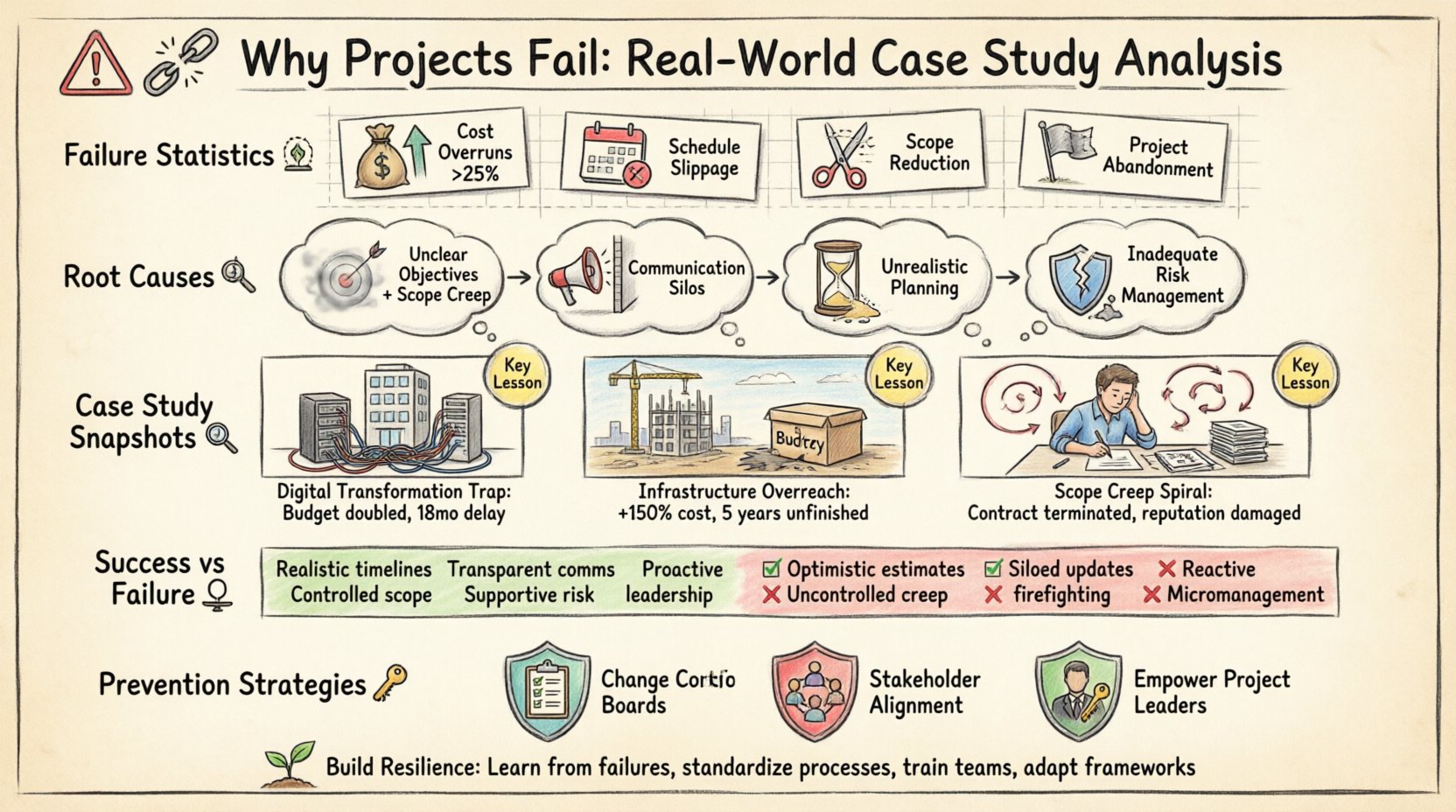
Hand-drawn infographic analyzing why projects fail: features failure statistics (cost overruns >25%, schedule slippage, scope reduction, abandonment), four root causes (unclear objectives/scope creep, communication silos, unrealistic planning, inadequate risk management), three real-world case studies (digital transformation trap, infrastructure overreach, scope creep spiral) with key lessons, success vs failure comparison table covering planning/communication/scope/risk/leadership/team factors, and five prevention strategies (change control boards, regular risk audits, stakeholder alignment workshops, empower project leaders), all illustrated with thick outline strokes in a sketchy hand-drawn aesthetic on 16:9 layout with parchment background and muted accent colors”/></figure>
</div>

<h2>The Statistics of Project Failure 📊</h2><p>Before diving into specific cases, it is essential to understand the landscape. Data consistently shows a significant portion of initiatives do not achieve their original goals. While definitions of “failure” vary, common metrics include:</p><ul><li><p><strong>Cost Overruns:</strong> Projects exceeding the allocated budget by more than 25%.</p></li><li><p><strong>Schedule Slippage:</strong> Deliverables arriving significantly past the agreed-upon deadline.</p></li><li><p><strong>Scope Reduction:</strong> Features or objectives being cut before final delivery.</p></li><li><p><strong>Abandonment:</strong> Projects halted entirely without completion.</p></li></ul><p>When we analyze these statistics, a clear picture emerges. Failure is rarely a singular event. It is usually the result of compounding errors, misaligned expectations, or a lack of governance. The following sections break down the primary drivers of these outcomes.</p><h2>Root Causes of Project Breakdowns 🕵️‍♂️</h2><p>Identifying the cause is the first step toward prevention. Most project failures stem from a combination of planning deficiencies and human factors. Below are the most frequent culprits.</p><h3>1. Unclear Objectives and Scope Creep 🧩</h3><p>Many projects begin with a vague vision. If the end goal is not defined with precision, the team lacks a North Star. As work progresses, stakeholders often request additional features or changes without understanding the impact on resources. This phenomenon, known as scope creep, dilutes focus and exhausts the budget.</p><ul><li><p><strong>Impact:</strong> Resources are spread too thin.</p></li><li><p><strong>Symptom:</strong> Meetings become endless discussions about “what ifs” rather than execution.</p></li><li><p><strong>Result:</strong> The core deliverable is never finished.</p></li></ul><h3>2. Communication Silos 📢</h3><p>Information flow is the lifeblood of any initiative. When departments operate in isolation, critical details get lost. A design team might build something the engineering team cannot implement, or a sales team might promise features that operations cannot support.</p><p>Breakdowns often happen because stakeholders are not informed about risks until it is too late. Transparency is often sacrificed for the sake of meeting short-term targets.</p><h3>3. Unrealistic Planning and Estimation ⏳</h3><p>Optimism bias is a common psychological trap. Teams tend to underestimate the time required for complex tasks while overestimating their own productivity. When initial plans ignore potential risks or dependencies, the schedule becomes fragile.</p><p>Once the first delay occurs, it creates a domino effect. Tasks that were scheduled for later get pushed, causing bottlenecks further down the line.</p><h3>4. Inadequate Risk Management 🛡️</h3><p>Projects operate in environments of uncertainty. If a team does not proactively identify potential risks (technical, financial, or personnel), they cannot prepare mitigation strategies. When an unexpected issue arises, the team reacts rather than responds, often making the situation worse.</p><h2>Case Study Analysis: Real-World Breakdowns 🏗️</h2><p>To illustrate these concepts, we examine three distinct scenarios. These cases represent anonymized examples drawn from various sectors to highlight universal principles.</p><h3>Case Study 1: The Digital Transformation Trap 💻</h3><p><strong>Context:</strong> A mid-sized logistics company attempted to replace its legacy tracking system with a new platform.</p><p><strong>The Goal:</strong> Automate inventory tracking and reduce manual data entry by 80% within six months.</p><p><strong>The Breakdown:</strong></p><ul><li><p><strong>Phase 1 (Initiation):</strong> Leadership approved the budget without consulting the floor staff who would use the system daily.</p></li><li><p><strong>Phase 2 (Planning):</strong> The timeline was set based on vendor promises rather than internal testing capabilities.</p></li><li><p><strong>Phase 3 (Execution):</strong> During integration, data migration failed repeatedly. The team spent months trying to fix data quality issues instead of building features.</p></li><li><p><strong>The Outcome:</strong> The project was delayed by 18 months. The budget doubled, and employee morale plummeted due to the new, flawed system.</p></li></ul><p><strong>Key Lesson:</strong> Technical capability does not equal operational readiness. User adoption must be part of the planning phase, not an afterthought.</p><h3>Case Study 2: The Infrastructure Overreach 🏗️</h3><p><strong>Context:</strong> A municipal government project to build a new public transit hub.</p><p><strong>The Goal:</strong> Construct a central station with integrated retail and parking facilities.</p><p><strong>The Breakdown:</strong></p><ul><li><p><strong>Scope Creep:</strong> During construction, local politicians added new requirements for aesthetics and additional amenities.</p></li><li><p><strong>Resource Strain:</strong> Material costs spiked unexpectedly. There was no contingency fund allocated for market volatility.</p></li><li><p><strong>Communication Gap:</strong> The construction manager knew about the delays but did not report them to the steering committee for fear of political backlash.</p></li><li><p><strong>The Outcome:</strong> The project remained unfinished for five years. The cost exceeded the initial estimate by 150%.</p></li></ul><p><strong>Key Lesson:</strong> Governance structures must protect the project from external scope changes without a formal change control process.</p><h3>Case Study 3: The Scope Creep Spiral 🌀</h3><p><strong>Context:</strong> A marketing agency developing a brand re-launch campaign.</p><p><strong>The Goal:</strong> Launch a new visual identity and website for a client within three months.</p><p><strong>The Breakdown:</strong></p><ul><li><p><strong>Lack of Prioritization:</strong> The client requested changes to the logo, color palette, and copy simultaneously.</p></li><li><p><strong>Team Fatigue:</strong> Designers were pulled into multiple revision loops, leading to burnout.</p></li><li><p><strong>Missed Deadlines:</strong> The website launch was pushed back three times.</p></li><li><p><strong>The Outcome:</strong> The client terminated the contract, citing poor delivery. The agency suffered reputational damage.</p></li></ul><p><strong>Key Lesson:</strong> “Yes” is the enemy of project success. Teams must have the authority to say no to changes that threaten the timeline.</p><h2>The Human Element: Leadership and Culture 👥</h2><p>Technology and processes are tools, but people drive the engine. A significant factor in project failure is the behavior of leadership and the culture of the organization.</p><h3>Micro-Management vs. Autonomy</h3><p>When leaders micromanage, they stifle innovation and slow down decision-making. Conversely, a complete lack of oversight can lead to drift. Successful projects require a balance where teams have autonomy to solve problems but are held accountable to clear milestones.</p><h3>Psychological Safety</h3><p>Teams need to feel safe admitting when they are behind schedule or when they made a mistake. If the culture punishes bad news, problems are hidden until they explode. A culture of transparency allows issues to be addressed early.</p><h2>Prevention Strategies and Mitigation 🛡️</h2><p>Knowing the causes allows for the creation of robust defense mechanisms. The following strategies can significantly reduce the risk of failure.</p><h3>1. Implement Change Control Boards</h3><p>Any request to change the scope, budget, or schedule should go through a formal review process. This ensures that stakeholders understand the trade-offs before agreeing to a change.</p><h3>2. Regular Risk Audits</h3><p>Risk management is not a one-time task. It should be a recurring agenda item in status meetings. Ask: “What could go wrong next week?” and “What do we need to mitigate it?”</p><h3>3. Stakeholder Alignment Workshops</h3><p>Before starting execution, bring all key parties together. Align on what “done” looks like. Document the requirements and get signatures. This creates a shared understanding and reduces ambiguity.</p><h3>4. Empower Project Leaders</h3><p>Assign authority to the project lead that matches their responsibility. They must have the power to reallocate resources and halt work if necessary to protect the project’s integrity.</p><h2>Comparative Analysis: Success vs. Failure Factors ⚖️</h2><p>To visualize the differences between projects that succeed and those that break down, consider the following comparison table.</p><table style=

Factor

Proyectos exitosos ✅

Proyectos fallidos ❌

Planificación

Plazos realistas con márgenes de seguridad

Estimaciones optimistas sin márgenes de seguridad

Comunicación

Actualizaciones transparentes y frecuentes

Retrasos aislados, esporádicos o ocultos

Alcance

Cambios estrictamente controlados

Expansión no controlada del alcance

Riesgo

Planes proactivos de mitigación

Reacción a emergencias

Liderazgo

Apoyo y accesible

Distante o micromanaging

Equipo

Roles y responsabilidades claros

Ambigüedad en la propiedad

Construyendo resiliencia para iniciativas futuras 🌱

El fracaso a menudo es un maestro, pero solo si escuchamos las lecciones que nos ofrece. Las organizaciones deben pasar de una cultura del blame a una cultura de aprendizaje. Cuando un proyecto falla, el análisis posterior no debe centrarse en quién cometió el error, sino en qué brecha sistémica permitió que el error ocurriera.

La resiliencia se construye mediante:

  • Estandarización de procesos: Cree plantillas para la iniciación y planificación que obliguen al pensamiento crítico.

  • Equipos de capacitación:Invierta en capacitación sobre metodologías de gestión de proyectos y habilidades blandas.

  • Revisión de proyectos anteriores:Mantenga un repositorio de lecciones aprendidas a partir de éxitos y fracasos anteriores.

  • Adaptación de marcos:Esté dispuesto a ajustar la metodología según la naturaleza específica del proyecto. Las aproximaciones ágiles, en cascada o híbridas deben elegirse según el ajuste, no por hábito.

Consideraciones finales sobre la gobernanza de proyectos 🔍

En última instancia, el éxito de una iniciativa depende de la calidad de la gobernanza que la rodea. Esto incluye cómo se toman las decisiones, cómo se asignan los recursos y cómo se mide el progreso. Sin un marco sólido, incluso los equipos más talentosos pueden tener dificultades para cumplir.

Al reconocer las realidades de la gestión de proyectos: incertidumbre, errores humanos y presiones externas, los líderes pueden construir sistemas más robustos. El objetivo no es eliminar por completo el fracaso, lo cual es imposible, sino minimizar su frecuencia e impacto.

Cuando los equipos abordan el trabajo con una mentalidad de mejora continua y evaluación honesta, crean un entorno en el que el éxito se convierte en el resultado probable, más que en un accidente afortunado. Analizar los fracasos pasados proporciona el mapa para enfrentar desafíos futuros.