
Tại sao các dự án thất bại: Phân tích trường hợp nghiên cứu về những sự sụp đổ thực tế của các dự án

Mỗi tổ chức đều ước mơ về việc thực hiện hoàn hảo. Tuy nhiên, thực tế thường mang đến một câu chuyện khác biệt. Trên nhiều ngành nghề, từ xây dựng đến phát triển phần mềm, các dự án thường xuyên trễ hạn, vượt ngân sách hoặc không đạt được mục tiêu. Việc hiểu rõtại sao các dự án thất bạikhông chỉ là một bài tập học thuật; mà còn là kỹ năng sống còn quan trọng đối với các đội ngũ lãnh đạo.

Phân tích này đi sâu vào cấu trúc của những sự sụp đổ trong dự án. Bằng cách xem xét các tình huống thực tế và các nguyên nhân cốt lõi, chúng ta có thể nhận diện những mẫu hình cảnh báo rủi ro trước khi nó trở thành thảm họa. Chúng ta sẽ đi xa hơn những triệu chứng bề mặt để tìm ra những vấn đề cấu trúc gốc rễ khiến các sáng kiến bị sụp đổ.
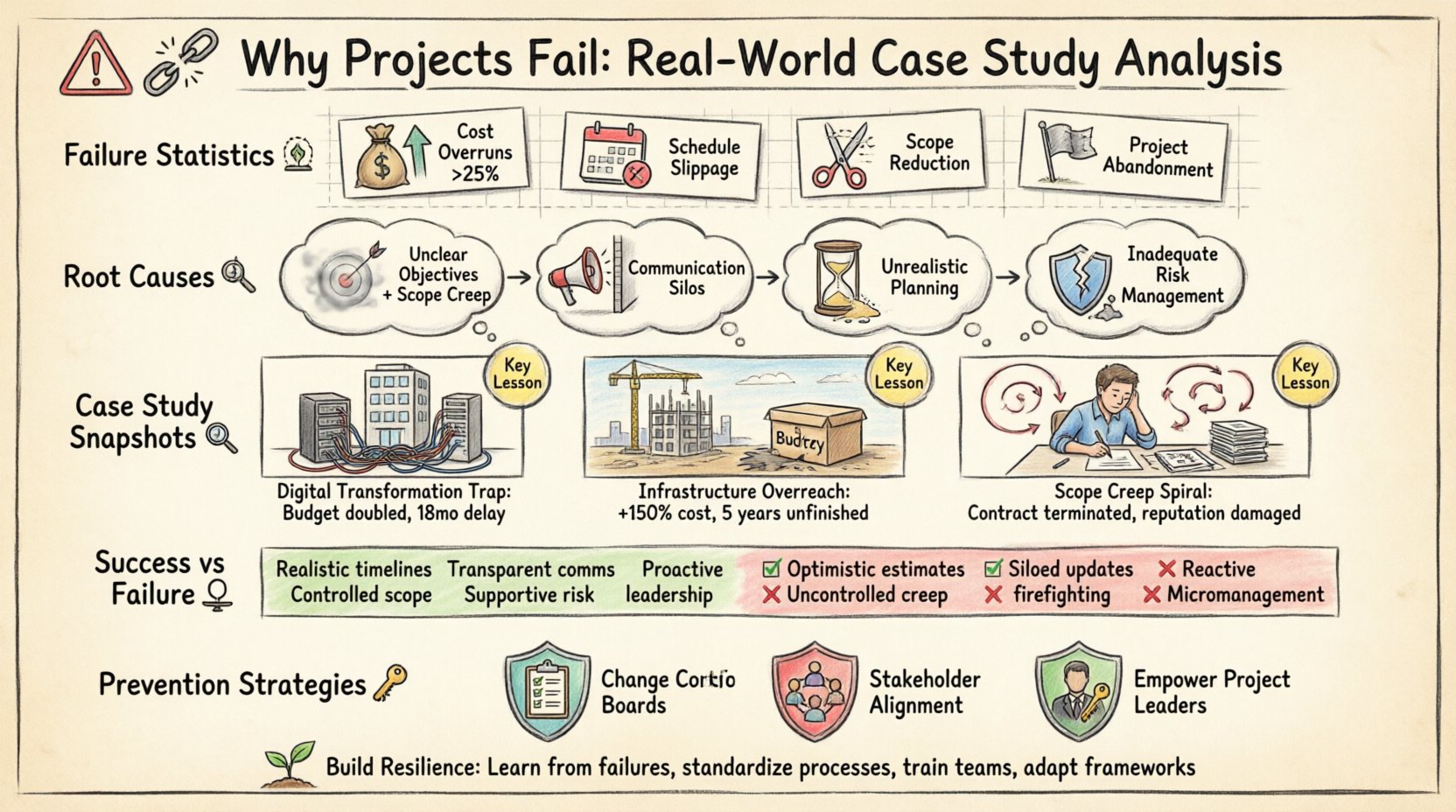
Hand-drawn infographic analyzing why projects fail: features failure statistics (cost overruns >25%, schedule slippage, scope reduction, abandonment), four root causes (unclear objectives/scope creep, communication silos, unrealistic planning, inadequate risk management), three real-world case studies (digital transformation trap, infrastructure overreach, scope creep spiral) with key lessons, success vs failure comparison table covering planning/communication/scope/risk/leadership/team factors, and five prevention strategies (change control boards, regular risk audits, stakeholder alignment workshops, empower project leaders), all illustrated with thick outline strokes in a sketchy hand-drawn aesthetic on 16:9 layout with parchment background and muted accent colors”/></figure>
</div>

<h2>The Statistics of Project Failure 📊</h2><p>Before diving into specific cases, it is essential to understand the landscape. Data consistently shows a significant portion of initiatives do not achieve their original goals. While definitions of “failure” vary, common metrics include:</p><ul><li><p><strong>Cost Overruns:</strong> Projects exceeding the allocated budget by more than 25%.</p></li><li><p><strong>Schedule Slippage:</strong> Deliverables arriving significantly past the agreed-upon deadline.</p></li><li><p><strong>Scope Reduction:</strong> Features or objectives being cut before final delivery.</p></li><li><p><strong>Abandonment:</strong> Projects halted entirely without completion.</p></li></ul><p>When we analyze these statistics, a clear picture emerges. Failure is rarely a singular event. It is usually the result of compounding errors, misaligned expectations, or a lack of governance. The following sections break down the primary drivers of these outcomes.</p><h2>Root Causes of Project Breakdowns 🕵️‍♂️</h2><p>Identifying the cause is the first step toward prevention. Most project failures stem from a combination of planning deficiencies and human factors. Below are the most frequent culprits.</p><h3>1. Unclear Objectives and Scope Creep 🧩</h3><p>Many projects begin with a vague vision. If the end goal is not defined with precision, the team lacks a North Star. As work progresses, stakeholders often request additional features or changes without understanding the impact on resources. This phenomenon, known as scope creep, dilutes focus and exhausts the budget.</p><ul><li><p><strong>Impact:</strong> Resources are spread too thin.</p></li><li><p><strong>Symptom:</strong> Meetings become endless discussions about “what ifs” rather than execution.</p></li><li><p><strong>Result:</strong> The core deliverable is never finished.</p></li></ul><h3>2. Communication Silos 📢</h3><p>Information flow is the lifeblood of any initiative. When departments operate in isolation, critical details get lost. A design team might build something the engineering team cannot implement, or a sales team might promise features that operations cannot support.</p><p>Breakdowns often happen because stakeholders are not informed about risks until it is too late. Transparency is often sacrificed for the sake of meeting short-term targets.</p><h3>3. Unrealistic Planning and Estimation ⏳</h3><p>Optimism bias is a common psychological trap. Teams tend to underestimate the time required for complex tasks while overestimating their own productivity. When initial plans ignore potential risks or dependencies, the schedule becomes fragile.</p><p>Once the first delay occurs, it creates a domino effect. Tasks that were scheduled for later get pushed, causing bottlenecks further down the line.</p><h3>4. Inadequate Risk Management 🛡️</h3><p>Projects operate in environments of uncertainty. If a team does not proactively identify potential risks (technical, financial, or personnel), they cannot prepare mitigation strategies. When an unexpected issue arises, the team reacts rather than responds, often making the situation worse.</p><h2>Case Study Analysis: Real-World Breakdowns 🏗️</h2><p>To illustrate these concepts, we examine three distinct scenarios. These cases represent anonymized examples drawn from various sectors to highlight universal principles.</p><h3>Case Study 1: The Digital Transformation Trap 💻</h3><p><strong>Context:</strong> A mid-sized logistics company attempted to replace its legacy tracking system with a new platform.</p><p><strong>The Goal:</strong> Automate inventory tracking and reduce manual data entry by 80% within six months.</p><p><strong>The Breakdown:</strong></p><ul><li><p><strong>Phase 1 (Initiation):</strong> Leadership approved the budget without consulting the floor staff who would use the system daily.</p></li><li><p><strong>Phase 2 (Planning):</strong> The timeline was set based on vendor promises rather than internal testing capabilities.</p></li><li><p><strong>Phase 3 (Execution):</strong> During integration, data migration failed repeatedly. The team spent months trying to fix data quality issues instead of building features.</p></li><li><p><strong>The Outcome:</strong> The project was delayed by 18 months. The budget doubled, and employee morale plummeted due to the new, flawed system.</p></li></ul><p><strong>Key Lesson:</strong> Technical capability does not equal operational readiness. User adoption must be part of the planning phase, not an afterthought.</p><h3>Case Study 2: The Infrastructure Overreach 🏗️</h3><p><strong>Context:</strong> A municipal government project to build a new public transit hub.</p><p><strong>The Goal:</strong> Construct a central station with integrated retail and parking facilities.</p><p><strong>The Breakdown:</strong></p><ul><li><p><strong>Scope Creep:</strong> During construction, local politicians added new requirements for aesthetics and additional amenities.</p></li><li><p><strong>Resource Strain:</strong> Material costs spiked unexpectedly. There was no contingency fund allocated for market volatility.</p></li><li><p><strong>Communication Gap:</strong> The construction manager knew about the delays but did not report them to the steering committee for fear of political backlash.</p></li><li><p><strong>The Outcome:</strong> The project remained unfinished for five years. The cost exceeded the initial estimate by 150%.</p></li></ul><p><strong>Key Lesson:</strong> Governance structures must protect the project from external scope changes without a formal change control process.</p><h3>Case Study 3: The Scope Creep Spiral 🌀</h3><p><strong>Context:</strong> A marketing agency developing a brand re-launch campaign.</p><p><strong>The Goal:</strong> Launch a new visual identity and website for a client within three months.</p><p><strong>The Breakdown:</strong></p><ul><li><p><strong>Lack of Prioritization:</strong> The client requested changes to the logo, color palette, and copy simultaneously.</p></li><li><p><strong>Team Fatigue:</strong> Designers were pulled into multiple revision loops, leading to burnout.</p></li><li><p><strong>Missed Deadlines:</strong> The website launch was pushed back three times.</p></li><li><p><strong>The Outcome:</strong> The client terminated the contract, citing poor delivery. The agency suffered reputational damage.</p></li></ul><p><strong>Key Lesson:</strong> “Yes” is the enemy of project success. Teams must have the authority to say no to changes that threaten the timeline.</p><h2>The Human Element: Leadership and Culture 👥</h2><p>Technology and processes are tools, but people drive the engine. A significant factor in project failure is the behavior of leadership and the culture of the organization.</p><h3>Micro-Management vs. Autonomy</h3><p>When leaders micromanage, they stifle innovation and slow down decision-making. Conversely, a complete lack of oversight can lead to drift. Successful projects require a balance where teams have autonomy to solve problems but are held accountable to clear milestones.</p><h3>Psychological Safety</h3><p>Teams need to feel safe admitting when they are behind schedule or when they made a mistake. If the culture punishes bad news, problems are hidden until they explode. A culture of transparency allows issues to be addressed early.</p><h2>Prevention Strategies and Mitigation 🛡️</h2><p>Knowing the causes allows for the creation of robust defense mechanisms. The following strategies can significantly reduce the risk of failure.</p><h3>1. Implement Change Control Boards</h3><p>Any request to change the scope, budget, or schedule should go through a formal review process. This ensures that stakeholders understand the trade-offs before agreeing to a change.</p><h3>2. Regular Risk Audits</h3><p>Risk management is not a one-time task. It should be a recurring agenda item in status meetings. Ask: “What could go wrong next week?” and “What do we need to mitigate it?”</p><h3>3. Stakeholder Alignment Workshops</h3><p>Before starting execution, bring all key parties together. Align on what “done” looks like. Document the requirements and get signatures. This creates a shared understanding and reduces ambiguity.</p><h3>4. Empower Project Leaders</h3><p>Assign authority to the project lead that matches their responsibility. They must have the power to reallocate resources and halt work if necessary to protect the project’s integrity.</p><h2>Comparative Analysis: Success vs. Failure Factors ⚖️</h2><p>To visualize the differences between projects that succeed and those that break down, consider the following comparison table.</p><table style=

Yếu tố

Dự án thành công ✅

Dự án thất bại ❌

Lên kế hoạch

Lộ trình thực tế có dự phòng

Dự đoán lạc quan mà không có dự phòng

Giao tiếp

Cập nhật minh bạch, thường xuyên

Chậm trễ bị tách biệt, thưa thớt hoặc che giấu

Phạm vi

Thay đổi được kiểm soát chặt chẽ

Mở rộng phạm vi không kiểm soát

Rủi ro

Kế hoạch giảm thiểu chủ động

Phản ứng chữa cháy

Lãnh đạo

Hỗ trợ và dễ tiếp cận

Xa cách hoặc can thiệp quá mức

Đội nhóm

Vai trò và trách nhiệm rõ ràng

Thiếu rõ ràng về trách nhiệm sở hữu

Xây dựng khả năng phục hồi cho các sáng kiến tương lai 🌱

Thất bại thường là người thầy, nhưng chỉ khi chúng ta lắng nghe những bài học mà nó mang lại. Các tổ chức cần chuyển từ văn hóa đổ lỗi sang văn hóa học hỏi. Khi một dự án thất bại, phân tích hậu quả không nên tập trung vào ai đã mắc sai lầm, mà cần tìm hiểu khoảng trống hệ thống nào đã cho phép sai lầm xảy ra.

Khả năng phục hồi được xây dựng nhờ:

  • Tiêu chuẩn hóa quy trình: Tạo các mẫu cho giai đoạn khởi đầu và lập kế hoạch nhằm thúc đẩy tư duy phản biện.

  • Đội ngũ đào tạo:Đầu tư vào đào tạo về các phương pháp quản lý dự án và kỹ năng mềm.

  • Xem xét các dự án trong quá khứ:Duy trì một kho lưu trữ các bài học kinh nghiệm từ những thành công và thất bại trước đó.

  • Thích ứng các khung công tác:Sẵn sàng điều chỉnh phương pháp dựa trên đặc thù cụ thể của dự án. Các phương pháp Agile, waterfall hay kết hợp nên được lựa chọn dựa trên sự phù hợp, chứ không phải thói quen.

Những cân nhắc cuối cùng về quản trị dự án 🔍

Cuối cùng, thành công của một sáng kiến phụ thuộc vào chất lượng của hệ thống quản trị xung quanh nó. Điều này bao gồm cách thức ra quyết định, phân bổ nguồn lực và đo lường tiến độ. Không có một khung nền tảng vững chắc, ngay cả những đội ngũ tài năng nhất cũng có thể gặp khó khăn trong việc hoàn thành nhiệm vụ.

Bằng cách công nhận những thực tế của quản lý dự án—sự bất định, sai sót do con người và áp lực từ bên ngoài—các nhà lãnh đạo có thể xây dựng các hệ thống vững chắc hơn. Mục tiêu không phải là loại bỏ hoàn toàn thất bại—điều đó là không thể—mà là giảm thiểu tần suất và tác động của nó.

Khi các đội nhóm tiếp cận công việc với tư duy cải tiến liên tục và đánh giá trung thực, họ tạo ra một môi trường mà thành công trở thành kết quả tất yếu thay vì một may mắn ngẫu nhiên. Việc phân tích những lần thất bại trong quá khứ cung cấp bản đồ để vượt qua những thách thức tương lai.