
Every organization invests significant time, capital, and human energy into launching new initiatives. Yet, a substantial portion of these efforts fail to meet their original objectives. The reasons are rarely technical; they are almost always procedural or human-centric. Understanding the friction points in project lifecycles is the first step toward stability.
Project management is not merely about tracking tasks. It is about orchestrating people, resources, and expectations to deliver value. When the orchestration falters, the result is often missed deadlines, budget overruns, and team burnout. This guide details seven critical pitfalls that undermine success and provides actionable strategies to neutralize them.
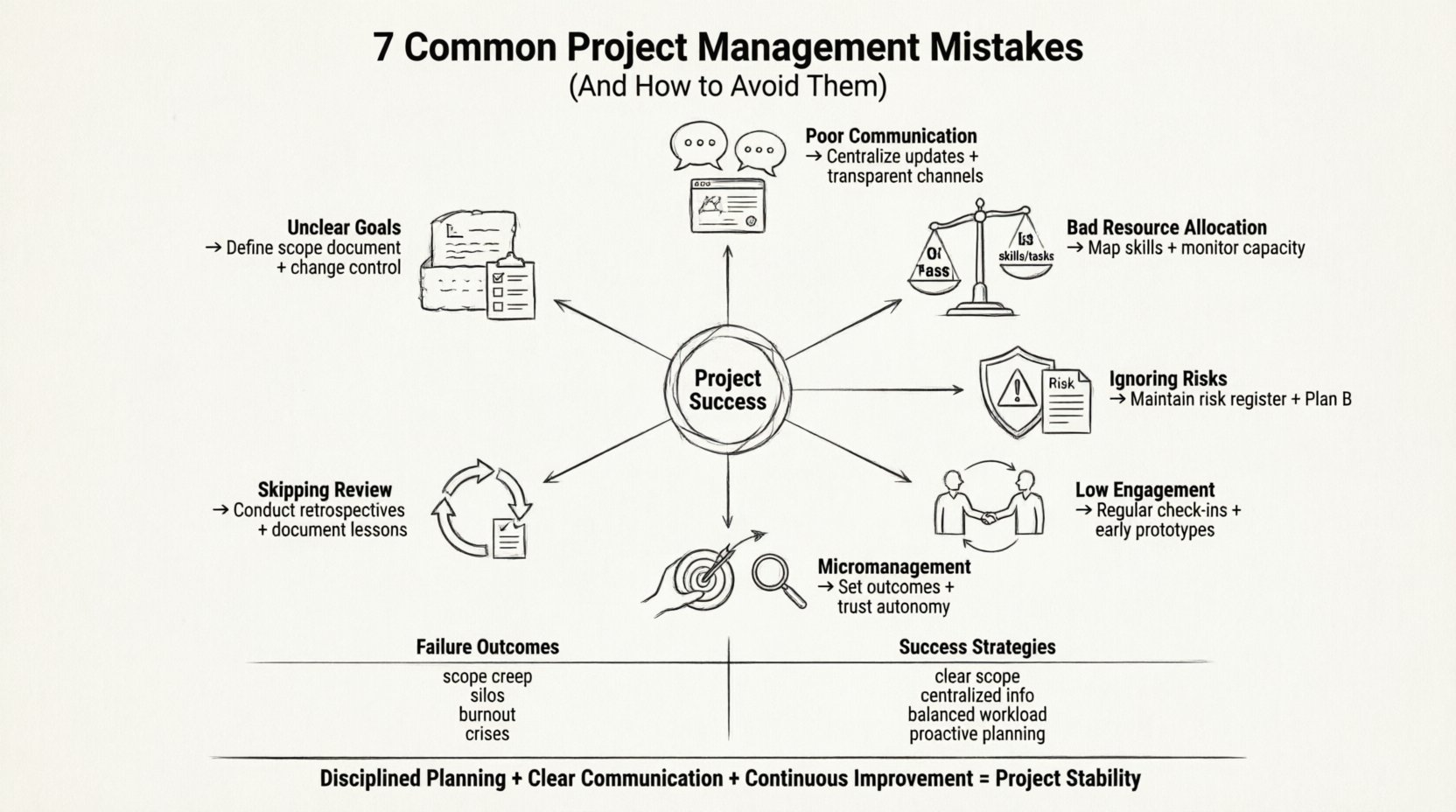
1. Unclear Goals and Scope Creep 📏
One of the most pervasive issues in project delivery is the lack of a well-defined starting line. When a project begins without precise objectives, the team lacks direction. Furthermore, without strict boundaries, the scope tends to expand organically, a phenomenon known as scope creep.
The Impact of Undefined Boundaries
Resource Drain: Team members spend time on tasks that were not part of the original agreement.
Budget Blowouts: Every additional feature or requirement costs money and time.
Confusion: Stakeholders assume different things are being built.
How to Prevent It
To combat this, you must establish a clear scope document before work begins. This document should outline deliverables, acceptance criteria, and explicitly state what is not included in the project.
Define Success Metrics: What does done look like? Quantify the outcome.
Implement Change Control: If a new request arises, it must go through a formal review process to assess impact on timeline and budget before approval.
Regular Alignment: Revisit the project charter weekly to ensure no deviation has occurred.
2. Poor Communication Channels 🗣️
Communication is the lifeblood of any project. When information flows poorly, silos form. Team members work in isolation, unaware of how their work affects others. This leads to duplicated efforts, missed dependencies, and frustration.
Signs of Communication Breakdown
Key decisions are made without the right people present.
Information is scattered across emails, chats, and verbal conversations.
Team members feel out of the loop regarding critical changes.
Strategies for Clarity
Establish a single source of truth for project documentation. While collaboration tools are available, the process of sharing information matters more than the platform used.
Centralize Updates: Maintain a project dashboard that is updated in real-time.
Standardize Meetings: Keep status meetings short and focused on blockers. Avoid status meetings that simply report progress without solving problems.
Encourage Transparency: Create a culture where bad news is shared early. Hiding issues until the last minute is a recipe for disaster.
3. Inadequate Resource Allocation 💼
Having the right people with the right skills is vital. However, assigning tasks without considering capacity leads to burnout and quality degradation. Overloading a team member to “save time” often results in delays because they become less efficient due to stress.
The Cost of Overallocation
Quality Issues: Rushed work requires rework.
Turnover: Chronic overwork leads to team members leaving.
Bottlenecks: Critical tasks stall because the same person is juggling too many responsibilities.
Optimizing Workload
Effective resource management requires visibility into individual capacity. You must balance the workload across the team to ensure sustainability.
Map Skills to Tasks: Assign work based on competency, not just availability.
Monitor Capacity: Ensure no team member is consistently at 100% capacity. Leave room for unexpected issues.
Delegate Effectively: Empower team leads to distribute work within their sub-teams based on current load.
4. Ignoring Risk Management ⚠️
Many projects operate on the assumption that everything will go according to plan. This optimism is dangerous. Risks are not just negative events; they are uncertainties that can impact the project. Ignoring them means reacting to crises rather than preventing them.
Common Risks to Consider
Technical Debt: Rushing code or implementation leads to future maintenance headaches.
Vendor Delays: Dependence on external parties can stall internal progress.
Regulatory Changes: New laws can alter project requirements mid-stream.
Proactive Risk Mitigation
Risk management is not a one-time activity. It is a continuous process throughout the project lifecycle.
Risk Register: Maintain a living document that lists potential risks, their probability, and their impact.
Mitigation Plans: For every high-risk item, define a plan B.
Regular Reviews: Discuss risks in every sprint or phase review. New risks emerge as the project evolves.
5. Lack of Stakeholder Engagement 🤝
Stakeholders are individuals who have an interest in the project’s outcome. This includes clients, executives, and end-users. A common mistake is treating them as passive observers rather than active participants. If they are not engaged, their expectations may drift from reality.
The Consequence of Exclusion
Rejection at Delivery: The final product does not meet user needs.
Scope Reversal: Stakeholders request major changes late in the process.
Lack of Support: Leadership does not champion the project during difficult phases.
Building Engagement
Engagement is about managing expectations and securing buy-in.
Identify Key Players: Know who holds the power to approve or reject deliverables.
Regular Check-ins: Schedule consistent touchpoints, not just at milestones.
Feedback Loops: Show prototypes or drafts early to gather input before finalizing.
6. Micromanagement vs. Autonomy 🎯
Leadership style significantly impacts team morale. Micromanagement stifles creativity and slows down execution. Conversely, total abandonment leads to drift. The balance lies in setting clear expectations and trusting the team to execute.
Signs of Micromanagement
Requiring approval for minor decisions.
Constantly checking on progress without asking for help.
Correcting work that does not require correction.
Fostering Ownership
Shift focus from monitoring activity to measuring outcomes.
Set Clear Outcomes: Define the “what” and the “why,” allow the team to decide the “how”.
Trust Competence: Hire skilled people and let them work.
Support, Don’t Direct: Be available to remove obstacles, not to dictate every step.
7. Skipping Post-Project Review 🔄
Once a project is delivered, many organizations move immediately to the next one. This misses a crucial opportunity for organizational learning. Without reflection, teams repeat the same mistakes in future initiatives.
The Value of Retrospectives
Identify Process Gaps: Find out where the workflow slowed down.
Celebrate Wins: Acknowledge what went well to boost morale.
Document Lessons: Create a knowledge base for future teams.
Implementing Retrospectives
Conduct a formal review after every major phase or project completion.
Safe Environment: Ensure the discussion is blame-free. Focus on process, not people.
Actionable Items: Turn insights into specific process improvements for the next project.
Archive Documentation: Store lessons learned where they are accessible to the wider organization.
Comparative Analysis: Failure vs. Success 📊
To visualize the differences between common pitfalls and effective practices, refer to the table below.
Mistake | Typical Outcome | Corrective Strategy |
|---|---|---|
Unclear Goals | Scope Creep & Budget Overrun | Define Scope Document & Change Control |
Poor Communication | Silos & Duplication of Work | Centralize Info & Standardize Updates |
Bad Resource Allocation | Burnout & Bottlenecks | Map Skills & Monitor Capacity |
No Risk Management | Crisis Reactions | Maintain Risk Register & Plan B |
Lack of Engagement | Rejection & Delays | Regular Check-ins & Feedback Loops |
Micromanagement | Low Morale & Slow Execution | Set Outcomes & Trust Autonomy |
No Post-Review | Repeating Mistakes | Conduct Retrospectives & Document |
Strategic Implementation for Sustainable Growth 📈
Addressing these seven mistakes requires a systemic approach. It is not enough to fix one area; the entire project ecosystem must be aligned. Here is how to integrate these principles into your workflow.
1. Standardize the Process
Develop a standard operating procedure for project initiation. This ensures that every project starts with the same level of rigor regarding goals, resources, and risk assessment. Consistency reduces the variance in project outcomes.
2. Invest in Training
Project management is a skill. Ensure your team has access to training on communication, risk analysis, and resource planning. A skilled team can identify pitfalls before they become problems.
3. Leverage Data
Use historical data to inform planning. If past projects consistently run over budget by 10%, adjust future estimates accordingly. Data removes guesswork from the equation.
4. Cultivate a Culture of Accountability
Accountability does not mean blame. It means owning your commitments. When team members feel responsible for the project’s success, they are more likely to spot risks and communicate issues early.
Final Thoughts on Project Stability 🛡️
Successful project delivery is not an accident. It is the result of disciplined planning, clear communication, and continuous improvement. By recognizing these seven common mistakes, you position your team to avoid the traps that derail so many initiatives.
The path to success involves vigilance. Monitor your scope, respect your team’s capacity, and maintain open lines of communication. When you address these foundational elements, you build a framework that supports consistent delivery and long-term organizational health.
Remember, the goal is not just to finish the project, but to finish it well. Focus on the quality of the process as much as the quality of the output. This mindset shift separates reactive teams from proactive leaders.