


Software teams have always struggled with one recurring issue: documentation that is either too high-level to be useful or too detailed to be maintainable. Traditional diagrams often end up outdated, inconsistent, or impossible to scale as systems grow.
This is where the C4 Model enters. Instead of asking teams to choose between clarity and depth, C4 provides a modern framework that offers both. The model’s layered approach gives you a structured, maintainable, and communication-friendly way to represent architecture at multiple levels without overwhelming the reader.
This article explains why the C4 Model matters, what problems it solves, and how its benefits improve collaboration, system understanding, and long-term project health. It focuses on the value of the model itself, not the four levels individually.
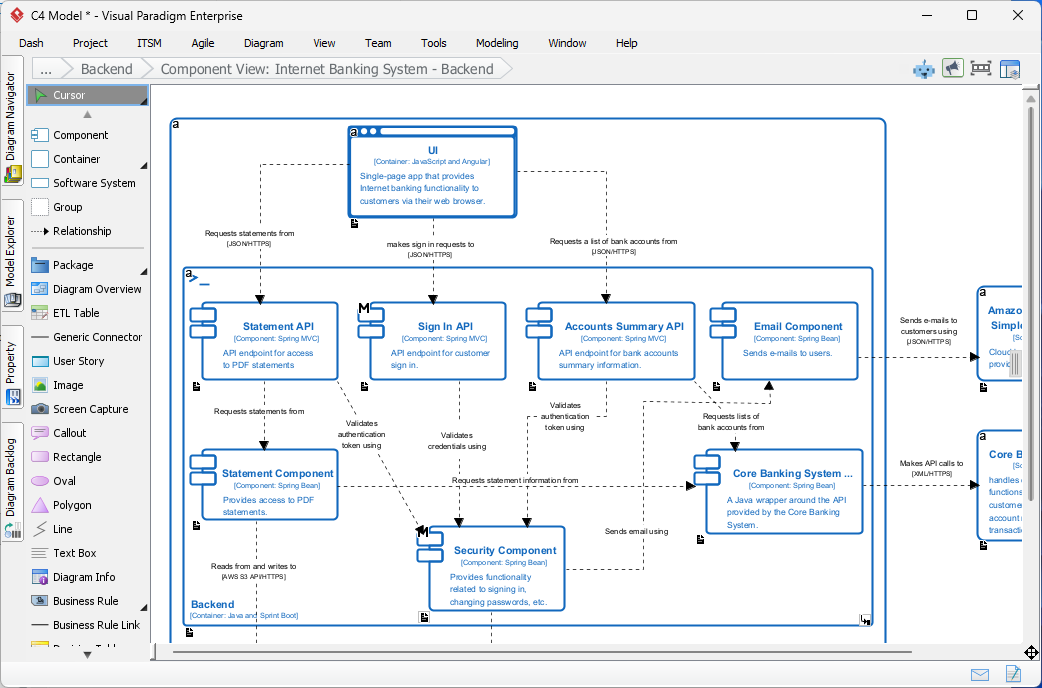
(Attribution: Below is a C4 Component Diagram created using Visual Paradigm’s C4 modeling tool)
What Is the Purpose of the C4 Model?
The C4 Model solves the problem of unclear, inconsistent, and unmaintainable architecture documentation by offering a structured, hierarchical way to describe software systems. It improves communication across all technical and non-technical roles while keeping diagrams easy to update as the system evolves.
The Problem With Traditional Architecture Documentation
Before the C4 Model, diagrams typically fell into one of two extremes:
1. Too simplistic
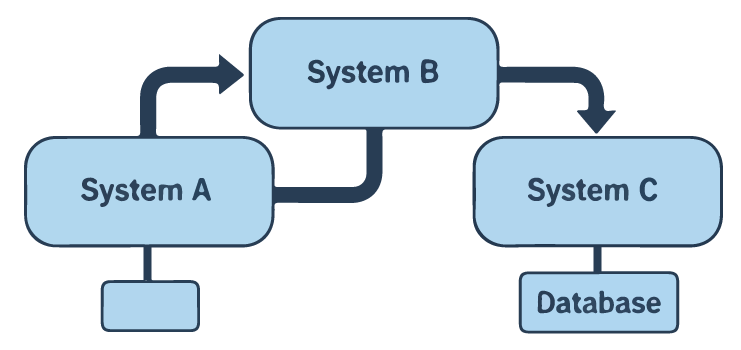
Many architecture diagrams are essentially broad sketches:
- A few boxes and arrows
- Minimal explanation
- Vague boundary definitions
- No insight into internal structure
These diagrams look polished but leave important questions unanswered, especially for developers.
2. Too detailed
On the other end, teams may rely heavily on:
- UML class diagrams
- Low-level implementation models
- Dense notations that only architects understand
These diagrams quickly become outdated because code changes faster than documentation.
3. No relationship between diagrams
Even when multiple diagrams exist, they usually:
- Have different notations
- Use inconsistent naming
- Duplicate information across files
- Lack a clear hierarchy
The result is a communication gap between stakeholders, architects, and developers.
How the C4 Model Solves These Problems
The C4 Model introduces a layered way to gradually explore the system. Instead of dumping everything into one diagram, information is distributed across four related views.
This structure solves several long-standing issues in software documentation.
Benefit 1: A Consistent, Scalable Structure
Unlike many documentation styles, the C4 Model defines a predictable structure where each diagram has one clear purpose:
- One level shows the big picture
- Another shows the system’s building blocks
- Another shows how individual parts work internally
- The last connects architecture to code
Because each level is well-defined, teams no longer argue about what belongs in a diagram.
The structure itself guides the documentation.
Benefit 2: Clear Communication Across All Roles
The C4 approach recognizes that different audiences need different information:
- Executives and product leaders want the high-level view
- Architects need to understand system structure
- Developers need internal organization
- New team members need a roadmap
Instead of forcing everyone to read the same dense diagram, C4 aligns information with the audience.
This dramatically improves communication and reduces misunderstanding.
Benefit 3: Easier Onboarding for New Developers
New team members often struggle to connect high-level concepts to code.
C4 creates a step-by-step learning path where each diagram builds on the previous one.
Instead of jumping from a rough architecture sketch directly to code, developers can see:
The system’s purpose
- The major building blocks
- The responsibilities of each block
- The implementation details
This removes guesswork and shortens onboarding time.
Benefit 4: Maintains Relevance as the System Evolves
Most architecture diagrams fail not because they are wrong, but because they are impossible to maintain.
C4 fixes this through its layered design:
- High-level diagrams remain stable over time
- Lower-level diagrams can change independently
- Only the diagrams closest to the code need frequent updates
This separation keeps documentation manageable even as the system grows or the team restructures the codebase.
Benefit 5: Works With Any Tech Stack or Methodology
C4 is intentionally technology-agnostic.
It does not impose a specific architecture style or stack.
The model works equally well for:
- Microservices
- Monoliths
- Event-driven systems
- Serverless architectures
- Hybrid cloud environments
This makes C4 adaptable for both small teams and enterprise-scale platforms.
Benefit 6: Encourages Clean, Logical Thinking About Architecture
C4 diagrams require clear boundaries, responsibilities, and interactions.
As a result, the act of creating them improves the architecture itself.
Teams often discover:
- Unclear boundaries between services
- Components doing too many things
- Hidden dependencies
- Communication patterns that are not obvious in the code
In this sense, C4 is not just a documentation model; it is also a design tool.
Benefit 7: Reduces Dependency on UML Complexity
Many teams appreciate UML but struggle with its breadth.
With dozens of diagram types and strict notation rules, UML often feels heavy for high-level architecture work.
The C4 Model offers:
- Fewer diagram types
- Simpler notations
- More natural storytelling
- A faster learning curve
This makes it more accessible to teams who want clarity without formal modeling overhead.
Benefit 8: Ideal for AI-Assisted Diagram Generation
Modern diagram tools—especially those with AI capabilities—work exceptionally well with C4.
Because the model uses predictable structures and clear narratives, AI can reliably generate diagrams that are consistent across all levels.
Platforms like Visual Paradigm Online support:
- Consistent shapes
- AI-generated C4 diagrams
- Easy updates as details change
- Cross-level synchronization
This makes maintaining architecture documentation far more efficient.
Benefit 9: Creates a Single, Coherent Architecture Story
Perhaps the biggest advantage of the C4 Model is how the four diagrams form one unified narrative.
They connect strategy, structure, and implementation in a clean, logical progression.
Teams using C4 gain:
- A shared understanding
- A unified vocabulary
- A consistent mental model across the entire organisation
This reduces confusion and eliminates fragmentation in documentation.
Looking for a C4 Modeling Tool?
Visual Paradigm features a C4 modeling tool as well as a bunch of C4 supporting toolset. Download Visual Paradigm and try it free. Or learn more about Visual Paradigm’s comprehensive C4 solution.
Related posts:
 The Definitive Guide to the C4 Model: A Practical Approach to Software Architecture
 C4 Model Explained: How the Four Levels Work Together in Software Architecture
C4 vs UML: How the C4 Model Complements and Modernizes Traditional UML Documentation
📘 Comprehensive Tutorial: The C4 Model for Software Architecture Visualization
C4 Model Explained: How the Four Levels Work Together in Software Architecture
C4 vs UML: How the C4 Model Complements and Modernizes Traditional UML Documentation
📘 Comprehensive Tutorial: The C4 Model for Software Architecture Visualization