
Enterprise architecture is not a monolithic discipline. It is a collection of lenses through which complex organizational structures are examined. The ArchiMate® specification provides a robust framework for this examination, primarily through its concept of viewpoints. A viewpoint defines the concerns of a specific stakeholder group and the principles for structuring a model to address those concerns.
For professionals navigating their career paths in architecture, strategy, and systems design, understanding which viewpoint aligns with your current responsibilities is crucial. Whether you are an entry-level analyst or a strategic executive, the appropriate architectural perspective dictates the value you bring to the organization. This guide breaks down the core ArchiMate viewpoints and maps them to career stages, helping you identify the right focus for your growth.
🔍 Understanding the Core Concept: Viewpoint vs. View
Before diving into specific roles, it is essential to distinguish between a viewpoint and a view. In the ArchiMate ecosystem, a viewpoint is the template or the set of rules. It defines what information should be included, what notation to use, and who the intended audience is. A view is the actual instance created from that viewpoint.
Think of a viewpoint as a camera lens. A wide-angle lens captures a broad landscape, while a macro lens focuses on intricate details. Your career stage often dictates which “lens” you need to wear to see the problems in front of you clearly.
- Viewpoint: The standard definition (e.g., Business Process Viewpoint).
- View: The specific diagram or document produced using that definition.
Choosing the correct viewpoint ensures that your communication is effective. Using a technical technology viewpoint to explain a business process to a non-technical board member creates friction. Conversely, using a high-level business motivation viewpoint when discussing code deployment creates confusion. Alignment between your career role and the viewpoint you utilize is the key to clarity.
🚀 The Career Ladder in Enterprise Architecture
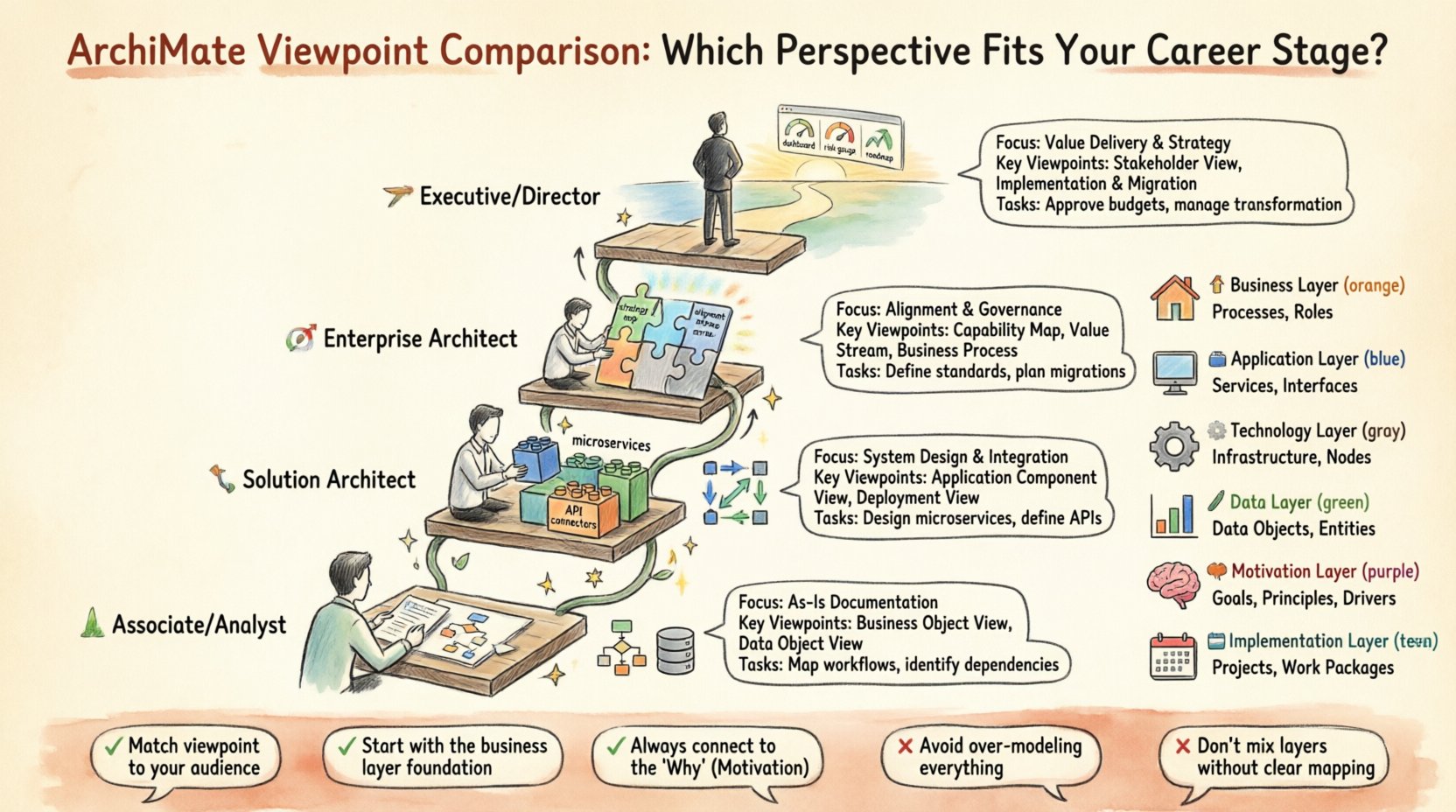
Architectural careers typically evolve from execution-focused roles to strategy-focused roles. As you progress, the scope of your influence widens, and the granularity of the viewpoints you engage with changes. We can categorize these stages into four primary tiers.
1. The Foundation: Associate and Analyst Roles
At this stage, professionals are often tasked with gathering requirements, documenting current processes, or maintaining system inventories. The focus is on understanding the “as-is” state. The relevant viewpoints here are those that describe concrete elements and their relationships without getting bogged down in abstract strategy.
- Primary Focus: Documentation, Data Integrity, Process Flow.
- Key Viewpoints: Business Service View, Data Object View.
- Typical Tasks: Mapping existing workflows, identifying data dependencies.
An Associate Architect or Business Analyst needs to master the Business Object Viewpoint. This perspective allows them to understand the core entities (like a Customer or an Order) and how they move through the system. It grounds their work in tangible reality rather than abstract theory.
2. The Builder: Practitioner and Solution Architect Roles
As you move into mid-level positions, the focus shifts from “what exists” to “how to build.” Solution Architects and Application Architects are tasked with designing specific systems to solve defined problems. The viewpoint requirements become more technical, bridging the gap between business needs and technical implementation.
- Primary Focus: System Design, Integration, Component Structure.
- Key Viewpoints: Application Component Viewpoint, Deployment Viewpoint.
- Typical Tasks: Designing microservices, defining API contracts, planning infrastructure.
In this stage, the Application Architecture Viewpoint becomes critical. It allows you to model the software applications, their interfaces, and their usage. This is where you translate business requirements into technical specifications. You also begin to interact with the Technology Layer to ensure your application designs are supported by the underlying infrastructure.
3. The Strategist: Lead and Enterprise Architect Roles
Enterprise Architects operate at a higher altitude. They are concerned with coherence across the entire organization. They do not just design a single system; they ensure that the business, applications, and technology layers align with long-term goals. The viewpoints used here must be capable of showing cross-layer relationships.
- Primary Focus: Alignment, Governance, Roadmaps.
- Key Viewpoints: Capability Map, Value Stream Viewpoint, Business Process Viewpoint.
- Typical Tasks: Defining technology standards, planning migration paths, optimizing organizational structure.
At this level, the Motivation Layer becomes increasingly important. An Enterprise Architect must understand the drivers (Goals, Principles, Requirements) that push the organization forward. The Business Motivation Model helps connect strategic ambitions to the actual capabilities and processes required to achieve them.
4. The Visionary: Executive and Director Roles
Senior leadership and C-level executives do not need to see the code or the specific process steps. They need to see the value proposition. Their viewpoint must be high-level, focusing on outcomes, risks, and value delivery. They use viewpoints that summarize complexity into actionable insights.
- Primary Focus: Value Delivery, Risk Management, Strategic Alignment.
- Key Viewpoints: Stakeholder View, Implementation and Migration Viewpoint.
- Typical Tasks: Approving budgets, defining strategic direction, managing transformation risks.
Executives rely on the Implementation and Migration Viewpoint. This perspective helps them understand the steps required to move from the current state to the future state. It highlights the projects, programs, and phases necessary to realize value without getting lost in the technical weeds.
📊 Viewpoint Comparison Matrix
To provide a clear overview of how these perspectives differ and where they fit, the following table compares the core ArchiMate viewpoints against their primary function and ideal career alignment.
| Viewpoint Category | Primary Focus | Key Elements | Best Career Fit |
|---|---|---|---|
| Business Layer | Processes, Organization, Roles | Process, Role, Function, Business Object | Business Analyst, Business Architect |
| Application Layer | Software, Services, Interfaces | Application Component, Application Service | Solution Architect, App Architect |
| Technology Layer | Infrastructure, Hardware, Network | Node, Device, Communication Network | Infrastructure Architect, DevOps Lead |
| Data Layer | Information Structure | Data Object, Data Entity | Data Architect, Data Analyst |
| Motivation Layer | Strategy, Goals, Drivers | Goal, Principle, Requirement, Assessment | Enterprise Architect, Strategy Lead |
| Implementation Layer | Projects, Migrations | Implementation Event, Work Package | Program Manager, Transformation Lead |
🧩 Deep Dive: Layer-Specific Perspectives
Understanding the layers is vital because they represent the vertical slice of the architecture. Each layer has a specific viewpoint that serves different career needs.
🏢 The Business Layer
The business layer is the entry point for most architects. It describes the business goals, processes, and organizational structure. The Business Process Viewpoint is the most common here. It allows professionals to map out workflows, identifying bottlenecks and inefficiencies.
For a mid-career professional, mastering the Business Layer means understanding how value is created. You are no longer just documenting tasks; you are optimizing the flow of work. This requires a shift from tracking individual steps to understanding the end-to-end value stream.
- Key Skill: Process Mining and Optimization.
- Common Artifact: Value Stream Map.
💻 The Application Layer
This layer bridges the gap between business logic and technical execution. The Application Communication Viewpoint is essential here. It shows how applications interact with one another, which is critical for integration projects.
As a Solution Architect, your career growth depends on your ability to decouple systems. You need to see the application layer not as a monolith, but as a collection of services. Understanding the interfaces between these services is the hallmark of senior technical leadership.
- Key Skill: API Design and Microservices Architecture.
- Common Artifact: Service Interface Diagram.
⚙️ The Technology Layer
Technology represents the hardware and software environment that supports the applications. The Technology Deployment Viewpoint maps software components to physical nodes. This is the domain of Infrastructure Architects.
For those in this track, the focus is on reliability, scalability, and security. Your viewpoint must clearly show dependencies between physical devices and logical components. A senior role here involves planning for disaster recovery and cloud migration strategies.
- Key Skill: Infrastructure as Code and Cloud Modeling.
- Common Artifact: Deployment Diagram.
🧠 The Motivation Layer
Often overlooked, the Motivation Layer is what separates a technician from a true architect. It models the reasons behind decisions. The Motivation Viewpoint connects Goals to Requirements, and Requirements to Assets.
For Enterprise Architects and Leaders, this layer is indispensable. It allows you to justify architectural decisions. Instead of saying “we need this server,” you say “we need this server to meet the Goal of reducing latency by 20%.” This aligns technical work with business strategy.
- Key Skill: Strategic Alignment and Governance.
- Common Artifact: Goal Dependency Map.
🛠️ How to Select the Right Perspective
Choosing a viewpoint is not a one-time decision. It is an ongoing practice of adaptation. When you are unsure which perspective to take, consider the following decision factors.
1. Who is the Audience?
If you are presenting to developers, use the Application or Technology viewpoints. If you are presenting to the Board, use the Business or Motivation viewpoints. The viewpoint must match the vocabulary of the audience.
2. What is the Problem?
If the problem is slow performance, look at the Technology Layer. If the problem is missed revenue targets, look at the Motivation Layer. The viewpoint should illuminate the root cause of the issue.
3. What is the Scope?
Are you designing a single module or the whole enterprise? Single modules require granular Application viewpoints. The whole enterprise requires Business and Capability viewpoints.
⚠️ Common Pitfalls to Avoid
Even experienced professionals can stumble when selecting viewpoints. Being aware of these traps will save you time and effort.
- Over-Modeling: Trying to model everything in every layer. Start with the specific concern. Do not create a full enterprise model unless the project requires it.
- Layer Confusion: Mixing Business Actors with Technical Nodes. Keep the layers distinct unless you are explicitly showing the mapping between them.
- Ignoring Motivation: Focusing only on the “what” and “how” without the “why.” This leads to architectures that are technically sound but strategically irrelevant.
- Static Views: Architecture is dynamic. Ensure your viewpoints can represent change over time, especially using the Implementation and Migration Viewpoint.
📈 Growing Your Architectural Toolkit
As you advance in your career, your toolkit should expand. You do not need to master every single viewpoint immediately, but you should be aware of the full spectrum.
Start by mastering the Business Layer. It is the foundation of Enterprise Architecture. Once comfortable, expand into the Application and Technology layers to understand the implementation constraints. Finally, integrate the Motivation layer to drive strategic value.
Continuous learning is essential. The landscape of technology changes rapidly. New patterns emerge, and the viewpoints must adapt to describe them. Engage with the community, read case studies, and practice modeling different scenarios.
🤝 Final Thoughts on Architectural Alignment
Archimate viewpoints are more than just diagramming tools. They are cognitive frameworks that help you structure your thinking. By matching the viewpoint to your career stage, you ensure that your contributions are relevant and impactful.
An entry-level professional gains confidence by mastering the Business Object Viewpoint. A mid-level architect finds authority in the Application Component Viewpoint. A senior leader finds influence in the Motivation Viewpoint. Each stage builds upon the previous one.
Remember that the goal of architecture is not to create complex models, but to facilitate understanding. The best viewpoint is the one that makes the complex simple for the people who need to make decisions. Align your perspective with your role, and you will find your path to professional growth becomes much clearer.
Whether you are designing a new service or planning a multi-year transformation, the right viewpoint provides the clarity needed to succeed. Focus on the value you deliver through these perspectives, and your career will follow the trajectory of an effective architect.