
Enterprise architecture is a discipline defined by complexity. When dealing with vast systems, intricate processes, and diverse stakeholders, clarity becomes the most valuable asset. This is where the ArchiMate Viewpoint concept becomes essential. It acts as the bridge between abstract modeling standards and practical business communication. Yet, even experienced practitioners often grapple with the nuances of creating effective viewpoints.
This guide addresses the most frequent inquiries regarding ArchiMate Viewpoints. Drawing on deep experience in enterprise modeling, we break down definitions, relationships, and best practices. Our goal is to provide actionable clarity without the fluff.
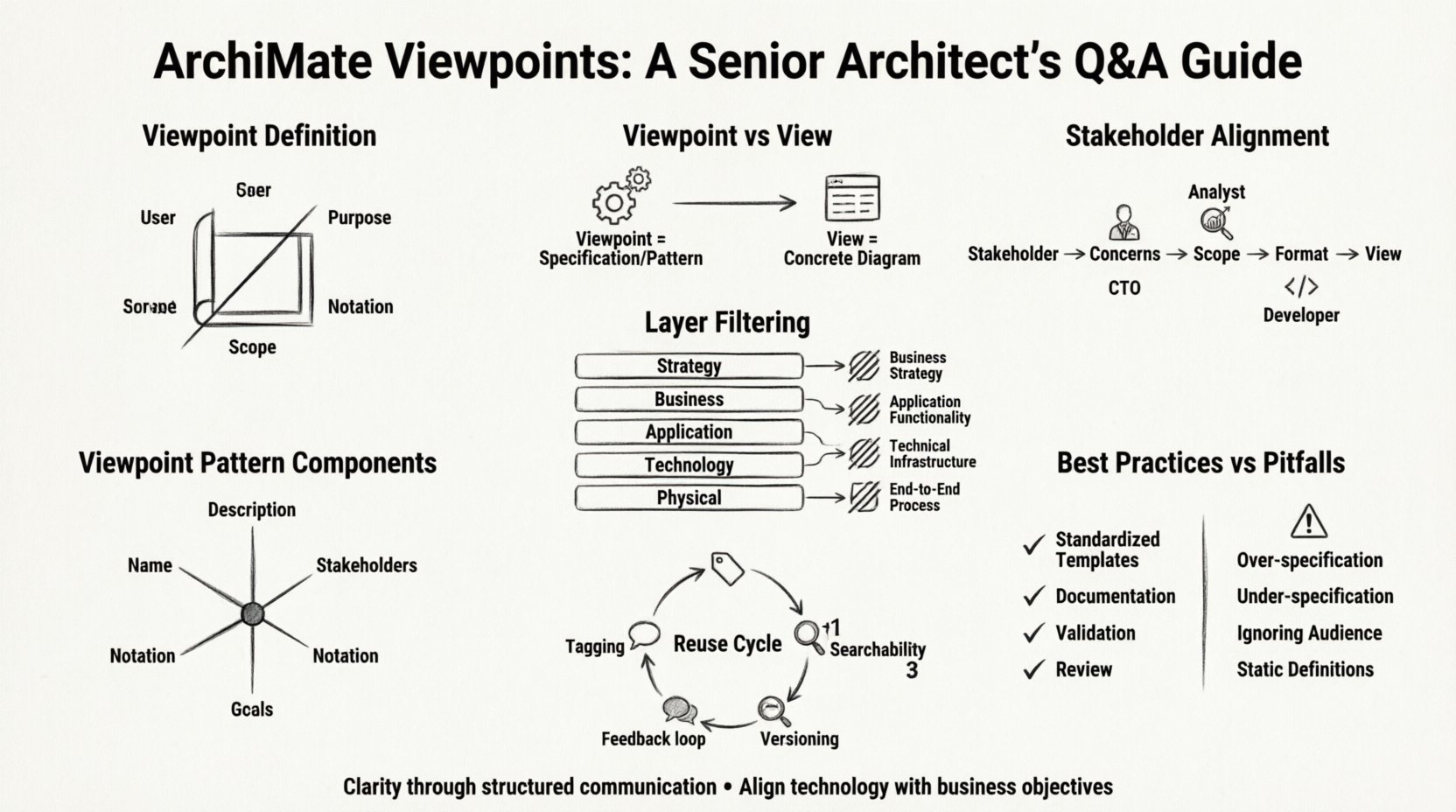
1. What Exactly Is an ArchiMate Viewpoint? 🤔
A common starting point for confusion is the definition itself. In the context of the ArchiMate modeling language, a Viewpoint is not the picture itself. It is the specification that defines how a view is constructed.
It defines the user: Who is this model intended for?
It defines the purpose: What question is this model answering?
It defines the scope: Which parts of the architecture are relevant?
It defines the notation: Which ArchiMate elements and relationships are allowed?
Think of a viewpoint as a template or a set of rules. It ensures that every model created under this specification remains consistent and readable for its intended audience. Without a viewpoint, a diagram is just a collection of shapes. With a viewpoint, it becomes a structured communication artifact.
Key Characteristics:
Abstraction: It determines the level of detail required.
Focus: It restricts the model to specific layers or domains.
Language: It specifies the terminology used in the model.
2. How Does a Viewpoint Differ From a View? 🔍
This distinction is critical for maintaining a clean architecture repository. Confusing the two leads to disorganized documentation and redundant modeling efforts.
Feature | Viewpoint | View |
|---|---|---|
Nature | A specification or pattern | A concrete representation |
Usage | Defines how to model | Is the model itself |
Frequency | Created once per stakeholder group | Created multiple times (instances) |
Content | Rules, elements, constraints | Specific data, relationships, diagrams |
For example, you might define a Business Capability Viewpoint that specifies only Business Layer elements should be used. You can then create five different Views using this same viewpoint, each showing different parts of the business capability map.
3. How Do We Align Viewpoints With Stakeholder Concerns? 🎯
The primary value of a viewpoint lies in its alignment with stakeholder needs. If a viewpoint does not address a specific concern, it is likely unnecessary. The process of alignment involves:
Identifying Stakeholders: Who needs information? (e.g., CTO, Business Analyst, Developer)
Mapping Concerns: What are their specific worries? (e.g., Cost, Risk, Compliance, Performance)
Defining Scope: Which layers of the ArchiMate model do they care about?
Setting Format: How should the information be presented? (e.g., Matrix, Process Flow, Layered Diagram)
Example Scenario:
Stakeholder: Security Officer
Concern: Data Protection Compliance
Viewpoint Requirement: Focus on Application Layer and Data Objects. Exclude Business Processes unless they handle sensitive data. Use specific security constraints.
By following this mapping, you ensure that the resulting views are not just technically accurate but also relevant to the people who must make decisions based on them.
4. Which ArchiMate Layers Should Be Included? 📚
The ArchiMate standard defines several layers: Business, Application, Technology, Physical, Infrastructure, Motivation, and Strategy. A common question is whether to show all layers in one view.
The Answer: No. Showing all layers simultaneously often results in a cluttered diagram that obscures the primary message. Instead, use the viewpoint to filter layers.
Viewpoint Focus | Recommended Layers | Typical Audience |
|---|---|---|
Business Strategy | Strategy, Motivation, Business | Executive Leadership |
Application Functionality | Business, Application | Product Owners |
Technical Infrastructure | Application, Technology, Physical | System Architects |
End-to-End Process | Business, Application, Technology | Process Owners |
When designing a viewpoint, explicitly state which layers are allowed. This prevents modelers from dragging in elements that do not fit the narrative of the diagram.
5. What Are the Components of a Viewpoint Pattern? 🧩
To create a reusable viewpoint, you need to define a pattern. A comprehensive pattern includes several mandatory components:
Name: A clear identifier (e.g., “Supplier Integration Viewpoint”).
Description: A brief explanation of the viewpoint’s purpose.
Stakeholders: Who is expected to consume this view?
Goals: What questions should this view answer?
Scope: Which elements of the repository are included?
Notation: Which ArchiMate elements and relationships are permitted?
Format: How is the information structured? (e.g., Swimlanes, Layered Stack)
Defining these components ensures that anyone in the organization can create a view using this pattern without needing to ask for clarification. It promotes consistency across the enterprise architecture model.
6. How Do We Manage Viewpoint Consistency Across Tools? 🛠️
In many organizations, architecture work happens in a centralized repository. However, different teams may use different tools or collaborate in different environments. Ensuring consistency in how viewpoints are interpreted is a significant challenge.
Strategies for Consistency:
Standardized Templates: Create a master template for each viewpoint pattern. This template contains the pre-defined constraints and allowed elements.
Documentation: Maintain a living document that describes every viewpoint. If a rule changes, update the documentation immediately.
Validation Rules: If the modeling tool supports it, enable validation rules that prevent the use of forbidden elements within a specific viewpoint.
Review Process: Implement a peer review process. Before a view is published, a senior architect should verify it adheres to the defined viewpoint pattern.
Consistency is not about rigid control; it is about ensuring that when a stakeholder sees a diagram, they understand the context immediately.
7. Can One Viewpoint Serve Multiple Stakeholders? 👥
Yes, but with caveats. Sometimes, different stakeholders share similar concerns. For instance, a Project Manager and a Business Analyst might both need a high-level process view.
When to Merge:
The level of detail is the same.
The terminology used is consistent.
The scope of the architecture domain is identical.
When to Separate:
One stakeholder needs strategic detail, the other needs operational detail.
The stakeholders have conflicting priorities (e.g., Security vs. Speed).
The audiences require different notation styles.
If you serve multiple stakeholders with one viewpoint, ensure the resulting views are customizable enough to meet specific needs without breaking the core pattern.
8. How Do We Handle Motivation Elements in Viewpoints? ⚖️
The Motivation Layer is often overlooked in practical modeling. However, it is crucial for understanding why an architecture exists. A well-designed viewpoint can include motivation elements like Drivers, Goals, and Principles.
Best Practices for Motivation:
Link Drivers to Business Goals: Show how external pressures drive internal objectives.
Traceability: Ensure that every capability or application in the view can be traced back to a motivating goal.
Keep it High-Level: Do not clutter detailed technical views with motivation elements unless the technical decision is directly driven by a strategic principle.
Including motivation elements adds context. It helps stakeholders understand that a specific technology choice is not arbitrary but is a response to a specific business driver.
9. What Are the Common Pitfalls in Creating Viewpoints? ⚠️
Even senior architects can make mistakes when defining viewpoints. Being aware of common pitfalls helps in avoiding them.
Over-Specification: Defining too many constraints makes the viewpoint unusable. Allow flexibility where possible.
Under-Specification: Leaving too much open to interpretation leads to inconsistent diagrams.
Ignoring the Audience: Creating a technical viewpoint for a business audience causes confusion. Always tailor the language to the reader.
Static Definitions: Architecture evolves. Viewpoints must evolve. A viewpoint that is valid today may need adjustment next year as the business changes.
10. How Do We Reuse Viewpoints Effectively? ♻️
One of the greatest efficiencies in enterprise architecture comes from reusing established patterns. Once a viewpoint is proven to work for a specific stakeholder group, it should be documented and reused.
Steps for Reuse:
Tagging: Label the viewpoint clearly in the repository.
Searchability: Ensure it is easy to find via keywords.
Versioning: If the pattern changes, maintain version history so users know which version to use.
Feedback Loop: Allow users to suggest improvements to the viewpoint pattern.
Reusing viewpoints reduces the cognitive load on new architects. They do not need to reinvent the wheel for every new project. They simply apply the existing standard.
Summary of Architectural Value 💎
The effective use of ArchiMate Viewpoints transforms architecture from a technical exercise into a strategic communication tool. By defining clear rules, scopes, and notations, you ensure that every diagram tells a coherent story. This clarity reduces risk, improves decision-making, and aligns technology with business objectives.
When implementing these practices, focus on the stakeholder. If the viewpoint serves the stakeholder’s need, the architecture succeeds. If it serves only the modeler’s preference, it fails. Always prioritize the human element of architecture over the rigid rules of the tool.
By adhering to these guidelines, your enterprise architecture practice will become more robust, consistent, and valuable to the organization.