
The landscape of enterprise architecture is shifting beneath our feet. Organizations are racing to adopt cloud-native solutions, microservices, and agile methodologies. In this environment of rapid change, the traditional frameworks that once guided strategic planning are under scrutiny. One of the most enduring standards in this field is ArchiMate. Specifically, the concept of Viewpoints within the ArchiMate modeling language is facing a critical question: does it still hold value in a world defined by speed and fluidity? 🤔
This guide provides a comprehensive analysis of the current state of ArchiMate Viewpoints. We examine how these modeling constructs interact with modern digital transformation initiatives. We will explore the tension between structure and agility, the necessity of abstraction, and how architects can leverage these tools without becoming bureaucratic bottlenecks. 🛠️
📐 Understanding the Core: What is an ArchiMate Viewpoint?
Before determining relevance, we must define the subject clearly. An ArchiMate Viewpoint is not merely a diagram style. It is a formal specification for how an architecture model is presented to a specific audience. The standard defines a set of rules that determine:
Which elements from the ArchiMate metamodel are visible.
How relationships between these elements are displayed.
What language or notation is used to describe the context.
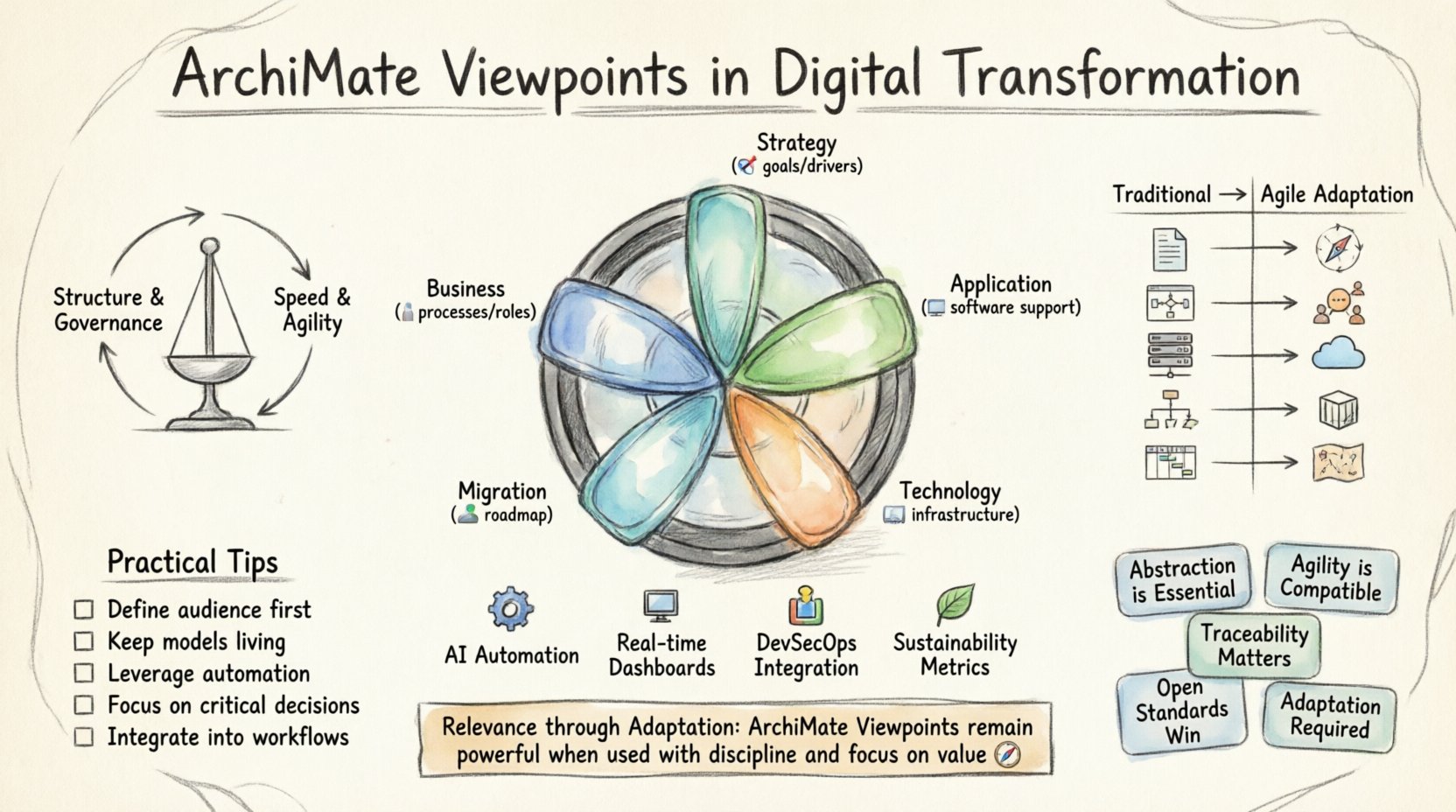
Think of a viewpoint as a lens. Just as a photographer chooses a specific lens to capture a landscape, an enterprise architect chooses a viewpoint to capture a specific aspect of the enterprise. A strategy view focuses on goals and drivers. A technology view focuses on infrastructure and devices. This distinction is vital because no single diagram can convey the complexity of an entire organization. 🧐
The standard organizes these viewpoints into several categories to ensure consistency across the enterprise:
Strategy Viewpoint: Focuses on the why. Goals, drivers, and principles.
Business Viewpoint: Focuses on the what. Processes, roles, and products.
Application Viewpoint: Focuses on the how software supports the business.
Technology Viewpoint: Focuses on the physical infrastructure.
Implementation & Migration Viewpoint: Focuses on projects and transitions.
🚀 The Shift in Digital Transformation
Digital transformation has changed the pace of work. In the past, architecture projects might have taken years to design and implement. Today, deployment cycles occur in days or hours. This speed creates friction with heavy modeling standards. Critics argue that maintaining detailed ArchiMate models for microservices that change weekly is an exercise in futility. 📉
However, this perspective overlooks the strategic necessity of alignment. While the implementation details may shift, the underlying business capabilities often remain stable for longer periods. Digital transformation is not just about technology; it is about business value realization. ArchiMate Viewpoints provide the vocabulary to map that value. Without a shared language, business leaders and technical teams speak different dialects. 🗣️
Consider the following challenges in modern transformation:
Complexity: Systems are more distributed. Visibility is harder to achieve.
Integration: Connecting legacy systems with new cloud platforms requires clear mapping.
Governance: Compliance and security requirements demand traceability.
Cost: Understanding the cost of technology decisions requires clear architectural context.
In this context, the ability to abstract complexity through Viewpoints becomes more valuable, not less. If a model is too detailed, it becomes noise. If it is too vague, it becomes useless. ArchiMate Viewpoints offer the mechanism to control that level of detail. 🎚️
⚖️ Relevance Analysis: Where It Holds Up
To understand the utility of these Viewpoints, we must look at where they provide the most leverage. They are not designed for every single developer or every daily stand-up meeting. Their primary value lies in the strategic and tactical layers of the organization. 🏗️
1. Strategic Alignment
The Strategy Viewpoint is perhaps the most critical for modern leadership. It allows architects to link business goals directly to IT capabilities. In a digital transformation, a company might want to “improve customer experience.” A Strategy Viewpoint helps visualize what capabilities are needed to achieve this and which processes must be reengineered. This traceability ensures that IT spending is not random but directed toward strategic outcomes. 🎯
2. Business Capability Mapping
The Business Viewpoint helps organizations understand their own DNA. By mapping processes to roles and functions, leaders can identify redundancies. During a transformation, knowing which processes are unique to a legacy system is crucial for deciding what to retire and what to migrate. This clarity reduces risk. 🛡️
3. Technology Rationalization
As organizations move to the cloud, they often end up with fragmented technology landscapes. The Technology Viewpoint provides a map of the infrastructure. It helps answer questions like: “Where is this application running?” and “What dependencies exist?”. This is essential for cost optimization and security compliance. 💻
4. Migration Planning
The Implementation & Migration Viewpoint is specifically designed for change. It models the transition from a current state to a target state. In a digital transformation, this is the roadmap. It helps project managers understand the sequence of work and the dependencies between different teams. Without this, migration projects often become chaotic. 🗺️
📊 Viewpoints vs. Modern Agile Practices
A common misconception is that ArchiMate and Agile are mutually exclusive. They are not. The tension often arises from how the modeling is performed, not the standard itself. Agile teams need lightweight artifacts. Heavy modeling tools can slow them down. However, the concepts within ArchiMate Viewpoints can be adopted without the heavy tooling overhead. 🏃♂️
The table below illustrates how traditional Viewpoints align with modern agile needs.
Viewpoint Category | Traditional Use | Modern Agile Adaptation |
|---|---|---|
Strategy Viewpoint | High-level annual planning documents. | OKR alignment and product roadmap visualization. |
Business Viewpoint | Static process maps. | Value stream mapping for continuous improvement. |
Application Viewpoint | Full system architecture diagrams. | Service dependency graphs for microservices. |
Technology Viewpoint | Datacenter floor plans. | Cloud infrastructure topology and cost models. |
Migration Viewpoint | Multi-year project plans. | Release train planning and sprint dependencies. |
This adaptation shows that the Viewpoints are flexible. They can be scaled down to fit the cadence of modern development without losing their structural integrity. 🔄
🌐 Integration with Other Frameworks
ArchiMate does not exist in a vacuum. It is often used alongside other standards like TOGAF or ISO/IEC 42010. In a modern context, integration is key. The Viewpoints serve as the bridge between high-level enterprise strategy and low-level technical execution. 🌉
For example, TOGAF provides the methodology for the architecture development process. ArchiMate provides the notation to document the results. When an organization adopts a digital transformation strategy, they need both the process (how to do it) and the language (what it looks like). ArchiMate Viewpoints fill the language gap. They allow stakeholders to read the same document and understand the implications. 📖
This interoperability is crucial. If an organization uses a proprietary modeling language, they lock themselves into a specific vendor. ArchiMate is an open standard. This ensures that the knowledge remains with the organization, not the tool provider. This longevity is a significant advantage in long-term transformation journeys. 🛡️
🔮 Future Trends and Challenges
Looking ahead, several trends will impact the relevance of ArchiMate Viewpoints. The architecture community must adapt to these shifts to maintain utility. 📈
AI and Automation: Artificial Intelligence can now generate diagrams from natural language descriptions. This changes the role of the architect from drawer to reviewer. Viewpoints will need to be defined in a way that machines can interpret and render them automatically.
Real-time Architecture: Static models are being replaced by dynamic dashboards. The Viewpoints must evolve to represent real-time data flows rather than static snapshots. This requires integration with observability tools.
DevSecOps: Security is no longer a phase; it is continuous. Viewpoints must incorporate security controls and compliance requirements directly into the model to ensure “security by design”.
Sustainability: Carbon footprint is becoming a metric for IT. Future Viewpoints may need to include energy consumption metrics for different technology choices.
If the standard can adapt to these trends, it will remain highly relevant. If it remains static, it risks becoming a legacy artifact. The open nature of the standard allows for updates and community-driven evolution. This agility in the standard itself is a positive sign. 🌱
🛠️ Practical Application Without Bureaucracy
Many architects fear that using ArchiMate leads to endless documentation that no one reads. This is a risk, but it is avoidable. The key is to focus on the value of the Viewpoint, not the act of creating it. Here is how to apply them effectively in a modern environment: 🛠️
Define the Audience First: Before drawing anything, ask who will use this Viewpoint. If it is for the CIO, focus on Strategy and Business. If it is for the DevOps team, focus on Application and Technology.
Keep it Living: Do not treat models as finished projects. Treat them as living documents. Update them when the architecture changes. If a change occurs but the model does not, the model is already wrong.
Leverage Automation: Use tooling that generates diagrams from code or configuration files. This reduces manual effort and increases accuracy.
Focus on Critical Decisions: Only model the parts of the system that are high risk or high complexity. Low-risk components do not need detailed Viewpoints. Apply the 80/20 rule.
Integrate into Workflows: Embed the Viewpoints into the project management workflow. If a project requires a specific Viewpoint to proceed, it becomes part of the process, not an extra task.
By following these practices, the burden of modeling is reduced, and the value is increased. The Viewpoints become a tool for decision-making, not just a record of decisions made. ⚖️
💡 Key Takeaways for Architects
To summarize the findings on the relevance of ArchiMate Viewpoints in modern digital transformation:
Abstraction is Essential: As systems grow in complexity, the ability to abstract details into specific Viewpoints becomes more valuable for communication.
Agility is Compatible: Agile practices and ArchiMate can coexist if the modeling is lightweight and integrated into the development lifecycle.
Traceability Matters: Connecting business goals to technical implementation is a critical need that Viewpoints fulfill effectively.
Open Standards Win: The open nature of ArchiMate protects organizational knowledge from vendor lock-in.
Adaptation is Required: The standard must evolve to support automation, real-time data, and sustainability metrics to stay current.
Digital transformation is not a destination; it is a continuous journey. Throughout this journey, the need for structure, clarity, and shared understanding remains constant. ArchiMate Viewpoints offer a proven framework for delivering that clarity. When used with discipline and focus on value, they remain a powerful asset in the modern architect’s toolkit. 🧭
🔍 Conclusion on Longevity
The question is not whether the standard is perfect, but whether it solves a problem. It solves the problem of communication across complex organizations. It solves the problem of aligning IT with business goals. It solves the problem of managing change over time. As long as these problems exist, the solutions that address them will remain relevant. 🏛️
Organizations that ignore architecture standards often find themselves with fragmented systems and unclear ownership. Those that adopt structured approaches like ArchiMate Viewpoints gain a roadmap for their future. The future outlook is positive for those who adapt the standard to fit the pace of modern development. The relevance lies not in the tool, but in the discipline of thinking architecturally. 🧠