
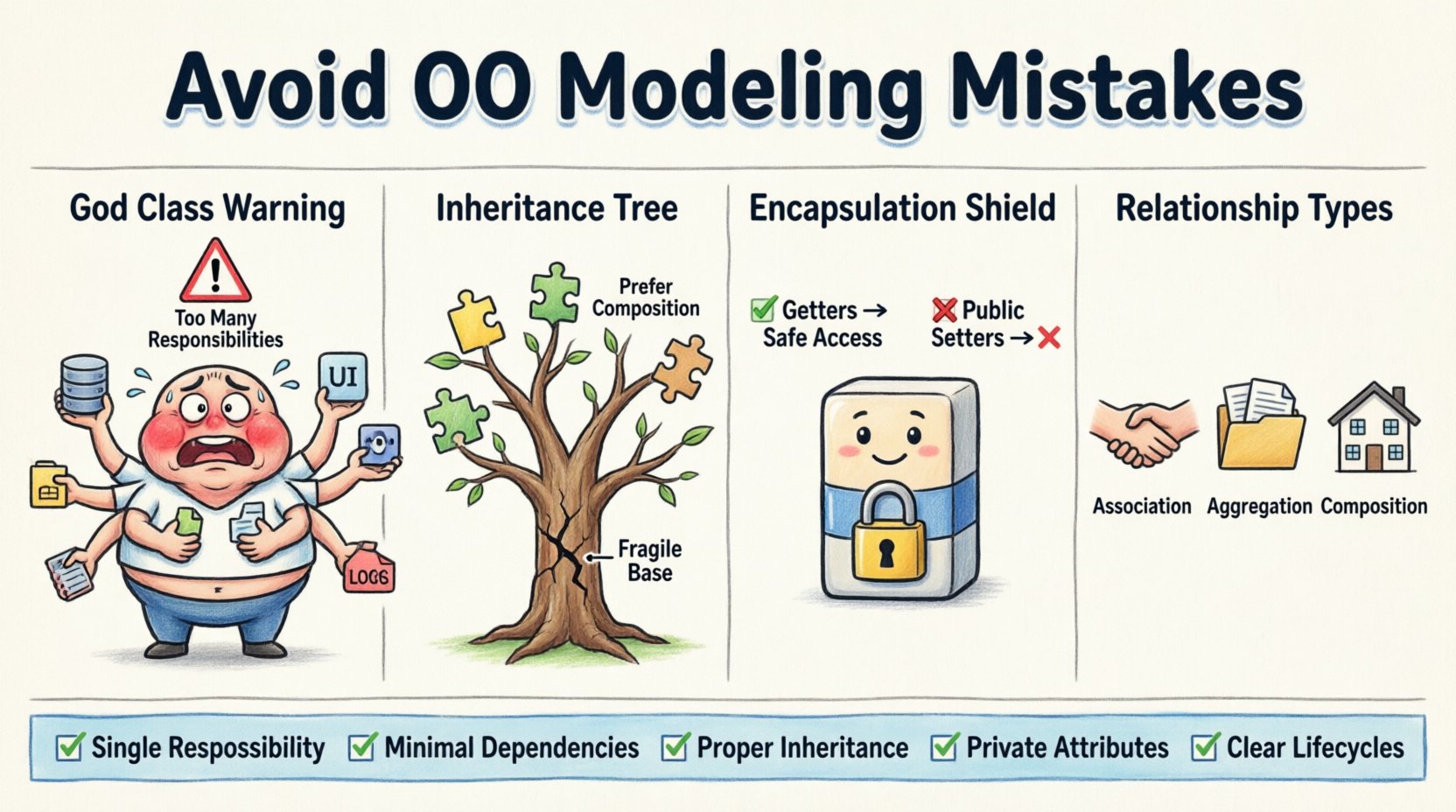
Object-Oriented (OO) modeling serves as the blueprint for software architecture. It defines how data and behavior interact before a single line of code is written. However, even experienced practitioners stumble into traps that compromise system integrity, scalability, and maintainability. Understanding these pitfalls is essential for creating robust systems.
This guide examines frequent errors in Object-Oriented Analysis and Design. We will explore class structures, inheritance hierarchies, and relationship definitions. The goal is to provide actionable insights that improve design quality without relying on specific tools or frameworks.
🚫 The Trap of Over-Generalization (God Classes)
One of the most prevalent issues in OO modeling is the creation of “God Classes.” These are classes that assume too much responsibility. They manage data for unrelated modules, handle complex business logic that belongs elsewhere, or coordinate global state.
Symptom: A class file contains thousands of lines of code.
Symptom: Every module in the system depends on this single class.
Symptom: Refactoring requires changing this class, introducing high risk of regression.
When a class does too much, it violates the Single Responsibility Principle. Changes in one area of functionality ripple unpredictably through the entire system. To correct this, decompose the class into smaller, cohesive units. Each unit should handle a specific domain concept.
🧬 Inheritance Deep Dives & Fragility
Inheritance is a powerful mechanism for code reuse, but it is often misused. Deep hierarchies can create fragile base classes where a change in a parent class breaks functionality in multiple child classes.
Common Inheritance Errors
Overuse of Inheritance: Using inheritance for code sharing rather than type substitution.
Deep Hierarchies: Classes that are five or six levels deep create confusion about where methods are defined.
Leaky Abstractions: Child classes exposing implementation details of the parent.
Instead of forcing every relationship into an inheritance model, consider composition. If a class has-a relationship rather than is-a, composition is often the safer architectural choice. This reduces coupling and increases flexibility.
🔒 Encapsulation Boundaries
Encapsulation protects the internal state of an object. It ensures that objects interact through well-defined interfaces rather than direct access to memory or variables. Violating this principle exposes internal data to unintended manipulation.
Public Attributes: Declaring data members as public allows any class to modify state without validation.
Setter Abuse: Providing setters for every attribute defeats the purpose of immutability and state control.
Direct Access: Accessing private variables directly from unrelated classes.
Strict encapsulation forces developers to think about *why* a state change is happening. It introduces validation logic at the boundary. This prevents invalid states from propagating through the system.
🔗 Relationship Confusion
Defining relationships between classes is critical. Modelers often confuse Association, Aggregation, and Composition. These distinctions define the lifecycle and ownership of objects.
Relationship Type | Ownership | Lifecycle Dependency | Example |
|---|---|---|---|
Association | None | Independent | A teacher teaches a student. |
Aggregation | Weak | Independent | A department has professors (professors exist without department). |
Composition | Strong | Dependent | A house has rooms (rooms die with the house). |
Using the wrong relationship type in your model leads to runtime errors. For instance, if you model a dependency as an association, the system might try to access an object after its parent has been destroyed. Ensure your diagram accurately reflects the intended lifecycle.
⚖️ State Management & Responsibility
State machines are often overlooked in high-level modeling. Objects change states based on events. If the transition logic is scattered across multiple classes, maintaining consistency becomes difficult.
Spaghetti Logic: Conditional checks for state scattered throughout methods.
Missing Transitions: States defined without valid paths to enter or exit them.
Global State: Relying on static variables to track application-wide status.
Centralize state logic within the object itself or a dedicated state manager. This keeps the behavior localized. When an object transitions, the change is clear and traceable. This reduces debugging time significantly.
📐 The Modeling vs Implementation Gap
A common disconnect occurs when the model does not match the implementation. This often happens when developers skip modeling to save time, or when modelers lack technical context.
Over-Engineering: Creating complex diagrams for simple logic that could be handled with basic functions.
Under-Modeling: Skipping critical entity definitions, leading to database schema changes later.
Static vs Dynamic: Focusing only on static structure (classes) while ignoring dynamic behavior (sequence of events).
Balance is key. The model should be detailed enough to guide development but abstract enough to remain valid as requirements change. Regular reviews between architects and developers bridge this gap.
✅ Corrective Checklist for Design Reviews
Before finalizing a design, run through this checklist to identify potential structural weaknesses.
❓ Does every class have a single reason to change?
❓ Are dependencies minimized and explicit?
❓ Is inheritance used only for type substitution?
❓ Are private attributes truly private?
❓ Do relationship lifecycles match business rules?
❓ Is the model readable by a new team member?
Applying these checks prevents technical debt from accumulating in the early stages of development. It ensures that the foundation remains solid as the system grows.
🔄 Iteration and Refinement
Modeling is not a one-time activity. As the system evolves, the model must evolve with it. Regular refactoring of the design itself is necessary. If a design pattern no longer fits the requirements, replace it. Do not force old structures onto new problems.
Effective OO modeling requires discipline. It demands a focus on clarity and correctness over speed. By avoiding these common mistakes, you build systems that are easier to understand, test, and extend. The effort invested in clean modeling pays dividends in reduced maintenance costs and fewer production issues.
Focus on the core principles: cohesion, coupling, and encapsulation. Keep the relationships clear and the responsibilities defined. This approach leads to software that stands the test of time.