
Enterprise architecture often feels like a foreign language. Acronyms, layered diagrams, and abstract models frequently sit in a repository, gathering digital dust while business teams struggle with disjointed processes. However, the true power of a structured framework lies not in the complexity of the model, but in the clarity of the communication it enables. This case study explores how a junior architect leveraged specific ArchiMate Viewpoints to bridge a significant gap between technical operations and business strategy.
The objective was straightforward: create a shared understanding that allowed both sides to speak the same language without losing the nuance of their respective domains. The result was a reduction in rework, faster decision-making, and a culture where technical constraints were understood early in the planning phase.
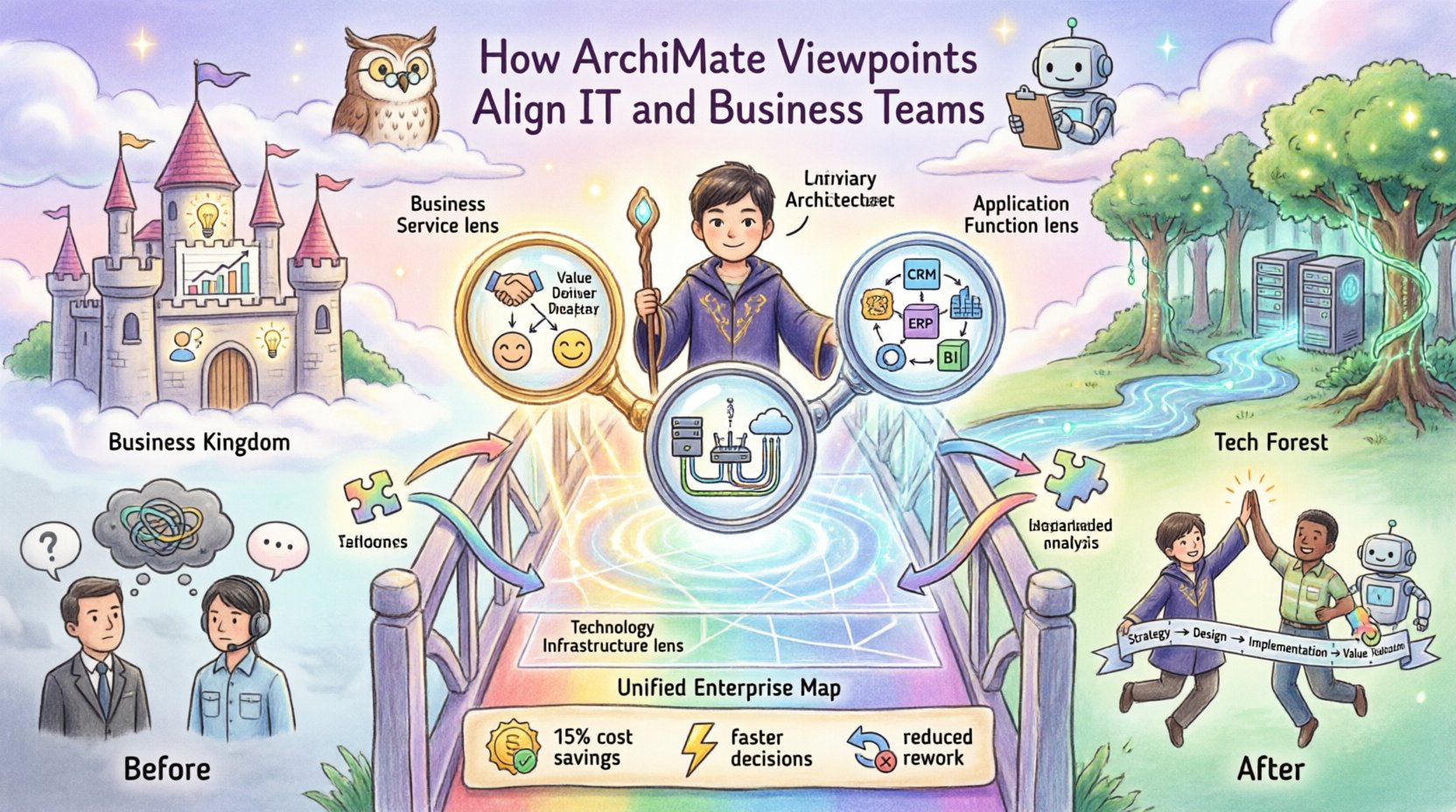
🧩 Understanding the Core Challenge: The Communication Gap
Before diving into the solution, it is essential to understand the environment. In many organizations, the disconnect between IT and Business is not a lack of information, but a lack of context. Business leaders ask for capabilities. IT teams hear requirements. The translation between the two often happens through email chains, lengthy meetings, and assumptions.
The specific issues identified in this scenario included:
- Scope Creep: Business requests expanded without visible impact analysis on existing infrastructure.
- Terminology Mismatch: A “service” meant a product to one team and a software component to the other.
- Visibility: IT could not explain why a delay occurred, and Business could not explain why a feature was needed.
- Fragmented Documentation: Information was scattered across wikis, spreadsheets, and individual emails.
The goal was to establish a single source of truth that was accessible to both technical and non-technical stakeholders. This required a tool that could abstract complexity while maintaining precision.
👁️ The Solution: ArchiMate Viewpoints Explained
ArchiMate is a modeling language that provides a structured way to describe enterprise architecture. However, a full model is often too dense for daily use. This is where Viewpoints become critical. A viewpoint defines the perspective from which a model is viewed, tailored to a specific audience and their concerns.
Think of a viewpoint as a lens. When you look through a camera lens, you focus on specific elements while blurring the background. Similarly, an ArchiMate viewpoint allows a stakeholder to focus on Business Capabilities without getting bogged down in Technology Infrastructure details.
Key characteristics of effective viewpoints in this context:
- Relevance: Does this diagram answer the question the stakeholder is asking?
- Simplicity: Can it be understood in under five minutes?
- Traceability: Does it link back to the source of the requirement?
- Consistency: Does it align with the broader enterprise model?
By selecting the right viewpoints, the beginner architect avoided the trap of creating a “big model” that no one could read.
📋 The Case Study Scenario: Nexus Dynamics
To illustrate this, we look at a fictional organization, Nexus Dynamics. The organization was undergoing a digital transformation initiative. The leadership wanted to launch a new customer portal, but the existing systems were decades old.
Stakeholders Involved:
- Business Unit Heads: Focused on revenue, customer experience, and speed to market.
- IT Operations: Focused on stability, security, and maintenance costs.
- Development Teams: Focused on code delivery, technical debt, and API standards.
The Architect, a junior member of the team, was tasked with facilitating the alignment. The challenge was not just drawing diagrams, but facilitating a dialogue that resulted in concrete action items.
🛠️ Step-by-Step Implementation Strategy
The implementation followed a disciplined approach. It did not rely on magic; it relied on structure. Here is how the process unfolded.
1. Identifying Stakeholder Concerns
The first step was not modeling. It was interviewing. The architect sat down with each group to understand their primary concerns.
- Business: “How does this affect our revenue goals? What capabilities are we missing?”
- IT Operations: “What is the impact on system uptime? Do we need new hardware?”
- Development: “What APIs do we need to expose? How does this fit our security policy?”
These concerns directly mapped to specific ArchiMate layers and viewpoints.
2. Selecting the Right Viewpoints
Based on the concerns, three primary viewpoints were selected for the project. Using a matrix helped ensure coverage across the organization.
| Viewpoint | Target Audience | Primary Focus | Key Question Answered |
|---|---|---|---|
| Business Service | Business Leaders | Value Delivery | What capabilities do we offer to the customer? |
| Application Function | IT Managers | System Logic | Which applications support the business service? |
| Technology Infrastructure | Operations Team | Hardware & Network | Where does this logic run physically? |
This table was not static. It was updated as the project evolved, ensuring that new concerns were addressed with appropriate views.
3. Developing the Business Capability Map
The Business Capability Viewpoint was the starting point. This model did not focus on processes or software. It focused on what the business could do.
Key steps in this phase:
- Identify Core Capabilities: Cataloged functions like “Customer Onboarding” or “Billing Management”.
- Assess Maturity: Rated each capability on a scale from “Non-existent” to “Optimized”.
- Gap Analysis: Highlighted where the current state did not meet the desired future state.
This map became the reference for all project discussions. If a feature was requested, it was first mapped to a capability. If the capability did not exist, it was created before discussing the software.
4. Linking Business to Technology
Once the business capabilities were defined, the next step was showing how they were supported. The Application Service Viewpoint was used here.
- Mapping: Each business capability was linked to the application functions that enable it.
- Dependency: Visualized dependencies between applications to understand risk.
- Consolidation: Identified redundant applications that served the same function.
This visualization allowed IT to see the cost of supporting a business function. It also allowed Business to see the technical effort required to change a capability.
5. Technology Infrastructure Visualization
For the Operations team, the Technology Deployment Viewpoint was essential. It showed how software components were deployed on physical hardware.
- Network Topology: Defined how systems communicated.
- Resource Allocation: Showed where compute power and storage were located.
- Security Zones: Highlighted where data flowed in and out of secure boundaries.
This prevented the common scenario where a new application was designed without considering network bandwidth or security compliance.
🤝 Facilitating the Alignment Workshops
Creating the models was only half the battle. The second half was facilitating the workshops where these models were discussed. The beginner architect used a specific protocol to ensure productive dialogue.
Pre-Workshop Preparation
Before inviting stakeholders, the architect ensured the models were clean. This meant removing technical jargon that did not serve the specific viewpoint. For the Business team, the Technology Viewpoint was simplified to show only critical dependencies, not every server.
During the Workshop
The workshop followed a strict agenda:
- Review Current State: Walk through the existing maps to confirm understanding.
- Identify Gaps: Mark areas where the model does not match reality.
- Define Future State: Agree on the target architecture for the specific capability.
- Action Items: Assign owners to specific tasks derived from the model.
Crucial Rule: The model was the source of truth. If a discussion drifted, the architect would refer back to the diagram. “According to this capability map, this function is currently supported by System X. If we change that, what is the impact on System Y?”
📈 Measuring Success and Outcomes
After six months of implementing this structured approach, the organization observed tangible changes. The success was measured not just by the number of diagrams created, but by the quality of decisions made.
Quantitative Improvements
- Reduced Rework: Projects that were previously rejected by IT due to feasibility issues were now identified during the planning phase.
- Faster Onboarding: New team members could understand the architecture in weeks instead of months by reviewing the relevant viewpoints.
- Cost Savings: Identification of redundant applications led to a 15% reduction in licensing costs.
Qualitative Improvements
- Trust: Business leaders trusted IT recommendations because they could see the underlying logic.
- Clarity: Technical debt was no longer a hidden concept; it was mapped and visible.
- Collaboration: Silos began to break down as teams shared a common visual language.
⚠️ Challenges Encountered
No implementation is without friction. The beginner architect faced several hurdles that are common in similar projects.
Resistance to Documentation
Initially, some team members felt that documenting the architecture was extra work. They preferred to build directly.
Resolution: The architect showed them how the model saved time in the long run. By visualizing dependencies early, they avoided building features that would break later.
Model Maintenance
Models become outdated quickly if not maintained. A static diagram is worse than no diagram at all.
Resolution: The architect integrated model updates into the standard development workflow. Changes to the architecture required an update to the corresponding viewpoint before deployment.
Tooling Constraints
While the prompt advises against mentioning specific software, the reality is that managing large models requires a repository. The architect ensured the chosen repository supported multiple viewpoints and easy export for presentations.
Key Requirement: The tool needed to support the ArchiMate standard natively to ensure interoperability and long-term viability.
🔑 Key Takeaways for Aspiring Architects
For those looking to replicate this success, several principles must be followed. These are not rules of law, but lessons learned from the field.
- Start with the Audience: Do not create a model first. Understand who will use it. Create the viewpoint for them.
- Simplicity is King: If a stakeholder cannot understand the diagram in 30 seconds, simplify it. Remove unnecessary detail.
- Iterate: The first model will be wrong. Expect to update it. Use feedback loops to improve accuracy.
- Context Matters: A technology view for a CIO is different from a technology view for a Network Engineer. Tailor the level of abstraction.
- Connect the Layers: Ensure that Business Capabilities link to Applications, and Applications link to Technology. This traceability is where the real value lies.
🌟 The Role of the Beginner Architect
It is a common misconception that only senior architects can manage enterprise alignment. In this case study, the beginner succeeded because they focused on communication rather than complexity.
Seniority does not equal clarity. The ability to translate technical constraints into business value is a skill that can be developed early. By using ArchiMate Viewpoints effectively, the architect acted as a translator. They took the abstract needs of the business and grounded them in the concrete reality of the technology.
🚀 Looking Forward
The journey does not end with the initial alignment. As the organization grows, the architecture must evolve. The viewpoints established in this case study provide a foundation for future scalability.
Future Considerations:
- Automation: Linking the architecture repository to CI/CD pipelines to ensure code matches the model.
- Real-time Data: Using runtime data to update the technology viewpoint automatically.
- Cloud Migration: Adapting the technology viewpoint to support hybrid and multi-cloud environments.
The foundation laid by aligning IT and Business through structured modeling remains a powerful asset. It turns architecture from a documentation exercise into a strategic enabler.
💡 Final Thoughts on Enterprise Alignment
Building a bridge between two different worlds requires patience, structure, and a shared language. The ArchiMate framework provides the vocabulary, but the viewpoints provide the context. When used correctly, they transform enterprise architecture from a theoretical concept into a practical tool for business success.
The story of this beginner architect serves as a reminder that effective architecture is not about the diagrams you draw, but the conversations you enable. By focusing on the needs of the stakeholders and selecting the right viewpoint for each, alignment becomes not just possible, but inevitable.
For any organization struggling with IT-Business friction, adopting this structured approach offers a path forward. It requires discipline, but the reward is an organization that moves faster, builds better, and understands itself more clearly.
By focusing on the specific needs of your stakeholders and utilizing the structured layers of the ArchiMate framework, you can achieve the clarity necessary for true enterprise alignment.