
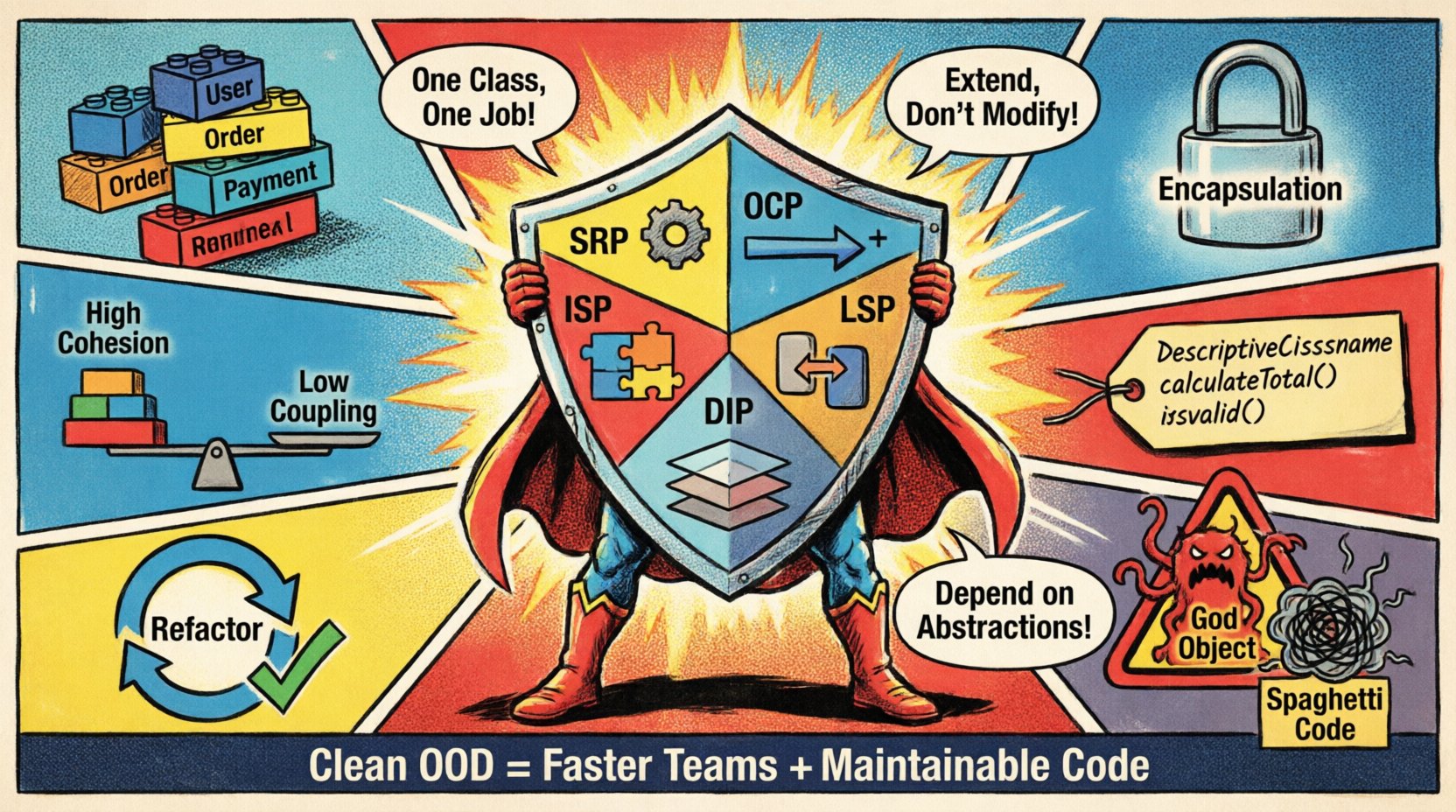
Designing software that stands the test of time requires more than just writing functional code. It demands a deliberate approach to structure, logic, and interaction. Object-Oriented Design (OOD) remains a cornerstone of modern software architecture, providing a framework for modeling real-world problems into manageable, reusable components. However, the mere use of objects does not guarantee quality. Without disciplined practices, codebases can quickly degrade into tangled webs of dependencies that resist change.
This guide explores the essential practices for achieving clean, maintainable, and scalable object-oriented systems. We will examine the core principles that guide professional development, focusing on how to structure classes and interfaces to support future evolution rather than just current functionality.
Understanding the Core Philosophy 🧠
Clean design is not an aesthetic choice; it is a functional necessity. When developers prioritize readability and logical separation, they reduce the cognitive load required to understand the system. This leads to fewer defects and faster feature delivery. The goal is to create a system where the intent of the code is immediately apparent to any team member.
Key characteristics of a well-designed object-oriented system include:
- Modularity: Components are isolated and interact through defined interfaces.
- Readability: Code names and structures convey meaning without requiring extensive comments.
- Extensibility: New features can be added with minimal modification to existing code.
- Testability: Individual components can be verified independently.
Achieving these characteristics requires a shift in mindset from writing code that works to writing code that adapts. This involves constant evaluation of how objects interact and how data flows through the application.
The SOLID Principles Explained ⚙️
The SOLID acronym represents five design principles intended to make software designs more understandable, flexible, and maintainable. Adhering to these rules helps prevent common architectural pitfalls.
1. Single Responsibility Principle (SRP)
A class should have one, and only one, reason to change. When a class handles multiple responsibilities, it becomes fragile. If one requirement changes, the entire class must be modified, increasing the risk of introducing bugs into unrelated areas.
To apply SRP:
- Identify the nouns in your domain logic.
- Ensure each class represents a single noun.
- Split large classes into smaller, focused units.
- Delegate tasks to helper classes rather than adding logic to the main class.
For example, a User class should handle user data and identity, not email notifications or database persistence. Those concerns belong in separate services.
2. Open/Closed Principle (OCP)
Software entities should be open for extension, but closed for modification. This seems contradictory, but it refers to the mechanism of change. You should be able to add new functionality without altering the source code of existing classes.
This is typically achieved through:
- Abstraction and interfaces.
- Inheritance where appropriate.
- Composition over inheritance.
When a new requirement arises, you create a new class that implements the existing interface rather than adding if statements to the original logic. This keeps the original code stable and tested.
3. Liskov Substitution Principle (LSP)
Subtypes must be substitutable for their base types. If a program uses a base class object, it should be able to use any subclass object without knowing the difference. Violating this principle leads to runtime errors and unexpected behavior.
Consider these checks:
- Does the subclass maintain the invariants of the parent class?
- Are preconditions not strengthened in the subclass?
- Are postconditions not weakened in the subclass?
Designing hierarchies requires deep consideration of behavior. If a subclass changes the expected outcome of a method, it breaks the contract established by the parent.
4. Interface Segregation Principle (ISP)
Clients should not be forced to depend on methods they do not use. Large, monolithic interfaces force classes to implement functionality they do not need, creating unnecessary coupling.
To adhere to ISP:
- Break large interfaces into smaller, specific ones.
- Ensure each interface represents a distinct capability.
- Allow classes to implement only the interfaces relevant to their role.
This reduces the impact of changes. Modifying a specific capability interface affects fewer classes than modifying a massive, all-encompassing interface.
5. Dependency Inversion Principle (DIP)
High-level modules should not depend on low-level modules. Both should depend on abstractions. Furthermore, abstractions should not depend on details; details should depend on abstractions.
This principle decouples the system. By depending on interfaces rather than concrete implementations, the system becomes flexible. You can swap out implementations without touching the high-level business logic. This is the foundation for dependency injection and testable architectures.
Encapsulation and Abstraction 🔒
These two pillars of object-oriented programming are often misunderstood or misused. They are not just about hiding data; they are about controlling access to maintain state integrity.
Encapsulation
Encapsulation binds data and the methods that operate on that data into a single unit. It restricts direct access to some of an object’s components, preventing accidental interference and misuse.
- Visibility Modifiers: Use private or protected access for internal state.
- Getters and Setters: Provide controlled access. Avoid exposing internal arrays or collections directly.
- Invariants: Ensure the object remains in a valid state after any operation.
Abstraction
Abstraction simplifies complexity by hiding implementation details. It allows the user to interact with a high-level concept without understanding the underlying mechanics.
- Define clear interfaces that describe what an object does, not how it does it.
- Use abstract classes or interfaces to define contracts.
- Hide algorithmic complexity within the class implementation.
Coupling and Cohesion 🧩
Two metrics define the quality of a design: coupling and cohesion. Understanding the relationship between them is critical for long-term maintenance.
Cohesion refers to how closely related the responsibilities of a single module are. High cohesion is desirable. A class with high cohesion has a single, well-defined purpose. Low cohesion means a class is doing too many unrelated things.
Coupling refers to the degree of interdependence between software modules. Low coupling is desirable. Modules should communicate through well-defined interfaces with minimal knowledge of the internal workings of other modules.
The following table illustrates the relationship:
| Concept | High | Low | Preference |
|---|---|---|---|
| Cohesion | Related responsibilities grouped together. | Unrelated responsibilities mixed. | High |
| Coupling | Heavy dependence on other modules. | Minimal dependence on other modules. | Low |
Strategies for Improving Coupling and Cohesion
- Reduce Data Coupling: Pass only the necessary data between objects.
- Use Message Passing: Encourage objects to send messages rather than accessing each other’s data directly.
- Limit Scope: Keep variables and methods local to where they are used.
- Refactor Frequently: Small, regular refactoring prevents the accumulation of technical debt.
Naming Conventions and Readability 📝
Code is read far more often than it is written. Names serve as the primary documentation for the system. A well-named variable or method can eliminate the need for comments.
- Intent Revealing: Names should reveal intent.
calculateTax()is better thancalc(). - Consistent Vocabulary: Use domain-specific language consistently across the codebase.
- Avoid Misleading Names: Do not name a class
Managerif it does not manage anything specific. - Eliminate Noise: Remove prefixes like
get,set, orisunless they add clarity.
Managing Complexity in Large Systems 🌐
As systems grow, complexity increases exponentially. Design patterns provide proven solutions to common structural problems. However, patterns should not be applied blindly. They must solve a specific problem.
Key strategies for managing scale include:
- Layering: Separate concerns into layers (e.g., presentation, business logic, data access).
- Domain-Driven Design: Align the structure of the code with the business domain.
- Modularization: Split the system into independent modules or packages.
- Lazy Loading: Load resources only when needed to improve performance and reduce memory footprint.
Refactoring as a Continuous Process 🔄
Design is not a one-time event. It is a continuous process. Code degrades over time as requirements change and shortcuts are taken. Refactoring is the disciplined technique for improving the design of existing code.
Effective refactoring requires:
- Safe Guards: Comprehensive tests must exist before modifying code.
- Small Steps: Make many small changes rather than one large overhaul.
- Timing: Refactor before adding new features to avoid compounding technical debt.
- Feedback: Use static analysis tools to detect violations of design principles.
Common Pitfalls to Avoid ⚠️
Even experienced developers fall into traps. Awareness of common mistakes helps prevent them.
- God Objects: Classes that know too much and do too much.
- Feature Envy: Methods that access more data from other objects than from their own.
- Parallel Inheritance Hierarchies: Creating new subclasses in one class but failing to update the corresponding subclass in another.
- Spaghetti Code: Unstructured code with complex, tangled control flow.
- Golden Hammer: Applying the same solution to every problem regardless of fit.
The Impact on Team Velocity 🚀
Clean design directly correlates with team productivity. When code is clear and modular, onboarding new developers is faster. Debugging becomes less time-consuming. Feature implementation accelerates because the foundation is stable.
Investing time in design pays dividends over the lifecycle of the project. A system built with clean principles can evolve for years without requiring a complete rewrite. This stability allows teams to focus on business value rather than fighting the codebase.
Final Thoughts on Implementation 💡
Adopting these practices requires discipline and a willingness to prioritize long-term health over short-term speed. It is a commitment to quality that benefits every stakeholder. Start by applying one principle at a time. Review existing code with fresh eyes. Ask if the structure supports the future needs of the application.
Clean Object-Oriented Design is a journey, not a destination. It requires constant vigilance and a deep respect for the complexity of software systems. By adhering to these principles, developers build systems that are robust, adaptable, and a pleasure to work with.
| Principle | Goal | Key Benefit |
|---|---|---|
| Single Responsibility | One reason to change | Reduced risk of side effects |
| Open/Closed | Extend without modifying | Stability of existing code |
| Liskov Substitution | Subtypes replaceable | Reliability in inheritance |
| Interface Segregation | Specific interfaces | Reduced dependency on unused code |
| Dependency Inversion | Depend on abstractions | Decoupled architecture |