
Enterprise architecture often fails not because of poor design, but because of poor communication. 🗣️ Stakeholders struggle to connect high-level strategy with technical implementation. ArchiMate provides a standard language, but without structured presentation, it remains a technical artifact. This guide explores using ArchiMate viewpoints to bridge that gap and ensure architectural decisions land with clarity.
When architects model systems, they create a complex web of relationships. If this web is presented without context, confusion follows. Viewpoints serve as the lens through which stakeholders view the architecture. By aligning the view with the audience’s concerns, architects transform abstract models into actionable intelligence. This process is critical for governance, compliance, and successful delivery.
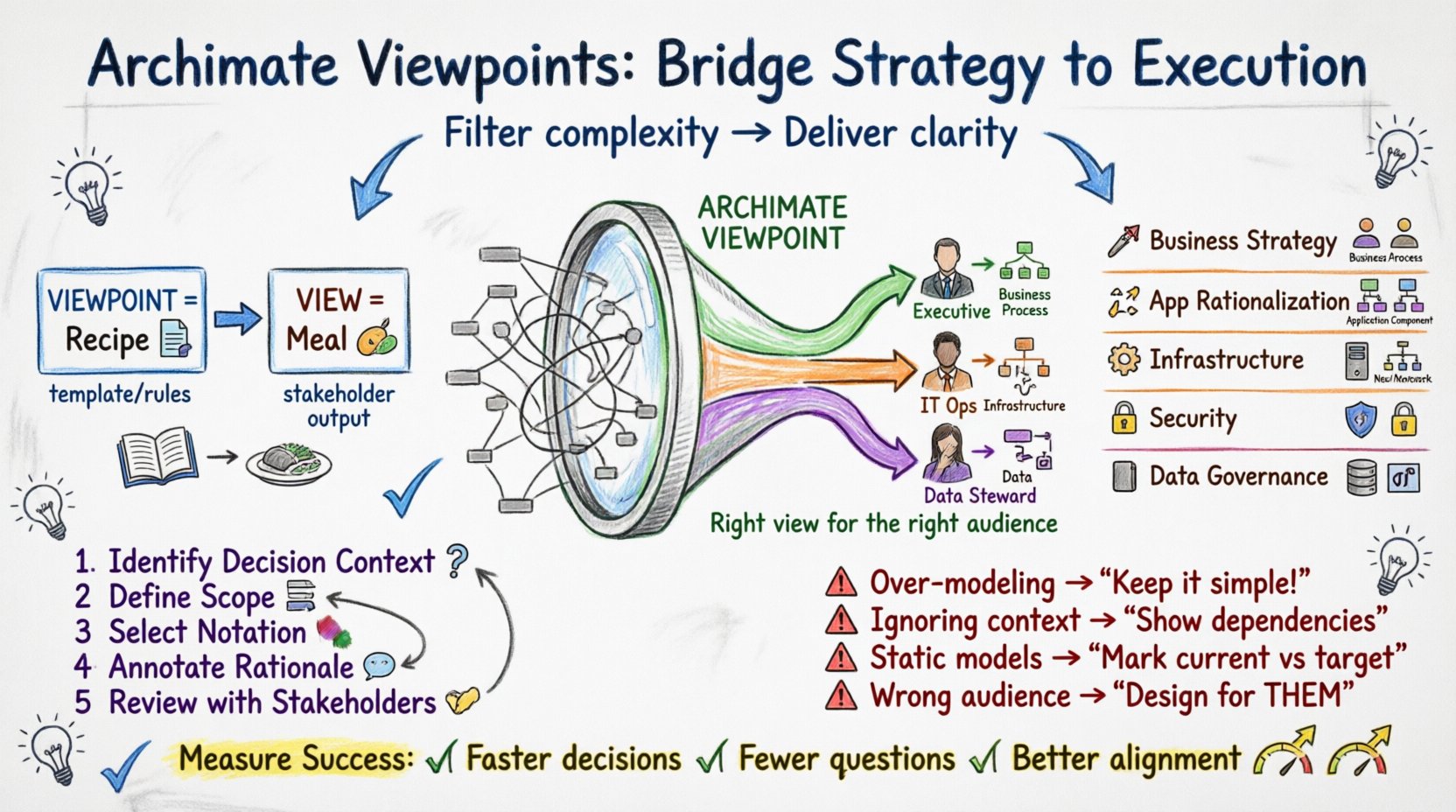
🔍 Understanding the Core Concept: Viewpoints vs. Views
Before implementing a communication strategy, one must distinguish between a View and a Viewpoint. These terms are often confused, yet they serve different purposes in the modeling lifecycle.
- Viewpoint: A specification for the creation of a view. It defines the rules, notation, and concerns that the view must address. It is the template or the standard.
- View: The actual representation of the architecture as seen by a specific stakeholder. It is the output generated from the viewpoint.
Think of a viewpoint as a recipe and the view as the meal. You do not want to serve the recipe to the guest; you serve the meal. Similarly, you do not show the technical specification to a business executive; you show the view generated from a business viewpoint.
In the context of architecture decisions, the viewpoint dictates what information is relevant. A decision regarding database normalization might be critical for a database administrator but irrelevant for a marketing director. The viewpoint filters the noise, allowing the signal to pass through.
🎯 Why Viewpoints Are Essential for Decision Communication
Architecture decisions define the trajectory of the organization. If these decisions are misunderstood, technical debt accumulates rapidly. Viewpoints mitigate this risk by ensuring the right people see the right information.
1. Addressing Specific Concerns
Stakeholders have distinct worries. A CFO cares about cost and ROI. A CTO cares about scalability and security. A Viewpoint allows you to isolate these concerns. By creating a specific viewpoint for financial analysis, you can show cost drivers without exposing the underlying source code structure.
2. Reducing Cognitive Load
A full enterprise model can contain thousands of elements. Showing this to a project team is overwhelming. A tailored viewpoint reduces the element count to what is necessary for the current decision. This reduction aids comprehension and speeds up the approval process.
3. Standardizing Communication
Without a viewpoint, every architect might draw a diagram differently. One might use swimlanes; another might use boxes. Viewpoints enforce a standard notation and layout. This consistency allows stakeholders to interpret diagrams quickly, knowing that a specific shape always means the same thing.
📊 Selecting the Right Viewpoint for the Decision
Choosing the correct viewpoint is the most critical step in the process. A mismatch between the decision type and the viewpoint leads to disengagement. Below is a matrix to help map decisions to appropriate viewpoints.
| Decision Type | Primary Audience | Recommended Viewpoint Focus | Key ArchiMate Elements |
|---|---|---|---|
| Business Strategy | Executive Board | Business Architecture | Business Actor, Business Process, Business Service |
| Application Rationalization | Application Owners | Application Architecture | Application Component, Application Service, Application Interface |
| Infrastructure Upgrade | IT Operations | Technology Architecture | Node, Device, System Software, Communication Network |
| Data Governance | Data Stewards | Information Architecture | Data Object, Data Store, Business Object |
| Security Compliance | CISO / Auditors | Security / Protection Viewpoint | Security Object, Access Right, Protection Mechanism |
Notice that the technology layer is not always the starting point. Often, the decision starts in the business layer and ripples down. Selecting the viewpoint that starts with the stakeholder’s concern is vital.
🛠️ Step-by-Step: Building a Decision-Centric Viewpoint
Creating a viewpoint is not just about drawing a diagram. It requires a structured approach to ensure the output is useful for decision-making.
1. Identify the Decision Context
What specific question is being answered? Is it about cost reduction? Is it about risk mitigation? Write down the decision criteria before opening the modeling tool. This ensures the viewpoint does not drift into generic documentation.
2. Define the Scope
Define the boundaries of the model. Which business units are involved? Which applications are in scope? Which time period does this decision cover? Explicitly stating the scope prevents scope creep in the modeling phase.
3. Select the Notation and Layout
ArchiMate offers multiple diagram types. Use the one that best fits the decision narrative.
- Deployment Diagrams: Best for showing physical infrastructure and dependencies.
- Process Diagrams: Best for showing flow and handoffs between actors.
- Requirements Diagrams: Best for linking decisions to specific business needs.
4. Annotate with Rationale
Diagrams show structure, but they often fail to show why. Add annotations or separate documentation that explains the reasoning behind the decision. This is where the “Architecture Decision Record” (ADR) meets the visual model. Link the visual element to the text rationale.
5. Review with Stakeholders
Before finalizing, present the viewpoint to a representative stakeholder. Ask them to explain the diagram back to you. If they misunderstand a symbol or relationship, the viewpoint needs adjustment. This feedback loop ensures the viewpoint is actually effective.
🤝 Mapping Stakeholders to Viewpoints
One viewpoint rarely satisfies everyone. A single model cannot serve the needs of the Board, the Developers, and the End Users simultaneously. You must map stakeholders to specific viewpoints.
The Stakeholder Matrix
Create a simple matrix to track who needs what view.
- Strategic Leaders: Need high-level business capability maps. They do not need to see specific software instances.
- Tactical Managers: Need process flows and resource allocation views. They need to see how decisions affect their teams.
- Operational Staff: Need detailed interaction diagrams and data flow views. They need to know exactly how to execute the architecture.
When communicating a decision, send the relevant viewpoint to the relevant group. Do not send a technical deployment view to a business strategist. This respect for their time builds trust in the architecture function.
🔗 Integrating Viewpoints with Architecture Decision Records (ADRs)
Architecture Decision Records are the textual log of why a decision was made. Viewpoints are the visual log of what the decision looks like. Combining them creates a powerful narrative.
Linking Visuals to Text
When documenting a decision in an ADR, include a reference to the specific ArchiMate viewpoint. For example:
Decision: Migrate from Monolith to Microservices.
Visual Evidence: See Migration Path Viewpoint (v2) in the repository.
Rationale: The visual model shows the decoupling of the payment service, reducing risk.
This linkage allows auditors and future architects to see the decision in context. It prevents the “black box” problem where decisions exist in text but cannot be verified against the model.
⚠️ Common Pitfalls to Avoid
Even with the best intentions, communication can go wrong. Be aware of these common traps when using ArchiMate for decision support.
- Over-Modeling: Creating a perfect model that is too complex to be understood. Simplicity is key for communication.
- Ignoring Context: Showing a component without showing its dependencies. This hides the risk of the decision.
- Static Models: Presenting a model as if it is frozen. Architecture is dynamic. Ensure the viewpoint indicates the current state versus the target state.
- Ignoring the “Who”: Designing the view for the architect, not the stakeholder. Always design for the audience.
Another significant issue is the use of jargon. Even within ArchiMate, terms like “Application Function” or “Business Service” can confuse non-technical audiences. Use annotations to clarify terminology where necessary.
📈 Measuring the Effectiveness of Viewpoints
How do you know if your communication strategy is working? You need metrics beyond “the model was drawn.” Consider the following indicators of success.
- Decision Velocity: Does the decision approval process speed up when using the viewpoint? If stakeholders understand the implications faster, the cycle time should decrease.
- Question Reduction: Are stakeholders asking fewer clarifying questions during the review meeting? This indicates the viewpoint is self-explanatory.
- Alignment Consistency: After implementation, does the actual system match the view presented during the decision phase? High fidelity suggests the viewpoint accurately captured the decision.
- Stakeholder Satisfaction: Survey the participants. Did they feel informed? Did they feel the decision was transparent?
Track these metrics over time to refine your viewpoints. If a specific viewpoint consistently leads to confusion, iterate on its design.
🔄 Iterating and Evolving Viewpoints
Viewpoints are not set in stone. As the enterprise evolves, the concerns of the stakeholders change. A viewpoint that worked for a legacy system migration might be obsolete for a cloud-native initiative.
Establish a review cycle for your viewpoints. Every quarter or after a major release, ask:
- Are the stakeholders still the same?
- Are the concerns still relevant?
- Is the notation still clear?
Update the viewpoint definitions accordingly. Document the changes in the viewpoint library so that new architects understand why the model looks a certain way.
🛡️ Handling Sensitive Information in Viewpoints
Sometimes, architecture decisions involve sensitive data or security constraints. Viewpoints can help manage this by controlling visibility.
- Redaction: Remove specific application names or IP addresses from public-facing viewpoints while keeping the structure.
- Layers: Use layers to show high-level security boundaries without exposing internal firewall rules.
- Access Control: Ensure the modeling platform restricts access to specific viewpoints based on user roles.
This granular control ensures that security is not compromised by the need for transparency.
🧠 Final Thoughts on Architectural Communication
Effective communication is the bridge between strategy and execution. ArchiMate provides the grammar, but viewpoints provide the sentence structure. By carefully selecting and designing viewpoints, architects ensure that decisions are not just recorded, but understood.
Focus on the audience. Focus on the decision. Focus on clarity. When these three elements align, the architecture function becomes a strategic partner rather than an administrative burden. The goal is not to create beautiful diagrams, but to facilitate clear understanding and informed action. 🚀
Start today by auditing your current communication materials. Identify where the confusion lies. Apply the principles of viewpoint design. The result will be a more agile and aligned enterprise.