
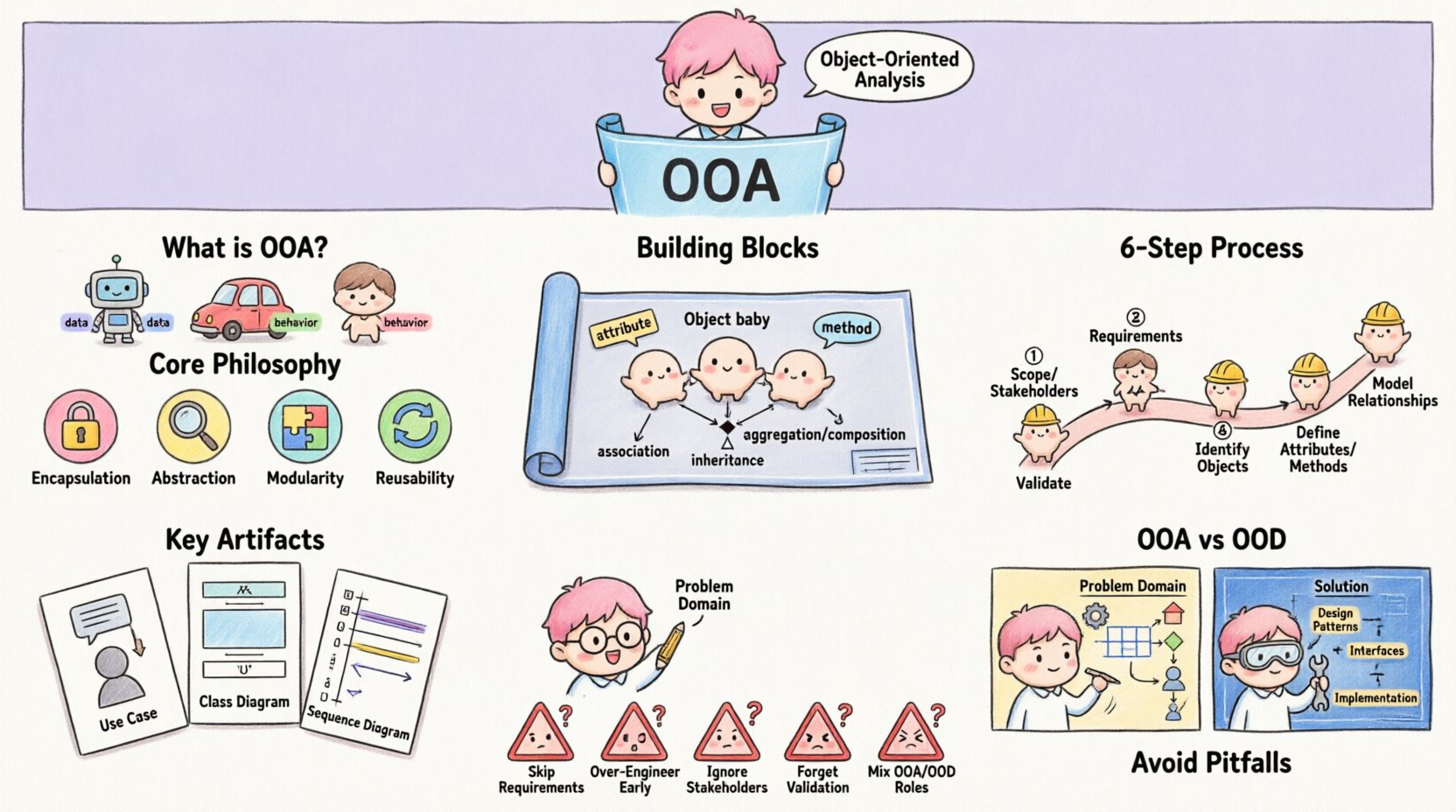
Welcome to the foundational layer of modern system design. When you embark on building complex software or data-driven platforms, the way you think about problems matters more than the code you write initially. This is where Object-Oriented Analysis (OOA) comes into play. It is the bridge between a vague problem statement and a concrete, structured solution. This guide breaks down the essence of OOA without the jargon, helping you understand the mechanics of modeling real-world entities into digital logic.
🔍 What Is Object-Oriented Analysis?
At its core, Object-Oriented Analysis is the process of defining what a system must do before deciding how it will do it. Unlike procedural analysis, which focuses on functions and actions, OOA focuses on objects. An object is a bundle of data and behavior that represents a concept within the system. Think of it as identifying the actors, their properties, and their interactions in a play before the script is written.
The primary goal is to create a model that reflects the problem domain accurately. This model serves as a blueprint for the subsequent design and development phases. By isolating responsibilities and defining clear boundaries, OOA reduces complexity and makes systems easier to maintain over time.
🧩 The Core Philosophy
OOA relies on several philosophical pillars that distinguish it from other methodologies:
- Encapsulation: Data and the methods that operate on that data are bundled together. This hides internal complexity from the outside world.
- Abstraction: You focus on essential features while ignoring irrelevant details. This helps manage complexity.
- Modularity: The system is divided into distinct, manageable units (objects) that can be developed and tested independently.
- Reusability: Well-defined objects can often be reused across different parts of the system or in future projects.
🏗️ The Building Blocks of OOA
To understand OOA, you must understand the vocabulary. These terms form the skeleton of your analysis model.
1. Classes and Objects
A Class is a blueprint or a template. It defines the structure and behavior common to a group of entities. For example, a Vehicle class might define properties like color and speed, and behaviors like accelerate or brake.
An Object is an instance of a class. If Vehicle is the blueprint, a RedCar with a specific speed of 0 is an object. In analysis, you are identifying these instances and their roles within the system context.
2. Attributes
Attributes are the data stored within an object. They describe the state. In a User object, attributes might include username, email, and account_status. These are the facts the system needs to remember.
3. Methods
Methods are the behaviors or actions an object can perform. They are the verbs associated with the noun. A BankAccount object might have methods like deposit, withdraw, or check_balance. In the analysis phase, you define what these methods should do logically, not necessarily how to code them.
4. Relationships
Objects rarely exist in isolation. They interact. OOA identifies these connections. Common relationship types include:
- Association: A generic link between two objects (e.g., a Student enrolls in a Course).
- Inheritance: A child object takes on properties of a parent object (e.g., a
Truckis a type ofVehicle). - Aggregation: A “whole-part” relationship where the part can exist independently (e.g., a Department has Employees, but Employees can exist without that Department).
- Composition: A stricter “whole-part” relationship where the part cannot exist without the whole (e.g., a House has Rooms; if the House is destroyed, the Rooms are destroyed).
🔄 The OOA Process: Step-by-Step
Conducting an analysis is not a linear task but an iterative cycle. You gather requirements, model the system, refine the model, and repeat. Here is a standard workflow used by professionals.
Step 1: Identify the Scope and Stakeholders
Before drawing any diagrams, you must know the boundaries. What is inside the system, and what is outside? Who are the people or external systems that interact with it? Defining the scope prevents scope creep later.
Step 2: Gather Requirements
This involves talking to users, reviewing documents, and observing workflows. You are looking for functional requirements (what the system does) and non-functional requirements (performance, security, reliability). Ask questions like:
- What triggers an action?
- What information is needed to perform the action?
- What should happen if the action fails?
Step 3: Identify Objects and Classes
Scan the requirements for nouns. These are your candidates for classes. Nouns like Customer, Order, Payment, or Product often translate directly into classes. Verify if these nouns represent distinct entities with unique identity and behavior.
Step 4: Define Attributes and Methods
For each identified class, list the data it holds and the actions it performs. Be careful not to mix responsibilities. A Customer object should know its address, but it shouldn’t calculate the shipping cost for an Order—that is the Order‘s or a separate Shipping object’s job.
Step 5: Model Relationships
Draw lines connecting your objects. Define the cardinality (one-to-one, one-to-many). Ensure the relationships make sense logically. If a Manager oversees Employees, how many employees can one manager oversee? How many managers can oversee one employee?
Step 6: Validate the Model
Review the model with stakeholders. Does it reflect their understanding of the business? Can they trace a requirement back to an object or relationship in the diagram? If the model is too complex, simplify it. If it is too simple, it may miss critical rules.
📄 Key Artifacts in OOA
During the analysis phase, you produce specific documents and diagrams. These artifacts communicate your findings to developers and stakeholders.
| Artifact | Purpose | Key Components |
|---|---|---|
| Use Case Diagram | Shows interactions between users and the system. | Actors, Use Cases, Relationships |
| Class Diagram | Static structure of the system. | Classes, Attributes, Methods, Relationships |
| Sequence Diagram | Dynamic behavior over time. | Objects, Messages, Timeline |
| State Machine Diagram | Lifecycle of a specific object. | States, Transitions, Events |
| Requirement Specification | Textual description of what is needed. | Functional rules, Constraints, Glossary |
⚖️ OOA vs. OOD: Understanding the Difference
It is common to confuse Object-Oriented Analysis (OOA) with Object-Oriented Design (OOD). While they are closely related, they serve different purposes.
- OOA (Analysis): Focuses on the problem domain. It asks, “What does the business need?” It is technology-agnostic. You might define a
Databaseconcept without deciding if it is SQL or NoSQL. - OOD (Design): Focuses on the solution domain. It asks, “How will we build this?” It involves choosing specific technologies, algorithms, and architectural patterns. It translates the analysis model into a technical blueprint.
Think of OOA as the architectural sketch of a house (rooms, doors, windows), and OOD as the engineering plan (materials, wiring, plumbing specifics).
⚠️ Common Pitfalls to Avoid
Even experienced analysts make mistakes. Being aware of these traps can save you significant time and rework.
1. Procedural Thinking in an Object World
Do not start with functions. Start with nouns. If you find yourself writing lists of functions that operate on unrelated data, you are likely thinking procedurally. Shift your focus to what objects are doing.
2. Over-Engineering
Do not create complex inheritance hierarchies immediately. Start simple. A deep tree of classes can become brittle and hard to maintain. Keep the hierarchy flat unless there is a clear need for abstraction.
3. Ignoring the Data
Focus too much on behavior and not enough on state. An object without data is just a function. Ensure every object has a clear purpose regarding the information it holds.
4. Skipping Validation
Never assume your model is correct without feedback. Stakeholders often see the diagrams and realize their requirements were misunderstood. Regular validation sessions are crucial.
🛠️ Tools for Modeling
While the thinking process is mental, documentation is physical (or digital). You do not need specific branded software to perform analysis. Generic modeling tools are sufficient. Look for tools that support:
- Diagramming capabilities (UML or similar).
- Text-based requirements management.
- Collaboration features for teams.
- Export options for documentation.
Remember, the tool does not make the model. A poorly thought-out diagram in a premium tool is still a poor model. Clarity and logic are more important than the software used.
🌱 Best Practices for Beginners
If you are new to this discipline, follow these guidelines to build a strong foundation.
- Start Small: Analyze a single feature before tackling the whole system.
- Use Standard Notation: Learn the standard symbols for diagrams so others can read your work.
- Keep it Simple: If a diagram has too many lines crossing each other, it is too complex. Simplify the model.
- Document Decisions: Why did you choose this relationship? Why did you exclude that attribute? Write down your reasoning.
- Iterate: Expect to change your model. Analysis is not a one-time event; it evolves as understanding deepens.
🔮 The Future of Analysis
The principles of object-oriented analysis remain relevant even as software architectures evolve. Microservices, cloud-native applications, and AI-driven systems still rely on the same fundamental concepts of encapsulation, modularity, and clear interfaces. Understanding OOA gives you the mental framework to adapt to new technologies without losing sight of the core structure.
By mastering the art of defining objects and their relationships, you ensure that the systems you build are robust, scalable, and aligned with business goals. It is a skill that pays dividends throughout your career as a technical professional.
📝 Summary
Object-Oriented Analysis is the discipline of understanding requirements through the lens of objects. It transforms abstract needs into concrete models. By focusing on classes, objects, attributes, and relationships, you create a stable foundation for design and development. Avoid the common traps of procedural thinking and over-complication. Stick to validation, iteration, and clear documentation. With practice, this approach becomes second nature, allowing you to design systems that stand the test of time.