
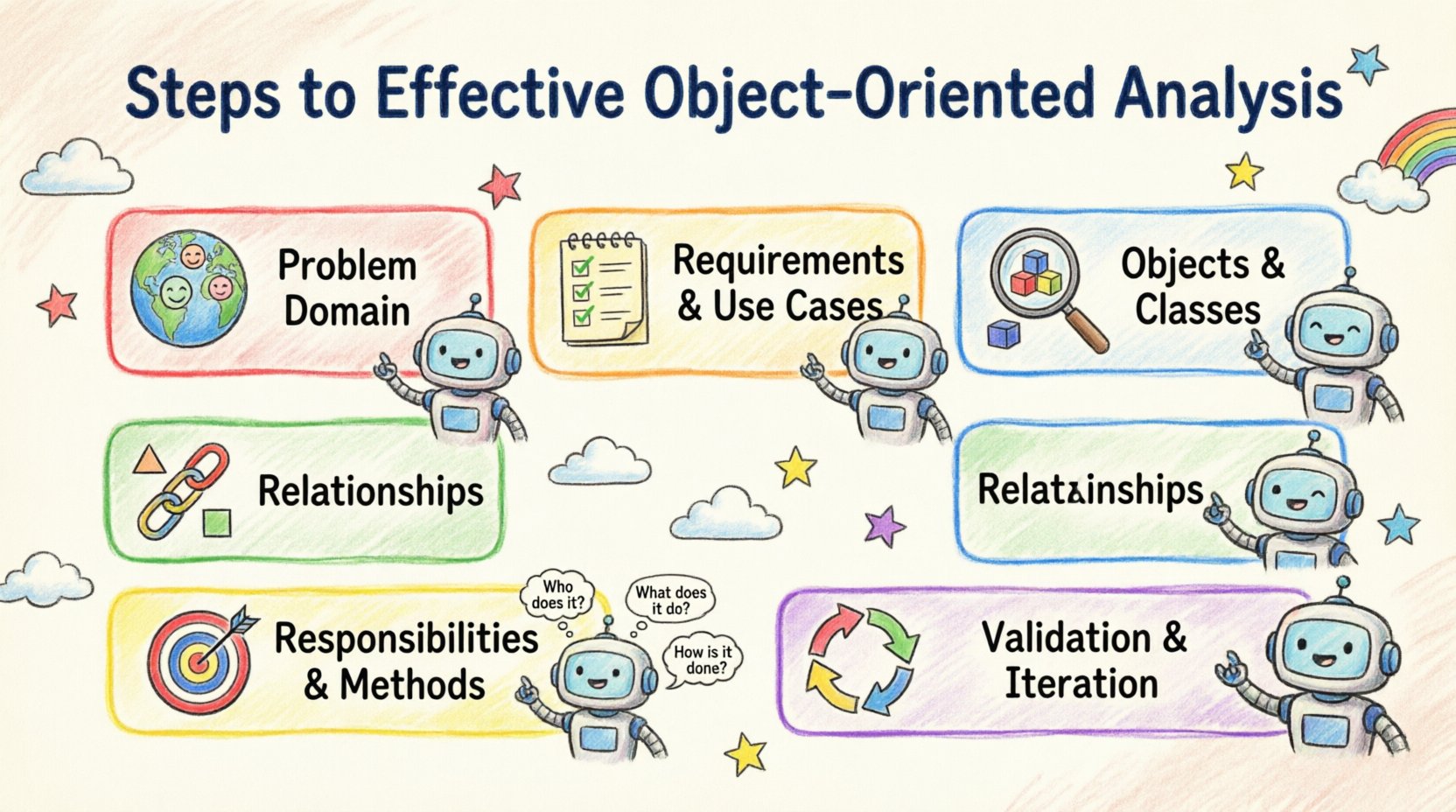
Building robust software systems begins long before the first line of code is written. It starts with understanding the problem space deeply. Object-Oriented Analysis (OOA) serves as the foundational phase in the Object-Oriented Analysis and Design (OOAD) lifecycle. It focuses on identifying the objects, their attributes, and their behaviors without getting bogged down in implementation details. This phase bridges the gap between stakeholder requirements and technical architecture.
Effective analysis ensures that the resulting system is scalable, maintainable, and aligned with business goals. By following a structured approach, teams can reduce technical debt and minimize costly refactoring later in the development cycle. This guide outlines the critical steps required to perform high-quality object-oriented analysis.
1. Understanding the Problem Domain 🌍
The first step involves immersing the analysis team in the context of the project. This is not merely about reading a document; it is about grasping the real-world entities and processes the software will support.
- Stakeholder Engagement: Conduct interviews with business owners, end-users, and domain experts to gather raw data.
- Contextual Research: Study existing systems, legacy data, and industry standards relevant to the domain.
- Goal Definition: Clearly articulate what the system must achieve in business terms.
Without a clear understanding of the domain, the resulting models will likely miss critical nuances. Analysts should focus on the what rather than the how. The goal is to create a shared mental model among developers and stakeholders.
2. Requirement Gathering and Use Cases 📝
Once the domain is understood, specific requirements must be captured. In OOA, these are often translated into use cases or user stories that describe interactions between actors and the system.
- Actor Identification: Determine who or what interacts with the system. This includes human users, external systems, and hardware devices.
- Use Case Definition: Describe the sequence of events that leads to a specific business value.
- Functional Requirements: List the specific functions the system must perform to satisfy the use cases.
It is crucial to distinguish between functional requirements (what the system does) and non-functional requirements (performance, security, reliability). While OOA focuses heavily on structure, ignoring constraints at this stage can lead to architectural bottlenecks.
3. Identifying Objects and Classes 🔍
This is the core of Object-Oriented Analysis. The goal is to map real-world concepts into abstract objects. This process often begins with noun analysis.
- Noun Extraction: Review requirement documents and identify key nouns. These often represent potential classes or objects.
- Attribute Definition: Determine the data that belongs to each object. For example, a Customer object might have attributes like Name, Email, and AccountBalance.
- Class Abstraction: Group similar objects into classes to avoid redundancy. Ensure that each class represents a single responsibility.
During this phase, avoid premature coupling. If an object seems to hold too much data, consider splitting it. If multiple classes share significant data, consider if inheritance or composition is appropriate.
4. Defining Relationships and Associations 🔗
Objects rarely exist in isolation. They interact with one another through various relationships. Defining these connections is vital for understanding data flow and dependency.
- Association: A structural link between two objects (e.g., a Student enrolls in a Course).
- Aggregation: A ‘whole-part’ relationship where the part can exist independently (e.g., a Department has Employees).
- Composition: A stronger ‘whole-part’ relationship where the part cannot exist without the whole (e.g., a House has Rooms).
- Inheritance: A mechanism for sharing behavior and state (e.g., a Manager extends the Employee class).
Clear relationship definitions prevent ambiguity in the system design. They dictate how data is navigated and how changes in one object affect others.
5. Specifying Responsibilities and Methods 🎯
Attributes define the state of an object, but methods define its behavior. This step involves determining what actions an object can perform and what it is responsible for.
- Encapsulation: Hide internal state and expose only necessary operations.
- Behavior Mapping: Assign use case actions to specific classes. For instance, the action of CalculateTax belongs to a TaxEngine object, not the Order object.
- Interface Definition: Define the public methods available to other objects without exposing implementation logic.
This step ensures that logic is placed in the correct location. A common mistake is creating ‘God Objects’ that handle too many responsibilities. Distributing behavior maintains a clean architecture.
6. Validation and Iteration 🔁
Analysis is rarely a linear process. It requires review, feedback, and refinement. Models created in earlier steps must be validated against the original requirements.
- Consistency Checks: Ensure that relationships defined in the model match the use case scenarios.
- Gap Analysis: Identify missing objects or relationships that were not captured during initial identification.
- Stakeholder Review: Present the model to domain experts to verify accuracy.
Iteration is expected. As understanding deepens, the model evolves. This flexibility is a strength of the object-oriented approach.
Common Pitfalls in Object-Oriented Analysis 🚧
Avoiding common mistakes saves significant time during the design and coding phases. The table below highlights frequent issues and their potential impact.
| Pitfall | Description | Impact |
|---|---|---|
| Over-Abstraction | Creating too many levels of inheritance or interfaces. | High complexity, difficult to understand. |
| Data Coupling | Passing raw data structures instead of objects. | Loss of encapsulation, fragile code. |
| God Objects | One class handling too many responsibilities. | Hard to test, hard to maintain. |
| Ignoring Non-Functional Needs | Focusing only on features, not performance or security. | System may fail under load or be insecure. |
| Skipping Validation | Accepting the model without stakeholder review. | Building the wrong product. |
Object-Oriented Analysis vs. Design ⚖️
It is important to distinguish between Analysis and Design. While they are closely linked, they serve different purposes.
- Analysis (OOA): Focuses on the problem. It defines what the system needs to do. It is technology-agnostic. It answers questions about data and behavior requirements.
- Design (OOD): Focuses on the solution. It defines how the system will be implemented. It involves choosing specific patterns, algorithms, and data structures.
Mixing these phases too early can lead to premature optimization. Keep the analysis phase focused on business logic and domain integrity. Save implementation details for the design phase.
The Role of Documentation 📄
While code is essential, the artifacts created during OOA are equally critical. They serve as a blueprint for the development team.
- Class Diagrams: Visual representations of classes and their relationships.
- Sequence Diagrams: Illustrations of interactions between objects over time.
- State Diagrams: Models showing how objects transition between different states.
These diagrams should be kept up-to-date. Outdated documentation leads to confusion and errors. In some methodologies, diagrams are considered the primary source of truth before code is written.
Impact on Long-Term Maintenance 🛠️
The quality of the analysis phase directly correlates to the maintainability of the software. A well-analyzed system is easier to modify when requirements change.
- Scalability: Proper object boundaries allow the system to grow without breaking core logic.
- Modularity: Clear separation of concerns makes it easier to isolate bugs.
- Onboarding: New developers can understand the system structure more quickly if the object model is logical.
Investing time in analysis reduces the cost of change. It is often cheaper to modify a diagram than to refactor production code.
Final Considerations for Success ✅
Successful Object-Oriented Analysis requires a blend of technical skill and communication ability. Analysts must translate business needs into technical models while keeping the team aligned.
- Collaboration: Work closely with developers to ensure the model is implementable.
- Simplicity: Prefer simple solutions over complex ones unless complexity is required.
- Continuity: Treat analysis as a continuous activity, not a one-time event.
By adhering to these steps and avoiding common pitfalls, teams can construct systems that are robust, flexible, and aligned with business objectives. The foundation laid during this phase supports the entire lifecycle of the software project.