
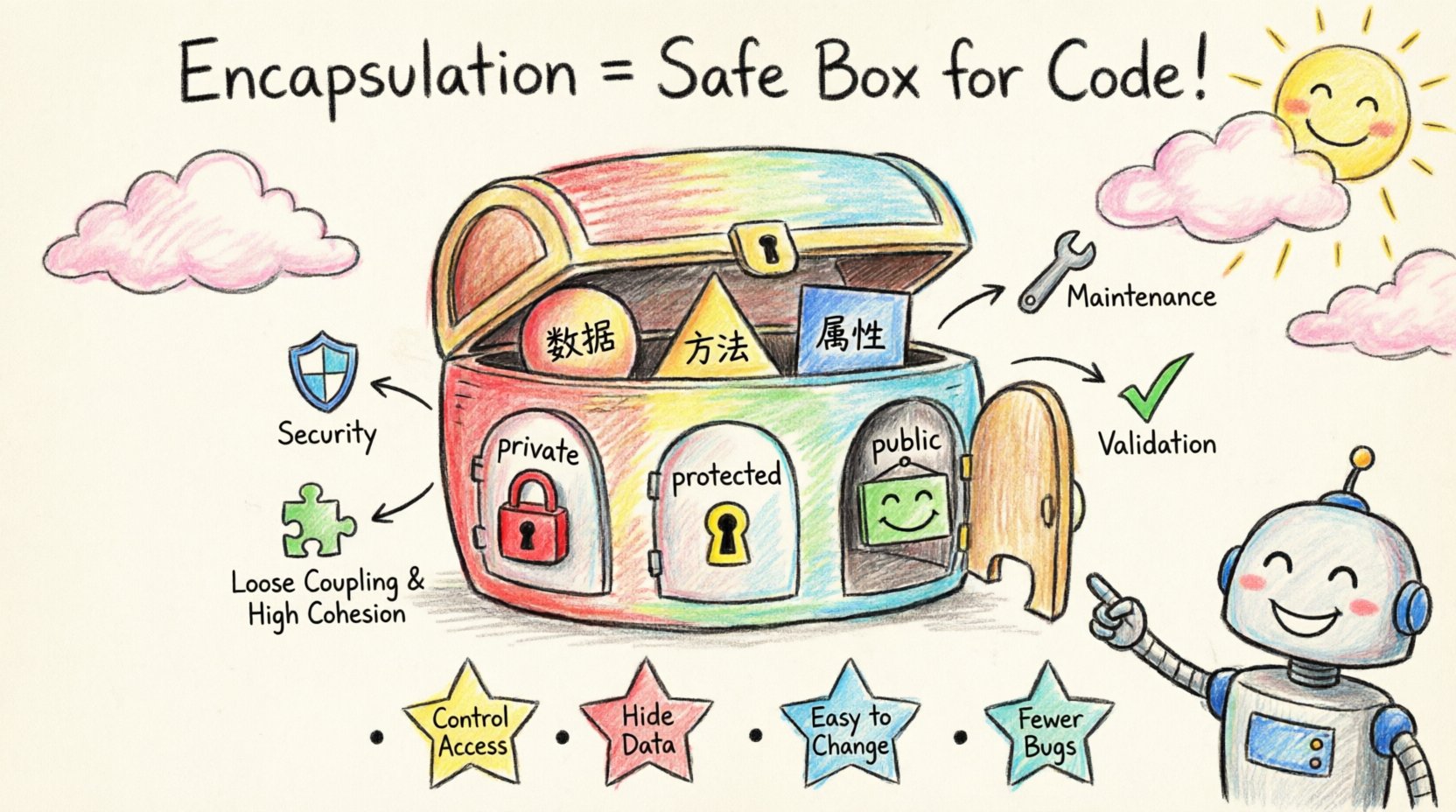
Encapsulation stands as one of the foundational pillars of object-oriented design. It is the mechanism that allows software systems to manage complexity by bundling data and the methods that operate on that data within a single unit. This principle is not merely about hiding information; it is about defining clear boundaries for how components interact. By controlling access to internal states, developers ensure that the integrity of the object is maintained throughout the lifecycle of the application.
In modern software architecture, the goal is to create systems that are robust, maintainable, and scalable. Encapsulation contributes directly to these goals. It reduces the surface area that external code can affect, thereby limiting the potential for unintended side effects. When a module is well-encapsulated, changes to its internal implementation do not necessarily require changes to the code that uses it. This separation of concerns is vital for large-scale development teams working on complex projects.
📦 Understanding the Core Concept
At its heart, encapsulation is about bundling. It combines the state (attributes) and the behavior (methods) of a concept into a cohesive unit. Think of a physical container. Inside the container, you might have various items, tools, or sensitive documents. The container has a lid that keeps these items secure and organized. External users can interact with the container, but they cannot see or touch the items directly unless they go through the proper channels.
In the context of programming, an object acts as this container. It holds data fields and exposes methods that allow other parts of the system to request information or perform actions. However, the internal data fields are not directly accessible. This restriction prevents external code from placing the object into an invalid state.
Why Is This Important? 🤔
Without encapsulation, data is exposed freely. Any part of the program can modify it at any time. This leads to what is often called “spaghetti code,” where dependencies are tangled and difficult to trace. If a variable changes unexpectedly, finding the source of the error becomes a nightmare. Encapsulation introduces discipline.
- Control: You control when and how data is modified.
- Security: Sensitive information remains hidden from unauthorized access.
- Maintenance: You can change the internal logic without breaking the rest of the system.
- Debugging: Errors are easier to isolate because the interface is stable.
🔒 Access Control Mechanisms
To achieve encapsulation, programming languages provide access modifiers. These keywords define the visibility of classes, methods, and fields. While specific syntax varies, the underlying logic remains consistent across most object-oriented paradigms.
The Three Levels of Visibility
| Modifier | Visibility Scope | Use Case |
|---|---|---|
| Private | Accessible only within the same class | Internal state that must never be touched directly |
| Protected | Accessible within the class and its subclasses | State that needs to be inherited but not exposed publicly |
| Public | Accessible from anywhere | Intended interface for external interaction |
Using private effectively is the most common strategy for strong encapsulation. When a field is private, no other class can read or write it directly. Instead, they must call a public method. This method, often called a getter or setter, acts as a gatekeeper.
🛡️ Data Integrity and Invariants
One of the primary responsibilities of encapsulation is maintaining data invariants. An invariant is a condition that must always be true for the object to function correctly. For example, a bank account object should never have a negative balance if the business rules dictate otherwise.
Validating Input
By forcing all changes to go through a public method, you can validate the data before it is stored. This is where the logic lives. If you try to set a balance to a negative number, the method can reject the request or throw an error.
- Validation: Check if the value meets requirements.
- Normalization: Convert data to a standard format before storage.
- Logging: Record when sensitive changes occur for auditing.
Consider a user profile object. If the system requires an email address to be valid, the setter method should check the format. If the format is wrong, the method refuses the update. This keeps the database clean and prevents errors downstream when the email is used for notifications.
🔗 Coupling and Cohesion
Encapsulation directly influences two critical metrics in software design: coupling and cohesion.
Low Coupling
Coupling refers to the degree of interdependence between software modules. High coupling means modules rely heavily on each other’s internal details. This makes the system fragile. If you change one module, you might break many others. Encapsulation lowers coupling by hiding implementation details. Other modules only know about the public interface, not the internal workings.
High Cohesion
Cohesion describes how closely related the responsibilities of a single module are. A cohesive module does one thing and does it well. Encapsulation helps achieve high cohesion by grouping related data and methods together. For instance, a “PaymentProcessor” class should handle all logic related to processing payments, not just a single variable.
When you have high cohesion and low coupling, the system is modular. You can replace a module with a better implementation without affecting the rest of the application. This is the essence of flexible design.
🛠️ Implementation Strategies
There are several patterns and techniques used to implement encapsulation effectively. Understanding these helps in writing cleaner code.
1. The Getter and Setter Pattern
This is the most traditional approach. You provide public methods to read and write private fields. However, modern design suggests caution. Unrestricted setters can be dangerous. They allow external code to bypass validation logic if not implemented carefully.
Instead of providing a setter for every field, consider providing a method that updates the state logically. For example, instead of a method called setBalance, you might have a method called addFunds. This enforces business rules and prevents invalid states like setting a balance to zero if the account is closed.
2. Immutable Objects
Immutability is the ultimate form of encapsulation. Once an object is created, its state cannot be changed. This eliminates the risk of accidental modification by other parts of the system. Immutable objects are inherently thread-safe because their state does not change, so no locks are needed.
To create a new state, you create a new object. This approach simplifies reasoning about code, as you know that an object you hold will not change while you are using it.
3. Interface Segregation
Don’t expose everything. Create specific interfaces for specific needs. If a class has ten public methods, but a specific client only needs three, expose only those three. This reduces the surface area for potential misuse and keeps the contract clear.
⚠️ Common Pitfalls
Even with the best intentions, developers often fall into traps that weaken encapsulation.
- God Objects: Classes that know too much about other objects. This creates tight coupling and violates the principle of separation of concerns.
- Public Fields: Declaring fields as public removes the ability to validate or log access. This should be avoided.
- Over-Encapsulation: Hiding data that needs to be shared across modules can lead to verbose code. Find a balance between security and usability.
- Breaking Invariants: Allowing a method to put an object into a state where invariants are violated, even temporarily, can cause race conditions or logical errors.
🔄 Interaction with Other Principles
Encapsulation does not work in isolation. It interacts closely with other design principles.
Abstraction
While encapsulation hides implementation details, abstraction defines the interface. Encapsulation is the “how” (hiding data), and abstraction is the “what” (defining behavior). You cannot have effective abstraction without encapsulation, because the abstraction relies on the internal details being hidden.
Inheritance
Inheritance allows a class to acquire properties from another. Encapsulation ensures that the parent class does not expose its internal implementation to the child class unless necessary. If a parent class relies on its internal structure, the child class becomes dependent on that structure, reducing flexibility.
Polymorphism
Polymorphism allows objects to be treated as instances of their parent class rather than their actual class. Encapsulation ensures that the common interface defined by the parent is the only way to interact with the object. This allows different implementations to be swapped without changing the code that uses them.
🚀 Future Proofing and Maintenance
Software systems evolve. Requirements change. Technologies update. Encapsulation is a strategy for longevity.
Refactoring
When you need to refactor code, encapsulation makes it safer. If the internal logic of a class changes, but the public interface remains the same, the rest of the system remains unaffected. This allows teams to improve performance or fix bugs without requiring a massive rewrite of dependent code.
Testing
Unit testing relies on isolating components. Encapsulation supports this by allowing you to test a class in isolation. You do not need to set up the entire environment to test a single method. You can mock the inputs and verify the outputs without worrying about the internal state of other objects.
Security
In security-sensitive applications, data hiding is critical. Encapsulation prevents unauthorized access to sensitive fields like passwords, tokens, or personal information. It ensures that only authorized methods can handle this data, reducing the attack surface.
🧩 Advanced Considerations
As systems grow, the application of encapsulation becomes more nuanced.
Thread Safety
In concurrent environments, multiple threads may access the same object. Encapsulation helps by managing state access through synchronized methods. If the internal state is private and modified only through controlled methods, it is easier to ensure thread safety.
Dependency Injection
Encapsulation works hand-in-hand with dependency injection. Instead of creating dependencies inside a class, they are passed in from the outside. This keeps the class focused on its primary responsibility. It also makes the class easier to test because you can inject mock dependencies.
API Design
When building libraries or APIs, encapsulation defines the contract. You decide what is part of the public API and what is internal implementation. Changing the internal implementation should be backward compatible with the public API. This ensures that users of your library do not have to update their code every time you improve your internal logic.
📝 Summary of Best Practices
To implement encapsulation effectively, follow these guidelines:
- Default to Private: Keep fields private unless there is a compelling reason to expose them.
- Validate Input: Ensure all data entering the object meets requirements.
- Minimize Public Methods: Expose only what is necessary for the interface.
- Use Immutable Objects: Prefer immutability where possible to reduce state management complexity.
- Document Behavior: Clearly document what the public methods do, not how they do it.
- Avoid Leaks: Do not return references to internal mutable objects.
By adhering to these practices, developers create systems that are resilient to change. Encapsulation is not just a technical requirement; it is a discipline that leads to better software architecture. It forces the developer to think about boundaries and interactions, leading to a more organized and logical codebase.
Remember that the goal is not to hide everything, but to control the flow of information. When data flows through controlled channels, errors are caught early, and the system remains stable. This stability is the foundation of reliable software development.
As you continue to design systems, keep the principle of encapsulation in mind. It is a tool that, when used correctly, simplifies complexity and enhances the quality of your work. It transforms a collection of variables and functions into a structured, logical entity that serves the needs of the application effectively.