
Moving a concept from a rough sketch to a tangible result is one of the most demanding challenges in any organization. It requires precision, coordination, and a clear vision that withstands the friction of reality. This guide explores a comprehensive project management case study, dissecting the journey from the initial spark of an idea to the final handover of a completed product. We will examine the methodologies, hurdles, and strategies that define successful delivery without relying on specific proprietary tools. 📝
The Hypothetical Scenario: The Greenfield Initiative 🌱
To illustrate these principles effectively, consider the “Greenfield Initiative.” This was a hypothetical project designed to launch a new community outreach platform. The goal was to create a digital ecosystem that connected local non-profits with potential volunteers and donors. The project faced tight deadlines, a distributed team, and evolving requirements. Understanding how this scenario unfolded provides a blueprint for your own complex endeavors.
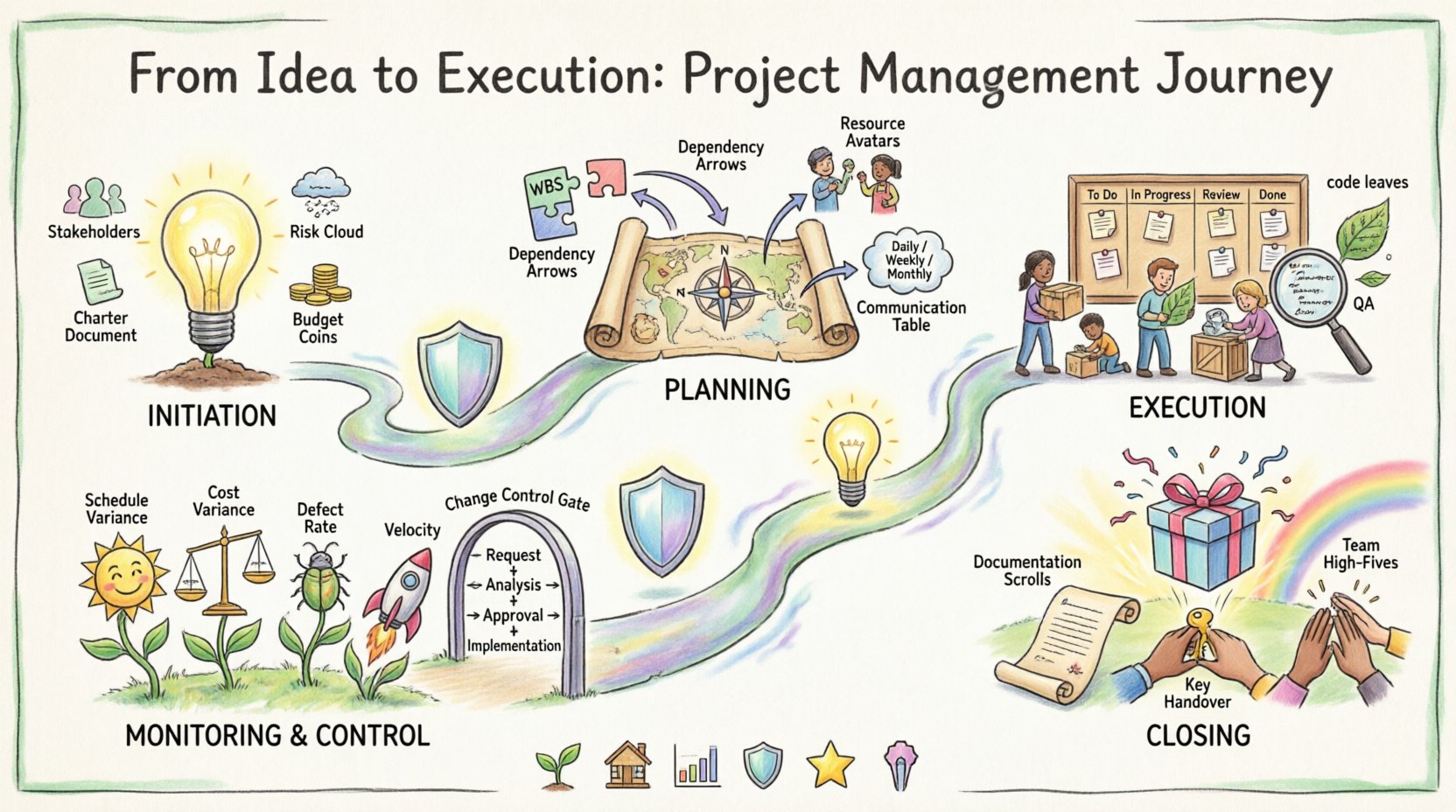
The project lifecycle is not linear; it is iterative and dynamic. Below is a breakdown of the core phases that governed the Greenfield Initiative.
Initiation: Defining the scope and securing approval.
Planning: Mapping the route, resources, and risks.
Execution: Building the solution and coordinating work.
Monitoring & Control: Tracking performance against the plan.
Closing: Final delivery and retrospective analysis.
Phase 1: Initiation and Validation 🔍
The journey begins before a single line of code is written or a meeting is scheduled. It starts with validation. In the Greenfield Initiative, the initial idea was broad: “Help people help people.” This vagueness posed an immediate risk. The project managers focused on narrowing the scope to ensure feasibility.
Key Activities in Initiation
Stakeholder Identification: Who has a vested interest? Who can block progress? In this case, local community leaders and tech partners were key.
Charter Creation: A formal document authorizing the project and outlining high-level goals.
Risk Assessment: Initial look at what could go wrong immediately.
Budget Estimation: Rough order of magnitude to ensure financial viability.
Without a clear charter, projects drift. The Greenfield team defined success metrics early. The primary metric was user adoption within the first six months post-launch, not just completion of features.
Phase 2: Planning the Roadmap 🗺️
Once approved, the team moved to planning. This phase is often where projects succeed or fail. A robust plan acts as a compass, though it must allow for deviation when necessary. The Greenfield team utilized a hybrid approach, combining predictive elements for budgeting with adaptive elements for development.
Defining Scope and Schedule
Scope creep is the silent killer of timelines. To combat this, the team created a detailed Work Breakdown Structure (WBS). This decomposed the massive goal into manageable tasks.
Task Decomposition: Breaking “Build Platform” into “Design Database,” “Create Frontend,” “Integrate Payment Gateway.”
Dependency Mapping: Identifying which tasks must finish before others begin.
Resource Allocation: Assigning specific roles to specific tasks based on skill sets.
Timeline Creation: Developing a schedule that accounted for holidays and known availability.
Communication Strategy
Planning also involves planning how to communicate. The Greenfield Initiative established a cadence for updates.
Frequency | Audience | Format | Objective |
|---|---|---|---|
Daily | Development Team | Stand-up Meeting | Quick blockers check |
Weekly | Stakeholders | Status Report | Progress review |
Monthly | Sponsor Board | Executive Presentation | Strategic alignment |
Phase 3: Execution and Coordination 🏗️
Execution is where the plan meets reality. The Greenfield team had to manage a diverse group of contributors, including remote developers and local community liaisons. Coordination was paramount. Without a central repository for documents and tasks, information would have fragmented.
Managing Workflow
The team adopted a Kanban-style workflow for their task tracking. This visual approach highlighted bottlenecks instantly.
To Do: Tasks ready to be started.
In Progress: Work currently being done.
Review: Completed work awaiting quality check.
Done: Verified and deployed.
During this phase, the focus shifted to output. The project manager facilitated meetings but avoided micromanagement. The goal was to empower team members to solve problems autonomously while keeping the broader timeline in sight.
Quality Assurance Integration
Testing was not an afterthought. Quality assurance (QA) was integrated into every sprint. This meant that code was reviewed and tested continuously. The Greenfield Initiative avoided the “big bang” testing phase at the end, which often leads to catastrophic delays.
Peer Reviews: Team members check each other’s work.
Automated Checks: Scripts run to catch common errors.
User Acceptance Testing (UAT): Real users interact with the build to confirm needs are met.
Phase 4: Monitoring and Control 📊
A plan is useless if no one watches the progress. Monitoring involves comparing actual performance against the baseline plan. Control involves taking corrective action when deviations occur.
Key Performance Indicators (KPIs)
The Greenfield team tracked specific metrics to gauge health.
Schedule Variance: Are we ahead or behind schedule?
Cost Variance: Are we under or over budget?
Defect Rate: How many bugs are found per release?
Velocity: How much work is completed in a set time?
Change Management
Change is inevitable. A stakeholder might request a new feature mid-project. A vendor might become unavailable. The Greenfield Initiative used a formal Change Control Board (CCB).
Request: Submit the change request in writing.
Impact Analysis: Determine how this affects time, cost, and scope.
Approval: The CCB votes to accept or reject.
Implementation: If approved, update the plan and notify the team.
This rigorous process prevented scope creep from derailing the launch date. It ensured that every change was intentional and understood by all parties.
Phase 5: Risk Management 🛡️
Risks are uncertainties that, if they occur, have a positive or negative effect on project objectives. The Greenfield team created a Risk Register at the start and updated it regularly.
Identified Risks and Mitigation Strategies
Risk: Key developer leaves the team.
Mitigation: Documentation standards require code comments and peer knowledge sharing.
Risk: Third-party API changes compatibility.
Mitigation: Build abstraction layers to isolate API dependencies.
Risk: Community adoption is low.
Mitigation: Early engagement with community leaders to validate features.
By anticipating these issues, the team did not panic when they arose. They had pre-planned responses ready to deploy.
Stakeholder Engagement Techniques 🤝
Technology is only half the battle; people are the other half. The Greenfield Initiative faced the challenge of balancing the needs of technical staff with the expectations of non-technical donors.
Communication Channels
Effective communication requires matching the channel to the message.
Formal Reports: For budget and timeline updates.
Informal Chats: For quick clarification on tasks.
Workshops: For gathering requirements and feedback.
Newsletters: For broad announcements to the wider community.
Managing Expectations
It is vital to be honest about progress. If a delay is likely, communicate it immediately. The Greenfield team adopted a “bad news early” policy. This built trust with sponsors, who appreciated transparency over false optimism.
Clarity: Avoid jargon when speaking to non-technical stakeholders.
Consistency: Provide updates on the same days every week.
Visuals: Use charts and graphs to make data digestible.
Lessons Learned from Execution 💡
Upon reaching the final stage, the team conducted a retrospective. This is a dedicated session to discuss what went well and what did not. The goal is continuous improvement for future projects.
What Went Well
The hybrid planning approach allowed flexibility without losing control.
Daily stand-ups kept the remote team aligned on priorities.
Early QA integration reduced the number of bugs found at launch.
Areas for Improvement
Documentation was sometimes delayed, causing knowledge gaps.
Initial budget estimates were slightly optimistic regarding third-party costs.
More time should have been allocated for user training.
Final Delivery and Handover 🎁
The project closed with the official launch of the platform. However, the work did not stop there. The transition to the operations team was critical.
Documentation Transfer: All technical specs, user manuals, and admin guides were handed over.
Access Management: Credentials and permissions were updated for the maintenance team.
Support Plan: A clear path for users to report issues was established.
Celebration: The team took time to recognize the effort and success.
Strategic Takeaways for Future Projects 📌
Applying the lessons from the Greenfield Initiative to general practice yields several actionable insights.
Define Success Early: Know what “done” looks like before you start.
Plan for Change: Assume requirements will shift and build buffers into the schedule.
Communicate Constantly: Silence is often interpreted as a problem.
Empower the Team: Trust your people to execute their specific tasks.
Document Everything: Institutional knowledge protects the project from turnover.
Executing a project is a complex dance of logic, creativity, and people management. By following a structured lifecycle and remaining adaptable to challenges, organizations can consistently deliver value. The Greenfield Initiative serves as a reminder that while tools and methodologies provide the framework, the human element drives the success.