
Starting a project can feel like standing at the edge of a vast ocean. The water looks deep, the waves are unpredictable, and the destination is not always clear. This feeling is common among those new to project management. The fear often stems from not knowing where the work begins and, more importantly, where it ends. This boundary is what we call the project scope.
Defining scope is not just about drawing a line in the sand. It is about establishing clarity, managing expectations, and ensuring that every hour spent on the task contributes to a tangible outcome. When scope is vague, teams suffer from burnout and clients feel unheard. When scope is clear, the team moves forward with purpose.
This guide walks you through the process of defining project boundaries without feeling paralyzed by the complexity. We will cover the essential steps, common pitfalls, and the communication strategies needed to keep your project on track.
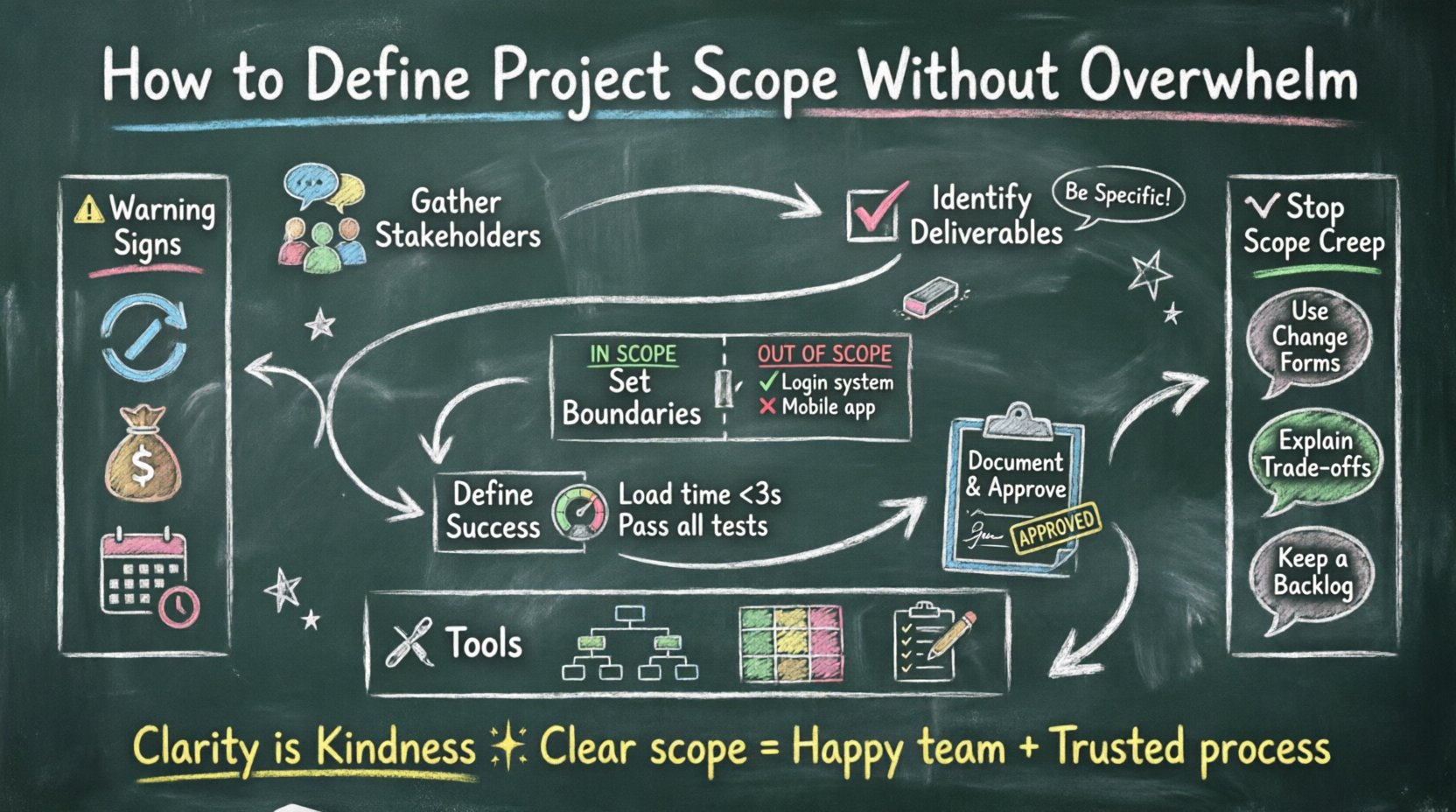
What Is Project Scope and Why Does It Matter? 🧭
At its core, project scope defines the specific goals, deliverables, tasks, costs, and deadlines of a project. It answers the question: “What are we building, and what are we not building?”
Without a defined scope, a project is open-ended. Open-ended projects are prone to a phenomenon known as scope creep. This occurs when additional features or tasks are added to the project without adjustments to time, budget, or resources. Over time, this small accumulation of changes can derail the entire initiative.
Here is why a clear definition is critical for success:
Resource Allocation: You know exactly what time and money are available.
Team Focus: Team members understand their specific responsibilities.
Client Satisfaction: Stakeholders know exactly what they will receive.
Risk Management: Potential issues can be identified before they become crises.
Signs Your Scope Needs Immediate Clarification ⚠️
Before diving into the steps, it is helpful to recognize when a project is drifting. If you notice any of the following signs, it is time to pause and redefine boundaries:
Constant Changes: Stakeholders request new features weekly without formal review.
Confusion on Deliverables: The team is unsure what constitutes “finished” work.
Budget Overruns: Expenses are rising faster than planned due to unplanned tasks.
Missed Deadlines: The timeline keeps slipping because the workload keeps growing.
Stakeholder Frustration: Clients feel the final product does not match their initial vision.
Step-by-Step Guide to Defining Project Scope 📝
Defining scope is a structured process. You do not need to guess. Follow these steps to build a solid foundation for your project management.
Step 1: Gather Key Stakeholders 🤝
You cannot define scope in isolation. You need input from the people who will pay for the project and the people who will execute it.
Identify Decision Makers: Who has the final say on the budget and timeline?
Identify End Users: Who will actually use the final product or service?
Identify Subject Matter Experts: Who knows the technical details or regulatory requirements?
Schedule a kickoff meeting with these individuals. The goal is not to make decisions immediately, but to gather the raw requirements that will inform the scope.
Step 2: Identify Deliverables 📦
Deliverables are the tangible outputs of your project. They are the physical or digital items that will be handed over at the end.
Be Specific: Instead of “a website,” define “a responsive website with five specific pages and a contact form.”
Use Actionable Language: Ensure every deliverable can be verified.
Categorize: Group deliverables into phases (e.g., Design, Development, Testing).
If a task cannot be delivered, it is likely a process step, not a scope item. Focus on the outputs.
Step 3: Set Boundaries (Define “Out of Scope”) 🚧
This is often the most overlooked step. Knowing what you will not do is just as important as knowing what you will do.
Explicitly stating exclusions protects your team from unnecessary work. It sets a firm expectation that certain requests fall outside the current agreement.
Common exclusions include:
Post-launch marketing campaigns.
Content creation for social media.
Training sessions for more than five staff members.
Hardware procurement beyond a specific cost limit.
Step 4: Define Success Criteria ✅
How will you know the project is successful? Success criteria provide a metric for completion.
Performance Metrics: For example, “The page load time must be under 3 seconds.”
Quality Standards: For example, “The software must pass all automated tests.”
Adoption Rates: For example, “80% of staff must log in within the first month.”
Without these metrics, a project can technically be “finished” but still fail to meet business needs.
Step 5: Document and Obtain Approval 📜
A scope that exists only in your head is not a scope. It must be documented. This document serves as the contract for the project.
Create a Scope Statement: Summarize the objectives, deliverables, and boundaries.
Review Process: Walk the stakeholders through the document line by line.
Sign-off: Obtain written approval. This formalizes the agreement.
In Scope vs. Out of Scope: A Practical Example 📊
To make this concept concrete, consider a scenario where a team is building an internal employee portal. The table below illustrates how scope is differentiated.
Category | In Scope (Included) | Out of Scope (Excluded) |
|---|---|---|
Features | Login system, Profile page, Dashboard | Mobile application version, Dark mode |
Data | Import current employee records | Import historical data from 2020 |
Support | 2 weeks of bug fixes post-launch | 30 days of bug fixes |
Training | One 1-hour webinar | On-site training sessions |
By clearly separating these items, the team avoids confusion when a stakeholder asks for the mobile app or extended support later.
Managing Scope Creep 📉
Even with a perfect plan, requests for changes will happen. This is normal. The key is to manage them without breaking the project.
1. Implement a Change Control Process
Do not accept verbal requests. Create a formal mechanism for change.
Submit a Change Request Form detailing the new requirement.
Assess the impact on budget, timeline, and resources.
Present the impact to the decision maker.
Get approval before work begins.
2. Communicate the Trade-offs
When a new feature is requested, explain the cost. If the budget is fixed, adding a feature might require removing another feature to maintain balance.
Time Trade-off: “We can add this, but the launch will be delayed by two weeks.”
Cost Trade-off: “We can add this, but we need an additional budget allocation.”
Feature Trade-off: “We can add this, but we must remove the reporting module.”
3. Say No (Politely)
Sometimes the best answer is no. If a request does not align with the primary goals, it is okay to decline it for this phase.
Keep a Backlog: Store the request for a future phase or version.
Explain the Why: Share the strategic reasoning behind the decision.
Common Pitfalls to Avoid 🚫
Even experienced managers make mistakes. Avoid these common traps to keep your scope definition robust.
Ambiguity: Using words like “user-friendly” or “fast.” Define these terms with numbers (e.g., “load time under 2 seconds”).
Ignoring Risks: Failing to account for potential delays or technical hurdles in the initial scope.
Skipping Validation: Assuming the team understands the scope without verifying their understanding.
Over-Committing: Saying yes to everything to please stakeholders, which leads to failure later.
Static Scope: Treating the scope as unchangeable. While boundaries are firm, the details may need adjustment if the environment changes drastically.
Tools for Scope Management (Non-Software Specific) 🧰
You do not need expensive technology to manage scope. You need structured methods.
Work Breakdown Structure (WBS): A hierarchical decomposition of the total scope of work.
Stakeholder Matrix: A chart identifying who needs to be consulted or informed at each stage.
Meeting Minutes: Written records of every discussion regarding scope changes.
Checklists: Simple lists to ensure every deliverable meets the criteria.
Communication is the Glue 🔗
Technical definitions are useless if the team does not understand them. Communication must be ongoing.
Regular Check-ins: Hold weekly meetings to review progress against the scope.
Visual Aids: Use diagrams or flowcharts to show how tasks connect.
Transparency: Share the scope document with the entire team, not just leadership.
Feedback Loops: Encourage team members to flag potential scope issues early.
Handling Difficult Conversations 💬
Sometimes, stakeholders will push back when you say no. Here is how to handle those moments with confidence.
Listen First: Understand the underlying need. They might want a feature for a specific reason.
Reframe the Request: “I hear you want better reporting. Let’s see if we can adjust the current dashboard to meet that need without changing the core scope.”
Refer to the Document: “As per our signed agreement, this falls outside the current phase. We can schedule it for the next quarter.”
Stay Calm: Do not get defensive. Stick to the facts and the agreed-upon boundaries.
Final Thoughts on Project Boundaries 🏁
Defining scope is an act of protection. It protects your team from burnout, your budget from depletion, and your reputation from failure. It is not about restricting creativity; it is about channeling effort into the right areas.
By following these steps, you move from a reactive stance to a proactive one. You stop putting out fires and start building a fireproof structure. Remember that clarity is kindness. Clear expectations allow your team to work with confidence and your stakeholders to trust the process.
Take your time during the definition phase. It is better to spend extra time upfront than to fix a broken project later. Start with the goal, define the boundaries, and document the agreement. With a solid scope, the path forward becomes much clearer.