
Project management is rarely about the technical details alone. It is fundamentally about people. You can have the perfect technical architecture, a flawless timeline, and a generous budget, but if you cannot navigate the human dynamics surrounding your project, failure is almost guaranteed. Stakeholder management is the backbone of successful delivery, yet it is often the source of the most significant stress for project leaders.
This guide focuses on practical, actionable strategies to manage stakeholders effectively. We will move beyond theoretical frameworks and look at real-world application. The goal is not to please everyone, but to align expectations, maintain trust, and drive the project forward without burning out your team or yourself. Let’s dive into the mechanics of engagement.
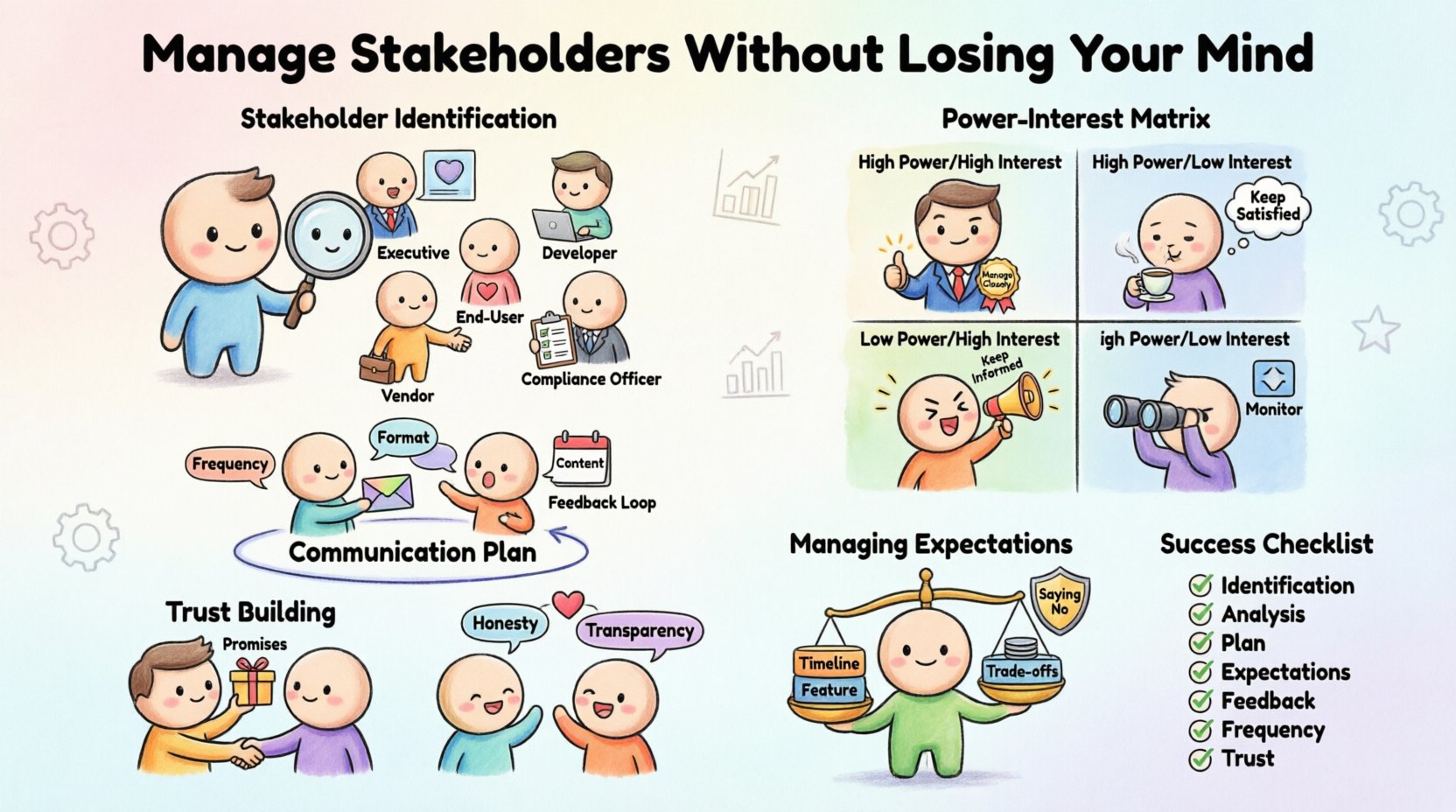
Understanding the Stakeholder Landscape 🗺️
Before you can manage anyone, you must know who they are and what they want. Stakeholders are not a monolith. They range from the executive sponsor who controls the budget to the end-user who will use the final product. They also include regulatory bodies, external vendors, and internal departments that might be impacted by the changes you are making.
Who Are Your Stakeholders?
Identifying stakeholders is the first step. You should look at the project through different lenses to ensure no one is missed.
Internal Sponsors: These individuals provide funding and strategic direction. They care about ROI and alignment with business goals.
Functional Managers: They provide resources (people, time, equipment). They care about how the project affects their department’s daily operations.
End Users: They are the ones who will interact with the deliverable. They care about usability, functionality, and how their jobs change.
Regulatory/Compliance: They ensure you are following laws and industry standards. They care about risk and adherence.
External Partners: Vendors or contractors working on your behalf. They care about clear requirements and timely payments.
Creating a comprehensive list is vital. If you miss a key stakeholder early on, they can become a blocker later, derailing timelines. Make sure to interview team members and look at organizational charts to find hidden influencers.
The Power-Interest Matrix 📊
Not all stakeholders require the same amount of attention. Some need daily updates, while others only need to know the final outcome. To manage your time effectively, you need to categorize stakeholders based on their influence over the project and their interest in the outcome.
The Power-Interest Matrix is a standard tool for this. It helps you decide where to focus your communication efforts.
Category | Characteristics | Management Strategy |
|---|---|---|
High Power, High Interest | Key decision-makers who care deeply about the outcome. | Manage Closely: Engage frequently. Keep them satisfied and informed. These are your primary stakeholders. |
High Power, Low Interest | People who can block you but don’t care about the details. | Keep Satisfied: Do not overwhelm them with data. Give them high-level summaries. Ensure they do not become obstacles. |
Low Power, High Interest | End users or team members who care deeply but have little influence. | Keep Informed: They can be champions or critics. Regular updates keep them engaged and prevent rumors. |
Low Power, Low Interest | People who are unlikely to impact the project significantly. | Monitor: Minimal effort required. Check in occasionally to ensure their status hasn’t changed. |
This categorization is dynamic. A stakeholder in the “Low Interest” category today might move to “High Interest” if a risk materializes. Regularly review your list to ensure your engagement strategy matches their current status.
Building a Communication Plan 🗣️
Communication is the tool you use to manage stakeholders. Without a plan, communication becomes reactive, chaotic, and stressful. A structured communication plan dictates who gets what information, when they get it, and how they receive it.
Key Elements of the Plan
Frequency: Determine how often updates are needed. Weekly status reports work well for most projects, but executives might prefer monthly high-level reviews.
Format: Match the medium to the message. Complex risks might require a call or meeting. Status updates can be a written report. Quick wins might be a chat message.
Content: What is the audience interested in? Executives want risks and budget. Team members want tasks and blockers. Tailor the content accordingly.
Feedback Loop: Communication is two-way. Ensure there is a mechanism for stakeholders to ask questions or raise concerns. A simple email address or scheduled Q&A slot works.
Do not send a generic email to everyone. If you send a detailed technical report to an executive, they will tune it out. If you send a high-level summary to a developer, they will feel out of the loop. Segmentation is key to efficiency.
Managing Expectations: The Art of Saying No 🛡️
One of the hardest parts of managing stakeholders is dealing with scope creep and unrealistic deadlines. Stakeholders often believe that adding features is easy or that time can be compressed without cost. Managing expectations is about setting realistic boundaries early.
Techniques for Alignment
Define Success Early: Before work begins, agree on what “done” looks like. Document the scope clearly. If a stakeholder asks for something outside that scope, refer back to the agreement.
Present Trade-offs: When a new request comes in, do not just say “no.” Say, “We can do that, but it will require moving X feature to the next phase or extending the timeline by Y days.” This puts the decision back in their court.
Use Data: Back up your assertions with historical data. If a similar task took two weeks last time, use that evidence to justify the timeline.
Transparency on Risks: If a deadline is aggressive, highlight the risks immediately. Do not wait until the deadline passes to say the project is at risk. Early warnings allow for course correction.
Saying no is not about being difficult; it is about protecting the integrity of the project. If you agree to everything, you will eventually fail to deliver anything. It is better to under-promise and over-deliver than to over-promise and disappoint.
Handling Conflict and Resistance 🤝
Conflict is inevitable in projects. Different stakeholders have competing priorities. One department wants speed; another wants stability. One wants new features; another wants maintenance. How you handle these tensions defines your leadership.
Navigating Difficult Conversations
Listen First: When a stakeholder is pushing back, listen to understand their underlying concern. Often, resistance comes from fear of change or lack of understanding.
Focus on Goals: Remind everyone of the shared business objective. You are all on the same team, even if you disagree on the path.
Find Common Ground: Identify areas where interests align. Build agreement on those points before tackling the contentious issues.
Escalate Appropriately: If a conflict blocks progress, escalate it to the next level of leadership. However, bring a recommendation, not just a problem.
Conflict is not always bad. Healthy debate can uncover risks you missed. The goal is to manage the conflict constructively, not to suppress it. Create a safe environment where concerns can be voiced without fear of retribution.
Building Trust Over Time 🔄
Trust is the currency of stakeholder management. It takes time to build and seconds to lose. Once trust is established, managing becomes easier. When stakeholders trust you, they give you the benefit of the doubt when things go wrong.
Strategies for Trust Building
Deliver on Promises: If you say you will send a report by Friday, send it by Friday. Consistency builds reliability.
Be Honest About Bad News: Bad news does not get better with time. Share problems as soon as they are known. Stakeholders appreciate honesty over optimism.
Understand Their Context: Learn about the pressures your stakeholders face. Acknowledging their challenges shows empathy and builds rapport.
Recognize Contributions: Publicly credit stakeholders who help the project. A simple thank you or a mention in a meeting goes a long way.
Trust is not a one-time transaction. It is a continuous investment. Every interaction is an opportunity to strengthen or weaken the relationship. Treat every meeting, email, and update as a chance to reinforce your reliability.
Common Pitfalls to Avoid ⚠️
Even experienced leaders make mistakes. Being aware of common pitfalls can help you steer clear of them.
Communication Overload: Sending too many emails or holding too many meetings can cause stakeholders to ignore you. Be concise and respectful of their time.
Assuming Alignment: Just because a stakeholder nodded in a meeting does not mean they agree. Confirm understanding explicitly.
Ignoring Silent Stakeholders: Sometimes the loudest voices are not the most important. Pay attention to those who are quiet but influential.
Blaming Others: If a project fails, do not point fingers at stakeholders. Take ownership of the management process and focus on solutions.
Forgetting the End User: It is easy to get caught up in executive demands and forget the person who actually uses the product. Keep the user in mind to ensure value is delivered.
Practical Checklist for Success ✅
Use this checklist to evaluate your current stakeholder management approach.
Identification: Have you identified all key stakeholders?
Analysis: Have you categorized them by power and interest?
Plan: Do you have a written communication plan?
Expectations: Are scope and timelines clearly defined and agreed upon?
Feedback: Is there a mechanism for stakeholders to provide input?
Frequency: Are you communicating at the right cadence?
Trust: Have you delivered on your last few commitments?
Final Thoughts on Sustainable Management 🌱
Managing stakeholders is a marathon, not a sprint. It requires patience, empathy, and a steady hand. There will be days when communication feels difficult or expectations seem impossible. In those moments, return to the basics: clarity, consistency, and honesty.
Remember that the goal is not to control every person in the room. It is to facilitate collaboration toward a shared goal. When you view stakeholder management as a service you provide to the project rather than a burden you endure, the dynamic changes. You become a facilitator of success rather than a blocker of progress.
By applying these strategies, you can navigate the complexities of project environments with greater confidence. You will find that when stakeholders feel heard and informed, they become your greatest allies. This guide provides the foundation; your experience will build the structure. Focus on the people, respect their time, and keep the project vision clear. That is the path to sustainable success.