
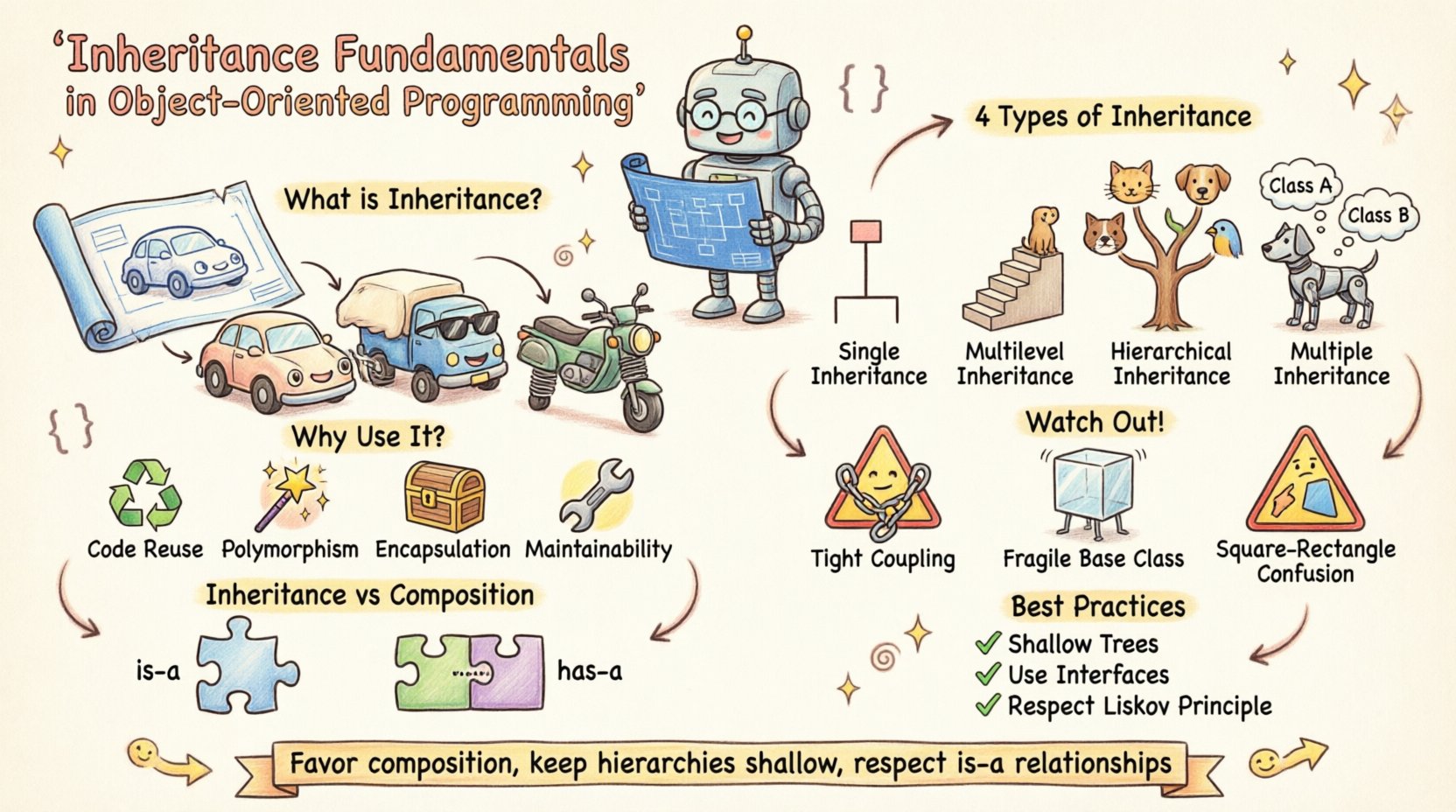
Object-Oriented Analysis and Design (OOAD) relies heavily on the concept of inheritance. It is a mechanism that allows new classes to be created based on existing ones. This relationship establishes a hierarchy where knowledge, behavior, and attributes are passed down from a general category to specific subcategories. Understanding this dynamic is essential for building scalable, maintainable software systems.
In this guide, we will explore the core principles of inheritance, how it functions within software architecture, and the design patterns that accompany it. We will look at why developers choose this path, the potential pitfalls they must avoid, and how to apply these concepts effectively in real-world modeling.
What is Inheritance? 🤔
Inheritance is a way of forming new classes using classes that already exist. The new class, often called a subclass or derived class, inherits attributes and methods from an existing class, known as the superclass or base class. This allows the new class to reuse code without rewriting it.
Think of it as a blueprint. If you have a blueprint for a generic vehicle, you can create blueprints for a car, a truck, or a motorcycle. These specific vehicles inherit the general properties of a vehicle (like having wheels or an engine) but add their own specific features (like the number of doors or fuel type).
Key Terminology 📝
- Class: A blueprint for creating objects. It defines attributes and methods.
- Object: An instance of a class. It represents a specific entity in memory.
- Base Class (Superclass): The existing class whose properties are inherited.
- Derived Class (Subclass): The new class that inherits from the base class.
- Method Override: When a subclass provides a specific implementation of a method that is already defined in its superclass.
- Method Overloading: Using the same method name with different parameters within the same class.
Types of Inheritance 🏗️
While the implementation varies across programming languages, the theoretical models of inheritance remain consistent in OOAD. There are several structural patterns used to organize class hierarchies.
1. Single Inheritance
This occurs when a class inherits from only one parent class. It is the simplest form and creates a linear hierarchy.
- Structure: Grandparent → Parent → Child.
- Use Case: Ideal when a specific entity is a specialized version of exactly one general entity.
- Example: A
Carclass inheriting from aVehicleclass.
2. Multilevel Inheritance
This happens when a class is derived from a derived class. The hierarchy extends deeper.
- Structure: Class A → Class B → Class C.
- Use Case: Modeling progressive specialization.
- Example:
Vehicle→Motorcycle→SportsBike.
3. Hierarchical Inheritance
Multiple subclasses inherit from a single base class. This creates a tree-like structure.
- Structure: Multiple children, one parent.
- Use Case: When different types of objects share common traits.
- Example:
Animal→Dog,Cat,Bird.
4. Multiple Inheritance
A class inherits from more than one base class. This is complex and not supported in all languages due to ambiguity issues (like the Diamond Problem).
- Structure: One child, multiple parents.
- Use Case: When an object needs to combine capabilities from distinct sources.
- Example: A
RobotDogclass inheriting fromRobotandDog.
Why Use Inheritance? 🚀
The primary motivation for using inheritance is to reduce code duplication. However, it offers several other advantages that contribute to the overall health of a software project.
1. Code Reusability
Common logic is written once in the superclass and utilized by all subclasses. This reduces the amount of code you need to write and test. If you need to change a core behavior, you update it in one place, and the change propagates to all derived classes.
2. Polymorphism
Inheritance enables polymorphism, which allows objects of different classes to be treated as objects of a common superclass. This means you can write generic code that works with the base type, while the specific behavior is determined at runtime.
3. Data Encapsulation
By organizing related data and methods into a hierarchy, you maintain a logical structure. Private members in the superclass remain protected, while public members are accessible to subclasses, ensuring data integrity.
4. Maintainability
When the system grows, a well-structured inheritance hierarchy makes it easier to navigate. Developers can understand the relationship between components quickly, reducing the time needed for debugging or adding new features.
The Risks and Challenges ⚠️
While inheritance is powerful, it is not a silver bullet. Overusing it or using it incorrectly can lead to significant technical debt.
1. Tight Coupling
Subclasses are tightly coupled to their superclasses. If the base class changes significantly, all derived classes may break. This makes refactoring difficult.
2. The Fragile Base Class Problem
If a change in the superclass causes unexpected behavior in a subclass, it can be hard to trace. The subclass relies on the internal implementation of the parent, which might not be visible in the public interface.
3. Misuse of “Is-A” Relationships
Inheritance implies an “is-a” relationship. If a class does not logically fit this description, using inheritance violates the design principle. For example, a Square class inheriting from a Rectangle class can cause issues with width and height independence.
4. Deep Inheritance Trees
Excessive depth in the hierarchy makes the code hard to read. A subclass might inherit behavior from a parent, which inherited behavior from a grandparent. Understanding the flow of logic becomes a maze.
Inheritance in Object-Oriented Analysis and Design 📐
In the analysis phase, we focus on modeling the problem domain. Inheritance is a critical tool for this modeling. It helps us identify commonalities and differences between entities in the real world.
Modeling Entities
When analyzing a system, you might identify that multiple entities share specific attributes. Instead of creating separate models for each, you create a general model and specialize it.
- Identify Commonality: Look for shared attributes and behaviors.
- Identify Differences: Determine what makes each entity unique.
- Abstract: Create a superclass for the commonality.
- Specialize: Create subclasses for the unique behaviors.
Design Patterns and Inheritance
Several design patterns utilize inheritance to solve recurring design problems.
- Template Method: Defines the skeleton of an algorithm in a superclass, letting subclasses override specific steps.
- Strategy: Defines a family of algorithms, encapsulates each one, and makes them interchangeable. Subclasses can implement different strategies.
- Factory Method: Creates objects without specifying the exact class to create. Subclasses decide which class to instantiate.
Inheritance vs. Composition 🧩
One of the most common debates in software design is whether to use inheritance or composition. Composition is often preferred in modern design principles because it is more flexible.
| Feature | Inheritance | Composition |
|---|---|---|
| Relationship | Is-A (Specialization) | Has-A (Part-Whole) |
| Coupling | Tight | Loose |
| Flexibility | Low (Fixed at compile time) | High (Can change at runtime) |
| Encapsulation | Less Control over superclass | Full Control over components |
| Use Case | Logical hierarchy | Functional aggregation |
When designing a system, ask yourself: Does the subclass truly represent a specialized version of the superclass? If the answer is no, composition is likely the better choice. For example, a Car should not inherit from Engine, but it should contain an Engine object.
Best Practices for Implementation ✅
To maintain a healthy codebase, follow these guidelines when working with inheritance.
1. Favor Composition over Inheritance
Start by asking if you can compose a solution using smaller objects rather than extending a class. This reduces dependencies and increases flexibility.
2. Keep Hierarchies Shallow
Aim for a hierarchy depth of 3 or 4 levels maximum. If you find yourself going deeper, consider refactoring to break the chain or using interfaces.
3. Use Interfaces for Behavior
Interfaces define a contract without implementation. They allow a class to inherit behavior from multiple sources without the complexity of multiple inheritance. Use them to define what an object can do, rather than what it is.
4. Document Relationships
Clearly document the relationships between classes. Use diagrams to visualize the hierarchy. This helps new team members understand the system structure without reading the entire codebase.
5. Avoid Fragile Hierarchies
Ensure that the base class is stable. Frequent changes to the superclass indicate a need for restructuring. If the base class changes often, it may be doing too much and should be split.
6. Respect the Liskov Substitution Principle
Objects of a superclass should be replaceable with objects of its subclasses without breaking the application. If a subclass cannot be used in place of the superclass without errors, the inheritance relationship is flawed.
Common Pitfalls to Avoid 🛑
- Over-abstracting: Creating a superclass that is too generic provides no value. Only extract commonalities that are actually used.
- Ignoring Visibility: Be careful with access modifiers. Making too many members public in a superclass exposes implementation details that subclasses should not rely on.
- Calling Overridden Methods in Constructors: This is a dangerous practice. The subclass constructor may not be fully initialized when the superclass constructor runs, leading to null pointer exceptions or incorrect states.
- Making Classes Final: While sometimes necessary, making classes final prevents inheritance. Use this sparingly and only when the class is complete and should not be extended.
- Ignoring the Interface: Focus on the interface of the superclass. Subclasses should be able to be used solely through the superclass interface without knowing the specific subclass type.
Real-World Application Scenarios 🌍
Understanding where inheritance fits into actual projects is crucial. Here are a few scenarios where it shines.
User Management Systems
In many applications, you have different types of users. You might have a BaseUser class containing common attributes like username and email. From there, you can derive AdminUser, CustomerUser, and GuestUser. Each inherits the login capability but has different permissions.
Graphics and UI Frameworks
UI libraries often use deep inheritance hierarchies. A generic Component might be the superclass for Button, Label, and Window. All components inherit drawing methods, event handling, and layout properties. This allows the framework to treat all UI elements uniformly.
Financial Calculations
In banking software, different account types share similar logic for interest calculation. A BankAccount class might hold the balance and transaction history. SavingsAccount and CheckingAccount inherit this logic but override the interest calculation method to apply specific rates.
Conclusion on Design Principles 🧠
Inheritance is a fundamental pillar of Object-Oriented Analysis and Design. It provides a structured way to model relationships between entities and promotes code reuse. However, it must be applied with discipline.
When used correctly, it simplifies complex systems and makes them easier to extend. When used poorly, it creates rigid structures that are difficult to modify. The key lies in understanding the “is-a” relationship and recognizing when a “has-a” relationship serves the design better.
By following best practices, respecting design principles, and understanding the trade-offs, developers can leverage inheritance to build robust, scalable, and maintainable software architectures. Always prioritize clarity and flexibility in your class hierarchies.