
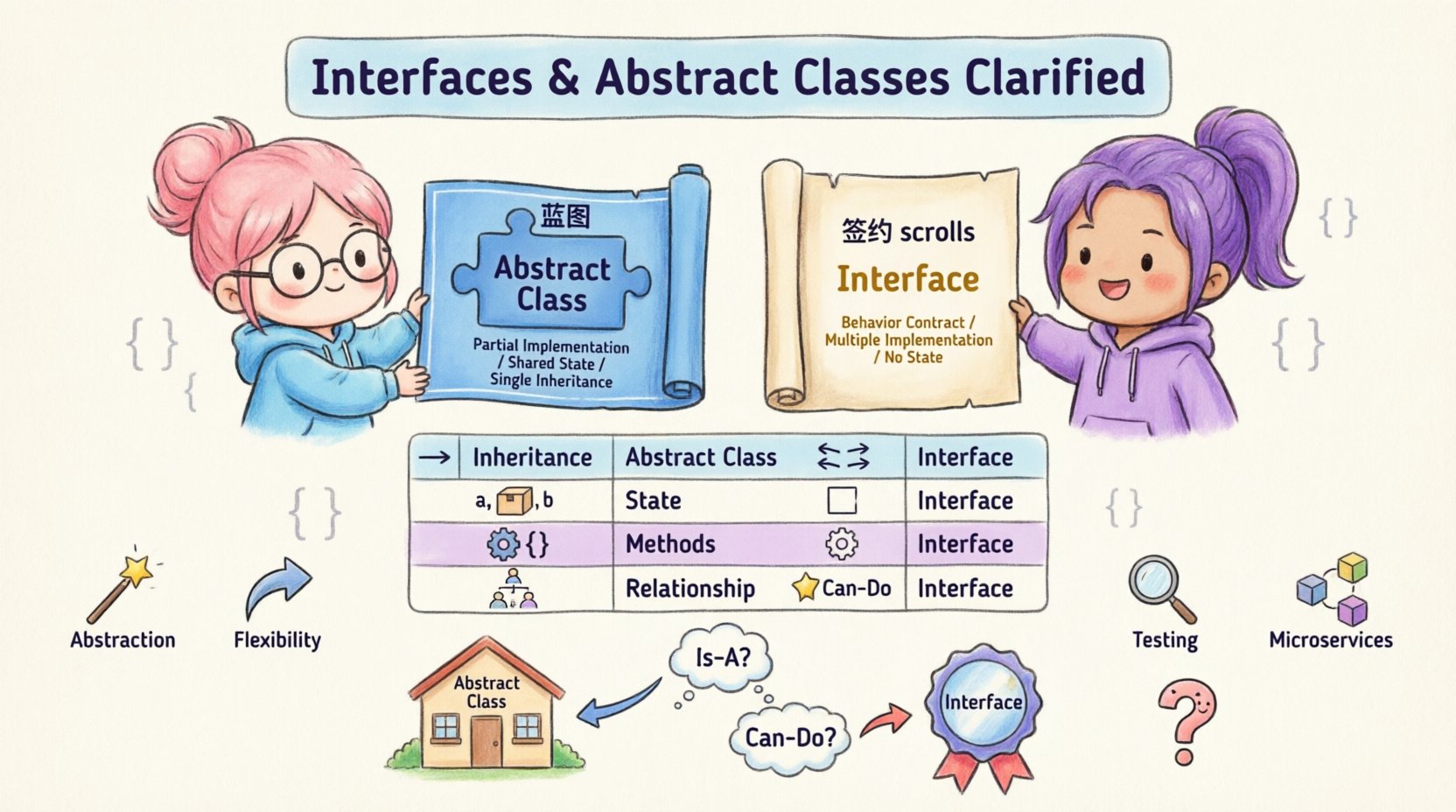
In the architecture of complex software systems, the ability to structure code effectively determines long-term maintainability. Object-Oriented Analysis and Design relies heavily on mechanisms that define behavior and state without exposing internal implementation details. Two primary tools exist for this purpose: interfaces and abstract classes. Understanding the distinction is critical for building scalable, robust applications. Confusion between these two constructs often leads to rigid hierarchies and fragile codebases that resist change. This article explores the theoretical underpinnings, practical applications, and strategic implications of choosing one over the other.
🧠 The Foundation of Abstraction
Abstraction is the process of hiding complex implementation details and exposing only the necessary parts of an object. It allows developers to work with high-level concepts rather than low-level data structures. This separation of concerns reduces coupling between components. When you define an abstraction, you are essentially creating a promise about how a piece of software will behave, regardless of how it behaves internally.
In the context of system design, abstraction serves several vital functions:
- Complexity Management: It allows teams to work on modules without needing to understand the internal logic of dependent modules.
- Flexibility: It enables the replacement of implementations without altering the code that uses them.
- Consistency: It enforces a standard set of behaviors across different parts of the system.
Both interfaces and abstract classes serve as mechanisms to achieve abstraction, but they do so with different constraints and capabilities. Selecting the correct tool requires a clear understanding of the relationships between your entities.
🏗️ Understanding Abstract Classes
An abstract class represents a partial implementation of a concept. It serves as a base for other classes to inherit from. It is designed for situations where there is a clear hierarchy of types. Think of it as a blueprint that some details are already filled in, while others remain to be completed by the builder.
Key characteristics include:
- Shared State: Abstract classes can define variables (fields) that hold state. Subclasses inherit this state, allowing for shared data across the hierarchy.
- Partial Implementation: They can contain both fully implemented methods and abstract methods that must be overridden. This reduces code duplication for common behaviors.
- Single Inheritance: Typically, a class can only inherit from one abstract class. This limits the depth of the inheritance tree but enforces a strict parent-child relationship.
- Constructor Logic: Abstract classes can have constructors to initialize state before the subclass initializes its own state.
When to utilize this pattern? Consider a scenario where you have a set of shapes: circles, squares, and triangles. They all share common properties like color and area calculation logic. An abstract class Shape can hold the color and provide a default implementation for area calculation, while subclasses override specific methods for geometry.
📋 Understanding Interfaces
An interface defines a contract that implementing classes must fulfill. It focuses on behavior rather than state. It is designed for situations where you need to define a capability that can be applied to unrelated classes. Think of it as a job description that any candidate must meet to be hired.
Key characteristics include:
- Behavior Only: Traditionally, interfaces contain only method signatures. They define what an object can do, not what it is.
- Multiple Implementation: A class can implement multiple interfaces. This allows for mixing and matching behaviors from different sources without deep inheritance hierarchies.
- State Management: Interfaces generally cannot hold state (instance variables). This ensures that the contract remains pure and does not rely on hidden data.
- Loose Coupling: Implementing an interface creates a dependency on the contract, not the implementation. This makes testing and mocking significantly easier.
Consider a scenario involving payment processing. You might have a credit card processor, a PayPal processor, and a cryptocurrency processor. These are unrelated types, but they all share the capability to processPayment. An interface PaymentGateway ensures that all these disparate types adhere to the same method signature, allowing your system to treat them uniformly.
📊 Key Differences at a Glance
The following table summarizes the structural and behavioral distinctions between these two mechanisms.
| Feature | Abstract Class | Interface |
|---|---|---|
| Inheritance | Single inheritance (extends) | Multiple inheritance (implements) |
| State | Can have instance variables | Cannot have instance variables |
| Implementation | Can have concrete methods | Typically abstract methods (mostly) |
| Relationship | Is-a relationship | Can-do relationship |
| Performance | Slightly faster method calls | Minimal performance overhead |
| Access Modifiers | Can use public, private, protected | Implicitly public |
🧭 Strategic Implementation Guidelines
Making the right choice impacts the evolution of your software. Poor decisions early in the design phase can make refactoring difficult or impossible later. Here are guidelines to help you decide.
1. Evaluate Shared State
If your subclasses share a significant amount of data or common logic that requires initialization, an abstract class is often the better fit. For example, if you are building a logging system where every logger needs an output stream, the abstract class can manage that stream.
2. Evaluate Type Relationships
Ask yourself: “Is this a type of that?” If the answer is yes, use an abstract class. If the answer is “Can this do that?”, use an interface. A car is a vehicle. A car can fly (via a plugin). The first relationship suggests inheritance; the second suggests an interface.
3. Consider Future Extensibility
Interfaces are generally safer for future expansion. Since a class can implement multiple interfaces, you can add new capabilities later without breaking existing inheritance chains. Abstract classes force a linear hierarchy, which can become brittle if you need to add a new parent.
4. Think About Testing
Interfaces are ideal for mocking in unit tests. You can create a test double that implements the interface without worrying about the state management of an abstract class. This separation makes your test suite more isolated and reliable.
⚠️ Common Design Pitfalls
Even experienced architects make mistakes when applying these concepts. Awareness of these pitfalls helps maintain code quality.
- The Diamond Problem: When a class inherits from multiple sources that share a method, ambiguity can arise. Interfaces mitigate this, but abstract class hierarchies can lead to complex resolution rules.
- Over-Abstraction: Creating an abstract class for a single subclass is a violation of design principles. Abstraction should reduce duplication, not create it.
- State Leakage: Using interfaces to expose mutable state can lead to unintended side effects. Interfaces should define contracts, not implementation details regarding data storage.
- Deep Hierarchies: Relying too heavily on abstract classes can create a deep inheritance tree. This makes understanding the code difficult because a method call might traverse many levels before reaching the implementation.
🔄 Integration with Modern Architecture
Modern software trends often blend these concepts. Dependency Injection frameworks, for instance, rely heavily on interfaces to manage the lifecycle of objects. This allows the container to swap implementations dynamically.
Furthermore, the evolution of language features has blurred the lines. Some systems now allow static methods in interfaces or default method implementations. This adds flexibility but also requires discipline. When default methods are added to interfaces, the distinction between the two becomes less clear.
Key considerations for modern contexts:
- Microservices: Interfaces define the API contracts between services. Abstract classes are rarely used across network boundaries.
- Plugin Systems: Abstract classes can provide a base for plugins to extend functionality, while interfaces define the lifecycle hooks.
- Functional Programming: In hybrid paradigms, interfaces often act as function signatures, while abstract classes manage stateful context.
🛡️ Conclusion
Selecting between an interface and an abstract class is a fundamental decision in Object-Oriented Analysis and Design. It is not merely a syntax choice; it is a statement about how your system models relationships and responsibilities. Abstract classes excel when there is a clear “is-a” hierarchy and shared state is required. Interfaces excel when defining capabilities that span unrelated types and loose coupling is a priority.
By adhering to these principles, developers can create systems that are easier to understand, test, and extend. The goal is not to maximize the use of either construct, but to apply them where they provide the most structural value. Clarity in design leads to clarity in code, which ultimately leads to success in software delivery.