
Enterprise architecture is the backbone of organizational strategy, yet it often suffers from complexity and ambiguity. To navigate this complexity, architects rely on structured frameworks like ArchiMate. A critical component of this framework is the concept of Viewpoints. Viewpoints define the perspective from which an architecture is viewed, ensuring that stakeholders receive information relevant to their specific concerns. This guide provides a deep dive into modeling an end-to-end solution using ArchiMate Viewpoints, focusing on clarity, alignment, and structural integrity.
When designing an end-to-end solution, the goal is not merely to draw diagrams but to create a coherent narrative that connects business intent with technical implementation. By leveraging standardized viewpoints, architects can bridge the gap between high-level strategy and low-level infrastructure. This walkthrough explores the methodology, layer interactions, and best practices required to build robust architectural models.
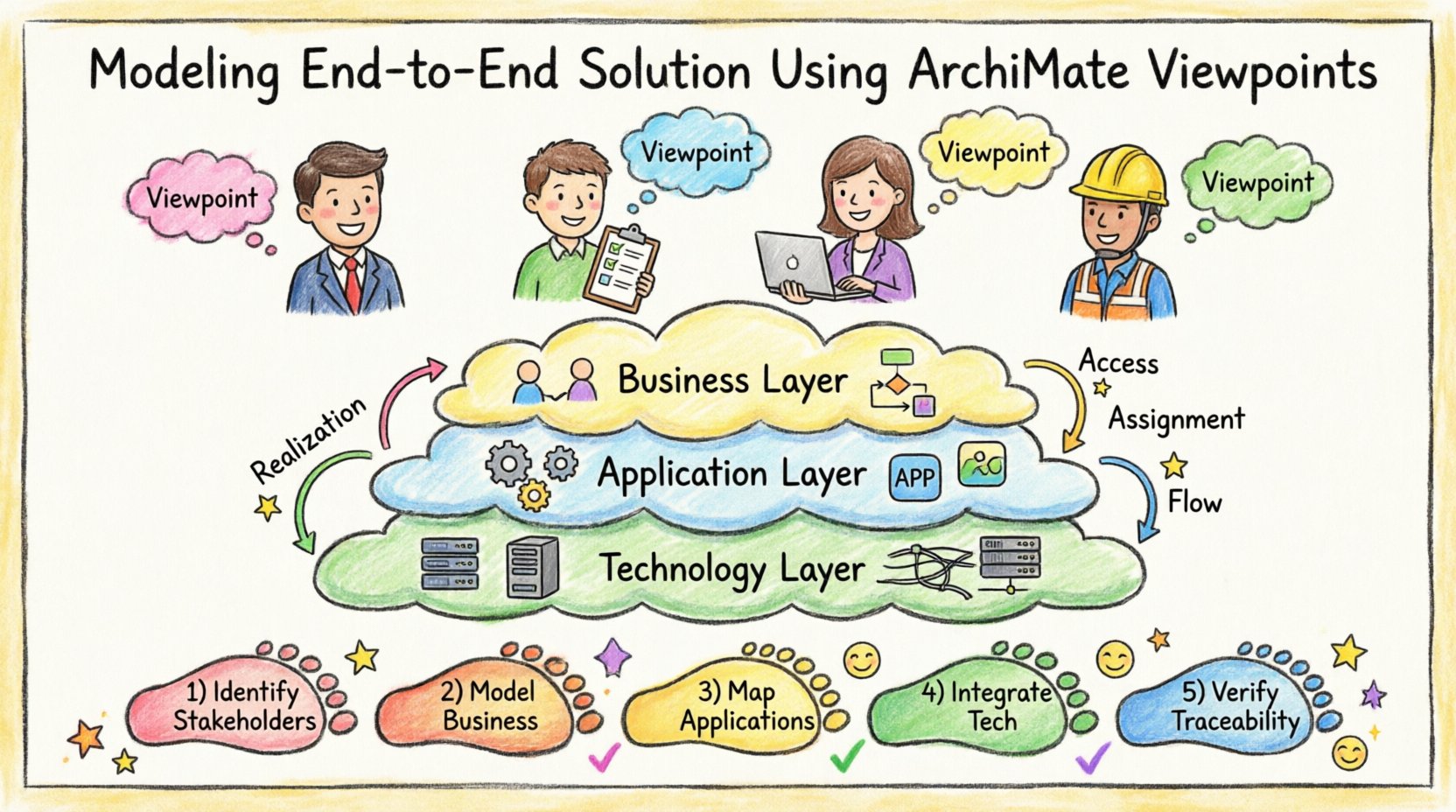
🧩 Understanding ArchiMate Viewpoints
A viewpoint is a specification that defines the conventions for constructing and interpreting an architecture view. It dictates which elements, relationships, and stereotypes are permitted within a specific context. Without viewpoints, models risk becoming chaotic collections of shapes that lack semantic meaning. Using viewpoints ensures consistency across the enterprise architecture repository.
Why Viewpoints Matter
- Stakeholder Alignment: Different roles require different information. A business manager needs to see processes and capabilities, while a systems engineer needs to see applications and nodes.
- Focus and Clarity: Viewpoints limit the scope of a view, preventing information overload.
- Reusability: Standardized viewpoints allow for the creation of templates that can be applied across multiple projects.
- Communication: They provide a common language for describing the architecture to diverse audiences.
Mapping Viewpoints to Stakeholders
| Stakeholder Role | Primary Concern | Suggested Viewpoint Focus |
|---|---|---|
| Business Executive | Strategic Alignment & ROI | Business Strategy & Value Flow |
| Process Owner | Operational Efficiency | Business Process & Capability |
| Application Architect | System Integration & Data Flow | Application & Business Function |
| Infrastructure Lead | Performance & Reliability | Technology & Deployment |
🎯 Defining the End-to-End Scope
Modeling an end-to-end solution requires a clear definition of boundaries. An end-to-end view spans from the initiation of a business trigger to the final realization of a value proposition. This scope must encompass the relevant layers of the ArchiMate framework to ensure that business drivers are traceable to technical capabilities.
Before drawing a single shape, architects must define the scope using the following criteria:
- Trigger Event: What initiates the process? (e.g., Customer Order, Regulatory Change).
- Value Outcome: What is the desired result? (e.g., Delivered Product, Compliance Report).
- Context Boundaries: What is included in the model? What is considered external? (e.g., External Suppliers, Legacy Systems).
- Time Horizon: Is this a current state, target state, or transition state model?
Defining these boundaries early prevents scope creep and ensures that the resulting model remains manageable and focused.
📊 Structuring the Layers
The ArchiMate framework divides the architecture into three main layers: Business, Application, and Technology. An end-to-end solution often requires cross-layer relationships to show how business needs drive technical investments. Understanding the semantics of each layer is crucial for accurate modeling.
1. Business Layer
The business layer represents the organization’s operational capabilities and processes. It is the foundation of the solution because it defines the “what” and “why” of the architecture.
- Business Actors: Internal or external entities performing business functions (e.g., Customer, Supplier).
- Business Processes: Sequences of activities that create value (e.g., Order Fulfillment).
- Business Services: Capabilities offered to consumers (e.g., Payment Processing).
- Business Objects: Data or resources acted upon (e.g., Invoice, Product).
2. Application Layer
The application layer supports the business layer by providing software services. It represents the logical systems that automate business processes.
- Application Services: Functionalities provided by software (e.g., Data Validation).
- Application Components: Logical building blocks of applications (e.g., Web Server, API Gateway).
- Application Functions: Behavior within a component (e.g., Calculate Tax).
3. Technology Layer
The technology layer provides the infrastructure for the application layer. It represents the physical or logical hardware and networks.
- Technology Services: Infrastructure capabilities (e.g., Network Connectivity).
- Technology Devices: Hardware nodes (e.g., Server, Router).
- Technology Interfaces: Points of interaction with the environment.
🔗 Establishing Relationships
Connecting elements across layers is where the “end-to-end” nature of the solution becomes visible. ArchiMate defines specific relationships that dictate how elements interact. Using these relationships correctly ensures the model is semantically valid.
Key Relationship Types
- Realization: Indicates that one element implements or realizes another (e.g., a Service realizes a Capability).
- Assignment: Links an active structure to a passive structure (e.g., a Business Actor assigned to a Process).
- Access: Shows that one element uses another (e.g., an Application uses a Data Object).
- Flow: Indicates the movement of data or control between processes.
When modeling an end-to-end solution, it is vital to maintain logical flow. For example, a Business Process should be realized by an Application Service, which in turn is deployed on a Technology Device. This chain of realization ensures traceability from strategy to infrastructure.
🛠️ Step-by-Step Modeling Process
Constructing a comprehensive model requires a disciplined approach. The following steps outline the workflow for building an end-to-end solution using ArchiMate Viewpoints.
Step 1: Identify Stakeholders and Viewpoints
Begin by listing all key stakeholders. Determine what information each stakeholder needs to make decisions. Select the appropriate viewpoints for each group. For instance, use a Business Viewpoint for management and a Technology Viewpoint for infrastructure teams.
Step 2: Model the Business Context
Start with the Business Layer. Map out the value chain. Identify the core processes that deliver value to the customer. Define the capabilities required to support these processes. Ensure that the business context is clear before adding technical details.
- Define the Business Goal.
- Identify the Business Process.
- Link the Process to the Business Capability.
Step 3: Map Application Support
Once the business logic is established, determine the application support required. Identify which applications automate which processes. Map the data flows between these applications. This step bridges the gap between business requirements and system functionality.
- Select relevant Application Services.
- Define Application Components.
- Establish data access relationships.
Step 4: Integrate Technology Infrastructure
Finally, model the technology layer. Determine where applications are deployed. Identify the network requirements. Ensure that the technology infrastructure supports the availability and performance needs of the applications.
- Map Application Components to Devices.
- Define communication paths.
- Specify hardware constraints.
Step 5: Verify Traceability
Review the model to ensure end-to-end traceability. Check if every business goal has a corresponding technical implementation. Verify that all data flows are accounted for. This validation step is critical for ensuring the solution is complete.
🚧 Common Modeling Challenges
Even with a clear methodology, architects often encounter obstacles when modeling complex solutions. Recognizing these challenges early can prevent rework and confusion.
- Layer Mixing: Placing technology elements in the business layer or business processes in the application layer. This violates the semantic rules of the framework and reduces model clarity.
- Over-Abstraction: Creating models that are too high-level to be useful for implementation. Balance strategic views with detailed implementation views.
- Under-Abstraction: Including too many details in a single view, making it unreadable. Use aggregation or sub-modeling to manage complexity.
- Lack of Context: Failing to define the boundaries of the view. Without context, elements appear disconnected from the wider enterprise.
- Inconsistent Naming: Using different terms for the same concept across different views. Maintain a consistent glossary.
✅ Best Practices for Clarity
To ensure the model remains a valuable asset, adhere to these best practices throughout the modeling lifecycle.
1. Consistent Naming Conventions
Establish a naming standard for all elements. Use clear, descriptive names that reflect the element’s function. Avoid abbreviations that are not universally understood. Consistent naming aids in searchability and comprehension.
2. Modularization
Break large models into smaller, manageable sub-models. Use groupings to organize elements logically. This allows stakeholders to focus on specific areas without being overwhelmed by the entire enterprise scope.
3. Version Control
Keep track of changes to the model. Document the rationale for significant changes. This history provides context for future decisions and helps in auditing the evolution of the architecture.
4. Regular Reviews
Schedule regular reviews with stakeholders. Ensure the model reflects the current reality. Architecture is not static; it evolves with the organization. Continuous validation keeps the model relevant.
🔄 Maintaining Alignment Over Time
Once the model is created, it becomes a living document. Maintaining alignment between the business strategy and the technical implementation requires ongoing governance. The following strategies support long-term alignment.
- Change Management: Any change to the business strategy should trigger a review of the architecture model. This ensures technical changes are driven by business needs.
- Automated Compliance: Use tooling to check for modeling rules. Automated checks can flag violations of standards before they become issues.
- Documentation: Complement the diagrams with textual descriptions. Text provides context that diagrams cannot convey.
- Training: Ensure all team members understand the ArchiMate framework. A shared understanding reduces modeling errors.
📈 Measuring Success
How do you know if the modeling effort was successful? Success is measured by the utility of the model in decision-making. Key indicators include:
- Reduced Ambiguity: Stakeholders understand the architecture without excessive explanation.
- Faster Decision Making: Architects can answer questions about impact and dependency quickly.
- Better Alignment: Projects are built in accordance with the defined strategy.
- Reduced Redundancy: Inefficient overlaps in applications or processes are identified and removed.
By focusing on these metrics, architects can demonstrate the value of their modeling work beyond the creation of diagrams.
🔍 Deep Dive: Cross-Layer Relationships
The most powerful aspect of an end-to-end model is the ability to trace a business requirement down to a specific hardware node. This requires careful use of cross-layer relationships.
Business to Application
The relationship between Business Services and Application Services is critical. A Business Service is what the customer experiences, while an Application Service is the backend logic that delivers it. Modeling this link clarifies the value chain.
Application to Technology
Deployment relationships map software to hardware. This is essential for capacity planning and cost analysis. It answers the question: “Where does this run?”
Business to Technology
While less common, direct relationships can exist. For example, a Business Process might be directly dependent on a specific Technology Device due to latency requirements. Use these sparingly to maintain layer integrity.
🎓 Conclusion on Methodology
Modeling an end-to-end solution using ArchiMate Viewpoints is a structured discipline that demands precision and foresight. By adhering to the layers, utilizing appropriate viewpoints, and maintaining rigorous traceability, architects can create models that drive organizational success. The process is iterative, requiring constant refinement as the organization evolves.
The value of this approach lies in its ability to translate abstract strategy into concrete technical reality. It provides a shared language for the enterprise, facilitating communication between business leaders and technical teams. When executed correctly, the model becomes more than a diagram; it becomes a strategic asset.
Remember that the tool is secondary to the thinking. The framework provides the structure, but the insight comes from the architect’s understanding of the business and technology landscape. Focus on clarity, consistency, and relevance. These principles will guide the creation of robust, enduring architectural models.