
Project management is often celebrated for its metrics: budgets, timelines, and milestones. Yet, the most significant factor determining success or failure rarely appears on a Gantt chart. It lies in the foundation: the requirements. When stakeholders cannot articulate what they need, or when teams interpret needs differently, the project begins to crumble before a single line of code is written or a brick is laid. This is the silent killer of projects. It is not a lack of effort, but a lack of clarity.
Understanding the anatomy of requirement failure is essential for any professional dedicated to delivering value. This guide explores why vague specifications lead to costly rework, how misalignment destroys team morale, and the concrete steps necessary to build a robust requirements process. We are not here to promise a magic solution, but to provide a framework for clarity.
🔍 Defining Requirements: More Than Just a List
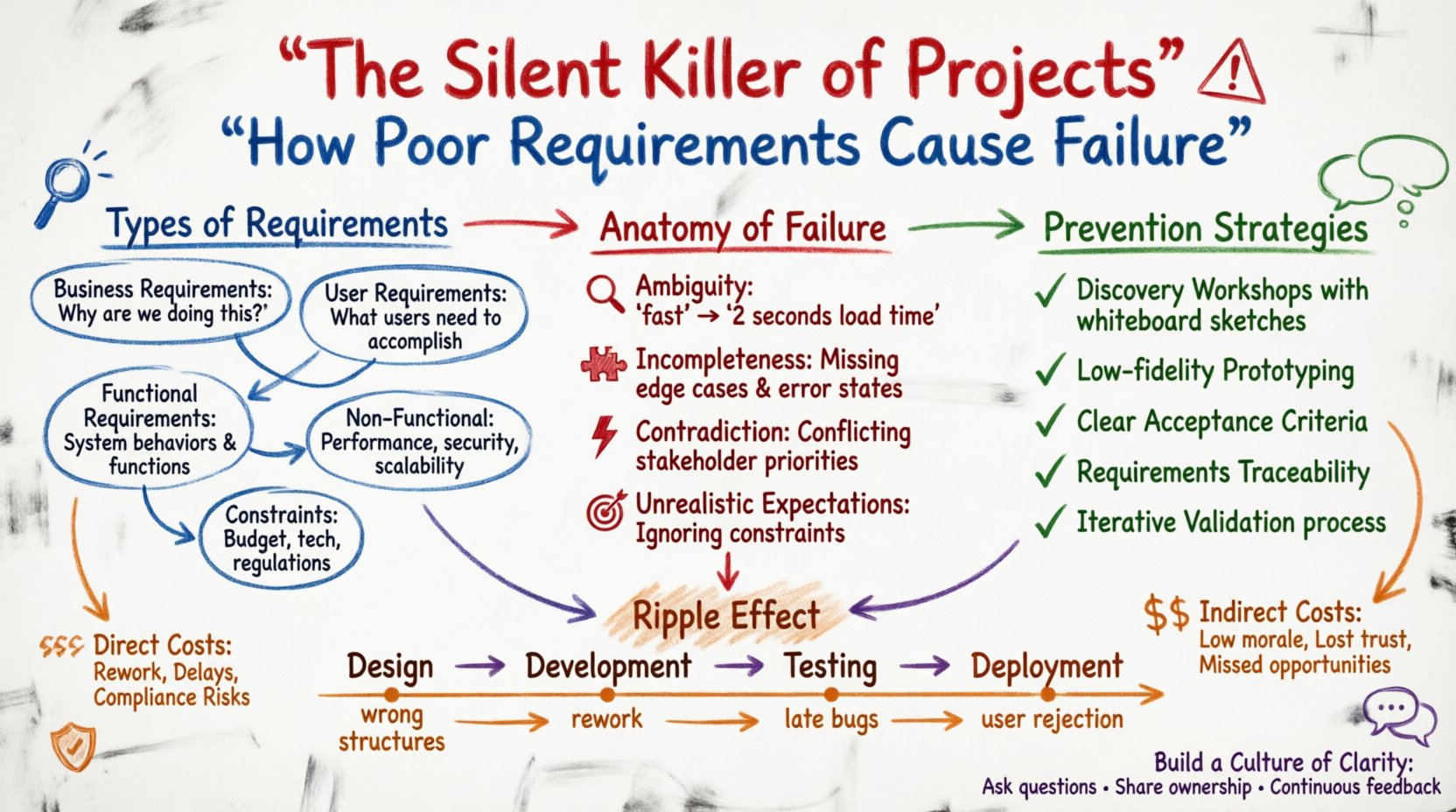
Requirements are the bridge between a business problem and a technical solution. They define what the system must do, not necessarily how it should do it, though some technical constraints are often necessary. In professional practice, requirements are typically categorized into several distinct types:
Business Requirements: High-level goals that the organization wants to achieve. These answer “Why are we doing this?”
User Requirements: What the end-user needs to accomplish their tasks. These focus on functionality from the user’s perspective.
Functional Requirements: Specific behaviors or functions the system must support. For example, “The system shall allow users to reset their password via email.”
Non-Functional Requirements: Criteria that judge the operation of a system, such as performance, security, reliability, and scalability. These are often the “invisible” requirements that cause failure when ignored.
Constraints: Limitations such as budget, technology stack, regulatory compliance, or timeline.
When these categories are blurred, confusion sets in. A stakeholder might describe a functional need but expect a non-functional performance level that is technically impossible within the budget. This gap is where projects die.
🧩 The Anatomy of Requirement Failure
Poor requirements do not usually manifest as a single error. They appear as patterns of ambiguity, incompleteness, and contradiction. Identifying these patterns early is the first step toward prevention.
1. Ambiguity and Vagueness
Words like “fast,” “user-friendly,” “robust,” or “modern” are subjective. What feels fast to a developer may feel sluggish to a user. What feels modern to a designer may be outdated to a compliance officer. Without measurable definitions, teams make assumptions.
Example: “The dashboard should load quickly.”
Better: “The dashboard must render within 2 seconds on a standard broadband connection.”
2. Incompleteness
Often, requirements documents describe the “happy path”—the ideal scenario where everything goes right. They fail to account for error states, edge cases, or what happens when a user cancels an action midway. If the specification is missing the “what ifs,” the development team will have to invent them, leading to inconsistent behavior.
3. Contradiction
Stakeholders often have conflicting priorities. One department wants maximum security, while another demands zero friction for login. If requirements are not reconciled, the final product will likely satisfy neither, causing friction between teams and dissatisfaction among users.
4. Unrealistic Expectations
Requirements that ignore technical or resource constraints are doomed. Demanding enterprise-grade security on a prototype budget, or a multi-platform launch without cross-functional resources, sets the team up for failure from day one.
💸 The Cost of Ambiguity
The financial impact of poor requirements is not immediate. It compounds over time. The longer a project proceeds with unclear definitions, the more expensive it becomes to fix the errors.
Direct Financial Costs
Rework: Building the wrong feature and then tearing it down to build the right one is the most wasteful activity in any project. It consumes budget that was allocated for new value.
Extended Timelines: Unclear requirements lead to delays. Teams spend time clarifying rather than building.
Legal and Compliance Risks: In regulated industries, missing a specific requirement can lead to fines or the inability to launch the product entirely.
Indirect Costs
Team Morale: Developers and designers feel demoralized when they are asked to build things that change constantly. It erodes trust and leads to burnout.
Customer Trust: Users lose faith in the organization if the product does not meet their initial needs or requires constant patching.
Opportunity Cost: Time spent fixing requirement errors is time not spent innovating or addressing market opportunities.
🗣️ Stakeholder Communication Breakdown
The root cause of poor requirements is rarely a lack of intelligence. It is a communication gap. Stakeholders often speak the language of business value, while technical teams speak the language of implementation. Bridging this gap requires discipline.
The Translation Problem
When a business leader says, “I want a solution that scales,” they are thinking about market growth. When an engineer hears “scale,” they might think about database sharding or server clustering. Without a shared vocabulary, the message gets distorted.
Stakeholder Management
Not all stakeholders are created equal. Some have the authority to change the direction of the project, while others are merely consumers. Managing the influence of stakeholders is critical.
Identify Key Decision Makers: Know who has the final say on requirements.
Engage Early Users: Involve end-users in the discovery phase to validate assumptions.
Manage Expectations: Be transparent about trade-offs. If a feature is requested that exceeds the budget, explain the impact immediately.
📉 The Ripple Effect on the Lifecycle
Requirements influence every stage of the development lifecycle. Errors introduced at the start ripple forward, affecting design, development, testing, and deployment.
Phase | Impact of Poor Requirements |
|---|---|
Design | Architects build structures that do not fit the needs. Interfaces become confusing because the user flow was not defined. |
Development | Engineers spend time asking questions instead of coding. Code may need to be refactored multiple times. |
Testing | Testers cannot write effective test cases without clear acceptance criteria. Bugs are found late in the cycle. |
Deployment | Users reject the product because it does not solve their actual problem. Adoption rates drop. |
🛡️ Prevention Strategies
Preventing requirement failure requires a proactive approach. It is about creating a process that validates understanding before work begins.
1. Discovery Workshops
Instead of sending a questionnaire, hold collaborative sessions. Use whiteboards to map out user journeys. Encourage stakeholders to draw their vision. Visual aids often reveal gaps that text misses.
2. Prototyping
Building a low-fidelity prototype allows stakeholders to interact with the idea before it is fully built. It is much cheaper to change a sketch than a deployed feature. This helps validate functionality and flow.
3. Acceptance Criteria
Every requirement must have clear conditions of satisfaction. These criteria define when a task is considered complete. They should be testable and specific.
4. Traceability
Maintain a link between business goals and specific requirements. If a requirement is added later, ensure it aligns with the original business case. This prevents scope creep from derailing the project.
5. Iterative Validation
Requirements are not static. In dynamic environments, they may need to evolve. However, changes must be managed formally. A change request process ensures that any modification is reviewed for impact on cost and timeline.
🚧 Common Pitfalls in Requirements Gathering
Even experienced teams fall into traps. Recognizing these pitfalls helps in avoiding them.
Assuming Knowledge: Do not assume the development team understands the business domain. Explain the context fully.
Ignoring Non-Functional Needs: Security, performance, and accessibility are not optional. They are requirements.
Documenting Too Late: If you wait until the end to document requirements, you will find that memory is unreliable. Document as you discover.
Lack of Sign-off: Without formal approval, stakeholders can claim they never agreed to a feature. Obtain clear sign-off on requirements before development starts.
One-Way Communication: Avoid sending documents and waiting for silence. Silence is not agreement. Seek active confirmation.
🏗️ Building a Culture of Clarity
Tools and templates are useful, but culture is what sustains quality. A culture of clarity values precision over speed. It rewards teams that ask questions rather than those who guess.
Encourage Questions
Create an environment where it is safe to say “I don’t understand.” If a requirement is unclear, the team should feel empowered to flag it immediately rather than proceeding blindly.
Shared Ownership
Requirements are not just the responsibility of the project manager. They are a shared obligation between business, design, and engineering. When everyone owns the clarity of the definition, the quality of the output improves.
Continuous Feedback
Establish channels for feedback throughout the lifecycle. If a requirement proves wrong during development, it should be documented as a learning point to improve the process for future projects.
📝 Final Thoughts on Project Success
Projects fail for many reasons, but the absence of clear requirements is one of the most preventable. It is the silent killer because it operates in the shadows, growing in complexity until it becomes impossible to manage.
Investing time in understanding what needs to be built is not a delay. It is a strategic advantage. It aligns the team, manages stakeholder expectations, and ensures that resources are spent on value, not rework.
By prioritizing clarity, defining success criteria, and maintaining open communication, teams can navigate the complexities of modern projects. The goal is not just to finish a project, but to finish the right project. Focus on the foundation, and the structure will hold.