
Every project manager knows the feeling. A deadline is set, often with optimism, and then the pressure mounts. Days pass, obstacles appear, and the date arrives with work still incomplete. Broken promises damage credibility, stress teams, and erode client trust. The issue is rarely a lack of effort. Instead, it is a fundamental misunderstanding of how work actually gets done. Understanding the mechanics of time estimation and the psychology behind deadlines is the first step toward reliability.
Deadlines are not arbitrary dates on a calendar. They are commitments. When you set a deadline, you are betting on your team’s ability to navigate unknown variables, manage resources, and maintain focus. Too often, these bets are lost because the foundation was weak. This guide explores the root causes of deadline failure and provides actionable strategies to build schedules that hold up under pressure.
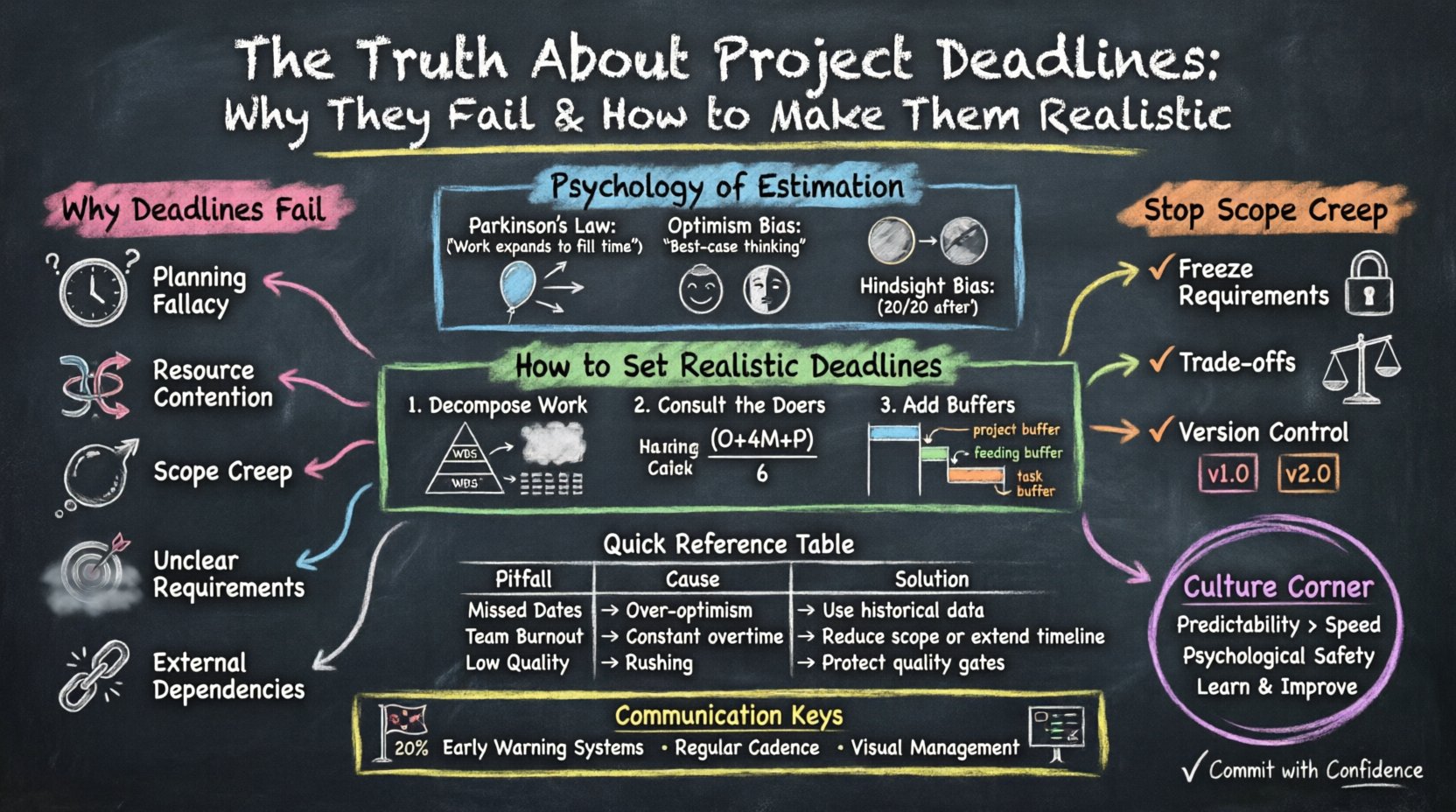
🔍 Why Deadlines Fail: The Hidden Culprits
When a project slips, it is tempting to blame the team. However, structural issues often lie beneath the surface. Identifying these root causes allows you to address the problem rather than the symptoms.
The Planning Fallacy: This is a cognitive bias where people underestimate the time needed to complete a task. We focus on the ideal scenario where everything goes right, ignoring the likelihood of delays.
Resource Contention: Team members often work on multiple projects simultaneously. When one project demands attention, others stall. This context switching kills productivity.
Scope Creep: Features get added without adjusting the timeline. Small changes accumulate until they become massive delays.
Unclear Requirements: If the goal is vague, the team wastes time clarifying rather than building. Ambiguity leads to rework.
External Dependencies: Waiting on third parties, approvals, or infrastructure creates bottlenecks that internal teams cannot control.
Recognizing these factors helps you anticipate risks. It shifts the conversation from “why are we late?” to “what risks are we managing?”.
🧠 The Psychology of Estimation
Estimating time is an art, not a science. Human beings are notoriously bad at predicting the future, especially when it involves complex work. Several psychological principles play a role in how we perceive time and effort.
1. Parkinson’s Law
This principle states that work expands to fill the time available for its completion. If you give a task a week, it will take a week. If you give it a day, it will likely take a day. While this sounds useful, it can also lead to unnecessary padding. Teams may subconsciously slow down if they feel they have ample time, or rush dangerously if the time is tight.
2. The Optimism Bias
We tend to believe our own plans are more likely to succeed than reality suggests. This leads to aggressive timelines that ignore historical data. Past projects that ran late should inform future estimates, yet we often ignore this evidence.
3. Hindsight Bias
After a project finishes, it is easy to say “it should have taken this long.” This makes it difficult to learn from mistakes. We forget the complexity we faced during the actual work.
To counter these biases, we must rely on data and diverse perspectives rather than gut feelings.
🛠️ How to Set Realistic Deadlines
Creating a schedule that works requires a disciplined approach. It involves breaking down work, consulting experts, and building in safety margins. Here is a step-by-step framework.
1. Decompose the Work
Large projects are intimidating and hard to estimate. Break them down into the smallest possible tasks. A task should ideally take no more than a few days to complete. If a task is too big, it hides hidden complexities. Break it down until the effort is visible.
Work Breakdown Structure (WBS): Organize tasks hierarchically. Start with major milestones, then phases, then individual activities.
Definition of Done: Clearly define what completion looks like for each task. This prevents teams from stopping work prematurely.
2. Consult the Doers
Never estimate tasks for someone else. The person doing the work knows the intricacies better than anyone. Ask them for their input, but do not let them set the deadline alone. They may be too optimistic or too cautious.
Three-Point Estimation: Ask for three values: Optimistic (O), Pessimistic (P), and Most Likely (M). Calculate the weighted average: (O + 4M + P) / 6.
Confidence Levels: Ask the team how confident they are in their estimate. Low confidence requires a larger buffer.
3. Add Buffers Strategically
No plan survives contact with reality. You need buffers to absorb shocks. However, buffers should not be hidden at the end of the project. Hidden buffers are often consumed by procrastination.
Project Buffer: Place this at the end of the critical path to protect the final delivery date.
Feeding Buffers: Place these before major milestones to protect them from upstream delays.
Task Buffers: Small amounts of time added to individual tasks to account for minor interruptions.
📉 Managing Scope Creep
Scope creep is the silent killer of deadlines. It happens when new requirements are added without adjusting the timeline or resources. This is often driven by well-meaning stakeholders who want to improve the product.
Preventing Scope Creep
Freeze Requirements: Once the design phase is complete, lock the requirements. New requests must go through a formal change process.
Trade-offs: If a new feature is requested, offer a trade. “We can add this, but we must remove that feature to keep the date.”
Version Control: Define what is in Version 1.0 versus Version 2.0. Push nice-to-haves to the next release.
The Change Request Process
When a change is inevitable, document it. Record the impact on time, cost, and resources. This makes the consequence of the change clear to decision-makers. Often, the mere visibility of the cost is enough to stop unnecessary additions.
📊 Common Pitfalls vs. Solutions
To help visualize the relationship between common issues and their remedies, review the table below.
Pitfall | Root Cause | Proposed Solution |
|---|---|---|
Missed Dates | Over-optimistic estimates | Use historical data for calibration |
Team Burnout | Constant overtime to meet tight dates | Reduce scope or extend timeline |
Low Quality | Rushing to finish before deadline | Protect quality gates regardless of schedule |
Communication Gaps | Stakeholders unaware of delays | Implement regular status updates |
Resource Conflicts | Team members double-booked | Visualize capacity and load |
🗣️ Communication Strategies
Even the best plan can fail if communication is poor. Stakeholders need to know the status of the project, especially when risks emerge. Transparency builds trust, even when the news is bad.
1. Early Warning Systems
Do not wait until the deadline to report issues. Establish triggers that indicate a task is at risk. If a task is 20% behind schedule, flag it immediately. This gives the team time to find a solution before it becomes a crisis.
2. Regular Cadence
Schedule recurring check-ins. These do not need to be long. Short, frequent meetings allow for quick course corrections. Ensure these meetings focus on blockers and risks, not just status updates.
3. Visual Management
Use visual aids to represent progress. Gantt charts show the timeline. Kanban boards show the flow of work. Visuals help stakeholders understand the complexity of the situation without needing a detailed report.
🏗️ Building a Predictable Culture
Deadlines are not just about tools or techniques. They are about culture. A team that fears failure will hide problems. A team that values honesty will surface risks early.
Prioritize Predictability Over Speed
Speed is important, but predictability is more valuable for long-term planning. If a team consistently delivers on time, even if it is slower, stakeholders can trust the schedule. Consistency builds a reputation for reliability.
Psychological Safety
Team members must feel safe admitting they do not know something or that they are struggling. Blameless post-mortems are essential. After a project, review what went wrong without assigning punishment. Focus on process improvements.
Continuous Improvement
Review estimates after every project. Compare the planned time versus the actual time. This data helps you calibrate future estimates. Over time, your estimation accuracy will improve significantly.
🚀 Handling External Dependencies
Some delays are out of your control. Vendors, regulatory bodies, or other departments can delay your work. Managing these requires specific tactics.
Contractual Agreements: Define deadlines in contracts with external parties. Include penalties for delays if necessary.
Early Engagement: Bring external partners into the conversation as early as possible. Their timeline should inform your schedule.
Parallel Work: Identify tasks that do not depend on the external party. Do these while you wait. This keeps momentum going.
📝 The Role of Risk Management
Risk management is often treated as a separate activity, but it must be integrated into the deadline planning process.
Risk Register: Maintain a list of potential risks. Assign a probability and impact score to each.
Mitigation Plans: For high-priority risks, have a plan ready. If the risk occurs, execute the plan immediately.
Contingency Reserve: Allocate time and budget specifically for identified risks. This is different from the project buffer.
🔄 Post-Project Analysis
The learning process does not end when the project closes. A review session is crucial for refining future deadlines.
Key Questions to Ask
Why did we miss this deadline?
Was the estimate realistic or optimistic?
Did scope creep occur? How was it handled?
Were resources available when needed?
How accurate was our risk assessment?
Documenting these answers creates institutional knowledge. New project managers can use this data to set better expectations from day one.
🤝 Aligning Stakeholders
Deadlines are often set by stakeholders who do not understand the technical work. Aligning their expectations is a critical part of the process.
Educate Them: Explain the complexity of the work. Help them understand why certain tasks take time.
Set Expectations Early: Communicate risks at the start. “We can meet this date, but it depends on X. If X changes, the date changes.”
Offer Options: Instead of saying “no,” offer trade-offs. “We can have this feature, but it will push the launch by two weeks.”
📌 Final Thoughts on Deadline Management
Setting realistic deadlines is about respect. It is respect for the team’s effort, respect for the client’s expectations, and respect for the product itself. When you commit to a date, you are making a promise. Keeping that promise requires discipline, data, and communication.
There is no magic formula to predict the future. However, by breaking down work, consulting the team, managing scope, and maintaining transparency, you can build schedules that stand up to reality. The goal is not to be perfect, but to be reliable. Over time, this reliability becomes your greatest asset in project management.
Start applying these principles today. Review your current projects. Identify where the estimates are weak. Talk to your team. Adjust the buffers. The next deadline does not have to be a gamble. It can be a commitment you are confident you can keep.