
Welcome to the world of structured delivery. Whether you are coordinating a small team event or overseeing a complex product launch, the core principles remain the same. Project management is not about micromanagement or endless meetings. It is about clarity, direction, and ensuring that a defined goal is reached within specific constraints. This guide breaks down the fundamental mechanics of leading projects so you can move from uncertainty to execution.
📌 What Is Project Management?
At its core, a project is a temporary endeavor undertaken to create a unique product, service, or result. Unlike ongoing operations, projects have a beginning and an end. Project management is the application of knowledge, skills, tools, and techniques to project activities to meet the project requirements. It involves balancing scope, time, cost, and quality.
When you lead a project, you are essentially acting as the navigator. You do not necessarily drive every part of the vehicle, but you ensure the map is correct, the fuel is sufficient, and the team knows the destination. This requires a shift in mindset from task-doer to outcome-owner.
🔑 Key Characteristics of a Project
Temporary: Every project has a defined start and end date.
Unique: The deliverable is not a standard, repetitive output.
Progressive Elaboration: Details become clearer as the project moves forward.
Constraints: Projects always operate within limits like budget and resources.
🔄 The Project Lifecycle: Five Phases
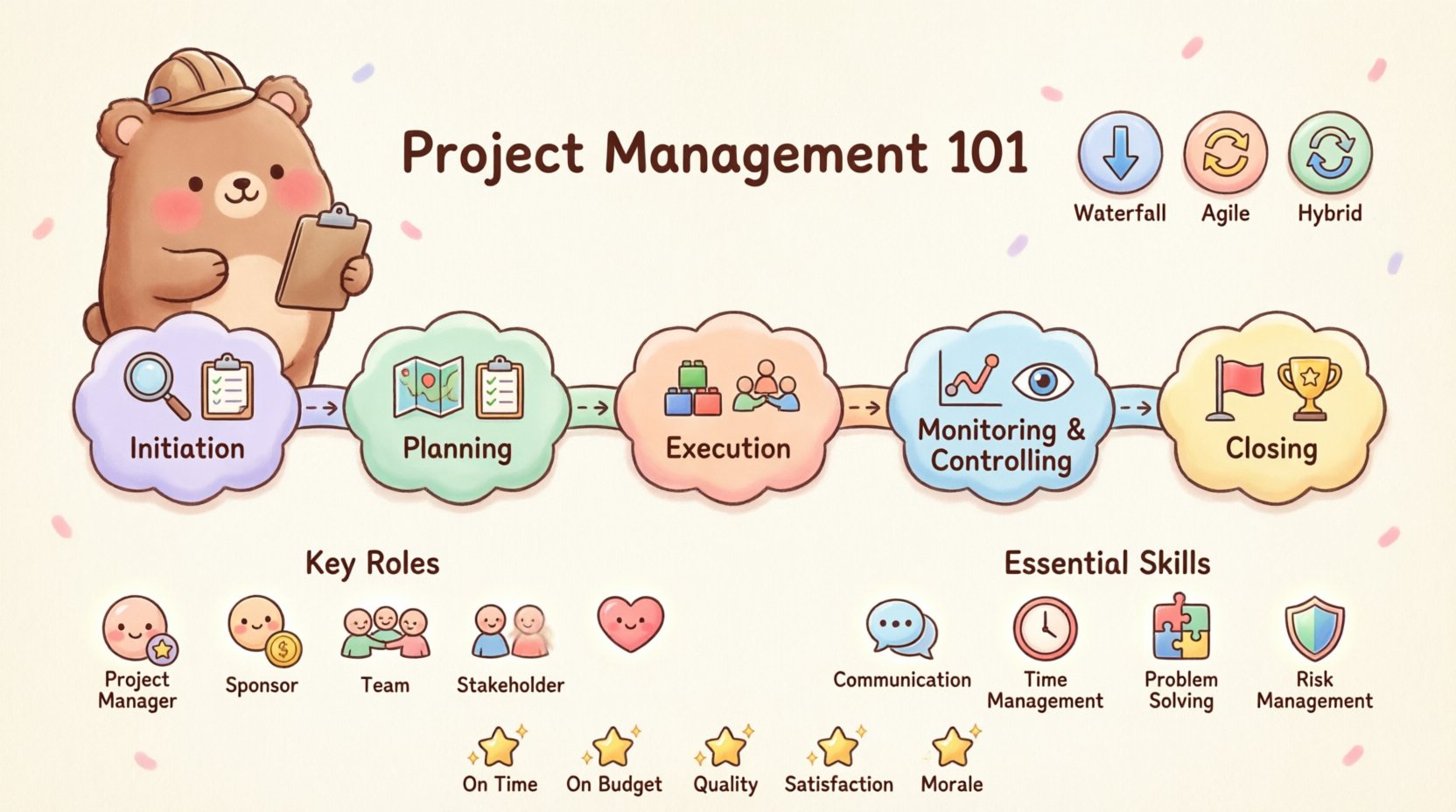
Understanding the lifecycle is crucial. Most methodologies agree on five distinct phases. Moving through these ensures nothing falls through the cracks.
1. Initiation 🔍
This phase is about defining the project at a broad level. You are answering the “why” and “what” before the “how”.
Goal: Define the business need and secure approval to start.
Deliverable: A Project Charter or Business Case.
Action: Identify stakeholders and set high-level objectives.
2. Planning 🗺️
This is where the map is drawn. Planning is often the most critical phase because it sets the baseline for success. If you plan poorly, execution will be chaotic.
Goal: Define the scope, schedule, and budget.
Deliverable: Project Management Plan.
Action: Break down work, estimate timelines, and identify risks.
3. Execution 🏗️
This is where the work happens. The team produces the deliverables outlined in the plan. The manager’s role shifts to coordination and support.
Goal: Complete the work defined in the scope.
Deliverable: Actual product, service, or result.
Action: Manage team performance and ensure quality standards.
4. Monitoring and Controlling 📊
While execution is happening, you must track progress. This phase runs parallel to execution. You compare actual performance against the plan.
Goal: Identify variances and take corrective action.
Deliverable: Status Reports and Change Requests.
Action: Track budget, schedule, and scope changes.
5. Closing 🏁
Formally ending the project is often skipped, but it is vital for organizational learning.
Goal: Obtain acceptance and close contracts.
Deliverable: Final Report and Lessons Learned.
Action: Release resources and archive documentation.
🛠️ Methodologies: Choosing Your Approach
There is no single way to manage a project. The approach depends on the nature of the work. Here is a comparison of the most common frameworks.
Methodology | Best For | Flexibility | Structure |
|---|---|---|---|
Waterfall | Construction, Manufacturing | Low | Sequential |
Agile | Software, Creative Work | High | Iterative |
Hybrid | Complex Enterprises | Medium | Mixed |
Waterfall
This is a linear approach. You finish one phase before moving to the next. It is rigid but predictable. It works well when requirements are clear and unlikely to change.
Agile
This approach focuses on flexibility and customer feedback. Work is broken into small chunks called sprints. Changes are expected and welcomed. This is ideal for environments where the end goal might shift based on user feedback.
Hybrid
Combines elements of both. You might use Waterfall for the planning phase and Agile for the execution phase. This allows for structure in budgeting while allowing flexibility in development.
👥 Key Roles and Responsibilities
Confusion often arises about who does what. Clear roles prevent bottlenecks. Below is a breakdown of the typical structure.
Role | Responsibility |
|---|---|
Project Manager | Owns the plan, manages risks, and leads the team. |
Sponsor | Provides funding and strategic direction. |
Team Members | Execute the tasks and deliver the work. |
Stakeholders | Have an interest in the outcome (clients, users). |
🧠 Essential Skills for Leaders
Technical skills get you hired, but soft skills keep you in the room. To lead with confidence, focus on developing these core competencies.
Communication 🗣️
This is the single most important skill. You must translate technical details for business leaders and business goals for the technical team. Clear communication prevents scope creep and misunderstandings.
Active Listening: Hear what is not being said.
Written Updates: Keep stakeholders informed without overwhelming them.
Feedback Loops: Create safe channels for team members to raise issues.
Time Management ⏱️
You must manage your own time and the team’s time. This involves prioritization and realistic scheduling.
Prioritization: Focus on high-value tasks first.
Delegation: Trust your team to own their work.
Deadline Adherence: Respect timelines to build trust.
Problem Solving 🧩
Issues will arise. Your job is to remain calm and find solutions. Avoid blaming; focus on fixing.
Risk Identification: Spot issues before they become crises.
Root Cause Analysis: Find the underlying reason for a problem.
Decision Making: Make timely decisions with available data.
⚠️ Risk Management
Risk is uncertainty that can affect objectives. Ignoring risk is a gamble. Effective risk management involves identifying potential issues and planning how to handle them.
Types of Risks
Technical: Technology fails or does not integrate.
Financial: Budget runs out or costs increase.
Schedule: Deadlines are missed.
Resource: Key staff leave or become unavailable.
Mitigation Strategies
For every significant risk, have a plan.
Avoid: Change the plan to eliminate the risk.
Transfer: Shift the risk to a third party (e.g., insurance).
Reduce: Take steps to lower the probability or impact.
Accept: Acknowledge the risk and prepare a contingency budget.
🚧 Common Pitfalls to Avoid
Even experienced leaders make mistakes. Being aware of common traps can save you from frustration.
Scope Creep 📈
This happens when small changes accumulate without formal approval. The project grows beyond its original intent.
Solution: Implement a strict change control process. No change is made without approval.
Unclear Goals 🎯
If the team does not know what success looks like, they will not achieve it.
Solution: Define SMART goals (Specific, Measurable, Achievable, Relevant, Time-bound) at the start.
Overloading the Team 🏋️♂️
Assigning too much work leads to burnout and poor quality.
Solution: Monitor workload regularly. Ensure capacity matches demand.
Poor Communication 📉
Information silos cause delays and errors.
Solution: Establish a regular cadence for updates. Use a central repository for documents.
📏 Measuring Success
How do you know the project was a success? It is not just about finishing on time. It is about value delivery.
On Time: Did you meet the deadline?
On Budget: Did you stay within financial limits?
Quality: Does the deliverable meet the requirements?
Stakeholder Satisfaction: Are the clients and users happy?
Team Morale: Is the team healthy and motivated?
❓ Frequently Asked Questions
Do I need a certification to start?
No. While certifications like PMP or CAPM are valuable for career growth, practical experience is often more important for daily success. Focus on learning the fundamentals first.
How do I handle difficult stakeholders?
Listen to their concerns. Understand their underlying interests. Document agreements clearly. If conflicts persist, escalate to the project sponsor for resolution.
What is the best tool to use?
There is no single best tool. The best tool is the one your team will actually use. It could be a spreadsheet, a whiteboard, or a dedicated task management system. Consistency matters more than the software.
How do I manage remote teams?
Focus on output rather than hours. Over-communicate status. Use video calls for complex discussions and text for quick updates. Establish clear norms for availability.
Can I manage multiple projects at once?
Yes, but it requires high-level organization. Prioritize based on strategic value. Ensure you have enough capacity to handle the workload without burnout.
🔚 Final Thoughts
Project management is a journey of continuous improvement. You will not get every detail perfect on the first try. The goal is progress. By following the lifecycle, communicating clearly, and preparing for risks, you build a foundation for consistent delivery. Start small, apply these principles, and scale your approach as you gain experience. Leadership is not about having all the answers; it is about guiding the team to find them together.