
Entering the world of organizational coordination often brings a specific type of confusion. You are handed a list of items to complete, a deadline to meet, and a team to organize. But are you managing projects, or are you simply managing tasks? This distinction is not merely semantic; it dictates how you allocate resources, communicate with stakeholders, and measure success. For new coordinators, understanding the nuance between these two disciplines is the foundation of professional effectiveness.
While the terms are frequently used interchangeably in casual conversation, they represent different scopes of work, different timeframes, and different skill requirements. Task management focuses on the execution of individual actions. Project management focuses on the strategic delivery of a specific outcome. Confusing the two can lead to scope creep, missed deadlines, and burnout. This guide breaks down the differences clearly, helping you navigate your responsibilities with confidence.
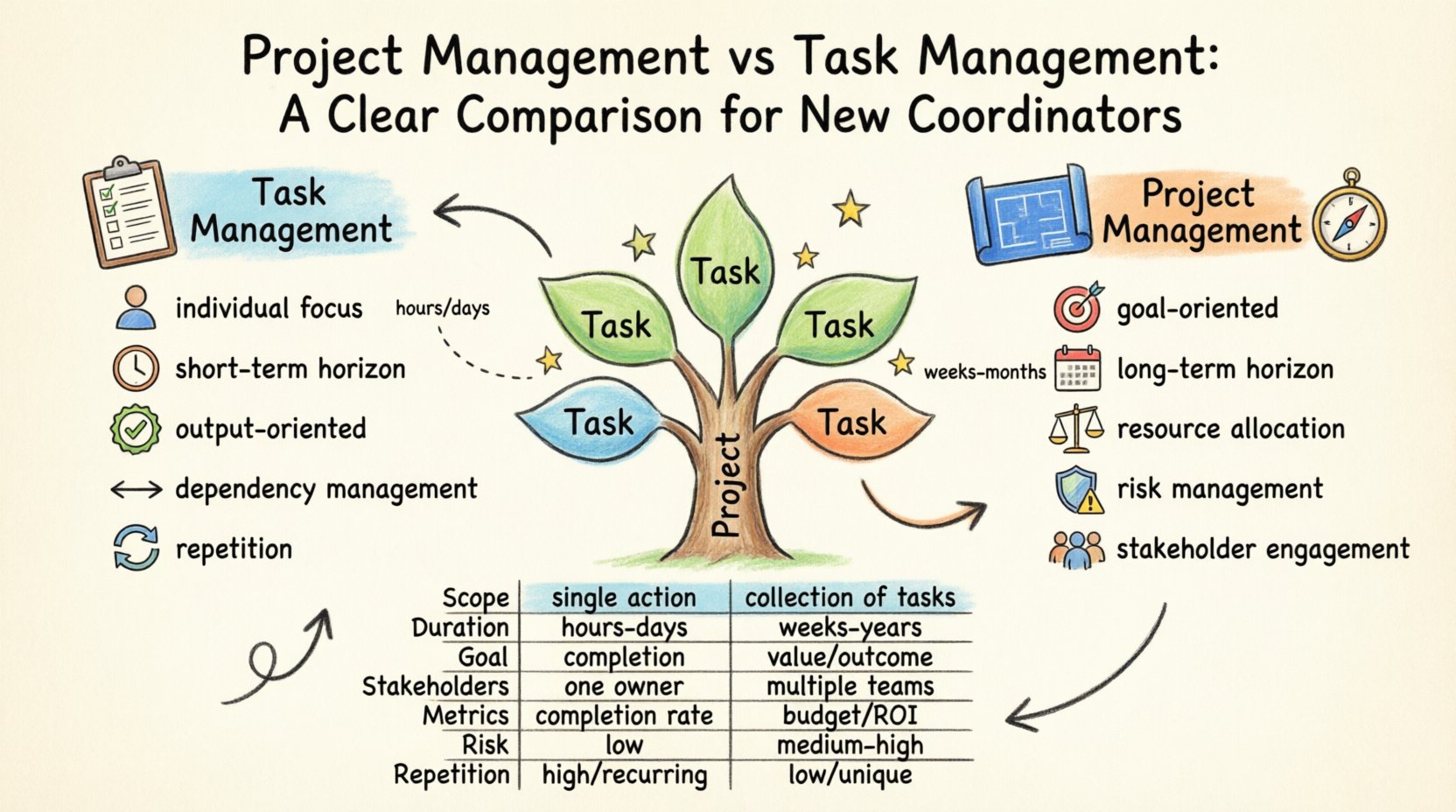
📝 Understanding Task Management
Task management is the process of planning, organizing, and tracking individual units of work. It is granular by nature. When you engage in task management, you are answering the question: “What needs to be done right now?” It is the operational layer of work.
Here are the core characteristics that define task management:
Individual Focus: It centers on single items or discrete actions. A task has a clear start and a clear end.
Short-Term Horizon: Tasks are often completed within hours, days, or at most a week. They do not typically span months.
Output Oriented: The goal is completion. Once the task is checked off, the immediate objective is met.
Dependency Management: While tasks can depend on other tasks, the complexity is usually linear and manageable by a single owner.
Repetition: Many tasks are recurring. They may happen daily, weekly, or monthly as part of a routine operation.
For a coordinator, task management is the bread and butter of daily work. It involves maintaining a list, prioritizing items based on urgency, and ensuring that each item moves from “pending” to “done.” It is about efficiency and throughput.
🏗️ Understanding Project Management
Project management is the application of knowledge, skills, tools, and techniques to project activities to meet the project requirements. It is strategic by nature. When you engage in project management, you are answering the question: “How do we deliver this specific goal successfully?” It is the tactical and strategic layer of work.
A project is a temporary endeavor undertaken to create a unique product, service, or result. Unlike ongoing operations, a project has a defined beginning and a defined end. Here is what defines this discipline:
Goal Oriented: The focus is on a specific outcome or deliverable, not just the completion of activities.
Long-Term Horizon: Projects span weeks, months, or even years. They require sustained effort and planning.
Resource Allocation: Projects require the coordination of people, budget, time, and materials. You must balance these constraints.
Risk Management: Because projects are complex and temporary, they carry inherent risks. Identifying and mitigating these is a core function.
Stakeholder Engagement: Projects usually involve multiple groups of people with varying interests. Communication is critical.
Project management encompasses the entire lifecycle. It begins with initiation, moves through planning and execution, and ends with closure. It is about effectiveness and value delivery.
📊 Key Differences at a Glance
To visualize the distinction, consider the following comparison. This table highlights the structural differences that influence how you approach your work.
Feature | Task Management | Project Management |
|---|---|---|
Scope | Single action or unit of work | A collection of related tasks leading to a deliverable |
Duration | Short-term (Hours to Days) | Long-term (Weeks to Years) |
Goal | Completion | Value and Outcome |
Stakeholders | Usually one owner or manager | Multiple teams, clients, and sponsors |
Metrics | Completion rate, Time spent | Budget variance, ROI, Timeline adherence |
Risk Level | Low | Medium to High |
Repetition | High (Recurring) | Low (Unique) |
Notice how the scope shifts from a single unit to a collection. This shift changes the coordinator’s mindset from “getting things done” to “delivering a result.”
🤝 How They Intersect
It is a common misconception that these two disciplines exist in silos. In reality, they are deeply interconnected. You cannot have a project without tasks, but you cannot manage a project by only looking at tasks.
Think of a project as a tree trunk and the tasks as the leaves. The trunk supports the structure, but the leaves are the active units of growth. To manage the tree, you must prune the leaves (tasks) while ensuring the trunk (project) remains stable.
Here is how they function together in a typical workflow:
Breakdown: A project manager defines the project scope. This scope is broken down into work packages.
Assignment: Work packages are further divided into specific tasks.
Execution: Team members work on the tasks.
Tracking: Progress on tasks aggregates to show progress on the project.
Reporting: Task completion status informs project status reports.
For a coordinator, this intersection is where the work happens. You are often the bridge. You take the high-level project goals and translate them into actionable task lists. You take the task status and translate it into project progress updates.
⚠️ Common Challenges for Coordinators
New coordinators often stumble when they fail to distinguish between the two management styles. This leads to specific pitfalls that can hinder progress.
1. Mistaking Activity for Progress
It is easy to feel productive when you are checking off dozens of tasks. However, being busy with tasks does not guarantee the project is succeeding. You might complete all assigned tasks but still miss the strategic goal of the project. Always verify that the tasks align with the project objectives.
2. Scope Creep
In task management, adding a new item to the list is simple. In project management, adding a new item changes the baseline. If you accept new tasks without assessing their impact on the timeline or budget, the project scope expands uncontrollably. You must evaluate every new request against the project charter.
3. Ignoring Dependencies
Tasks often rely on other tasks. A project relies on tasks being completed in a specific order. If you manage tasks in isolation, you might assign work that cannot start until a prerequisite is finished. Understanding the critical path is essential for project management.
4. Lack of Risk Visibility
Task lists rarely show risk. They show status. If a task is “in progress,” you assume it is fine. In project management, you must actively look for what could go wrong. A task might be on schedule but at risk of quality failure. A project might be on budget but at risk of stakeholder disapproval.
🛠️ Essential Skills for Success
Whether you lean more towards tasks or projects, certain skills are required to excel. A coordinator needs a blend of organizational precision and strategic foresight.
Skills for Task Management
Time Blocking: The ability to allocate specific time slots for specific actions.
Prioritization: Distinguishing between urgent and important activities.
Attention to Detail: Ensuring small items are not overlooked.
Follow-up: Ensuring communication loops are closed on every item.
Skills for Project Management
Strategic Planning: Mapping out the journey from start to finish.
Communication: Managing expectations across different teams and levels.
Problem Solving: Navigating obstacles that arise during the lifecycle.
Negotiation: Balancing resources, time, and scope when conflicts arise.
Developing both sets of skills makes you a versatile coordinator. You become the person who can handle the daily grind while keeping an eye on the big picture.
🔁 Best Practices for Daily Work
To operate effectively, you need a system. While tools vary, the underlying principles remain consistent. Adopt these practices to maintain clarity.
1. Define the Outcome First
Before creating a list of tasks, define the project outcome. Ask: “What does success look like?” If you cannot answer this, do not start breaking down tasks. Clarity on the end result prevents wasted effort on the wrong actions.
2. Group Tasks by Project
Do not maintain a single, flat list of everything. Group tasks under their respective projects. This provides context. When you open a task list, you should immediately know which goal it serves. This prevents context switching and mental fatigue.
3. Establish Checkpoints
For projects, do not wait until the deadline to check progress. Establish milestones. These are checkpoints where you review the state of the work. For tasks, establish review times. Are you spending too long on one item? Does this task need to be delegated?
4. Document Decisions
In project management, decisions often change the course of work. Document why a decision was made. If a scope change occurs, record it. This creates a history that helps you understand the project evolution and protects against miscommunication.
5. Review and Reflect
At the end of a project or a week, review what happened. What tasks took longer than expected? What project risks materialized? Use this data to improve your planning for the next cycle. Continuous improvement is the engine of coordination.
📈 Measuring Success
How do you know if your management approach is working? You need metrics. However, the metrics differ based on the scope.
Task Metrics
Completion Rate: Percentage of tasks finished within a set period.
Lead Time: Time from task creation to completion.
Backlog Size: Number of pending tasks at any given time.
Project Metrics
Budget Variance: The difference between planned and actual costs.
Schedule Variance: The difference between planned and actual timelines.
Deliverable Quality: Whether the final output meets the defined standards.
Stakeholder Satisfaction: Feedback from those invested in the outcome.
Tracking these numbers helps you identify bottlenecks. If your completion rate is high but your budget variance is negative, you might be working too fast and overspending. If your timeline is met but stakeholder satisfaction is low, you missed the quality expectations. Balance is key.
🧭 Navigating the Future
The landscape of work is evolving. Automation is handling more routine tasks. This means the value of the coordinator shifts even further toward project management and strategic oversight. You will spend less time chasing items and more time ensuring those items align with broader goals.
Embracing this shift requires discipline. It requires you to step back from the immediate demands and look at the trajectory of your work. It requires you to speak the language of business value, not just the language of activity.
By mastering the distinction between managing tasks and managing projects, you position yourself as a critical asset. You become the person who ensures that work is not just done, but done right. You become the anchor that keeps the team focused on the destination, rather than just the steps along the way.
Start by auditing your current workload. Separate your projects from your tasks. Apply the appropriate management style to each. Watch your efficiency and your impact grow.