
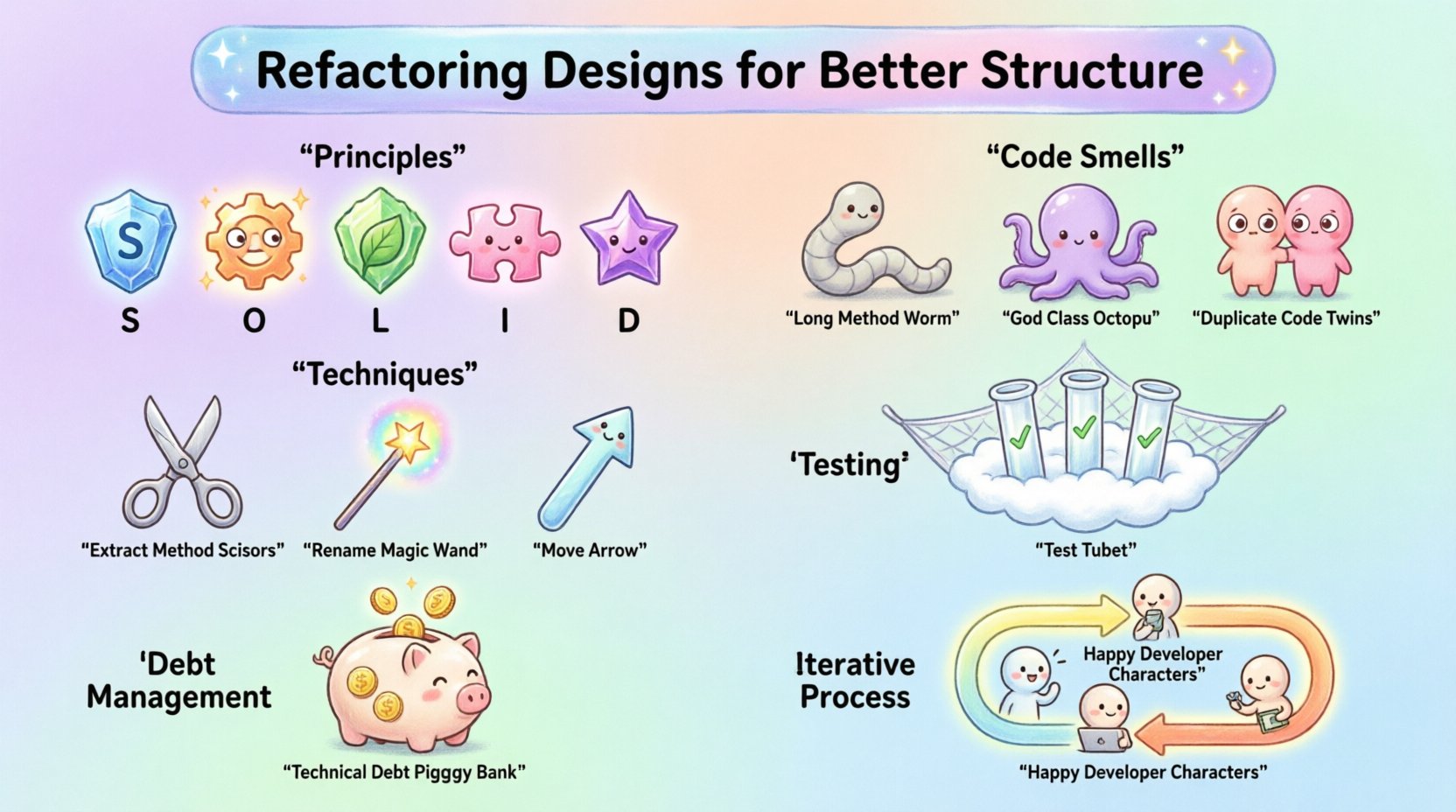
Software systems are living entities. They evolve, change, and grow alongside the requirements they serve. However, as features accumulate and deadlines loom, the internal architecture of a system often begins to degrade. This degradation is not immediate; it is a slow erosion of quality known as technical debt. To combat this, developers must engage in the deliberate process of refactoring. Refactoring is not about adding new features or changing external behavior; it is about improving the internal structure of the code without altering its functionality. In the context of Object-Oriented Analysis and Design (OOAD), this process is critical for maintaining flexibility and clarity.
When we design systems using object-oriented principles, we aim to create models that reflect real-world entities and their interactions. Over time, these models can become distorted. Classes grow too large, responsibilities blur, and dependencies become tangled. Refactoring allows us to restore the integrity of the design. It ensures that the structure of the codebase continues to support the business logic effectively. This guide explores the principles, techniques, and strategies required to refactor designs for better structure.
🧱 Foundational Principles for Structure
Before diving into specific techniques, it is essential to understand the theoretical underpinnings that guide good structure. Without these guiding stars, refactoring can become a random exercise of moving lines of code. The goal is to align the implementation with established design principles.
- Single Responsibility Principle: A class should have only one reason to change. If a class handles both database connections and user interface rendering, it violates this principle. Refactoring involves separating these concerns into distinct entities.
- Open/Closed Principle: Entities should be open for extension but closed for modification. When adding new functionality, the goal is to extend existing behavior rather than altering the core logic of existing classes.
- Dependency Inversion: High-level modules should not depend on low-level modules. Both should depend on abstractions. This reduces coupling and makes the system easier to test and modify.
- Interface Segregation: Clients should not be forced to depend on interfaces they do not use. Large, monolithic interfaces should be split into smaller, more specific ones.
- Liskov Substitution: Objects of a superclass should be replaceable with objects of its subclasses without breaking the application. Refactoring ensures that inheritance hierarchies remain logical and safe.
Adhering to these principles during refactoring ensures that the system remains robust. It transforms a collection of working code into a well-organized architecture.
🔍 Identifying Code Smells
Refactoring begins with recognition. You cannot fix what you cannot see. Code smells are indicators of potential structural issues. They are not bugs, but they suggest that the design is becoming fragile. Below is a structured overview of common code smells encountered in object-oriented systems.
| Code Smell | Description | Refactoring Implication |
|---|---|---|
| Long Method | A function that performs too many distinct tasks. | Split into smaller, focused methods. |
| God Class | A class that knows or does too much. | Break down into smaller, specialized classes. |
| Feature Envy | A method that uses data from another class more than its own. | Move the method to the class it depends on. |
| Data Class | A class that holds data but has no behavior. | Add methods that operate on the data to the class. |
| Duplicate Code | Similar logic appears in multiple places. | Extract common logic into a shared method. |
| Switch Statements | Complex conditional logic used to determine behavior. | Replace with polymorphism or strategy patterns. |
Recognizing these patterns allows developers to prioritize refactoring efforts. When a God Class is identified, it signals a need for decomposition. When Duplicate Code appears, it indicates a missed opportunity for abstraction. Addressing these smells systematically improves the overall health of the design.
🛠️ Common Refactoring Techniques
Once issues are identified, specific techniques can be applied to resolve them. These techniques are categorized based on the type of structural change they effect. Each technique focuses on a specific aspect of the code, ensuring that changes are atomic and safe.
1. Extracting and Extracting Methods
The most fundamental technique is extracting. This involves taking a block of code and moving it into a new method or class. The primary benefit is the reduction of complexity in the original location.
- Extract Method: Select a segment of code that performs a single operation. Move it to a new method with a descriptive name. This makes the original method easier to read and the new method reusable.
- Extract Class: If a class has responsibilities that do not belong together, create a new class. Move the relevant fields and methods to the new class. Link the two classes through a reference.
2. Renaming and Organizing
Clarity is a structural attribute. If names are confusing, the structure is flawed. Renaming is not just cosmetic; it is a cognitive tool for understanding.
- Rename Variable: Change a name to reflect its true purpose. If a variable named
flagis used to track a specific status, rename it toisActive. - Rename Method: Ensure the method name describes exactly what it does. Avoid generic names like
processDatain favor ofvalidateUserInput. - Rename Class: A class name should represent the entity it models. If a class is used for calculations but named
Service, rename it toCalculator.
3. Moving Responsibilities
Often, functionality is located in the wrong place. Moving code to the appropriate class improves cohesion.
- Move Method: If a method uses the data of another class more than its own, move it. This reduces coupling and increases cohesion.
- Move Field: Similar to moving methods, move attributes to the class where they are most relevant.
- Introduce Parameter Object: If a method requires many arguments, group them into a single object. This reduces the signature length and improves clarity.
4. Reducing Complexity
Complex logic obscures intent. Refactoring should aim to simplify conditional structures and loops.
- Replace Conditional with Polymorphism: Instead of using a large
if-elseorswitchstatement to determine behavior, create subclasses that implement the behavior differently. - Replace Magic Numbers with Constants: Hard-coded values make code brittle. Define constants with meaningful names to improve readability.
- Inline Method: If a method is trivial and called only once, inline its code into the caller to remove unnecessary indirection.
🧪 Ensuring Safety During Refactoring
Changing code structure introduces risk. The goal is to change the structure without changing the behavior. This requires a robust testing strategy. Without tests, refactoring is a guess.
- Regression Testing: Before making structural changes, run the existing test suite to establish a baseline. If tests pass before and after, behavior is preserved.
- Unit Testing: Focus on testing small units of behavior. This allows you to verify that extracted methods function correctly independently.
- Integration Testing: Ensure that moving components between classes does not break the flow of data across the system.
- Automated Checks: Use static analysis tools to detect violations of design principles. These tools can highlight potential issues before they become problems.
Testing acts as a safety net. It gives the developer the confidence to make bold structural changes. It shifts the mindset from “fear of breaking things” to “confidence in improvement”.
💰 Managing Technical Debt
Refactoring is a financial decision as much as a technical one. Every hour spent refactoring is an hour not spent on new features. Therefore, technical debt must be managed strategically.
- Identify High-Impact Areas: Focus refactoring on modules that are frequently changed or contain critical logic. Do not waste time on stable, low-risk code.
- Boy Scout Rule: Leave the code cleaner than you found it. When touching a file for any reason, perform minor refactoring to improve its structure.
- Budget Refactoring Time: Allocate specific time in the development cycle for structural improvements. Treat it as a mandatory task, not an optional luxury.
- Communicate Value: Explain to stakeholders why refactoring is necessary. Frame it as risk reduction and future speed enhancement, not just code cleanup.
Ignoring technical debt compounds over time. The cost of fixing a design flaw doubles every time it is touched. Addressing it early is more efficient than dealing with a crumbling foundation later.
🔄 The Iterative Process
Refactoring is not a one-time event; it is a continuous process. It is woven into the daily workflow of development. The process follows a cycle of small, incremental steps.
- Make a Change: Start with a small, specific goal. For example, extract a single method.
- Run Tests: Verify that the change did not break existing functionality.
- Commit: Save the progress. Small commits make it easier to revert if something goes wrong.
- Repeat: Move to the next structural improvement.
This iterative approach prevents large, risky deployments. It allows the team to maintain a steady pace of delivery while steadily improving the codebase. It is the difference between a revolution and an evolution.
🌟 Conclusion on Structural Integrity
Maintaining a clean structure is essential for long-term software success. Object-Oriented Analysis and Design provides the framework for this, but it requires active maintenance. Refactoring is the tool that keeps the design aligned with the evolving needs of the system. By understanding principles, identifying smells, applying techniques, and testing rigorously, developers can ensure that their software remains adaptable and understandable.
The journey of refactoring is ongoing. As the system grows, the design must grow with it. There is no final state of perfection, only a continuous pursuit of clarity. By committing to this process, teams build systems that are resilient to change and efficient to maintain. This is the true value of good structure.