
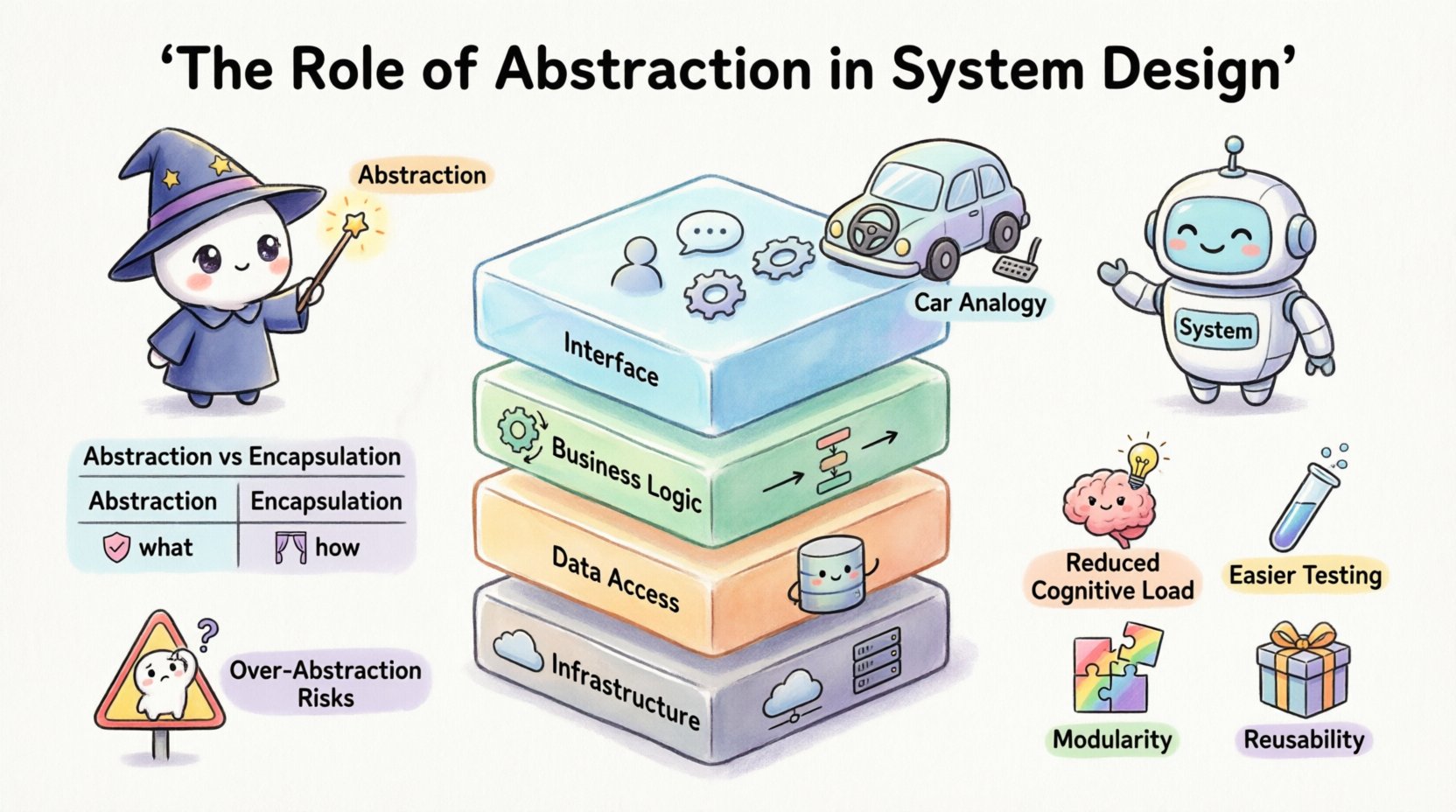
System design is fundamentally about managing complexity. As software systems grow in size and scope, the cognitive load required to understand, modify, and maintain them increases exponentially. In the context of Object-Oriented Analysis and Design (OOAD), abstraction serves as the primary mechanism for taming this complexity. It allows architects and developers to focus on what a system does rather than how it does it, creating a manageable mental model of the underlying logic. This article explores the critical role of abstraction in building robust, scalable, and maintainable software architectures.
🔍 Understanding Abstraction in OOAD
Abstraction is the process of hiding complex implementation details and exposing only the necessary functionality. In Object-Oriented Analysis and Design, this concept is not merely a coding technique; it is a philosophical approach to modeling real-world entities and their interactions. By defining abstract entities, we create a contract between different parts of a system without requiring them to know the internal workings of one another.
Consider a car. When you drive, you interact with the steering wheel, pedals, and gear stick. You do not need to understand the thermodynamics of the combustion engine or the hydraulic pressure within the braking system. The car itself provides an abstraction layer. In software, this translates to objects that expose methods and properties while keeping variables and internal algorithms private.
🏛️ Core Principles of Object-Oriented Abstraction
To effectively implement abstraction, designers must adhere to specific principles that ensure the integrity of the system. These principles guide how data and behavior are exposed to the rest of the application.
- Interface Definition: Defining a clear set of methods that a component must support, regardless of the underlying implementation.
- Implementation Hiding: Ensuring that the internal state of an object is not directly accessible from outside the object’s scope.
- Behavioral Contract: Establishing expectations about how an object will respond to specific inputs without revealing the logic used to generate the output.
- Modularity: Breaking down a system into distinct units that can be developed and tested independently.
When these principles are applied correctly, the system becomes more resilient to change. If the internal logic of a module changes, as long as the interface remains consistent, dependent modules do not require modification.
📊 Levels of Abstraction in System Architecture
Different parts of a system require different levels of abstraction. A user interface requires a high-level abstraction that focuses on user experience, while a database layer requires a lower-level abstraction that focuses on data integrity and storage efficiency. Understanding these levels helps in organizing code and responsibilities.
| Level | Focus | Example Concept |
|---|---|---|
| Interface | Interaction | What the user sees or calls |
| Business Logic | Process | Rules and workflows |
| Data Access | Storage | Retrieval and persistence |
| Infrastructure | Execution | Network, hardware, OS |
By clearly separating these levels, developers can swap out infrastructure components without affecting business logic, provided the interface contracts are maintained.
🛡️ Benefits of Strategic Abstraction
Implementing abstraction is not just about following a pattern; it delivers tangible benefits to the lifecycle of the software. These advantages accumulate over time, reducing technical debt and increasing developer velocity.
- Reduced Cognitive Load: Developers can work on specific modules without needing to understand the entire system. They only need to understand the interfaces they interact with.
- Easier Testing: Abstract interfaces allow for the creation of mock objects. This enables unit testing without requiring external dependencies like databases or network services.
- Enhanced Maintainability: When requirements change, the impact is contained within the specific module. The rest of the system remains insulated from the change.
- Improved Reusability: Generic abstractions can be reused across different projects. A data access layer designed with abstraction in mind can often be applied to multiple applications.
- Parallel Development: Teams can work on different components simultaneously. As long as the interface agreements are defined upfront, integration issues are minimized.
⚙️ Implementation Techniques
There are several ways to achieve abstraction within a system. Each technique serves a specific purpose depending on the nature of the data and the behavior being modeled.
1. Abstract Classes
Abstract classes provide a base structure for related objects. They can contain both implemented methods and abstract methods that must be defined by subclasses. This is useful when multiple objects share common functionality but require specific variations.
2. Interfaces
Interfaces define a contract without providing implementation. They are the purest form of abstraction, ensuring that any class implementing the interface adheres to the defined method signatures. This is crucial for decoupling components.
3. Data Abstraction
This involves hiding the internal representation of data. For example, a list data structure might hide whether it is implemented using an array or a linked list. The consumer of the data only cares about adding, removing, or iterating over items.
4. Process Abstraction
Complex processes are broken down into smaller, abstracted functions or services. Instead of writing out the entire logic flow in one place, a high-level function calls lower-level abstracted functions.
🔄 Abstraction vs. Encapsulation
While often used interchangeably, abstraction and encapsulation are distinct concepts. Confusing them can lead to poor design decisions. Encapsulation focuses on bundling data and methods together and restricting access, whereas abstraction focuses on exposing only essential features.
| Feature | Abstraction | Encapsulation |
|---|---|---|
| Definition | Hiding implementation details | Bundling data and methods |
| Focus | What the object does | How the object works |
| Goal | Reduce complexity | Protect internal state |
| Implementation | Abstract classes, Interfaces | Access modifiers, Private variables |
Understanding this distinction helps in applying the right tool for the job. Encapsulation protects the object, while abstraction simplifies the interaction with the object.
⚠️ Risks of Over-Abstraction
While abstraction is powerful, it is not without risks. Excessive abstraction can lead to confusion and rigidity. Designers must avoid creating abstractions before the need arises, a common pitfall known as premature abstraction.
- Complexity in Understanding: If layers of abstraction are too deep, tracing the flow of data becomes difficult. Debugging requires navigating through multiple interfaces.
- Performance Overhead: Indirect calls and virtual method dispatches can introduce latency, though this is often negligible compared to I/O operations.
- Reduced Flexibility: Highly abstracted systems can become rigid. If the abstraction is too specific, it may not accommodate future requirements without significant refactoring.
- Confusion for New Developers: A system with too many abstract layers can be intimidating for new team members trying to understand the codebase.
🛠️ Best Practices for Implementation
To maximize the benefits of abstraction while minimizing risks, follow these guidelines during the design phase.
- YAGNI Principle: Do not design for requirements that do not exist yet. Abstraction should solve a current problem, not a hypothetical future one.
- Keep Interfaces Small: Interfaces should be narrow and focused. A single method per concern is often better than a massive interface with dozens of methods.
- Document Contracts: Clearly document what an interface guarantees. This serves as the source of truth for developers using the abstraction.
- Use Concrete Classes for Implementation: Keep the implementation details simple. Do not hide simple logic behind complex abstractions.
- Refactor Regularly: As the system evolves, review abstractions. Remove unused interfaces and merge overly granular ones.
🚀 Scaling with Abstraction
As systems scale from small scripts to enterprise platforms, the need for robust abstraction grows. Large teams working on the same codebase rely on clear boundaries to prevent conflicts. Abstraction provides these boundaries.
In microservices architectures, for example, the API acts as the abstraction layer. The internal logic of a service can change completely, provided the API response format remains stable. This allows teams to update backend logic without breaking client applications.
Similarly, in plugin architectures, the core system defines abstract interfaces for plugins. The core does not know what specific plugin does, only that it conforms to the interface. This allows for extensibility without modifying the core code.
🔑 Key Takeaways for Designers
- Abstraction is essential for managing complexity in large systems.
- It separates the “what” from the “how,” allowing for flexible design.
- Interfaces and abstract classes are the primary tools for implementation.
- Balance abstraction with simplicity to avoid unnecessary overhead.
- Encapsulation protects state, while abstraction simplifies interaction.
- Design interfaces based on current needs to avoid premature abstraction.
Mastering the art of abstraction requires experience and discipline. It is not about creating more layers, but about creating the right layers. When done correctly, the system becomes a collection of well-defined components that work together seamlessly. This approach leads to software that is easier to build, easier to test, and easier to evolve over time.
For architects and developers committed to quality, prioritizing abstraction is not optional. It is a fundamental requirement for sustainable software engineering. By focusing on clear contracts and hidden complexity, teams can build systems that stand the test of time and changing requirements.