
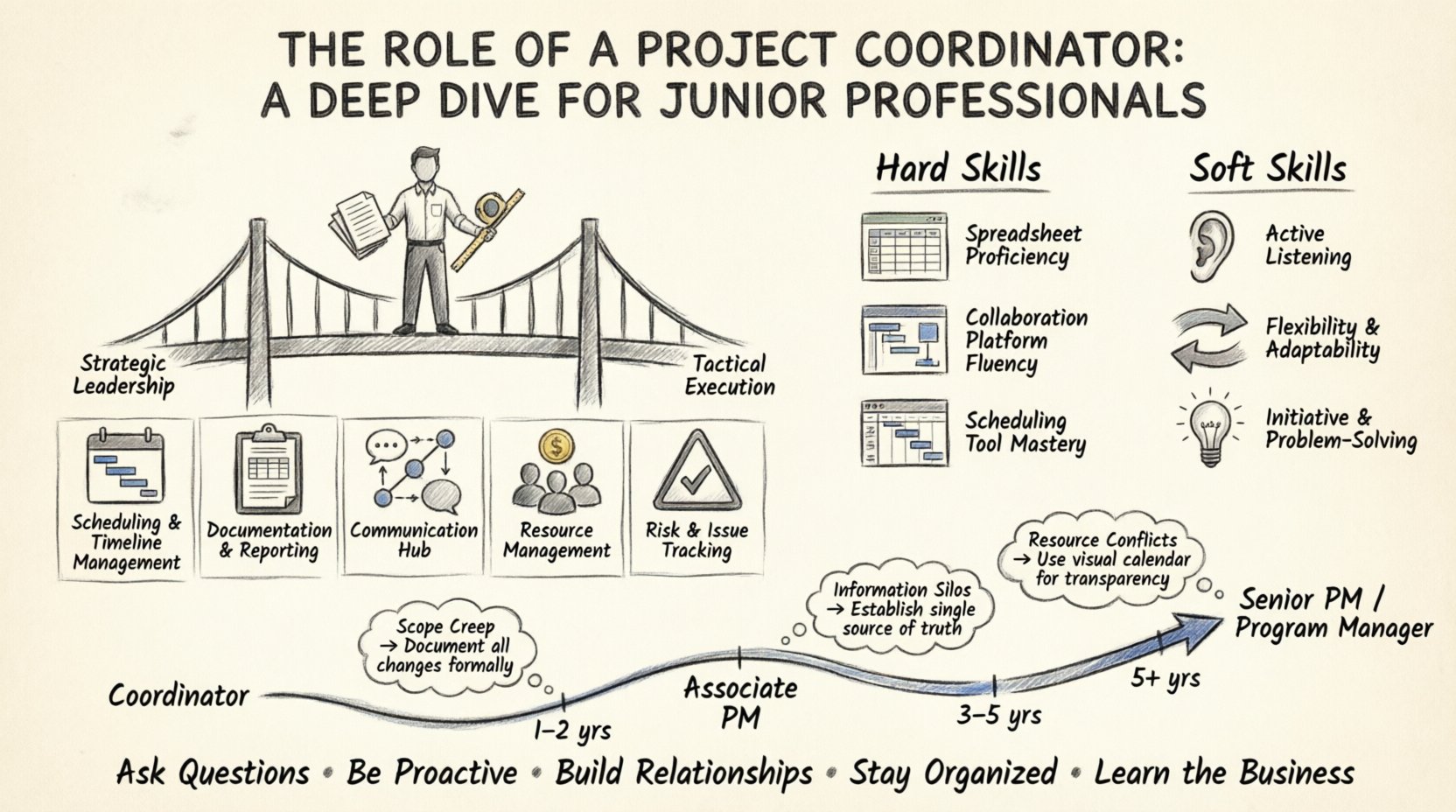
Entering the world of project management can feel like stepping onto a moving train. The pace is fast, the stakes are high, and the expectations are clear. For junior professionals, the entry point often comes in the form of the Project Coordinator role. This position acts as the backbone of project delivery, bridging the gap between strategic leadership and tactical execution.
While Project Managers focus on the vision and high-level strategy, the Project Coordinator ensures the wheels keep turning. It is a role that demands precision, communication, and an unwavering commitment to organization. If you are looking to understand what this position entails, how to excel in it, and where it can lead you, this guide provides a comprehensive look at the responsibilities and skills required.
Defining the Project Coordinator Position 🛠️
A Project Coordinator is primarily responsible for supporting the Project Manager and the team throughout the project lifecycle. They handle the logistical details that allow the larger team to focus on execution. Without this role, communication breakdowns and missed deadlines become common issues. The coordinator acts as the central hub for information flow.
This role is distinct from the Project Manager, though the lines can blur in smaller organizations. The Manager sets the direction; the Coordinator tracks the path. They ensure that resources are allocated correctly, timelines are updated, and stakeholders are informed.
Key Distinctions from Project Management 🔄
Strategic vs. Tactical: The Project Manager focuses on strategy and decision-making, while the Coordinator focuses on task execution and tracking.
Authority: Managers often have the authority to make scope changes; Coordinators usually facilitate the documentation of those changes.
Scope: Coordinators often manage multiple smaller tasks or administrative duties across several projects simultaneously.
Core Responsibilities and Daily Tasks 📅
The day-to-day life of a Project Coordinator involves a mix of administrative duties and active communication. Below is a breakdown of the primary responsibilities that define this role.
Primary Duties Overview
Responsibility Area | Specific Tasks | Impact on Project |
|---|---|---|
Scheduling & Timeline Management | Updating Gantt charts, tracking milestones, sending reminders | Ensures deadlines are met and delays are caught early |
Documentation & Reporting | Meeting minutes, status reports, change logs | Creates a single source of truth for project health |
Communication Hub | Organizing meetings, distributing agendas, following up on action items | Keeps all stakeholders aligned and informed |
Resource Management | Tracking team availability, managing budgets (basic), ordering supplies | Prevents bottlenecks caused by lack of resources |
Risk & Issue Tracking | Maintaining risk registers, logging blockers | Enables proactive problem solving before escalation |
Detailed Breakdown of Tasks
Understanding the specific actions involved helps clarify the weight of the role. Here is what the work actually looks like in practice.
Meeting Coordination: This goes beyond booking a room. It involves preparing the agenda, inviting the right people, taking detailed notes, and distributing the minutes within 24 hours. The Coordinator ensures that what was discussed leads to action.
File Management: Organizing project documentation is critical. This includes version control, ensuring the latest contracts are accessible, and archiving completed project artifacts.
Status Updates: Compiling data from different team members into a cohesive report. This requires the ability to ask for updates without being intrusive and to synthesize raw data into clear insights.
Stakeholder Liaison: Acting as the first point of contact for external vendors or internal clients. This requires professionalism and the ability to manage expectations regarding timelines and deliverables.
Essential Hard Skills for Success 🧠
While soft skills are vital, there are tangible technical abilities required to perform the job effectively. These hard skills form the foundation of your daily workflow.
1. Organizational Tools Proficiency
You do not need to be a developer, but you must be comfortable with digital platforms. This includes:
Spreadsheet Software: Advanced use of formulas, pivot tables, and conditional formatting to track budgets and timelines.
Collaboration Platforms: Navigating shared drives, task management boards, and communication channels used by the team.
Scheduling Software: Managing complex calendars, handling time zone differences, and avoiding conflicts.
2. Documentation Standards
Writing clear, concise documentation is a non-negotiable skill. You will be creating:
Project Charters
Meeting Minutes
Standard Operating Procedures (SOPs)
Status Reports
Each document must be accurate, easy to read, and stored in a location where others can find it immediately.
3. Basic Financial Literacy
Even if you are not the accountant, you need to understand the financial aspect of projects. This involves:
Tracking expenses against a budget
Understanding invoice processing cycles
Identifying variances between projected and actual costs
Soft Skills That Drive Performance 🤝
Technical skills get you hired; soft skills get you promoted. In a role defined by people and processes, emotional intelligence is your greatest asset.
Communication and Interpersonal Skills
Communication in this role is multidirectional. You speak to the team, the manager, and the client. You must adapt your tone for each audience.
Active Listening: Hearing what is not being said. Often, team members will hint at issues before they report them formally.
Clarity: Avoiding jargon when speaking to non-technical stakeholders.
Negotiation: Finding a middle ground when resource requests conflict with timelines.
Adaptability and Problem Solving
Plans change. Scope creep occurs. People get sick. The Coordinator must be the calm in the storm.
Flexibility: Being willing to pivot tasks when priorities shift overnight.
Resilience: Handling the pressure of tight deadlines without burning out.
Initiative: Identifying a potential problem before it becomes a crisis and proposing a solution.
The Daily Workflow of a Coordinator 🔄
What does a typical day look like? It varies, but a structured approach helps maintain control.
Morning Review: Check emails, update the task board, and review the day’s agenda. Identify any urgent blockers.
Mid-Day Execution: Attend stand-up meetings, chase pending approvals, and update documentation. This is the core administrative work.
Afternoon Synthesis: Compile status updates for the Project Manager. Prepare materials for the next day’s meetings.
End of Day Wrap-up: Clear the inbox, prioritize tomorrow’s tasks, and ensure all files are saved correctly.
Common Challenges and How to Navigate Them ⚠️
Every coordinator faces hurdles. Recognizing them early allows for better preparation.
Challenge 1: Scope Creep
When stakeholders request “just one more thing” without adjusting the timeline, the project suffers.
Solution: Document every change request. Refer back to the original project charter to show the impact on timeline and budget.
Challenge 2: Information Silos
Teams working in isolation often miss updates.
Solution: Establish a single source of truth. Ensure all communication regarding project decisions happens in the central platform, not via private messages.
Challenge 3: Resource Conflicts
Team members are often shared across multiple projects.
Solution: Maintain a resource calendar. Visually display conflicts to the Project Manager so they can make resourcing decisions.
Career Progression Paths 🚀
Starting as a Project Coordinator is a strategic move for a career in Project Management. It provides a ground-level view of how projects actually succeed or fail.
Short-Term Goals (1-2 Years)
Master the organization’s specific tools and processes.
Take ownership of smaller, independent projects.
Obtain a foundational certification in project management.
Mid-Term Goals (3-5 Years)
Transition into an Associate Project Manager role.
Lead cross-functional teams.
Specialize in a specific industry or methodology.
Long-Term Goals (5+ Years)
Become a Senior Project Manager or Program Manager.
Move into Operations or Business Analysis.
Lead department-level initiatives.
Getting Started: Tips for Junior Professionals 🌱
If you are stepping into this role for the first time, keep these principles in mind.
Ask Questions: It is better to ask for clarification than to make an assumption. No one expects you to know everything on day one.
Be Proactive: Don’t wait to be told what to do next. Identify what needs to happen and do it.
Build Relationships: Your success depends on the team. Treat everyone with respect, from the intern to the executive.
Stay Organized: Your personal system must be better than the chaos of the project. If your files are messy, the project will feel messy.
Learn the Business: Understand how the project fits into the broader company goals. This context helps you prioritize effectively.
Conclusion on Professional Growth
The Project Coordinator role is a critical component of successful project delivery. It requires a unique blend of administrative precision and interpersonal skill. For junior professionals, it offers a robust training ground for understanding the complexities of organizational work.
By mastering the responsibilities outlined above, you build a foundation that supports long-term career growth. The skills you learn here—communication, organization, and problem-solving—are transferable to almost any industry. As you navigate this path, remember that consistency is key. Showing up reliably and delivering quality work builds the trust necessary for advancement.
This role is not just about managing tasks; it is about enabling people to do their best work. If you can facilitate that environment, you become indispensable to the organization. Focus on continuous learning, stay adaptable, and keep your eye on the value you bring to the table.
With dedication and the right mindset, the transition from Coordinator to Manager is a natural progression. You are well on your way to building a career defined by competence and reliability.