
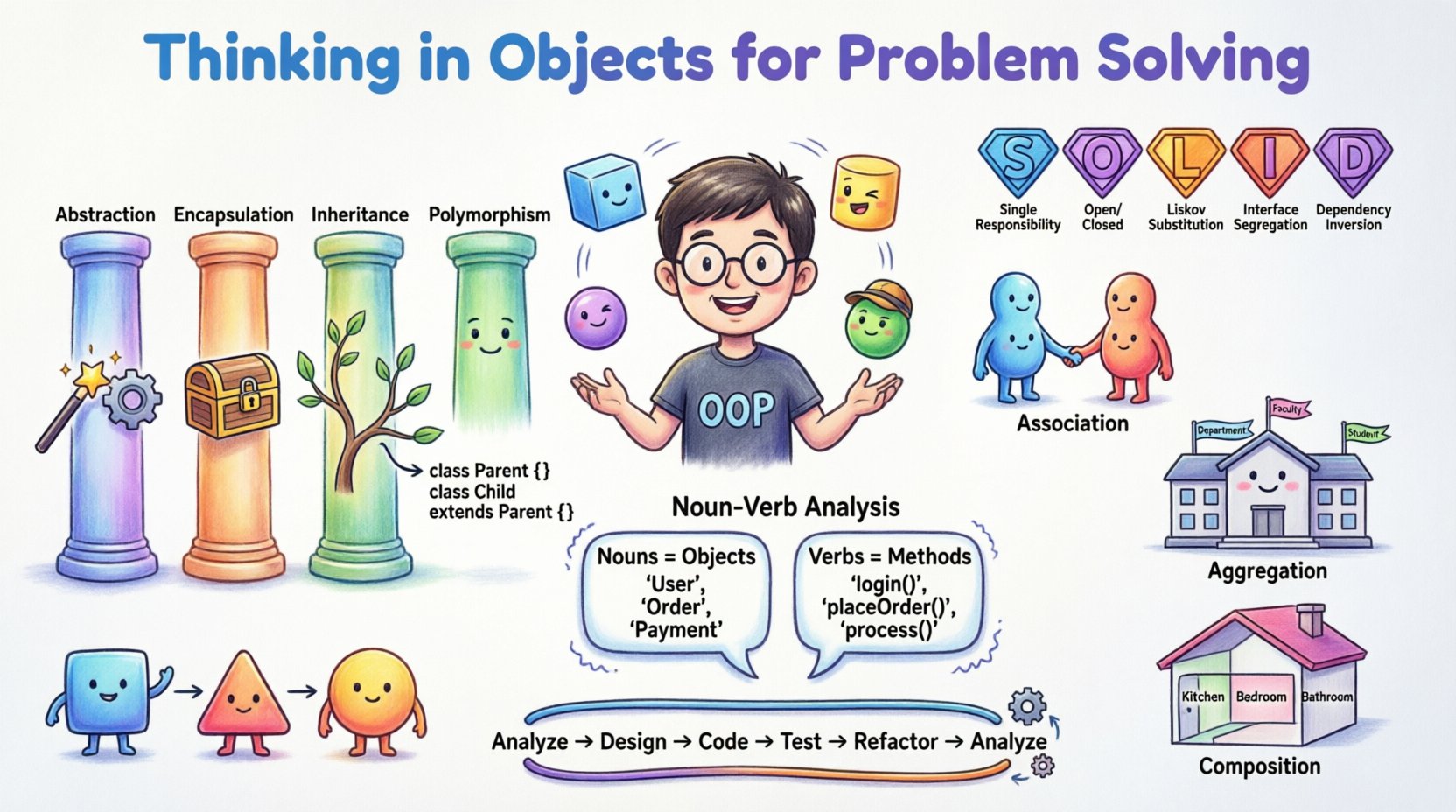
Effective software architecture begins long before the first line of code is written. It begins with how you perceive the problem itself. Thinking in Objects is not merely a programming technique; it is a cognitive framework for modeling real-world complexity within a digital environment. This approach, central to Object-Oriented Analysis and Design (OOAD), allows developers to construct systems that are modular, maintainable, and scalable.
When you approach a problem with an object-oriented mindset, you shift your focus from a sequence of actions to a collection of interacting entities. Each entity possesses its own state and behavior. This shift reduces cognitive load by encapsulating complexity within specific boundaries. Instead of managing global variables and spaghetti logic, you define clear contracts between components. This article explores the core principles, modeling techniques, and strategic considerations required to implement this paradigm effectively.
The Paradigm Shift: From Procedures to Entities 🔄
Traditional procedural programming organizes code around functions and the flow of data between them. While effective for linear tasks, this approach often struggles with complex systems where data and behavior are tightly coupled. Object-oriented thinking addresses this by binding data and methods together into single units known as objects.
Consider a banking system. In a procedural model, you might have a function updateBalance(accountId, amount). The function knows how to access the database and modify the record. In an object-oriented model, the account itself is an object. You send a message to the account object: account.deposit(amount). The object manages its own state. It decides how to update its internal ledger. This separation of concerns is fundamental.
- Procedural Focus: What happens next? (Control flow)
- Object-Oriented Focus: Who is responsible for this? (Responsibility distribution)
This shift allows for better abstraction. You do not need to know the internal implementation of the deposit method to use it. You only need to know the interface. This reduces dependencies and makes the system more resilient to change.
The Four Pillars of Object Thinking 🏛️
To think in objects, you must understand the four core pillars that define the paradigm. These concepts guide the structure and interaction of your system components.
1. Abstraction 🧩
Abstraction is the process of hiding complex implementation details and exposing only the necessary features. It allows you to interact with an object without understanding its internal workings. For example, when you drive a car, you use the steering wheel and pedals without knowing the mechanics of the engine or transmission.
- Interface Design: Define what an object can do, not how it does it.
- Complexity Management: Break down large problems into smaller, manageable classes.
- Flexibility: Change the implementation without affecting the code that uses the object.
2. Encapsulation 🔒
Encapsulation bundles data and methods into a single unit and restricts direct access to some of the object’s components. This is often achieved through access modifiers. It protects the internal state of an object from unintended interference.
- Data Hiding: Prevent external code from setting invalid states.
- Controlled Access: Use getters and setters to validate data before it enters the object.
- Security: Limit the exposure of sensitive information.
3. Inheritance 🌳
Inheritance allows a new class to adopt the properties and behaviors of an existing class. This promotes code reuse and establishes a hierarchical relationship. It is the mechanism for creating specialized versions of general concepts.
- Code Reuse: Write common logic once in a parent class.
- Specialization: Create specific types that extend general types.
- Polymorphism Support: Allows different classes to be treated as instances of a common superclass.
4. Polymorphism 🎭
Polymorphism allows objects of different types to be treated as objects of a common type. It enables the same interface to be used for different underlying forms. This is crucial for writing flexible and extensible code.
- Runtime Polymorphism: Method overriding allows the correct method to be called based on the object’s actual type.
- Compile-time Polymorphism: Method overloading allows multiple methods with the same name but different parameters.
- Interchangeability: Functions can operate on generic types, accepting any subclass.
Identifying Objects: The Noun-Verb Analysis 🔍
One of the most practical techniques for starting an object-oriented design is analyzing the problem statement for nouns and verbs. This linguistic approach helps identify potential classes and methods.
| Linguistic Element | OO Correspondence | Example |
|---|---|---|
| Noun | Class / Object | Customer, Order, Invoice |
| Verb | Method / Function | PlaceOrder, CalculateTotal, ShipItem |
| Adjective | Attribute / Property | IsPremium, HasPriority, IsActive |
While not every noun becomes a class, this exercise provides a strong starting point for the domain model. You must refine the list by removing abstract concepts and focusing on concrete entities that hold state.
Refinement Steps:
- Filter: Remove nouns that do not have state or behavior (e.g., “the system”).
- Consolidate: Merge synonyms (e.g., “User” and “Client”).
- Validate: Ensure each class has a clear responsibility.
Relationships: Connecting the Model 🔗
Objects rarely exist in isolation. They interact with other objects to achieve business goals. Understanding the nature of these interactions is critical for designing a robust system. There are three primary types of relationships to consider.
1. Association
An association defines that objects are connected. It is the most general form of relationship. It implies a link between two classes.
- Example: A
Doctortreats aPatient. - Cardinality: One-to-one, one-to-many, or many-to-many.
2. Aggregation
Aggregation is a specific form of association where the relationship represents a “whole-part” connection. The part can exist independently of the whole.
- Example: A
UniversityhasDepartments. If the university closes, the departments might cease to exist in that context, but the department concept is distinct. - Key Characteristic: The lifecycle of the part is not strictly bound to the whole.
3. Composition
Composition is a stronger form of aggregation. The part cannot exist without the whole. It represents a strict ownership model.
- Example: A
HousehasRooms. If the house is demolished, the rooms no longer exist. - Key Characteristic: The lifecycle of the part is dependent on the whole.
Choosing the correct relationship type prevents structural errors in your design. Misusing composition can lead to tight coupling, while misusing aggregation can lead to orphaned data.
Design Principles for Maintainability 🛠️
Thinking in objects is not just about syntax; it is about adhering to design principles that ensure the system remains healthy over time. These principles guide decision-making when defining classes and their interactions.
- Single Responsibility Principle: A class should have only one reason to change. If a class handles both data storage and business logic, it becomes hard to maintain.
- Open/Closed Principle: Classes should be open for extension but closed for modification. Add new behavior through new classes rather than editing existing ones.
- Liskov Substitution Principle: Subtypes must be substitutable for their base types. If a method works with a parent class, it must work with any child class without breaking functionality.
- Interface Segregation Principle: Clients should not be forced to depend on methods they do not use. Split large interfaces into smaller, specific ones.
- Dependency Inversion Principle: Depend upon abstractions, not concretions. High-level modules should not depend on low-level modules; both should depend on abstractions.
Adhering to these principles reduces coupling and increases cohesion. High cohesion means the elements within a module are closely related and work together. Low coupling means the modules are independent of each other.
Common Pitfalls in Object Modeling ⚠️
Even experienced designers can fall into traps that undermine the benefits of object-oriented thinking. Recognizing these anti-patterns early saves significant refactoring effort later.
The God Object
A class that knows too much or does too much. It becomes a dumping ground for all functionality. This violates the Single Responsibility Principle and makes testing difficult.
The Anemic Domain Model
Classes that contain only public properties with no behavior. They act as data structures rather than objects. This pushes logic back into procedural functions, negating the benefits of encapsulation.
Tight Coupling
When classes rely heavily on the specific implementation details of other classes. This makes the system rigid. If one class changes, many others must change.
Over-Engineering Inheritance
Creating deep inheritance hierarchies that are difficult to navigate. Often, composition is a better alternative to inheritance for code reuse.
Iterative Refinement 🔄
Designing a system is rarely a linear process. You will identify objects, design relationships, and then realize that a class needs to change. This is normal. Object-oriented design is iterative.
The Cycle:
- Analyze: Understand the problem domain.
- Model: Draft the initial class structure.
- Implement: Write code based on the model.
- Review: Check against design principles.
- Refactor: Improve the structure without changing behavior.
Refactoring is a continuous activity. As requirements evolve, the object model must evolve with them. The goal is to keep the code flexible enough to accommodate change without requiring a complete rewrite.
Practical Application: A Workflow Example 📝
To visualize this thinking process, consider a notification system. You need to send alerts to users via Email, SMS, and Push Notification.
- Abstraction: Create a generic
NotificationServiceinterface. - Encapsulation: The
EmailProviderclass hides the SMTP connection details. - Inheritance: Create a base
Channelclass with common properties likerecipient. - Polymorphism: The main system calls
send(message)on any channel object, regardless of whether it is Email or SMS.
This approach allows you to add a new channel type, such as Slack, without modifying the core notification logic. You simply create a new class that implements the interface. The system remains stable and extensible.
The Human Element of Design 🤝
Technical design is ultimately about communication. An object model serves as documentation for the system. When your classes are named clearly and their responsibilities are well-defined, other developers can understand the system faster. The code speaks to the reader.
Use descriptive names for classes and methods. calculate() is vague. calculateTaxForRegion() is specific. This clarity reduces the cognitive load for anyone reading the code later. Documentation should focus on the “why” rather than the “how”, as the code explains the “how”.
Conclusion on Object Thinking 🏁
Thinking in objects is a disciplined approach to software construction. It requires a shift in perspective from managing data to managing relationships between entities. By adhering to core principles like encapsulation and abstraction, you build systems that are easier to understand, test, and modify.
The journey from analysis to implementation involves constant refinement. There is no perfect design, only the best design for the current context. Focus on clarity, maintainability, and alignment with business requirements. When done correctly, the object model becomes a reliable blueprint for your software, guiding the development process from the first concept to the final deployment.
Mastering this mindset takes practice. Start by analyzing existing systems and identifying the objects. Then, apply these concepts to your own projects. Over time, the distinction between code and design will blur, and you will find yourself building robust architectures naturally.