
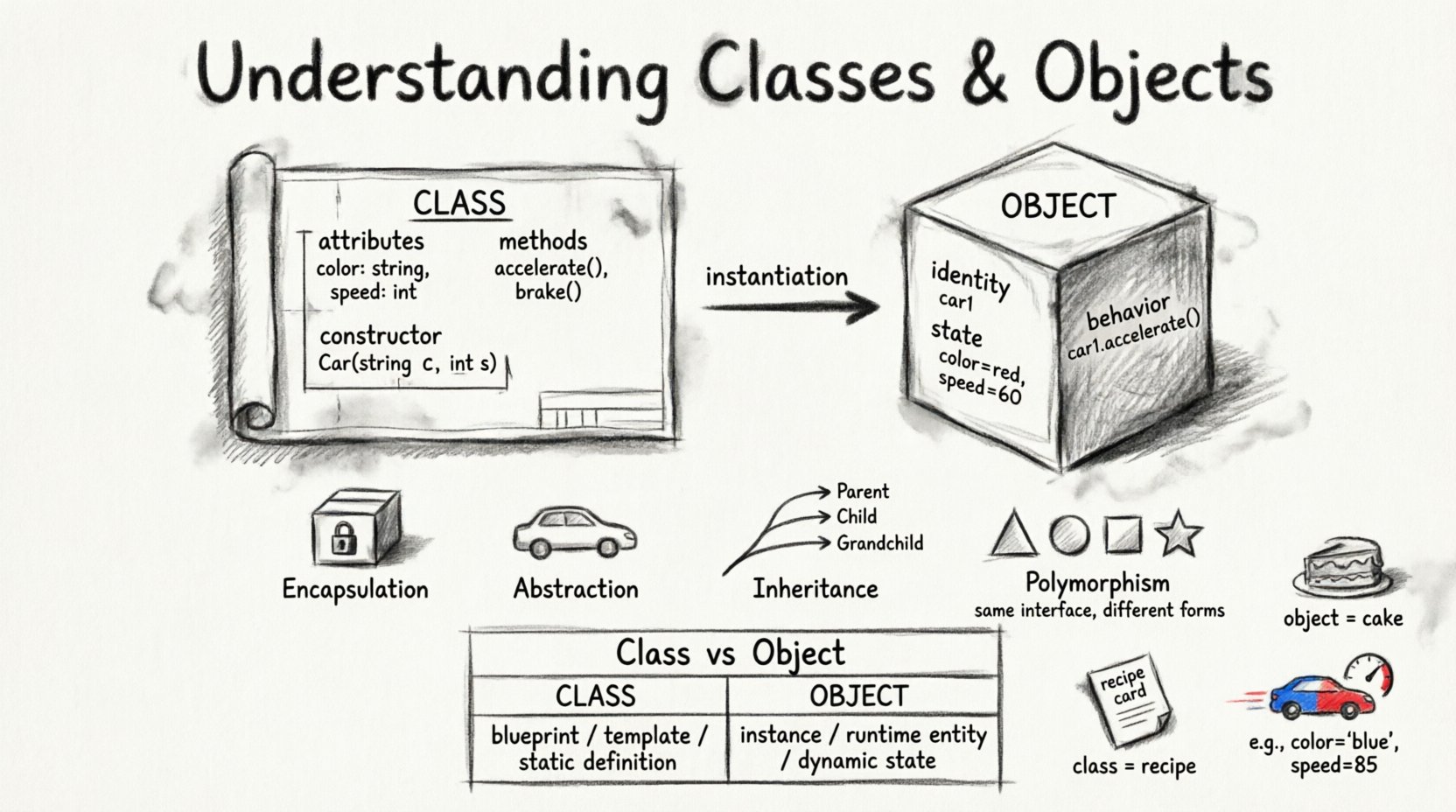
In the landscape of software development, structure is everything. When engineers approach complex problems, they do not merely write lines of code; they construct logical systems. Object-Oriented Analysis and Design (OOAD) provides a robust framework for this construction. At the heart of OOAD lie two fundamental concepts: classes and objects. While often discussed together, they represent distinct aspects of software modeling. Grasping the distinction is critical for building maintainable, scalable systems.
This guide explores these concepts in depth. We will move beyond simple definitions to understand how they function within a design system. By the end of this article, you will have a clear mental model for how data and behavior interact in an object-oriented paradigm. We will avoid abstract jargon where possible, focusing on practical application and logical flow.
🧱 The Concept of a Class
A class acts as a blueprint or a template. It defines the structure and behavior that objects of that type will possess. Think of a class as a recipe for a cake. The recipe exists independently of any actual cake being baked. It lists the ingredients (attributes) and the steps (methods) required. Until the recipe is executed, no physical cake exists.
In technical terms, a class is a user-defined data type. It encapsulates both state and behavior into a single unit. This encapsulation allows developers to manage complexity. Instead of tracking individual variables scattered across a system, we group related data and functions under a single name.
Core Components of a Class
- Attributes: These represent the state or data associated with the class. In a car class, attributes might include color, speed, and fuel level. These define what the object is.
- Methods: These represent the behavior or actions the class can perform. A car class might have methods like
accelerate,brake, orturn. These define what the object does. - Constructors: A special method used to initialize new objects. It sets the initial state when the object is created.
- Destructors: A method that handles cleanup when an object is no longer needed, ensuring resources are released properly.
It is important to note that a class itself does not occupy memory for data storage in the same way an instance does. It occupies memory for its definition. It is static in nature until instantiated. This separation allows multiple objects to share the same logic without duplicating the code.
📦 The Concept of an Object
If a class is the blueprint, an object is the building. An object is an instance of a class. When you follow the instructions of the class definition, you create an object in memory. Objects are the active entities that run the program. They hold actual values for the attributes defined in the class.
Every object has its own unique identity, state, and behavior. You can create ten different objects from the same car class. One might be red and fast; another might be blue and slow. They share the same structure (because they come from the same class), but their specific data differs.
Characteristics of Objects
- Identity: Each object is distinct. Even if two objects have the same data values, they exist at different memory locations.
- State: The current values of the attributes. If a button object has a
isPressedattribute, the state is either true or false at any given moment. - Behavior: The methods available to the object. An object communicates with other objects by sending messages (calling methods).
Objects interact through interfaces. One object does not need to know how another object works internally. It only needs to know what actions it can request from the other object. This reduces dependencies and makes the system more modular.
🆚 Class vs. Object: A Direct Comparison
Confusion often arises between these two terms. To clarify, we can look at a side-by-side comparison. This table highlights the functional differences essential for design.
| Feature | Class | Object |
|---|---|---|
| Definition | Template or Blueprint | Instance or Realization |
| Memory | Does not allocate memory for data | Allocates memory for specific data |
| Quantity | Single definition per type | Can create multiple instances |
| Existence | Abstract concept | Concrete entity |
| Creation | Declared in code | Instantiated via constructor |
Understanding this distinction prevents common architectural errors. For example, trying to store data directly in a class definition without an instance is a design flaw in most contexts. Data belongs to the object; the structure belongs to the class.
🔑 The Four Pillars of Object Orientation
Classes and objects are not standalone concepts; they operate within a system governed by four key principles. These pillars guide how we design interactions between classes.
1. Encapsulation
Encapsulation is the bundling of data with the methods that operate on that data. It restricts direct access to some of an object’s components. This is often achieved through access modifiers (public, private, protected).
- Protection: Prevents external code from setting an object’s state to an invalid value.
- Control: Allows the class to validate data before accepting it.
- Flexibility: Internal implementation can change without affecting external code using the object.
2. Abstraction
Abstraction involves hiding complex implementation details and showing only the necessary features of an object. When you use a vehicle, you care about steering and acceleration, not the combustion mechanics inside the engine.
- Simplicity: Reduces complexity for the user of the class.
- Interface: Defines a contract that objects must fulfill.
- Focus: Allows developers to focus on high-level logic rather than low-level details.
3. Inheritance
Inheritance allows a new class to derive properties and behaviors from an existing class. The new class is a subclass (child), and the existing one is a superclass (parent).
- Reusability: Common code is written once in the parent class.
- Hierarchy: Creates a logical taxonomy of types.
- Extension: Subclasses can add new features or override existing ones.
4. Polymorphism
Polymorphism allows objects of different types to be treated as objects of a common super-type. The same message can be sent to different objects, and each will respond in its own way.
- Flexibility: Code can handle various types without explicit type checking.
- Interchangeability: Different implementations can be swapped easily.
- Extensibility: New types can be added without changing existing code.
🔗 Relationships and Associations
Classes rarely exist in isolation. They relate to one another. Understanding these relationships is vital for accurate modeling.
Types of Relationships
- Association: A structural relationship where one class is linked to another. Example: A
Studentis associated with aCourse. - Aggregation: A specific type of association representing a “whole-part” relationship where the part can exist independently. Example: A
LibraryhasBooks. If the library closes, the books still exist. - Composition: A stronger form of aggregation where the part cannot exist without the whole. Example: A
HousehasRooms. If the house is destroyed, the rooms cease to exist as part of that house. - Inheritance: As mentioned, a “is-a” relationship. A
Truckis aVehicle.
⚙️ Designing Effective Classes
Creating a class requires more than just naming attributes. It requires thought about responsibility. A class should have a single, well-defined purpose.
Single Responsibility Principle
A class should have one reason to change. If a class handles both database storage and user interface rendering, it becomes fragile. Changes to the UI might break the database logic. Separating concerns makes the system more stable.
High Cohesion
Cohesion refers to how closely related the responsibilities of a class are. High cohesion means all methods and data within the class work together to achieve a specific goal. Low cohesion leads to “God Objects” that do too much.
Low Coupling
Coupling refers to the degree of interdependence between software modules. You want low coupling. If Class A depends heavily on the internal implementation of Class B, a change in B breaks A. Instead, Class A should depend on an interface or abstract contract provided by B.
🐛 Common Pitfalls in Modeling
Even experienced designers make mistakes when applying these concepts. Being aware of these pitfalls helps in avoiding technical debt.
- Over-Engineering: Creating deep hierarchies of classes for simple problems. Not every feature needs a dedicated class. Simple data structures often suffice for simple tasks.
- God Classes: Classes that contain too much logic and data. They become difficult to test and maintain. Break them down into smaller, focused classes.
- Data Transfer Objects: Using classes merely as bags of data without behavior. While sometimes necessary, classes should ideally control their own state through methods.
- Circular Dependencies: Class A depends on Class B, and Class B depends on Class A. This creates a loop that makes initialization and testing difficult.
- Ignoring Immutability: Mutable objects can be changed unexpectedly. Designing classes to be immutable where possible reduces side effects and bugs.
🧠 The Mental Shift
Transitioning to object-oriented thinking requires a shift in perspective. Procedural programming focuses on functions and actions. Object-oriented programming focuses on entities and their interactions.
When designing a system, ask the following questions:
- What are the core entities in this domain?
- What state does each entity hold?
- What actions can each entity perform?
- How do these entities communicate?
Answering these questions naturally leads to a class diagram. The diagram serves as a map for the implementation. It is a communication tool as much as a technical specification.
🛠️ Lifecycle Management
Objects have a lifecycle. They are created, used, and eventually destroyed. Managing this lifecycle is part of the design responsibility.
Creation
Objects are typically created using constructors. The constructor ensures the object starts in a valid state. It is good practice to validate inputs at this stage.
Usage
During usage, objects interact. They pass messages. The duration of this period depends on the scope of the object. Some objects exist for the entire duration of the application (Singletons). Others exist only for a specific task (Stack objects).
Destruction
When an object is no longer needed, it should be removed from memory. In languages with garbage collection, this happens automatically. In manual memory management, the developer must explicitly deallocate resources. Failure to do so leads to memory leaks.
🚀 When to Use This Approach
Object-Oriented Analysis and Design is not a silver bullet. It is best suited for systems that are complex and require long-term maintenance.
- Complex Systems: When logic is too complex for simple scripts, OOAD provides structure.
- User Interfaces: GUI elements are naturally modeled as objects with state and behavior.
- Simulation: Modeling real-world entities (cars, people, machines) maps well to object concepts.
- Team Collaboration: Clear class boundaries allow multiple developers to work on different parts of the system simultaneously.
Conversely, for simple scripts or data processing pipelines, a functional approach might be more efficient. The choice depends on the specific requirements of the project.
📝 Summary of Key Takeaways
To summarize the essential points for effective design:
- Classes define structure. They are the abstract definitions of data and logic.
- Objects represent reality. They are the concrete instances that hold data and perform work.
- Encapsulation protects state. Keep data private and expose only necessary methods.
- Inheritance promotes reuse. Share common logic between related types.
- Polymorphism enables flexibility. Write code that works with various types.
- Keep classes focused. Avoid broad responsibilities in a single unit.
Mastering these concepts takes time and practice. It involves reading code, designing diagrams, and refactoring existing systems. The goal is not just to write code that works, but to write code that is understandable and adaptable. By treating classes and objects as fundamental building blocks rather than syntax rules, you can construct systems that stand the test of time.
As you continue your journey in software design, remember that the blueprint is only as good as the structure it supports. Use classes to organize your thoughts and objects to execute your vision. This disciplined approach leads to robust, high-quality software solutions.