
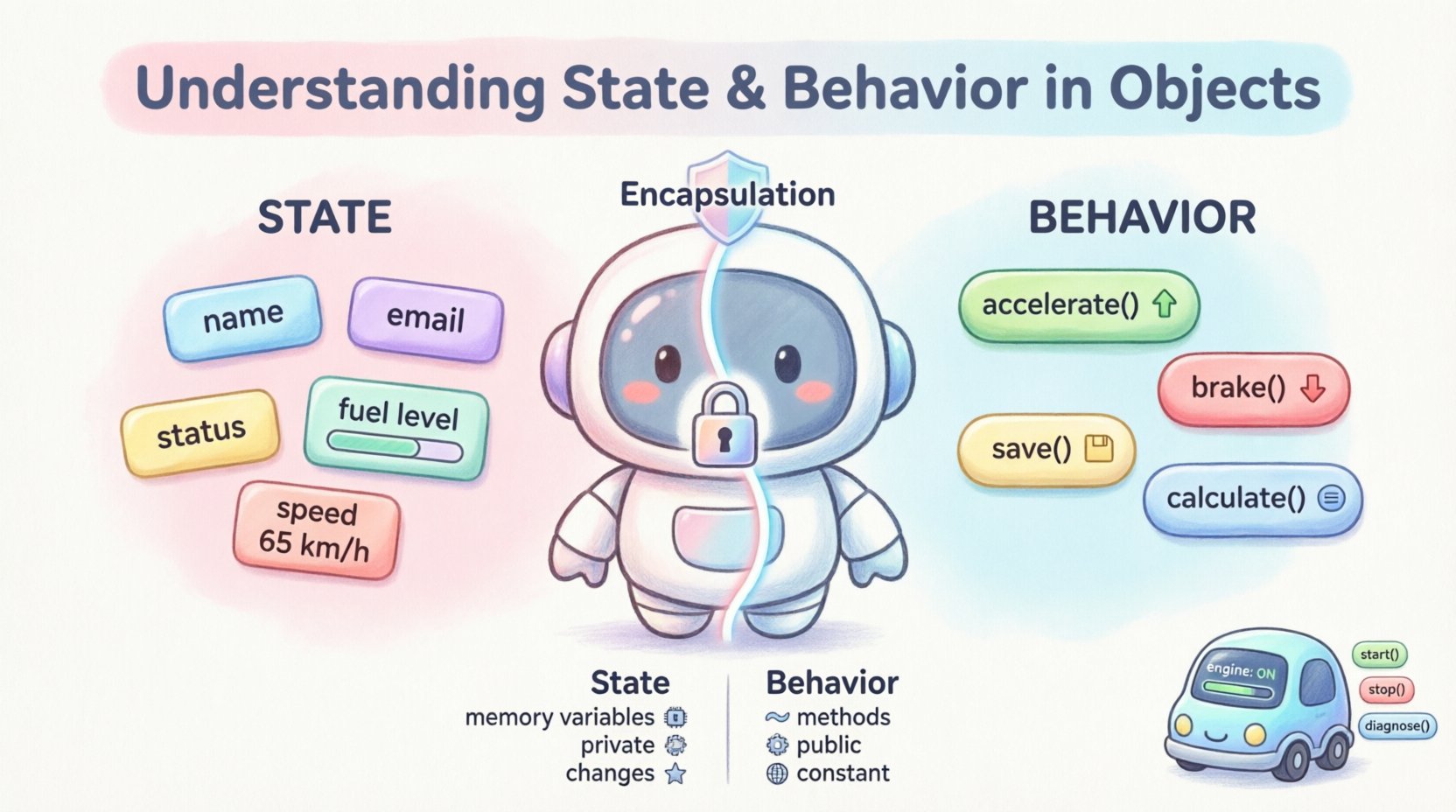
In the landscape of software architecture, few concepts are as fundamental as the relationship between state and behavior. These two pillars form the backbone of Object-Oriented Analysis and Design. When developers construct systems, they are essentially defining entities that hold information and perform actions. Grasping how these elements interact is crucial for building maintainable, scalable, and robust applications. This guide explores the intricacies of object structure without relying on specific vendor tools, focusing on universal principles that apply across various programming paradigms.
The Foundation of Object-Oriented Analysis 🧱
Object-Oriented Analysis and Design (OOAD) shifts the focus from procedural logic to data-centric modeling. Instead of viewing a program as a series of steps, OOAD views it as a collection of interacting objects. Each object represents a distinct entity within the problem domain. To model these entities effectively, one must understand the dual nature of an object: what it knows and what it does.
State refers to the condition of an object at a specific point in time. It is stored in variables, often called attributes or properties. Behavior refers to the actions an object can perform. These are implemented as methods or functions. The separation and interaction of these two concepts dictate the quality of the software architecture.
Defining State in Software Systems 📦
State is the data that persists within an object. It represents the history, current configuration, or identity of the entity. Without state, an object would be a static collection of logic, unable to adapt to different inputs or scenarios. In practical terms, state is managed through memory allocation.
- Attributes: These are the named containers for data. For example, a user object might have a name, an email address, and a status flag.
- Data Types: State can be primitive (numbers, booleans) or complex (references to other objects).
- Visibility: Access to state is often restricted to ensure data integrity. Public state allows modification from anywhere, while private state restricts access to internal methods.
The lifecycle of state is critical. An object is instantiated, its state is initialized, it undergoes modifications through behavior, and eventually, it is destroyed. During its existence, the state may change many times. Managing these changes is a primary concern in design.
Types of State
Not all state is created equal. Distinguishing between different types helps in managing complexity.
- Instance State: Unique to each object created from a class. Two user objects have different names, even if they are the same type.
- Class State: Shared across all instances. A counter for the total number of users created might be stored here.
- Transient State: Data that does not need to be persisted. For example, a temporary calculation result that is discarded after use.
- Persistent State: Data that survives beyond the lifetime of the application, often stored in a database or file system.
Defining Behavior in Software Systems ⚙️
Behavior is the dynamic aspect of an object. It defines how the object responds to messages or method calls. Behavior is the mechanism through which state is modified or accessed. Without behavior, state is static and inert.
Methods encapsulate logic. They can be categorized by their purpose:
- Accessors: Retrieve information about the state without changing it.
- Mutators: Change the state of the object.
- Transformers: Perform complex operations that may change state or return new data.
- Queries: Return boolean values or status checks based on current state.
Behavior should be cohesive. A single method should ideally perform one distinct task. If a method tries to update a database, calculate a tax rate, and send an email, it is likely doing too much. High cohesion in behavior makes code easier to test and understand.
Encapsulation and Data Hiding 🔒
The bridge between state and behavior is encapsulation. This principle bundles data and the methods that operate on that data into a single unit. More importantly, it restricts direct access to some of the object’s components. This is known as data hiding.
By hiding internal state, an object protects itself from invalid modifications. If an attribute is public, any part of the program can set it to an invalid value. If it is private, only the object’s own methods can modify it. This allows the object to enforce invariants.
Benefits of Encapsulation
- Protection: Prevents external interference with critical data.
- Flexibility: Internal implementation can change without affecting external code.
- Simplicity: Users of the object interact with a clean interface rather than a complex data structure.
Consider a bank account. The balance is state. The deposit and withdrawal methods are behavior. If the balance were public, a user could set it to a negative number directly, bypassing business rules. By making the balance private and only allowing modifications through the withdrawal method, the system ensures the balance never drops below a certain threshold unless authorized.
State vs Behavior Comparison 📊
To clarify the distinction, the following table outlines the key differences between state and behavior within an object context.
| Feature | State | Behavior |
|---|---|---|
| Definition | The data held by the object. | The actions performed by the object. |
| Storage | Memory variables (fields/properties). | Executable code (methods/functions). |
| Visibility | Often private to protect integrity. | Often public to allow interaction. |
| Change | Changes over the object’s lifecycle. | Remains constant unless refactored. |
| Example | Price, Quantity, Status. | CalculateTotal, UpdateStatus, Save. |
Modeling Real-World Entities 🏗️
Effective OOAD relies on mapping real-world concepts to code. This process requires identifying the relevant state and behavior for each entity. Let us consider a generic Vehicle.
Vehicle Object Analysis
- State:
- Current Speed
- Color
- Engine Status (Running/Stopped)
- Fuel Level
- Behavior:
- Accelerate
- Brake
- Refuel
- TurnOff
Notice that behavior depends on state. The Accelerate method cannot work if the Engine Status is Stopped. Furthermore, the action changes the state. Calling Accelerate increases Current Speed.
This dependency creates a contract. The behavior defines the rules for how state can transition. A well-designed object ensures that these transitions are logical and safe.
Managing State Transitions 🔄
In complex systems, objects often move through different states. This is often modeled using Finite State Machines. An object might be in a Pending state, move to Active, and then to Completed.
Not all transitions are valid. You cannot move directly from Completed to Pending. The behavior must enforce these rules. If an action is attempted that violates the state machine, the system should handle it gracefully, perhaps by throwing an error or ignoring the request.
- Valid Transitions: Ensure data consistency.
- Invalid Transitions: Trigger error handling or warnings.
- Side Effects: Some transitions trigger events in other objects (e.g., sending a notification when an order ships).
Common Design Pitfalls ⚠️
Even experienced architects can stumble when managing state and behavior. Recognizing these patterns helps in avoiding technical debt.
1. The God Object
A God Object is an entity that knows too much and does too much. It accumulates all the state and behavior for a system. This makes the object difficult to test, maintain, and reuse. The solution is to decompose the object into smaller, focused units.
2. State Leakage
This occurs when internal state is exposed to the outside world without proper encapsulation. For example, returning a reference to an internal list allows external code to modify the list directly, bypassing the object’s logic. This breaks the integrity of the object.
3. Tight Coupling
When behavior in one object relies too heavily on the internal state of another, the objects become tightly coupled. Changing one object may break the other. The goal is loose coupling, where objects interact through well-defined interfaces rather than shared memory.
4. Mutable State everywhere
Excessive mutability makes it hard to reason about code. If an object’s state can change at any time, debugging becomes difficult. Consider using immutable state where possible, or restricting mutability to specific methods.
Testing and Verification 🧪
Testing state and behavior requires a dual approach. Unit tests should verify that behavior produces the expected state changes. Integration tests should verify that objects interact correctly.
- State Testing: Assert that after a method call, the object’s attributes have the correct values.
- Behavior Testing: Assert that the method executes without errors and performs the intended logic.
- Interaction Testing: Assert that the object sends the correct messages to other objects.
Mock objects are often used to simulate the state of dependent objects. This isolates the behavior being tested. It ensures that the logic under scrutiny is the only variable.
Best Practices for Sustainable Architecture ✅
To ensure longevity and clarity in software design, adhere to these principles regarding state and behavior.
- Single Responsibility: An object should have one reason to change. Separate state management from business logic if they evolve at different rates.
- Clear Naming: Attribute names should describe the state (e.g.,
isCompleted). Method names should describe the action (e.g.,complete). - Minimize Exposure: Expose the minimum amount of state necessary. Use read-only properties where possible.
- Validation: Validate state at the point of entry. Do not assume external code will provide valid data.
- Immutability: Prefer immutable objects when the state does not need to change. This simplifies concurrency and reasoning.
- Dependency Injection: Inject dependencies rather than creating them internally. This allows behavior to be swapped without changing state logic.
By following these guidelines, developers create systems that are easier to extend. New features can be added by introducing new objects or extending existing behaviors without destabilizing the core state management.
The distinction between what an object holds and what it does is not just a technical detail; it is a philosophical approach to problem-solving. When state and behavior are aligned correctly, the code reflects the domain model accurately. This alignment reduces cognitive load for anyone reading or maintaining the system. It transforms a collection of instructions into a representation of the real-world processes the software supports.
Maintaining this balance requires constant attention. As requirements evolve, the state may need to grow, or behavior may need to shift. The structure of the objects must accommodate these changes without requiring a complete rewrite. This resilience is the hallmark of good Object-Oriented Analysis and Design.