Visual Paradigm 18.0, released on January 19, 2026, represents a transformative milestone in the evolution of enterprise modeling tools. This version is not merely an incremental upgrade—it marks a strategic pivot toward intelligent, generative AI as a core component of digital design and systems thinking. By embedding advanced AI capabilities directly into its suite of modeling, architecture, and knowledge management tools, Visual Paradigm redefines how professionals conceive, analyze, and communicate complex systems.

The Convergence of Generative AI and Enterprise Modeling
For decades, enterprise architecture has relied on manual, time-consuming processes—creating diagrams, writing gap analyses, drafting roadmaps, and aligning artifacts with frameworks such as TOGAF. These workflows often require deep subject-matter expertise and can take weeks to complete, especially when scaling across domains like healthcare, finance, or logistics.
Visual Paradigm 18.0 breaks this cycle by introducing a suite of generative AI features that act as intelligent co-pilots. These tools do not replace human judgment or strategic insight but instead accelerate cognitive labor, reduce error rates, and democratize access to enterprise-grade modeling practices—especially for mid-level practitioners, project managers, and process owners who may lack formal training in architecture or system design.
1. AI-Enhanced TOGAF Architecture: From Description to Compliance
The most significant innovation in VP 18.0 is the AI TOGAF Tool, embedded within a newly enhanced version of theTOGAF Guide-Through. This tool leverages large language models and domain-specific reasoning engines to transform natural-language inputs into compliant, standards-aligned enterprise architecture artifacts.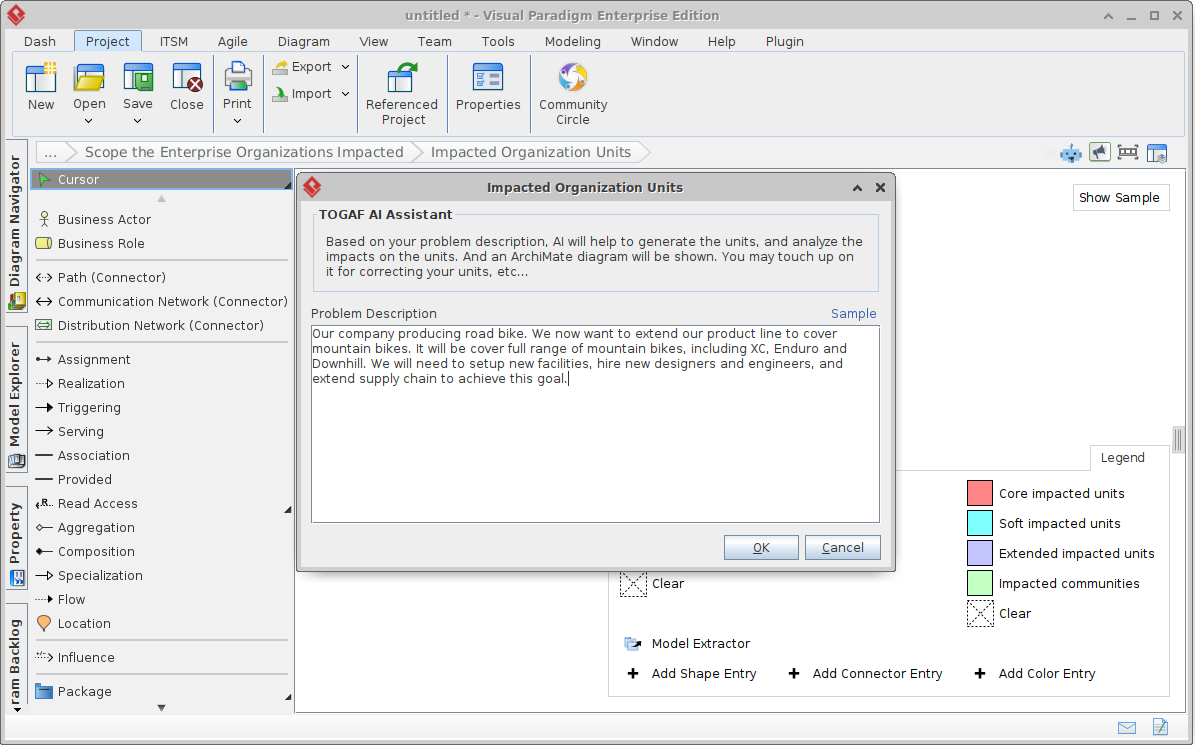
How It Works in Real-World Scenarios
- Input: A business stakeholder describes a challenge—such as ‘We need to modernize the legacy patient portal for a telehealth rollout, integrating AI diagnostics, ensuring HIPAA compliance, and minimizing system downtime.’
- Processing: The AI parses the request through a structured ontology of TOGAF’s ADM (Architecture Development Method) phases—baselining, opportunity identification, gap analysis, migration strategy, and transition planning.
- Output: Automatically generated, professionally styled artifacts including:
| Artifact Type | Description |
|---|---|
| ArchiMate Diagrams | Visual models showing business, data, application, and technology layers with proper semantic relationships. |
| Domain Gap Matrices | Quantified comparisons between current and target states across business, data, and tech domains. |
| Capability Maturity Radar | Assesses maturity levels across process, data, and architecture domains. |
| Work Breakdown Structures (WBS) | Organized decomposition of architectural implementation into manageable phases. |
| Migration Roadmap | Timeline-based, milestone-driven plan with risk and dependency mapping. |
Crucially, the output adheres to TOGAF standards, automatically formats content (e.g., consistent font, color, layering), and aligns with organization-wide visual styles. This allows non-architects to generate high-fidelity artifacts in minutes, while senior architects can use the outputs as a starting point for deeper refinement.
Strategic Implications
- Democratization of Enterprise Architecture: Junior staff and operational teams can now create compliant, auditable models without relying on architects for every artifact.
- Agility in Decision-Making: Enterprises can rapidly prototype scenarios and test assumptions, reducing time-to-implementation from months to days.
- Future-Forward Intelligence: The AI begins to identify latent patterns—such as the potential for microservices migration, cloud-native infrastructure shifts, or data governance upgrades—based on industry trends and best practices.
This isn’t just automation; it’s the emergence of AI as a proactive advisor—a system that anticipates structural weaknesses and suggests architectural blueprints before the business even identifies them.
2. AI-Powered Value Stream Mapping: From Waste to Insight
Lean operations and process excellence depend on clear visibility into workflow inefficiencies. Traditional Value Stream Mapping (VSM) remains labor-intensive, requiring process experts to manually map flows, capture cycle times, and identify root causes.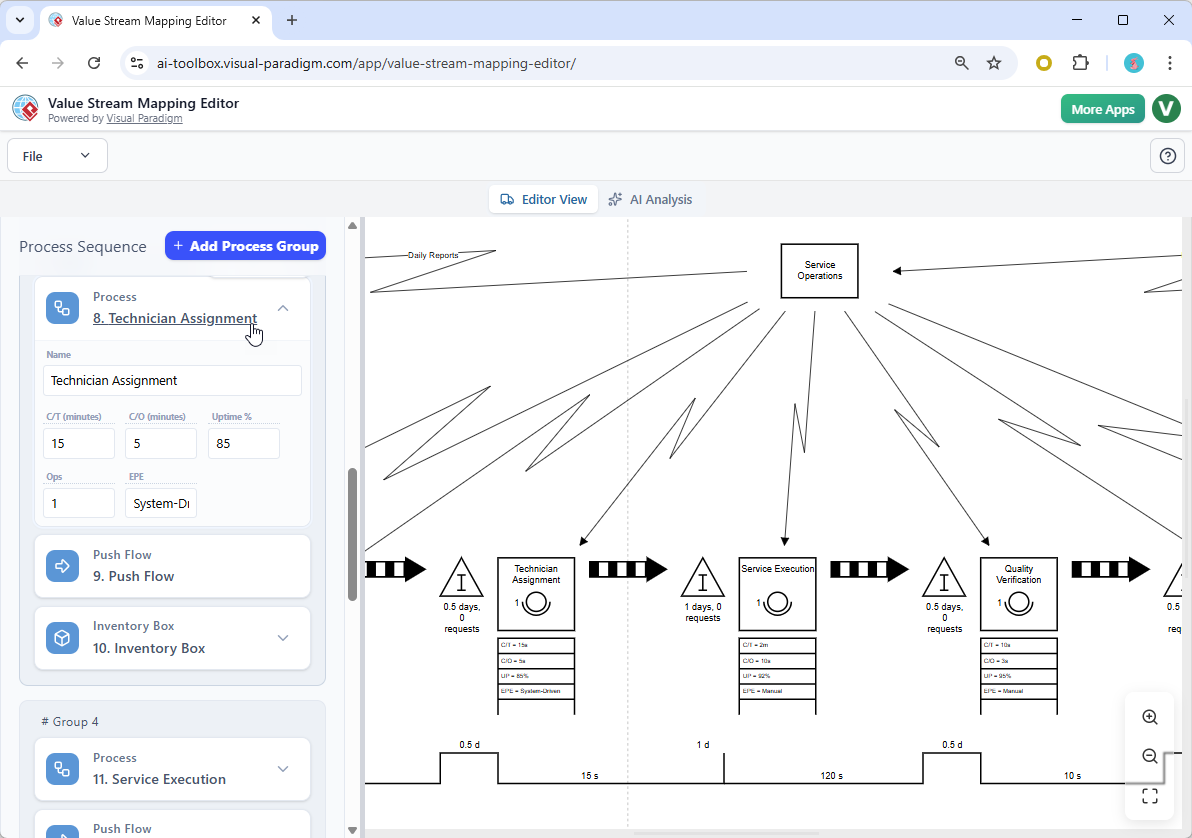
Visual Paradigm 18.0’s AI Value Stream Mapping Tool changes this by using generative AI to auto-construct VSMs from structured inputs. The workflow is intuitive:
- Enter key data points on a split-screen: cycle times, inventory levels, staffing, changeover durations, and material movement.
- The AI analyzes these inputs to generate a live, auto-laid-out value stream map with clear process boundaries.
- Using its built-in pattern recognition, it identifies the Seven Wastes (overproduction, waiting, transport, over-processing, inventory, motion, defects) and highlights bottlenecks.
- It then outputs actionable recommendations—e.g., ‘Switch to a pull-based kanban system to reduce work-in-process by 35% and shorten lead times by over two days.’
The system also generates supporting visualizations such as lead time distributions, process flow timelines, and inventory heatmaps—all in real time.
Why This Changes Operations
- Shifts Focus: Operations teams no longer spend hours mapping—they can spend time innovating.
- Real-Time Optimization: As new data is collected from IoT sensors or ERP systems, the tool can dynamically update the map and re-analyze performance.
- Predictive Capability: In future iterations, AI will forecast potential bottlenecks based on historical trends and seasonal demand patterns.
This represents a foundational shift in process management: from reactive, periodic reviews to continuous, AI-driven optimization. The tool becomes a living part of operational intelligence, not just a documentation artifact.
3. Democratizing Visual Communication: The AI Infographic Generator
One of the most overlooked challenges in modern business is the gap between information and communication. Even with access to rich data, many organizations struggle to translate insights into compelling narratives that resonate with stakeholders.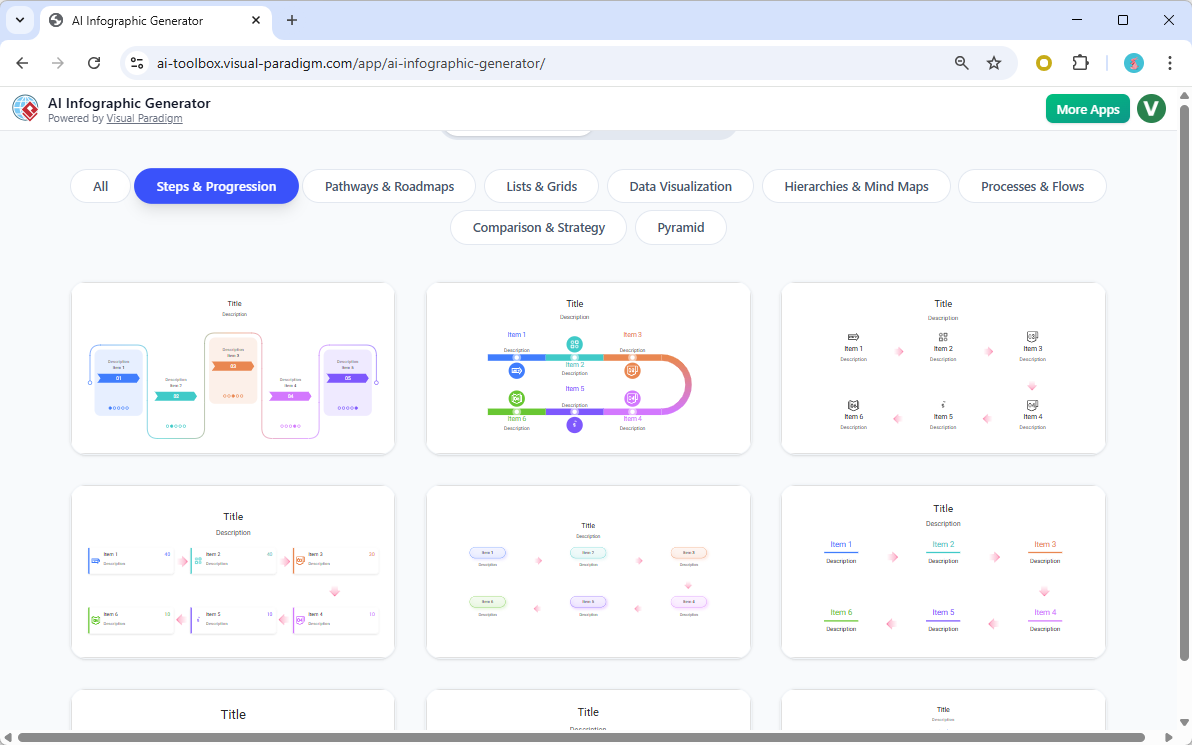
Visual Paradigm 18.0 introduces the AI Infographic Generator, a feature that turns simple text prompts into visually engaging, professional-grade infographics.
Practical Use Cases
- Prompt: ‘Infographic on renewable energy adoption trends in 2026—highlighting solar, wind, and storage growth with key forecasts.’
- Prompt: ‘Visual guide to our five-pillar digital transformation strategy with KPIs and impact metrics.’
The AI selects appropriate templates, organizes content into logical sections, integrates real data points (when available), and embeds charts, icons, and color schemes to ensure clarity and impact.
Beyond the Prompt
- Outputs are ready for immediate export in formats like PNG, SVG, or PDF.
- Users can refine elements—such as adjusting chart scales, adding watermarks, or changing color palettes—before finalizing.
- Future versions may pull live data from internal dashboards or external APIs, enabling dynamic, fresh content generation.
This capability empowers non-designers—executives, sales teams, educators, and operational leads—to produce presentation-grade visuals without design skills. It accelerates internal communication, supports executive storytelling, and enables faster feedback loops when presenting ideas.
4. OpenDocs: The Living Knowledge Platform
Fragmented documentation and knowledge silos remain one of the most persistent challenges in enterprise environments. Teams often maintain multiple spreadsheets, unstructured notes, and disconnected diagrams that are difficult to search or update.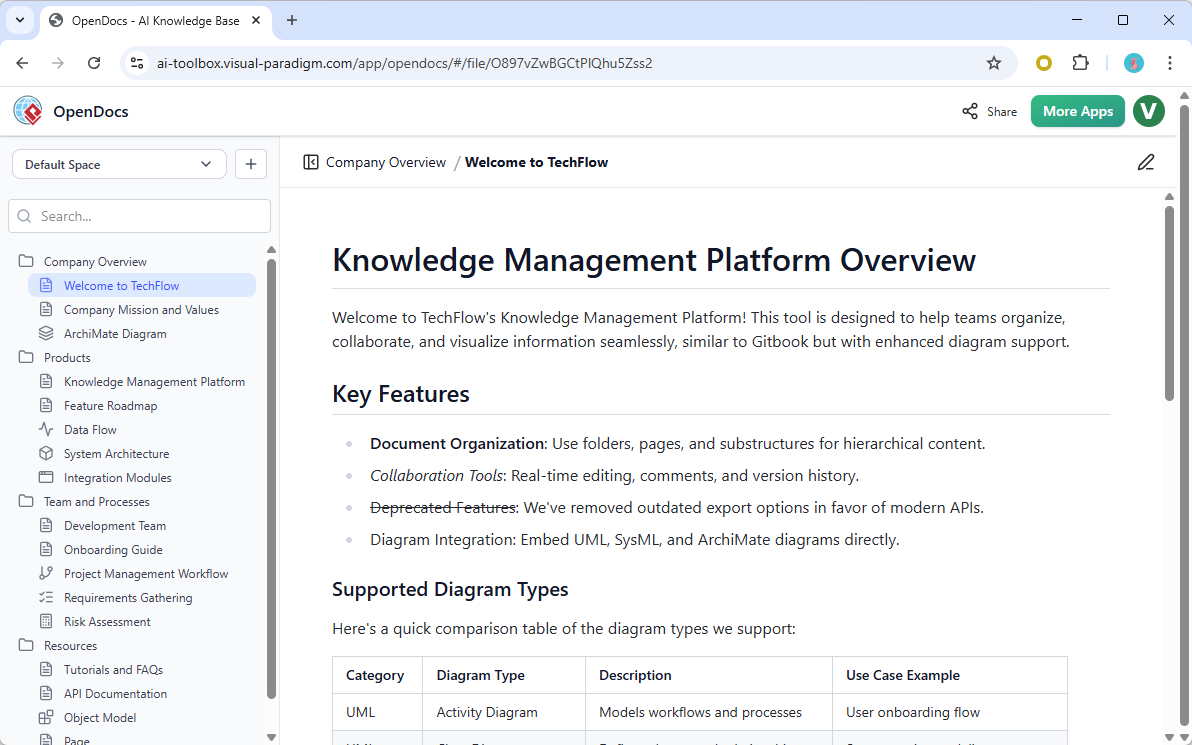
Visual Paradigm 18.0 introduces OpenDocs, a modern, AI-enhanced knowledge platform designed as a single source of truth for all organizational documentation.
Key Features
- Distraction-free Markdown editor with real-time live preview.
- Seamless embedding of diagrams—UML, flowcharts, ArchiMate, mind maps—directly into documentation pages.
- Organizational structure via hierarchical folders and drag-and-drop file management.
- Secure sharing and collaboration capabilities with granular permissions.
- Support for versioning and change tracking of diagrams and text.
- Smart search and summarization powered by AI (implied in future roadmap).
Strategic Vision
OpenDocs is not just a document editor—it’s a foundation for living systems of knowledge. As teams evolve, so do their processes, diagrams, and insights. OpenDocs captures these changes in real time, preserving institutional memory and enabling knowledge continuity during transitions or leadership changes.
With AI-assisted summarization and semantic search, users can quickly find relevant information—such as ‘all diagrams related to the 2026 AI strategy’ or ‘every gap analysis in the healthcare domain’—without manually browsing through folders.
Why Visual Paradigm 18.0 Matters for the Future of Work
This release signals a broader shift in how organizations approach digital transformation. It demonstrates that generative AI is no longer a novelty—it is a functional, strategic enabler of design, process, and communication.
What sets VP 18.0 apart is its ecosystem thinking:
- It integrates AI into modeling, architecture, process, and communication—without fragmentation.
- It reduces tool clutter by unifying features across domains.
- It lowers the barrier to entry for complex disciplines like enterprise architecture and Lean process management.
Looking ahead, we can expect:
- AI as a proactive advisor: Systems that suggest architectural patterns, recommend process improvements, or flag risks based on real-time data.
- Real-time data integration: Tools that automatically update diagrams and documents using data from ERP, CRM, or IoT systems.
- Enhanced collaboration: Teams working in shared environments where AI helps generate, explain, and compare different design options.
- Automated knowledge synthesis: AI summarizing meetings, extracting insights from documents, and generating timelines or action plans.
The end result is not just faster workflows—but smarter, more resilient, and more adaptable organizations.
Conclusion: The Intelligent Modeling Ecosystem is Here
Visual Paradigm 18.0 is not about replacing human expertise. It is about enhancing it. By embedding generative AI in core modeling and architectural workflows, it enables professionals to focus on high-level strategy, innovation, and stakeholder engagement—while the system handles the cognitive load of modeling, analysis, and communication.
In 2026 and beyond, the future of enterprise design will be defined by human-AI collaboration. Tools like those in Visual Paradigm 18.0 will become standard components of digital transformation strategies—offering organizations the agility, clarity, and insight needed to thrive in an era of rapid change.
Explore the release: https://updates.visual-paradigm.com/releases/visual-paradigm-18-0-release-ai-powered-features/
Tags: #VisualParadigm #GenerativeAI #EnterpriseArchitecture #FutureOfWork #DigitalTransformation #LeanAI #AIInDesign #KnowledgeManagement #ProcessOptimization
-
AI-Powered Visual Modeling and Design Solutions by Visual Paradigm: This site allows users to explore cutting-edge AI-driven tools for visual modeling, diagramming, and software design to enable faster development workflows.
-
AI Chatbot Feature – Intelligent Assistance for Visual Paradigm Users: This feature enables users to leverage AI-powered chatbot functionality to get instant guidance, automate tasks, and enhance productivity.
-
AI Textual Analysis – Transform Text into Visual Models Automatically: This tool uses AI to analyze text documents and automatically generate diagrams such as UML, BPMN, and ERD for faster modeling and documentation.
-
Visual Paradigm AI Diagram Generation Guide: A comprehensive step-by-step guide to using AI-powered tools for generating various diagram types quickly and accurately.
-
C4-PlantUML Studio | AI-Powered C4 Diagram Generator: An AI-powered tool that automatically generates C4 software architecture diagrams from simple text descriptions.
-
AI-Powered UML Class Diagram Generator by Visual Paradigm: This is an advanced AI-assisted tool that automatically generates UML class diagrams from natural language descriptions.
-
AI Development Plan Generator – Visual Paradigm: This tool is designed to revolutionize project planning by transforming ideas into actionable roadmaps and visualizing timelines.
-
AI-Powered 3-Aspect Infographic Designer Tool: This application allows users to generate professional infographics instantly using an AI-driven designer based on three specific aspects.
-
Mastering the Visual Paradigm AI Diagram Generator – Method Post: A guide for leveraging AI-driven diagram generation in Visual Paradigm to create efficient design workflows.
-
Visual Paradigm AI Chatbot: The World’s First Purpose-Built AI Assistant for Visual Modeling: This article discusses the launch of the AI chatbot designed to assist users with natural language interactions and intelligent guidance.