
When people hear the title Project Manager, they often picture a person who constantly schedules meetings, updates spreadsheets, and chases team members for status reports. While these tasks exist, they are merely symptoms of the deeper work happening beneath the surface. The reality is far more complex, strategic, and human-centric.
A project manager is not just an administrator; they are the glue holding a temporary organizational structure together. They bridge the gap between high-level strategy and ground-level execution. This guide breaks down the actual components of the role, moving past the stereotypes to reveal the core responsibilities that drive successful delivery.
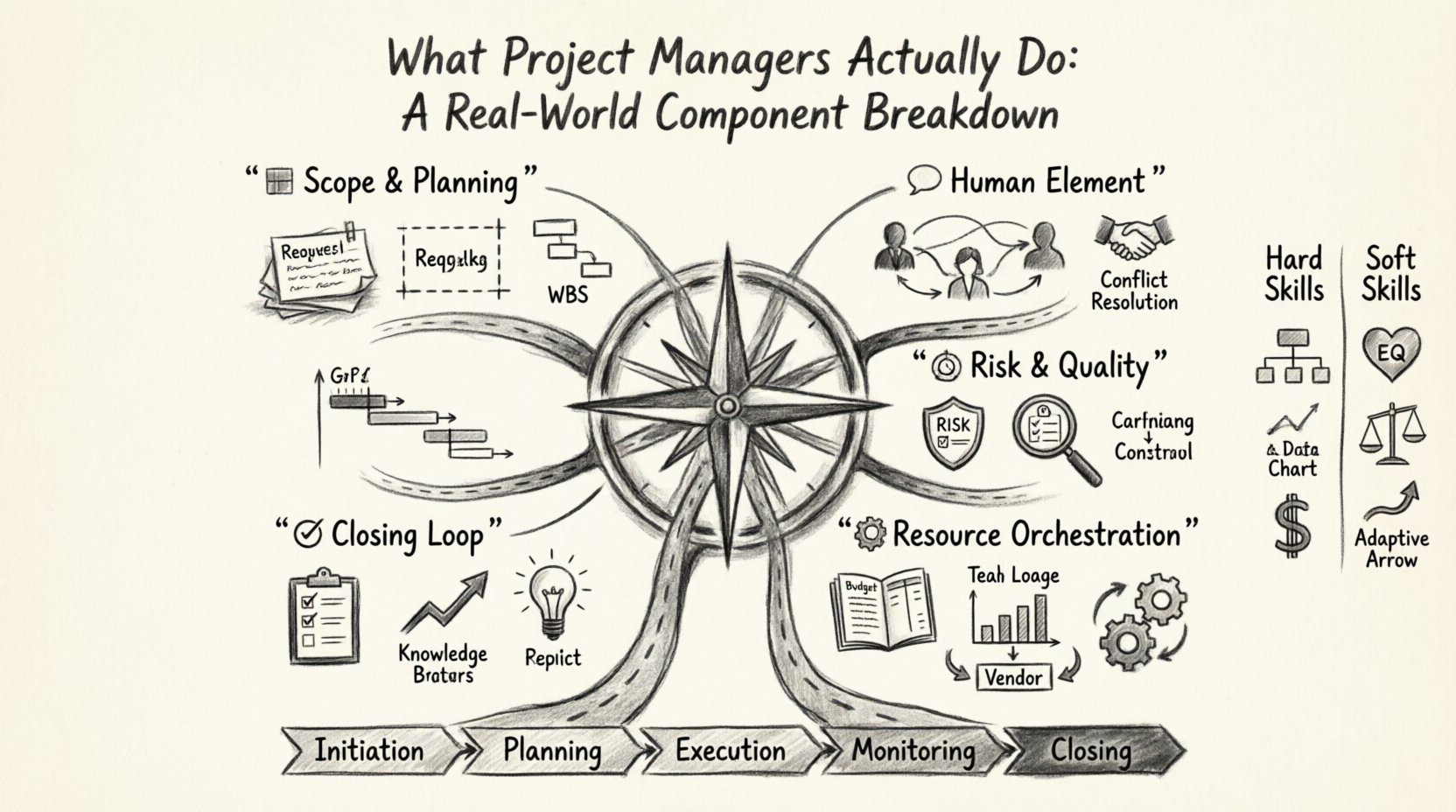
1. Defining the Path 🗺️: Scope and Planning
The first and perhaps most critical component of the role involves setting the boundaries of the work. Before a single task is assigned, the project manager must understand what success looks like and what the limits are.
Requirements Gathering: This involves sitting down with stakeholders to understand the problem they need solved. It is not about accepting a wish list; it is about digging into the why behind the request.
Scope Definition: Once requirements are clear, the manager defines what is in and out of the project. This prevents scope creep, where the project expands endlessly without additional resources.
Work Breakdown Structure: Large goals are too big to manage directly. The manager breaks the project down into smaller, manageable work packages. This creates a hierarchy that makes progress measurable.
Timeline Creation: Based on the work packages, the manager sequences activities. They identify dependencies, such as Task B cannot start until Task A is finished, to build a realistic schedule.
This phase is not about drawing a perfect line in the sand. It is about creating a baseline. A plan is a hypothesis about how work will flow. When reality deviates from the plan, the project manager adjusts the course.
2. The Human Element 🤝: Communication and Stakeholders
Tools and processes are easy to standardize. People are not. A significant portion of a project manager’s day is dedicated to managing relationships. This is often where projects succeed or fail.
Stakeholder Management: Every project has people who care about the outcome. These might be executives, clients, or end-users. The manager identifies who these people are, what they need to know, and how often they need updates.
Expectation Setting: It is the manager’s job to ensure that what stakeholders expect aligns with what is deliverable. If a stakeholder expects a product in one week, the manager must communicate why that is impossible based on current resources and complexity.
Team Alignment: The development or execution team needs clarity. The manager ensures everyone understands their specific responsibilities and how their work contributes to the larger goal.
Conflict Resolution: Disagreements will happen. They might be about technical approaches or resource allocation. The manager acts as a neutral party to facilitate a resolution that keeps the project moving forward.
Effective communication is not just about sending emails. It is about active listening. It is about reading the room during a meeting and knowing when to push for a decision and when to allow more time for discussion.
3. Keeping the Ship Steady ⚓: Risk and Quality
No project goes exactly according to plan. Unforeseen events occur. The project manager prepares for this by managing risk and ensuring quality standards are met.
Identifying Risks: A risk is a potential event that could negatively impact the project. Common examples include key team members leaving, technology failing, or budget cuts.
Mitigation Strategies: For every high-priority risk, there should be a plan. This might involve having a backup resource, buying insurance, or building in extra time for testing.
Quality Assurance: Delivering on time is useless if the product is broken. The manager ensures there is a process for testing and review. They advocate for the time needed to fix bugs rather than rushing to a deadline.
Change Management: When a change is requested, the manager evaluates the impact. Does this new feature delay the launch? Does it increase costs? The decision to accept the change is made with full visibility of these trade-offs.
This component requires a proactive mindset. Waiting for a problem to happen is too late. The manager must anticipate where friction might occur and smooth the path before the team hits it.
4. Resource Orchestration 🎻: Budget and People
Projects consume resources. Whether it is money, time, or human effort, these resources are finite. The project manager is the steward of these assets.
Budget Tracking: The manager monitors spending against the approved budget. They track labor costs, software licenses, and vendor fees. If spending gets ahead of schedule, they investigate immediately.
Capacity Planning: Before starting, the manager checks if the team has the capacity to take on the work. Assigning too much work leads to burnout and lower quality output.
Vendor Management: Sometimes work is outsourced. The manager ensures external partners deliver on their contracts and meet quality standards.
Efficiency Monitoring: The manager looks for waste. Are people waiting on decisions? Is there too much bureaucracy? They streamline processes to maximize the value of every hour worked.
It is important to note that the project manager does not always have direct authority over the people or budget. They often lead through influence. They must convince resource owners to prioritize their project over other competing demands.
5. Closing the Loop 🏁: Handover and Retrospective
Many people forget that a project has an end. Closing is not just about turning off the lights on a project. It is about formalizing the completion and capturing value for the future.
Formal Sign-off: The stakeholders must officially accept the deliverables. This protects the organization from endless revisions after the project is supposedly done.
Knowledge Transfer: The team must hand over the work to the operations or support teams. Documentation is crucial here so the new owners can maintain what was built.
Lessons Learned: The team gathers to discuss what went well and what did not. This is not a blame session. It is a learning opportunity to improve the next project.
Resource Release: The team is released from the project so they can be assigned to new work. This prevents them from lingering on a finished project.
Project Lifecycle Components at a Glance 📊
To visualize how these responsibilities map to the standard phases of work, consider the following breakdown:
Phase | Primary Focus | Key PM Activity |
|---|---|---|
Initiation | Value & Feasibility | Define the business case and appoint the team. |
Planning | Strategy & Scope | Create the roadmap, budget, and schedule. |
Execution | Delivery & Coordination | Manage the team, track progress, and handle issues. |
Monitoring | Control & Performance | Compare actuals to plan and adjust as needed. |
Closing | Transition & Review | Finalize contracts, archive documents, and celebrate. |
Essential Competencies for Success 🧠
While technical knowledge helps, the most effective project managers rely heavily on a blend of hard and soft skills. A breakdown of the most critical competencies follows.
Category | Competency | Why It Matters |
|---|---|---|
Hard Skills | Methodology Knowledge | Understanding frameworks helps structure the work logically. |
Hard Skills | Data Analysis | Interpreting metrics ensures decisions are based on facts. |
Hard Skills | Financial Acumen | Understanding costs ensures the project remains viable. |
Soft Skills | Emotional Intelligence | Reading team morale prevents burnout and turnover. |
Soft Skills | Negotiation | Getting the best terms for time and resources is daily work. |
Soft Skills | Adaptability | Plans change; the manager must pivot without losing momentum. |
Navigating Common Obstacles 🚧
Even with a solid plan, obstacles will arise. Here is how experienced leaders handle the most frequent challenges.
Scope Creep
Stakeholders often want to add features after the project has started. The manager must enforce a change control process. Every new request must be evaluated for its impact on time and budget before it is approved.
Misaligned Expectations
If the team builds what the stakeholder asked for but not what they needed, the project has failed. The manager prevents this by creating prototypes or wireframes early in the process to validate understanding.
Resource Constraints
Sometimes the team is understaffed. The manager cannot magic up more people. They must prioritize. They work with the team to decide which features are essential for the launch and which can be pushed to a later phase.
Burnout
High pressure leads to fatigue. The manager monitors the pace of work. They protect the team from unnecessary interruptions and ensure breaks happen. A rested team works faster and with fewer errors.
The Evolving Nature of the Role 🔮
The industry changes, and so does the project manager’s role. In the past, the focus was heavily on following a rigid sequence of steps. Today, the environment is more fluid.
Agile Integration: Many organizations now use iterative approaches. The manager shifts from being a commander to a facilitator, removing blockers and enabling the team to self-organize.
Strategic Partnership: Project managers are increasingly expected to contribute to business strategy. They provide data on delivery performance that helps leadership decide which projects to fund.
Remote Leadership: With distributed teams, the manager must build culture and connection without being in the same room. Communication tools are used, but the human connection remains the priority.
Becoming a Leader in This Space
If you are considering this career path, remember that it is a journey of continuous learning. You will never know everything. The best project managers are the ones who admit when they do not have the answer and know where to find it.
It requires patience. You will have days where nothing seems to go right. You will have stakeholders who push back hard. But when you see a team come together, overcome a difficult hurdle, and deliver something of value, the effort is worth it.
Start by observing how projects are run in your current environment. Ask questions about why decisions are made. Look at the plans and see where the gaps are. The more you understand the mechanics of delivery, the more effective you will become.
Focus on building trust. Trust is the currency of project management. If your team trusts you, they will work harder for you. If your stakeholders trust you, they will give you the benefit of the doubt when things go wrong.
This work is not about control. It is about enablement. Your goal is to create an environment where the team can do their best work. When you remove obstacles and provide clarity, the results speak for themselves.
As you move forward, keep learning about new methodologies, but do not let them dictate your actions. Use them as tools to solve problems, not as rules to follow blindly. The context of your specific project will always dictate the best approach.
Ultimately, the role is about delivering value. Whether it is a new software system, a construction site, or a marketing campaign, the project manager ensures that the investment yields a return. That is the core purpose. Everything else is in support of that goal.