


Enterprise Architecture is inherently complex. It involves the structure of business processes, information systems, technology infrastructure, and strategic goals. When you attempt to represent this entire ecosystem in a single diagram, the result is often a tangled mess that confuses more than it clarifies. This is where the concept of a viewpoint becomes essential. In the context of the ArchiMate modeling language, a viewpoint acts as a filter or a lens, allowing you to focus on specific aspects of the enterprise without getting lost in the noise.
Understanding how to select and apply the correct ArchiMate viewpoint is not just about drawing pretty pictures. It is about communication, governance, and ensuring that the right stakeholders receive the information they need to make decisions. This guide provides a deep dive into the mechanics of viewpoint selection, helping you structure your enterprise model effectively.
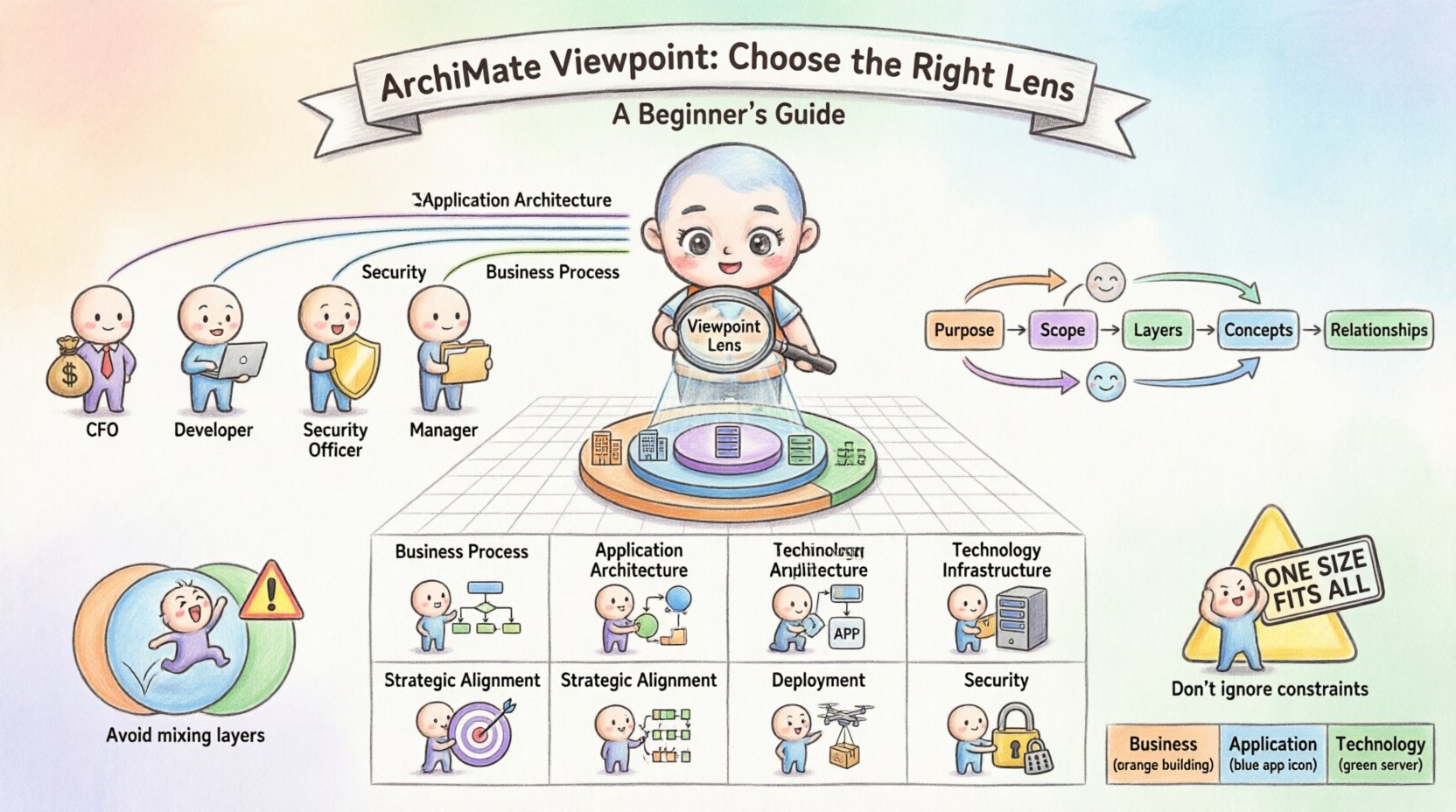
🔍 Defining the Core Concepts: View vs. Viewpoint
Before selecting a lens, you must distinguish between the view and the viewpoint. These terms are often used interchangeably in casual conversation, but in the ArchiMate standard, they hold distinct meanings.
- View: This is the actual representation of the system. It is the diagram, the document, or the set of models that a stakeholder sees. A view is the output.
- Viewpoint: This is the specification that defines how the view should be constructed. It specifies the modeling language, the specific concepts (like Business Actor or Application Component), the constraints, and the purpose of the view.
Think of it this way: The viewpoint is the recipe, and the view is the cake. You cannot bake the cake without the recipe. In enterprise architecture, if you have a viewpoint that specifies “Technology Layer” but your view includes “Business Process” concepts, the model is inconsistent. The viewpoint enforces the rules of engagement for that specific slice of the architecture.
🤝 The Stakeholder Connection
The primary reason for using viewpoints is to address the concerns of different stakeholders. A Chief Financial Officer does not need to see the details of your server rack layout. A Lead Developer does not need to see the high-level strategic mission statement. If you present the wrong information to the wrong person, you waste their time and reduce the credibility of the architecture function.
When choosing a viewpoint, you must start by asking who the audience is. Consider the following categories:
- Management: Often concerned with strategy, value streams, and high-level business capabilities.
- Architecture Team: Focused on the relationships between layers, consistency, and the integration of business and IT.
- Development Teams: Need detailed Application and Technology architecture to build and deploy systems.
- Security Officers: Require views that highlight access control, data sensitivity, and infrastructure security boundaries.
By mapping stakeholders to their specific concerns, you can determine which ArchiMate concepts are relevant. For example, a Security Officer needs the Application Function and Access Control Point concepts, whereas a Business Analyst might only care about Business Process and Business Role.
🛠️ The Selection Framework: A Step-by-Step Approach
Selecting the right viewpoint is a deliberate process. It requires analysis and discipline. Follow this structured approach to ensure your models remain focused and useful.
1. Identify the Purpose
Why are you creating this model? Is it for a compliance audit? For a migration plan? For a budget request? The purpose dictates the scope. A migration plan requires a comparison of As-Is and To-Be states, necessitating a viewpoint that supports versioning and transition modeling.
2. Define the Scope
What is in scope, and what is out of scope? Enterprise models can be overwhelming. You must define boundaries. Are you modeling the entire enterprise or just a specific department? A viewpoint should reflect these boundaries to prevent scope creep.
3. Select the Relevant Layers
ArchiMate is structured into layers: Business, Application, and Technology. There are also cross-cutting layers like Strategy and Implementation. You do not need to model all layers for every diagram. Select the layers that are relevant to the stakeholder’s concern.
- Business Layer: Focus on roles, processes, and services.
- Application Layer: Focus on software components and functions.
- Technology Layer: Focus on hardware, networks, and devices.
4. Choose the Concepts
Once the layers are selected, choose the specific concepts. A Business Viewpoint might use Business Actor, Business Role, and Business Process. A Data Viewpoint might utilize Business Object and Data Object. Stick to the subset of concepts that the viewpoint defines.
5. Establish Relationships
What relationships are allowed? In ArchiMate, relationships can be flow, access, usage, or assignment. A viewpoint should restrict which relationships are visible. For instance, a high-level strategy view might hide the underlying Usage relationships between applications to keep the diagram clean.
📊 Common ArchiMate Viewpoint Categories
While there are infinite ways to slice an enterprise model, there are standard categories that align with industry best practices. The table below outlines common viewpoints and their typical focus areas.
| Viewpoint Name | Primary Audience | Key Concepts | Typical Purpose |
|---|---|---|---|
| Business Process View | Process Owners, Operations | Process, Role, Function, Goal | Analyze workflow efficiency and bottlenecks |
| Application Architecture View | Developers, System Architects | Application Component, Service, Interface | Plan system integration and dependencies |
| Technology Infrastructure View | IT Operations, Infrastructure Team | Node, Device, Network | Manage hardware and network topology |
| Strategic Alignment View | Executive Management, CIO | Principle, Value, Goal, Driver | Ensure IT supports business strategy |
| Deployment View | DevOps, Release Managers | Deployment Node, Path, Artifact | Visualize software deployment paths |
| Security View | Security Officers, Compliance | Security Object, Access Control, Threat | Assess risk and compliance posture |
Notice how the key concepts change based on the audience. A Security Officer would find a Business Process Viewpoint confusing if it lacks security objects. Conversely, a Process Owner would find a Technology Infrastructure Viewpoint irrelevant if it lacks process flow.
🚫 Avoiding Common Modeling Pitfalls
Even with a solid framework, mistakes happen. Here are common errors to avoid when implementing viewpoint strategies.
- Mixing Layers Indiscriminately: While cross-layer relationships exist, cluttering a diagram with every possible layer creates noise. A Business Layer diagram should primarily show Business concepts. If you must show Application concepts, use a specific Business-Application view, not a generic Business view.
- Ignoring Constraints: Viewpoints often include constraints. For example, a “High Level” viewpoint might state that only Business Actors are allowed, not Business Roles. Ignoring these constraints leads to inconsistent models.
- One Size Fits All: Do not create a single “Master Viewpoint” for everything. If you try to please everyone with one diagram, you end up pleasing no one. Create a matrix of viewpoints that map to specific stakeholder groups.
- Over-Engineering: Beginners often try to model every possible relationship. Focus on the relationships that add value to the decision-making process. If a relationship does not help explain the scenario, exclude it.
- Lack of Documentation: A viewpoint is a specification. It should be documented. Explain why a specific viewpoint was chosen for a specific project. This ensures that future architects understand the context when they revisit the model.
🔗 Integrating Viewpoints with Business Strategy
The ultimate goal of enterprise architecture is to bridge the gap between strategy and execution. Viewpoints are the mechanism that makes this bridge traversable. When you align your viewpoint selection with strategic goals, the architecture becomes a strategic asset rather than a documentation exercise.
For example, if the strategic goal is Cost Reduction, your viewpoint selection should prioritize:
- Views that highlight redundant applications.
- Views that show underutilized technology resources.
- Views that compare current state costs against target state costs.
If the strategic goal is Innovation, your viewpoints should shift focus to:
- Views that identify technology gaps.
- Views that show agility in the application landscape.
- Views that map business capabilities to potential new markets.
By tailoring the lens you use, you ensure that the architecture model supports the specific strategic narrative of the organization at any given time.
📝 Maintaining Consistency Across Models
Consistency is the hallmark of a mature architecture practice. If you have a Business Process view and an Application view, they must align. This is where the concept of cross-view consistency becomes vital.
To maintain consistency:
- Use a Common Metamodel: Ensure all viewpoints adhere to the same version of the ArchiMate standard. Do not mix concepts from different versions.
- Centralize Definitions: Maintain a central repository for named elements. If a Customer is defined as a Business Actor in one view, it should not appear as a Business Role in another without a clear mapping.
- Automate Where Possible: If you have access to modeling tools, use them to validate viewpoint compliance. Automated checks can flag elements that do not belong in a specific layer or viewpoint.
- Review Cycles: Establish a review process where different architects validate each other’s viewpoints. This peer review helps catch inconsistencies early.
🌱 Future-Proofing Your Viewpoint Strategy
The technology landscape changes rapidly. Cloud computing, microservices, and AI are altering how enterprises operate. Your viewpoint strategy must be adaptable.
- Modularity: Design your viewpoints so they can be combined. A Cloud Migration Viewpoint should be able to integrate with a Security Viewpoint without breaking the underlying model.
- Scalability: Ensure your viewpoints can handle large volumes of data. Some viewpoints work well for small projects but fail when scaled to an enterprise level. Choose concepts that scale.
- Extensibility: Be open to extending the standard. While ArchiMate provides a robust set of concepts, sometimes organizations need specific extensions. Document these extensions clearly so they do not break the standard.
📈 Measuring the Value of Viewpoints
How do you know if your viewpoint strategy is working? Look for these indicators of success:
- Reduced Meeting Times: If stakeholders can understand the diagram without a long explanation, the viewpoint is effective.
- Faster Decision Making: If architects can find the information they need quickly because the views are well-structured, the strategy is paying off.
- Higher Quality Models: Fewer errors and inconsistencies in the model indicate that the viewpoint constraints are being followed.
- Stakeholder Satisfaction: Ask the stakeholders directly. Do they feel the models provide the insights they need?
🏁 Final Thoughts on Architecture Clarity
Choosing the right ArchiMate viewpoint is a foundational skill for any enterprise architect. It transforms a complex web of data into a clear, actionable narrative. By focusing on the stakeholder, defining the scope, and adhering to the rules of the metamodel, you create models that drive value.
Remember that architecture is not about the diagram itself; it is about the understanding it generates. A well-chosen viewpoint facilitates that understanding. Take the time to plan your views, document your viewpoints, and maintain consistency across your enterprise. This discipline will make your architecture practice robust, reliable, and essential to the organization’s success.