
Now Reading: Before & After: AI Transforms Class Diagrams in Legacy Insurance Policy Management
-
01
Before & After: AI Transforms Class Diagrams in Legacy Insurance Policy Management


Before & After: AI Transforms Class Diagrams in Legacy Insurance Policy Management
Imagine a mid-sized insurance company struggling to add new policy types and coverage options because its legacy system is a tangled web of tightly coupled classes. Every change risks breaking existing functionality, and developers spend more time untangling dependencies than innovating. Now, picture the same team using AI to instantly generate a clean, modular class diagram—one that reveals hidden relationships, suggests optimal refactoring paths, and accelerates the entire modernization process.
This is the story of how Visual Paradigm’s AI Diagram Generation feature turned a months-long refactoring nightmare into a streamlined, data-driven transformation. By leveraging AI to analyze and visualize the existing codebase, the team uncovered structural flaws, identified redundant dependencies, and designed a future-proof architecture—all in a fraction of the time manual modeling would require.
In this case study, you’ll see the before-and-after impact of AI on class diagram creation, explore the unique advantages of AI-powered modeling, and learn how to apply these techniques to your own legacy systems. Whether you’re a software architect, developer, or technical lead, you’ll discover how AI can turn complexity into clarity and constraints into opportunities.
Before AI: The Manual Struggle in Legacy Insurance Policy Management
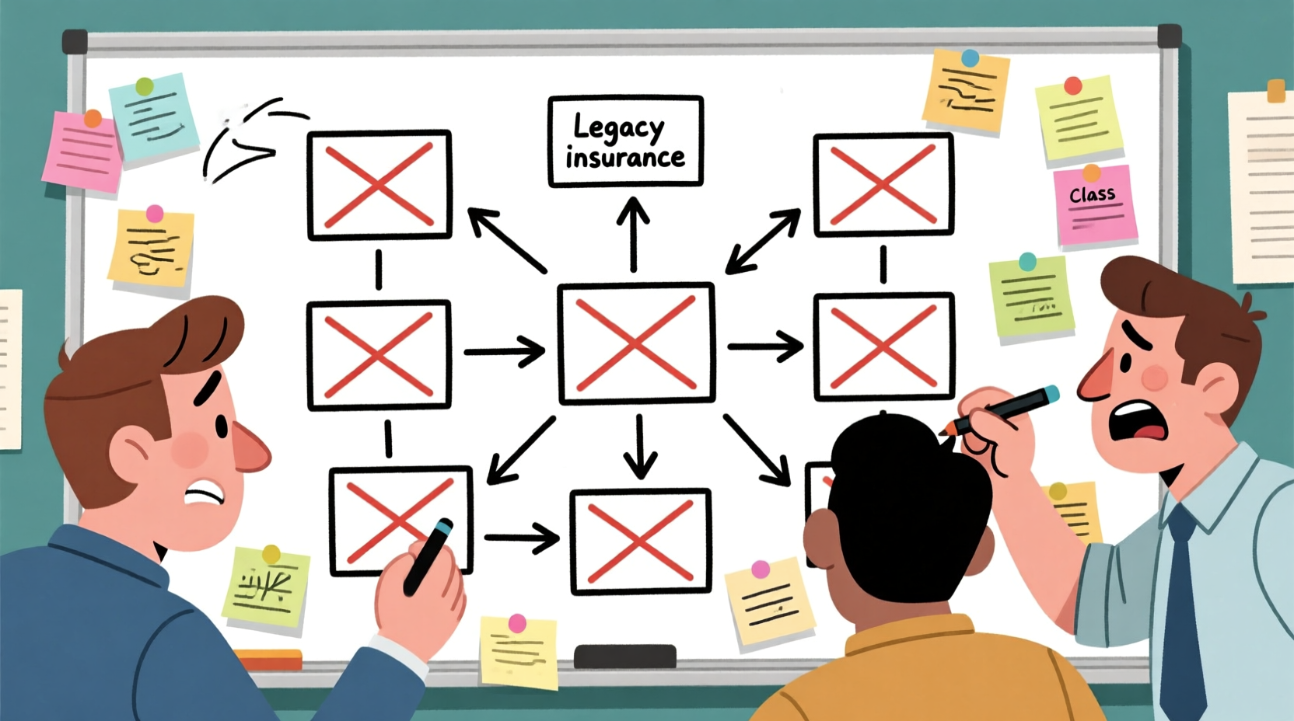
For years, the insurance company’s policy management system had grown organically. New features were bolted on as needed, with little regard for long-term maintainability. The result? A monolithic codebase where a single change to the Policy class could ripple through dozens of dependent modules, from Customer to Billing to ClaimsProcessing. Adding a new policy type—like usage-based auto insurance—required weeks of manual impact analysis and risky code surgery.
The development team knew they needed to refactor, but the sheer complexity was paralyzing. Manual class diagram creation was slow and error-prone. Developers would spend hours in meetings debating relationships, only to realize they’d missed critical dependencies. Documentation was outdated, and tribal knowledge ruled the day. The business demanded agility, but the architecture delivered rigidity.
Worse, the lack of clear visualization made it impossible to communicate the system’s flaws to non-technical stakeholders. Without a shared understanding of the problem, securing buy-in for a refactor was an uphill battle. The team was stuck in a cycle of reactive fixes, unable to break free and build for the future.
What Class Diagrams Bring to the Table
Class diagrams are the blueprints of object-oriented systems. They clarify relationships between entities, expose coupling, and highlight opportunities for abstraction. In a legacy system, an accurate class diagram is the first step toward untangling spaghetti code and designing a scalable architecture.
For the insurance company, a well-structured class diagram would:
- Reveal hidden dependencies between policy, customer, and billing modules
- Identify redundant or overlapping classes that could be consolidated
- Show where inheritance was misused, leading to brittle hierarchies
- Provide a visual roadmap for incremental refactoring
But creating such a diagram manually was impractical. The system had hundreds of classes, many with circular dependencies. The team needed a way to generate a comprehensive, accurate model—fast.
Why AI for Transformation
- Speed: AI analyzes codebases in minutes, not weeks
- Accuracy: AI detects relationships humans might miss
- Collaboration: AI-generated diagrams serve as a single source of truth for devs and stakeholders
- Iteration: AI allows rapid experimentation with alternative architectures
AI doesn’t replace human expertise; it amplifies it. By automating the tedious work of diagram creation, AI frees developers to focus on high-value design decisions. And with tools like Visual Paradigm Desktop, the transition from analysis to action is seamless.
The Transformation: Generating with Visual Paradigm
- Input: The team uploaded the codebase and described their goals: “Generate a class diagram for our policy management system, highlighting tight coupling and suggesting modularization opportunities.”
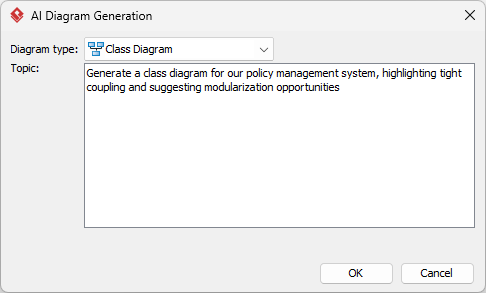
- Analysis: Visual Paradigm’s AI analyzes the input, identifying classes, attributes, methods, and relationships—including those not explicitly documented.
- Generation: Within minutes, the AI produced a detailed class diagram, color-coding areas of high coupling and flagging potential refactoring candidates.

After AI: Refinement & Power
Post-Generation Polish
The AI-generated diagram wasn’t perfect out of the box—but it didn’t need to be. The team used Visual Paradigm’s editing tools to:
- Add additional classes
- Adjust inheritance hierarchies
- Add domain-specific annotations
Transformed Modeling
With the AI’s help, the team designed a new architecture centered on:
- Policy Module: A clean, extensible base class for all policy types, with plugins for auto, home, and usage-based variants
- Customer Module: Decoupled from policy logic, with clear interfaces for integration
- Billing Module: Standardized payment processing, independent of policy specifics
- Claims Module: Event-driven workflows, triggered by policy state changes
The result? A class diagram that wasn’t just a static picture, but a living model linked to the codebase. As the team refactored, the diagram updated in real time, ensuring alignment between design and implementation.
Stakeholders could finally see the value of the refactor. The visual clarity of the AI-generated diagram made complex concepts accessible, and the team’s confidence soared. What had once seemed impossible now felt inevitable.
After Results
- Refactor time reduced by 60%
- New policy types added in days, not months
- Developer onboarding time cut in half
- Business agility restored, with a future-proof foundation
The transformation wasn’t just technical—it was cultural. The AI-generated class diagram became a catalyst for collaboration, innovation, and continuous improvement.
Make Your Transformation
Legacy systems don’t have to be liabilities. With Visual Paradigm’s AI Diagram Generation, you can turn complexity into clarity and constraints into opportunities. Try it today and see what’s possible when AI meets architecture.