


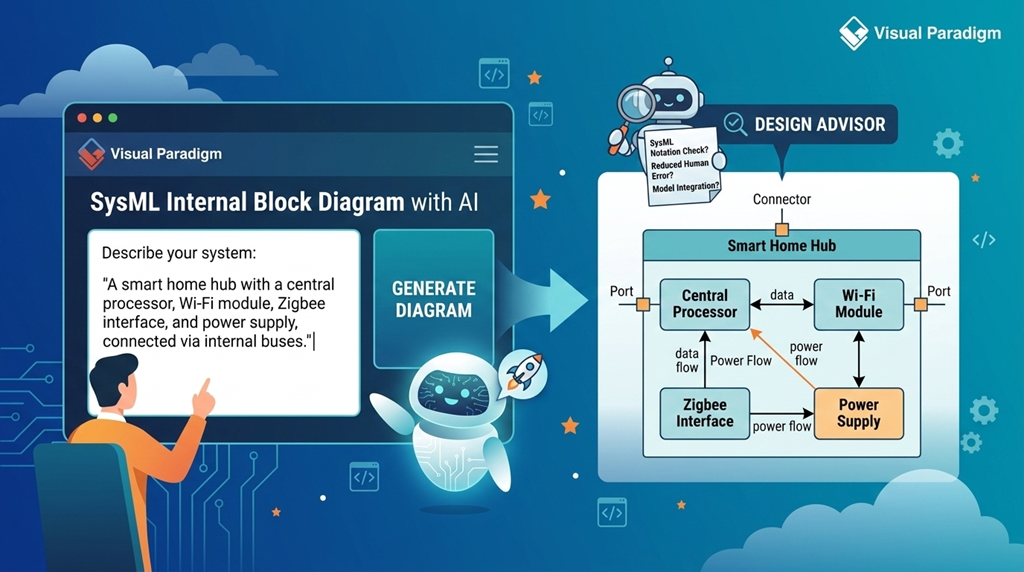
In systems engineering, understanding how components interact within a system is as critical as knowing what components exist. While SysML Block Definition Diagrams (BDDs) define the structure of a system’s parts, Internal Block Diagrams (IBDs) reveal how those parts connect and communicate. This “white-box” view is essential for modeling the internal architecture of complex systems—whether they are software applications, embedded devices, or industrial automation systems.
Traditionally, creating IBDs has been a manual, time-consuming process requiring deep expertise in SysML notation. But with the integration of artificial intelligence into modeling tools, engineers now have a faster, more accurate way to design and refine these diagrams.
What Is a SysML Internal Block Diagram?
An Internal Block Diagram (IBD) shows the internal structure of a system block, illustrating how its components are interconnected. Unlike a BDD, which focuses on what a system contains, the IBD emphasizes how its parts interact.
Key elements of an IBD include:
- Parts: Represent internal components or subsystems, such as a processor or sensor.
- Ports: Define interaction points on a block’s boundary where connections occur.
- Connectors: Lines that link ports between parts, indicating data, energy, or material flow.
- Item Flows: Specify the type of data or material exchanged across a connector (e.g., sensor data, power).
These elements help engineers visualize the physical or logical relationships inside a system—crucial for identifying dependencies, ensuring correct integration, and validating system behavior.
The Role of AI in SysML Diagram Design
Visual Paradigm has introduced an AI-powered ecosystem that streamlines the creation and refinement of SysML diagrams, including IBDs. By combining natural language input with intelligent modeling, the platform enables engineers to generate accurate, standards-compliant diagrams with minimal effort.
The AI-driven approach works through a text-to-diagram process. For example, entering a description like:
“A smart home hub with a central processor, Wi-Fi module, Zigbee interface, and power supply, connected via internal buses”
…triggers an automated diagram generation process. The AI interprets the description, identifies relevant blocks, and places them appropriately. It automatically creates ports, connectors, and item flows—ensuring all elements follow SysML notation standards.
This capability significantly reduces the time and cognitive load associated with manual drawing. Engineers no longer need to manually place shapes, align ports, or verify notation rules. Instead, they can focus on architectural decisions and system validation.
How the AI Ecosystem Enhances Design Efficiency
Visual Paradigm Desktop: AI Enabled Modeler
VP Desktop is Visual Paradigm’s flagship tool—perfect when you need full control over complex SysML models. The integrated AI diagram tool lets you generate an Internal Block Diagram right inside the app. Just describe the block’s internal structure: parts, interfaces, flows. AI builds the diagram instantly, complete with proper ports and connectors.
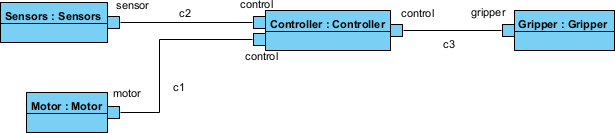
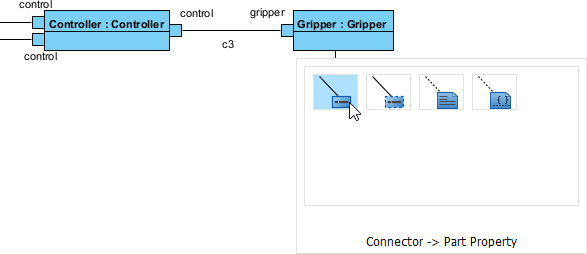
Touchup and refinement:
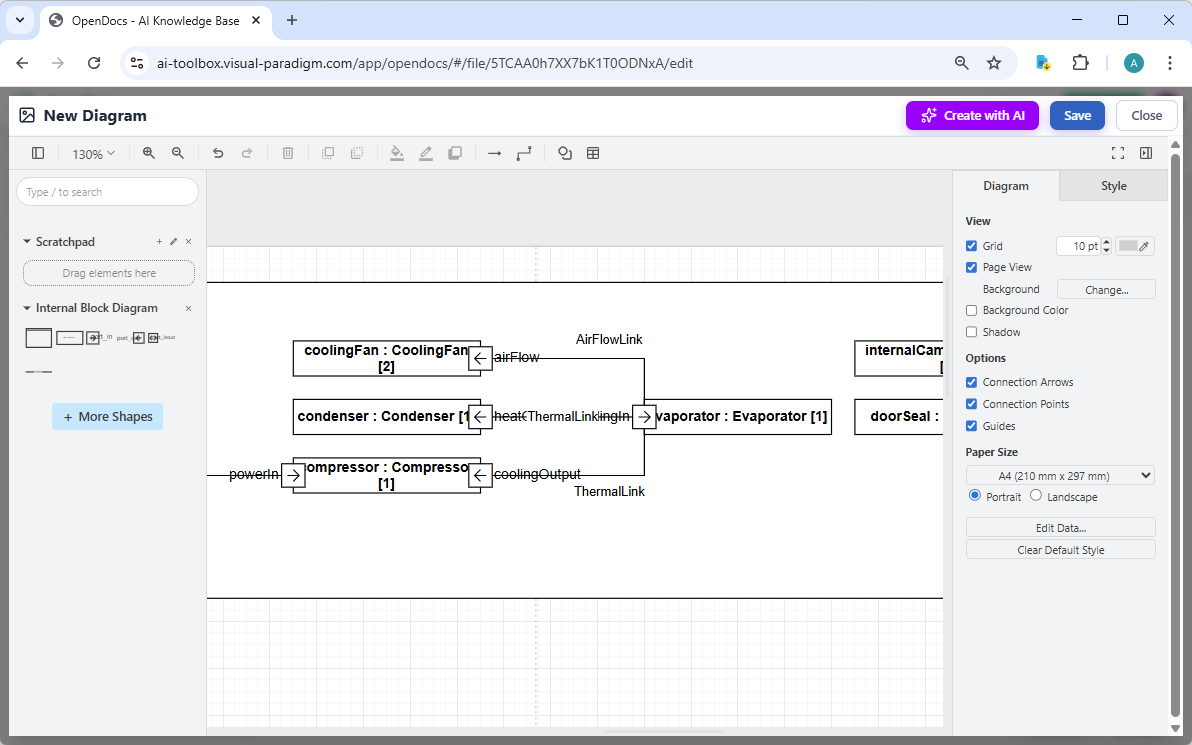
Visual Paradigm OpenDocs: Smart, AI Powered Knowledge Management Platform
Diagrams don’t live alone—they belong in documents, wikis, reports. OpenDocs turns static content into dynamic knowledge bases, much like Notion but with real modeling power. Generate or import your SysML IBD using AI, then embed it directly into pages.
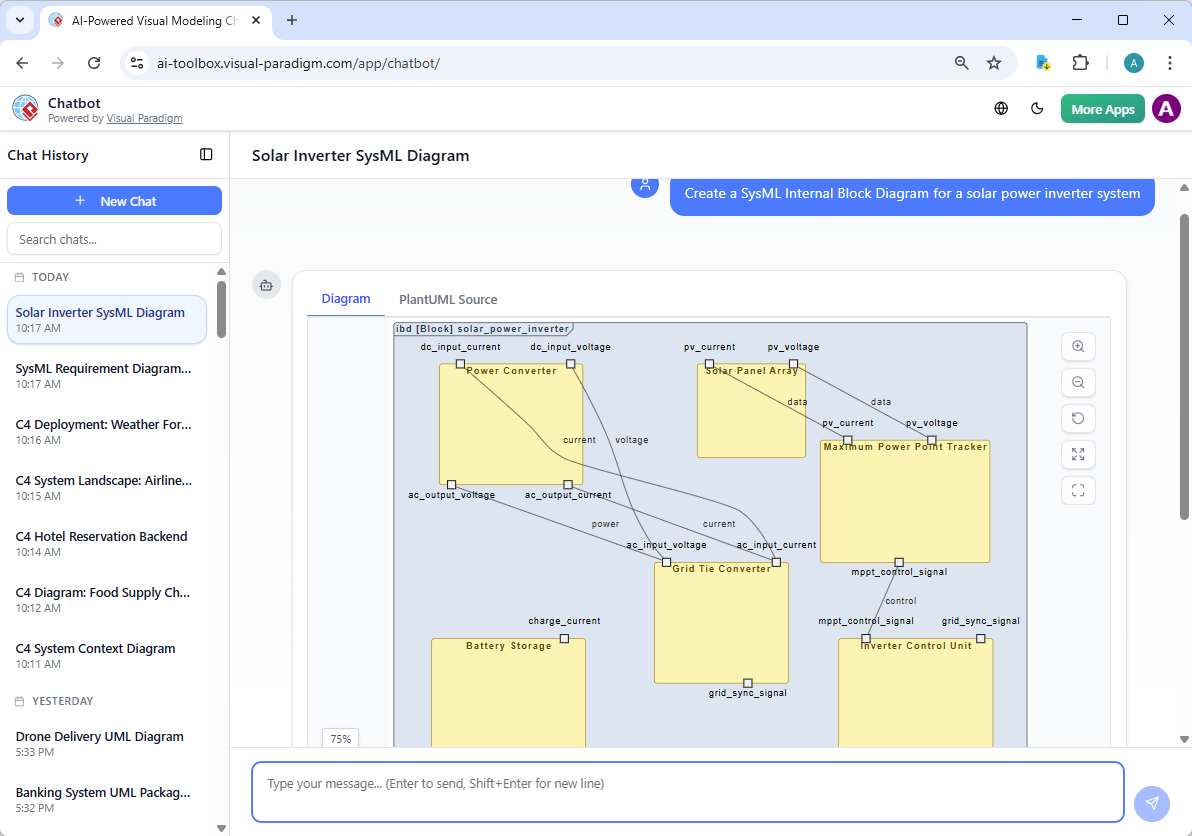
Visual Paradigm AI Chatbot for Visual Modelers
Need quick prototypes or iterative design? Visual Paradigm’s AI Visual Modeling Chatbot turns natural language into diagrams through simple conversation. Type or speak: “Create a SysML Internal Block Diagram for a drone’s flight control system, showing sensor integration, processor, actuators, with item flows for commands and telemetry.”
The chatbot generates the IBD instantly. Not happy with a connection? Ask it to “add a proxy port for external interface” or “explain the item flow between battery and power distribution.” It refines, explains elements, suggests improvements, or even generates related diagrams like Block Definition Diagrams for context.
Real-World Applications
IBDs are widely used across industries, including:
- Automotive: Modeling the internal architecture of an autonomous vehicle’s control system.
- IoT: Designing communication flows between sensors, gateways, and cloud platforms.
- Industrial Automation: Mapping data exchange between PLCs, HMIs, and field devices.
- Medical Devices: Visualizing signal and power flows in implantable electronics.
In each case, AI-assisted IBD creation allows engineers to focus on system functionality rather than diagram mechanics.
Best Practices for Using AI in SysML Modeling
To maximize the benefits of AI-powered IBD generation:
- Start with clear, descriptive prompts. The more specific your input, the more accurate the output.
- Validate AI-generated diagrams against system requirements and architectural guidelines.
- Use the AI as a collaborative tool, not a replacement for engineering judgment.
- Leverage the model’s editability to refine diagrams during design reviews.
Conclusion
The integration of AI into SysML modeling tools like Visual Paradigm is reshaping how engineers design complex systems. By automating the creation of Internal Block Diagrams, AI reduces design time, improves accuracy, and enhances collaboration. This shift allows teams to focus on high-value tasks—such as validating system behavior and solving real-world engineering challenges—rather than getting bogged down in diagram mechanics.
As systems grow in complexity, tools that support efficient, standards-compliant modeling will become increasingly essential. AI-driven diagramming is not just a convenience—it’s a strategic advantage in modern systems engineering.
- Beginner’s Guide to SysML Internal Block Diagrams (IBDs) – Visual Paradigm Blog: Step-by-step introduction to SysML Internal Block Diagrams, which show internal structure and interconnections of blocks (parts, connectors, ports, flows, item flows, constraints), notation basics, examples (e.g., vehicle subsystem with engine, transmission, and interfaces), and practical creation tips in Visual Paradigm for detailed part-level system behavior and interfaces.
- SysML Diagram Tool – Visual Paradigm: Full certified SysML 1.6 support including Internal Block Diagrams (IBDs): drag-and-drop parts/ports, connectors with item flows, flow ports, proxy ports, full port definitions, constraint properties, parametric linking, traceability to requirements/BDDs, and AI-assisted generation/refinement for precise internal system architecture modeling.
- Refine Structural Elements with Internal Block Diagrams in SysML – Visual Paradigm Guide: Detailed guide on using IBDs to elaborate block structures from Block Definition Diagrams (BDDs): defining internal parts, connectors, ports/interfaces, item flows, delegations, allocations, and constraints; includes AI enhancements for automatic element population, relationship suggestions, layout optimization, and validation to ensure accurate, traceable system decomposition.
- UML vs. SysML: Strategic Choice for Systems Engineering with AI – Diagrams AI: Comparative analysis of UML (software-centric) vs. SysML (systems-focused extension with IBDs, requirement diagrams, parametrics); emphasizes AI’s role in Visual Paradigm for generating/refining SysML IBDs from text, improving structural detail, interface consistency, and cross-layer traceability in complex engineering projects.
- How AI Visual Modeling Platforms Boost Speed, Efficiency, and Standards Compliance – ArchiMetric: In-depth discussion of AI-driven tools (including Visual Paradigm) for SysML/UML modeling: instant diagram generation (e.g., IBDs from system descriptions), real-time refinements, automatic compliance checks against SysML standards, reduced errors, and accelerated iteration in systems engineering workflows.
- Comprehensive Guide to Visual Paradigm’s AI-Powered UML & SysML Modeling Ecosystem (2025–2026) – Cybermedian: Forward-looking overview of AI integration in Visual Paradigm: text-to-SysML diagram automation (including IBDs for internal structures), contextual refinements, intelligent validation (e.g., port/flow consistency), traceability across BDD/IBD/requirements, and ecosystem enhancements for future-proof MBSE in aerospace, automotive, and defense domains.
- AI-Powered SysML Requirement Diagram Tool – Visual Paradigm: Explores AI chatbot for SysML requirement diagrams (hierarchy, satisfy/verify/deriveReqt relationships), with direct implications for IBD design: linking requirements to structural elements (parts, ports, flows), ensuring traceability from high-level needs to internal implementations, and supporting iterative refinement for consistent system modeling.
- AI-Powered SysML Diagram Generation Demo – YouTube: Video tutorial demonstrating real-time AI interaction in Visual Paradigm: generating and refining SysML diagrams (including structural types like IBDs) from natural language, showing prompt techniques, automatic element/connector creation, iterative edits, and practical application in systems engineering.