

In the discipline of software engineering, the precision of language dictates the precision of implementation. Object-Oriented Analysis and Design (OOAD) relies on a specific vocabulary to describe how systems behave, how data is structured, and how components interact. Without a shared understanding of these terms, communication between stakeholders, analysts, and developers breaks down. This guide outlines the fundamental concepts that form the backbone of modern software architecture.
🏗️ The Core Building Blocks: Classes and Objects
Before diving into complex relationships, one must understand the primary units of structure. OOAD treats data and behavior as a single entity.
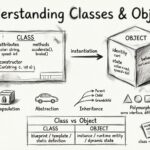
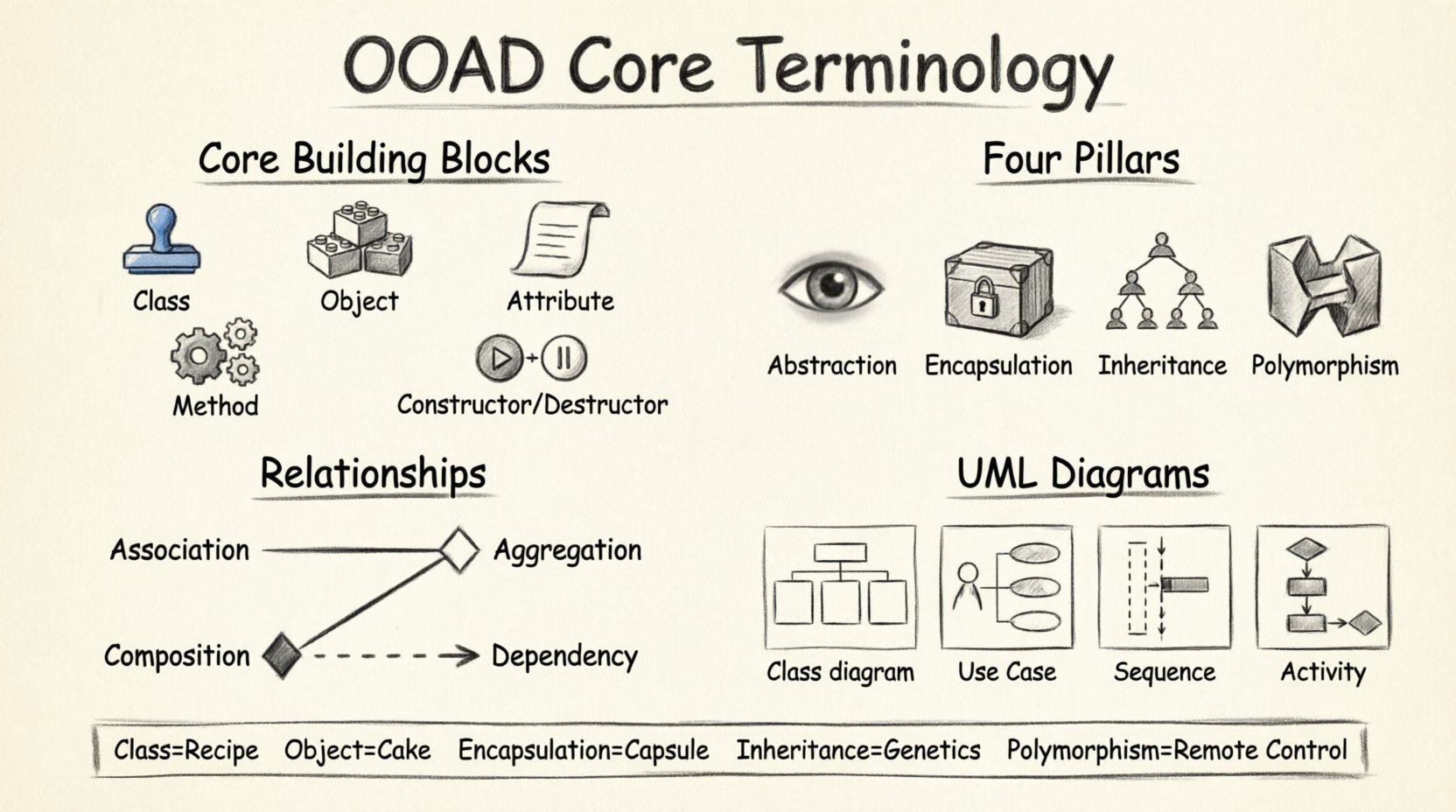
- Class: A blueprint or template from which objects are created. It defines the state (attributes) and behavior (methods) that the resulting instances will possess. Think of it as a architectural plan for a house, not the house itself.
- Object: An instance of a class. When a class is instantiated, memory is allocated to store the specific data for that object. If a class is a blueprint, the object is the actual building constructed from that plan.
- Attribute: Also known as a property or field, this represents the state or data held within an object. Examples include a user’s name, an account balance, or a product’s price.
- Method: A function or procedure associated with an object that defines its behavior. Methods allow objects to perform actions, such as calculating a total or sending a notification.
- Constructor: A special method invoked when an object is created. It initializes the object’s state to a valid starting point.
- Destructor: A method invoked when an object is destroyed. It handles cleanup tasks, such as releasing memory or closing file connections.
🧩 The Four Pillars of Object Orientation
These four principles distinguish object-oriented systems from procedural ones. Understanding the distinction is critical for designing flexible and maintainable software.
1. Abstraction 🧠
Abstraction involves hiding complex implementation details and showing only the essential features of an object. It allows developers to focus on what an object does rather than how it does it.
- Interface: A contract that defines a set of methods a class must implement, without providing the implementation details.
- Abstract Class: A class that cannot be instantiated on its own and is meant to be subclassed. It can contain both abstract methods (no body) and concrete methods (with body).
2. Encapsulation 🔒
Encapsulation bundles data and methods together while restricting direct access to some of the object’s components. This protects the internal state from external interference.
- Access Modifiers: Rules that control visibility. Common types include:
- Public: Accessible from any other class.
- Private: Accessible only within the defining class.
- Protected: Accessible within the class and its subclasses.
- Getter/Setter: Methods used to read or modify private attributes safely.
3. Inheritance 🌳
Inheritance allows a new class to acquire the properties and behaviors of an existing class. This promotes code reusability and establishes a hierarchical relationship.
- Parent/Super Class: The class being inherited from.
- Child/Sub Class: The class that inherits from the parent.
- Method Overriding: When a child class provides a specific implementation of a method that is already defined in its parent class.
4. Polymorphism 🔄
Polymorphism allows objects of different classes to be treated as objects of a common superclass. It enables one interface to be used for a general class of actions.
- Compile-time Polymorphism: Achieved through method overloading, where multiple methods share the same name but have different parameter lists.
- Run-time Polymorphism: Achieved through dynamic method dispatch, where the specific method to be executed is determined during program execution.
🔗 Understanding Relationships
Objects rarely exist in isolation. They interact through relationships. Visualizing these connections is a primary task in Analysis and Design.
- Association: A structural relationship where objects of one class are linked to objects of another. It represents a “has-a” relationship.
- Aggregation: A specialized form of association representing a “whole-part” relationship where the part can exist independently of the whole. If the whole is destroyed, the part remains.
- Composition: A stronger form of aggregation. The part cannot exist independently of the whole. If the whole is destroyed, the part is also destroyed.
- Dependency: A relationship where one class uses another as a parameter or returns it as a result. It is a temporary “uses-a” relationship.
- Multiplicity: Defines the number of instances of one class that relate to a single instance of another class (e.g., one-to-many, many-to-many).
📊 Modeling with UML
The Unified Modeling Language (UML) is the standard notation for visualizing system design. While OOAD is the process, UML is the language used to document it.
Class Diagrams
The most common diagram type. It depicts the static structure of a system by showing classes, attributes, methods, and relationships. It serves as the map for developers implementing the system.
Use Case Diagrams
Focuses on the functional requirements from the user’s perspective. It shows actors (users or external systems) and the use cases (goals) they want to achieve.
Sequence Diagrams
Illustrates how objects interact in a specific scenario over time. It emphasizes the order of messages passed between objects to accomplish a task.
Activity Diagrams
Similar to flowcharts, these depict the flow of control from activity to activity. They are useful for modeling the logic of complex business rules.
📋 Quick Reference Table
Use this table to review the core terms quickly.
| Term | Definition | Analogy |
|---|---|---|
| Class | A blueprint for objects. | Cookbook recipe |
| Object | An instance of a class. | A cake baked from the recipe |
| Encapsulation | Restricting access to components. | A capsule hiding medicine |
| Inheritance | Acquiring properties from a parent. | Genetic traits passed to children |
| Polymorphism | Same interface, different behavior. | A remote control for different devices |
| Association | A relationship between classes. | A person owning a car |
| Composition | Strong ownership relationship. | A heart belonging to a body |
🛠️ Analysis vs. Design
Distinguishing between analysis and design phases helps in applying the correct terminology at the right stage of development.
Object-Oriented Analysis (OOA)
Focuses on what the system should do. It identifies the problem domain and defines the requirements without considering technical constraints.
- Domain Model: A representation of the concepts and relationships in the problem domain.
- Actor: An entity that interacts with the system.
- Use Case: A description of a sequence of actions that provide a measurable value to an actor.
Object-Oriented Design (OOD)
Focuses on how the system will do it. It translates the analysis model into a technical solution.
- Architectural Pattern: A fundamental structure for the system (e.g., Layered, MVC).
- Design Pattern: A reusable solution to a common problem in software design.
- Interface: A definition of a contract for interaction between components.
🧩 Design Patterns Overview
Design patterns are proven solutions to recurring problems. They are not code, but templates for how to solve a problem.
Creational Patterns
Dealing with object creation mechanisms. Examples include Singleton (ensuring only one instance exists) and Factory (dealing with object creation without specifying exact classes).
Structural Patterns
Dealing with class and object composition. Examples include Adapter (allowing incompatible interfaces to work together) and Decorator (adding behavior to objects dynamically).
Behavioral Patterns
Dealing with communication between objects. Examples include Observer (notifying objects of state changes) and Strategy (defining a family of algorithms).
🚀 Why Terminology Matters
Using the correct terminology is not merely an academic exercise. It reduces ambiguity in requirement documents. When an analyst specifies “Composition” instead of “Association,” the developer understands the lifecycle constraints of the data. This precision prevents bugs related to memory management and data integrity.
Furthermore, a strong vocabulary facilitates collaboration. When team members share a common language, code reviews become more efficient, and architectural decisions are debated based on facts rather than confusion. It allows new students to read existing documentation and understand the legacy systems without needing a constant guide.
📝 Final Thoughts
Mastery of Object-Oriented Analysis and Design begins with the words used to describe it. By internalizing these definitions, students build a foundation that supports complex problem-solving. The concepts of abstraction, encapsulation, inheritance, and polymorphism are not just buzzwords; they are the tools used to build resilient, scalable software systems. Continual practice in applying these terms to real-world scenarios will solidify understanding and prepare learners for professional challenges.
Remember, the goal is not to memorize definitions in isolation, but to understand how these concepts interact to form a cohesive system. As you progress in your studies, refer back to these core terms to ensure your designs remain clear, logical, and maintainable.