


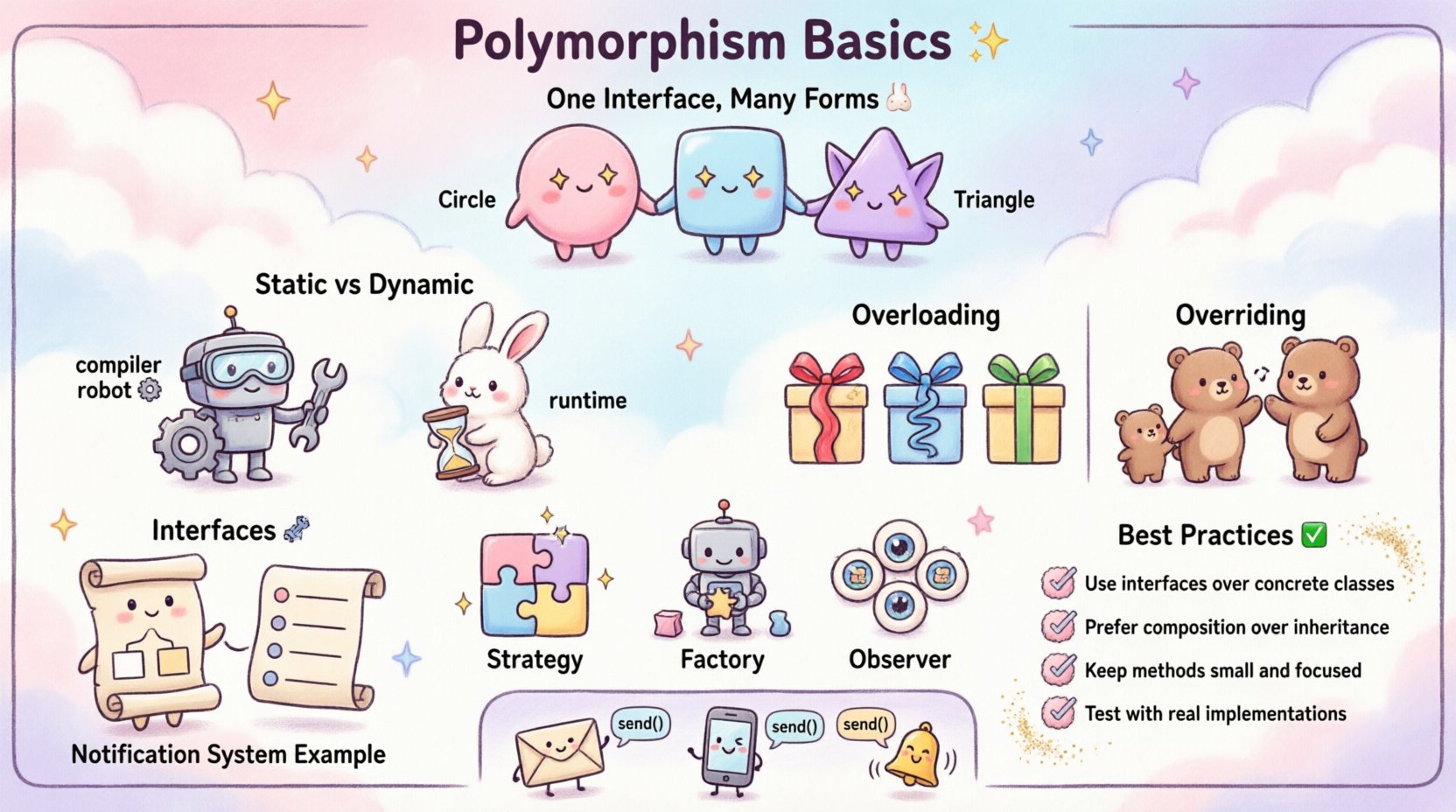
Understanding object-oriented design requires navigating several complex concepts, but few are as misunderstood as polymorphism. Often shrouded in academic jargon, this principle is actually one of the most practical tools available for creating flexible, maintainable software systems. This article breaks down polymorphism basics without the confusion, focusing on clear definitions, real-world logic, and structural integrity within object-oriented analysis and design.
We will explore how this mechanism allows objects to respond differently to the same message, why it matters for long-term code health, and how to implement it effectively without over-engineering your architecture. Let us dive into the mechanics.
Defining the Core Concept 🧠
At its simplest, polymorphism allows different types of objects to be treated as instances of a common super-type. The word itself comes from Greek roots meaning “many forms.” In the context of software architecture, it means a single interface can represent multiple underlying forms or data types.
Consider a scenario where you have a system managing various shapes. You might have circles, squares, and triangles. If you need to calculate the area of each, polymorphism allows you to write a function that accepts a generic “Shape” object. Regardless of whether the specific object is a circle or a square, the function calls the appropriate calculation method internally without needing to know the specific type beforehand.
This approach reduces coupling. Your code does not need to know the specific implementation details of every shape to perform actions on them. It only needs to know that the object adheres to the expected interface.
Key Characteristics
- Flexibility: New types can be added without modifying existing code that uses the base interface.
- Extensibility: The system grows organically as requirements change.
- Abstraction: Implementation details are hidden behind a unified interface.
Static vs Dynamic Binding ⚖️
To truly understand polymorphism, one must distinguish between how the method call is resolved. This distinction is critical for performance and behavior prediction.
1. Compile-Time Polymorphism (Static)
This occurs when the method to be executed is determined by the compiler before the program runs. It relies on method signatures.
- Method Overloading: Multiple methods share the same name but differ in their parameter lists (number or type of arguments).
- Operator Overloading: Operators are given special meanings for specific user-defined types.
- Resolution: The compiler looks at the variable type and the arguments provided to decide which method to call.
2. Runtime Polymorphism (Dynamic)
This occurs when the method to be executed is determined while the program is running. It relies on the actual object instance, not just the reference type.
- Method Overriding: A subclass provides a specific implementation of a method that is already defined in its parent class.
- Dynamic Dispatch: The virtual machine resolves the call based on the runtime type of the object.
- Resolution: The decision is made only when the code executes.
Understanding the difference between these two binding times is essential for debugging and performance tuning. Static binding is generally faster, but dynamic binding offers the flexibility required for complex object hierarchies.
Overloading vs Overriding ⚙️
These terms are often used interchangeably by beginners, yet they serve distinct purposes in design.
| Feature | Method Overloading | Method Overriding |
|---|---|---|
| Scope | Within the same class | Between parent and child classes |
| Parameters | Must differ | Must be the same |
| Binding Time | Compile-time | Runtime |
| Return Type | Can differ | Must be the same or covariant |
| Primary Use | Convenience, similar functionality | Behavior modification, specialization |
Overloading is about convenience. It allows you to name a method `calculate` whether you are passing a single radius or a width and height. Overriding is about specialization. It allows a `Vehicle` class to define a `move()` method, while a `Car` subclass overrides it to define how wheels turn, and a `Boat` subclass overrides it to define how propellers turn.
The Role of Interfaces 🔗
In modern design, polymorphism is frequently achieved through interfaces rather than just inheritance. An interface defines a contract. It specifies what methods an object must have, without dictating how they work.
Why Use Interfaces?
- Loose Coupling: Code depends on the interface, not the concrete implementation.
- Multiple Inheritance Simulation: A class can implement multiple interfaces, achieving multiple type inheritance.
- Testing: Interfaces make it easier to create mock objects for unit testing.
When you program to an interface, you ensure that any class implementing that interface can be swapped in without breaking the logic that consumes it. This is the essence of the Dependency Inversion Principle, a cornerstone of robust design.
Design Patterns Utilizing Polymorphism 🏗️
Many established design patterns rely heavily on polymorphism to solve recurring problems.
1. Strategy Pattern
This pattern defines a family of algorithms, encapsulates each one, and makes them interchangeable. The client code selects the specific algorithm at runtime.
- Example: A payment processor might accept a `PaymentStrategy` interface. You can inject a `CreditCardStrategy` or a `CryptoStrategy` depending on user preference without changing the checkout logic.
2. Factory Pattern
Factory methods allow a class to instantiate one of several derived classes based on the context. The caller receives a generic type, but the polymorphism handles the specific creation logic.
3. Observer Pattern
When an object changes state, it notifies a list of observers. The subject does not know the specific type of observer, only that it implements a `notify` method.
Common Misconceptions ❌
There are several myths surrounding this concept that often lead to poor design decisions.
- Myth 1: Polymorphism requires deep inheritance trees.
False. While inheritance is a common vehicle, composition and interfaces often provide better polymorphism without the fragility of deep hierarchies. Prefer composition over inheritance.
- Myth 2: It makes code slower.
Dynamic dispatch adds a small overhead compared to direct method calls. However, modern runtime optimizations often mitigate this. The benefit of maintainability usually outweighs the micro-optimization cost.
- Myth 3: Every class should support it.
False. Not every class needs to be polymorphic. Use it where behavior varies based on type. If all instances behave identically, polymorphism adds unnecessary complexity.
When to Avoid It 🛑
While powerful, polymorphism is not a universal solution. Applying it indiscriminately can lead to “spaghetti code” where the flow of execution is difficult to trace.
Signs You Should Stop
- Excessive Type Checking: If your code uses `if (type == ‘X’)` inside a polymorphic block, you have likely undermined the polymorphism.
- Complexity vs Clarity: If a simple procedure would suffice, do not build an interface hierarchy.
- Implementation Leakage: If the base class knows too much about the subclasses, the abstraction is leaking.
Best Practices for Implementation ✅
To implement polymorphism effectively, adhere to these guidelines.
1. Favor Abstractions
Design your classes around the behavior they provide, not the data they store. Interfaces should represent roles (e.g., `Readable`, `Writable`), not just categories (e.g., `File`, `NetworkStream`).
2. Keep Interfaces Small
Follow the Interface Segregation Principle. A large interface forces implementations to include methods they do not need. Small, focused interfaces make polymorphism easier to manage.
3. Use Abstract Classes for Shared Code
If multiple subclasses share implementation details, an abstract base class can hold that logic. If they only share a signature, use an interface.
4. Document Behavior, Not Mechanics
When defining a polymorphic interface, document the expected behavior and invariants. Do not document the internal algorithm, as that is an implementation detail.
Practical Example: A Notification System 📩
Let us look at a conceptual example of a notification system. We want to send notifications via Email, SMS, and Push.
The Interface: `NotificationSender` with a method `send(message, recipient).`
The Implementations:
- EmailSender: Implements `send` to format an email and route it through a mail server.
- SMSSender: Implements `send` to format a text message and route it through a gateway.
- PushSender: Implements `send` to push to a device token.
The Client: The `NotificationManager` accepts a `NotificationSender` object. It calls `send()` without knowing if it is email or SMS.
If we add a `SlackSender` later, we simply create the new class. The `NotificationManager` does not change. This is the power of polymorphism in action. It isolates the impact of change.
Relationship with Inheritance and Abstraction 🔄
Polymorphism does not exist in a vacuum. It relies on two other pillars of object-oriented design: inheritance and abstraction.
- Inheritance: Provides the structural hierarchy. It allows subclasses to inherit state and behavior from a parent.
- Abstraction: Provides the interface. It hides the complexity of the implementation.
- Polymorphism: Provides the flexibility. It allows the interface to work with any valid implementation.
Without abstraction, polymorphism is just inheritance. Without inheritance, polymorphism is just duck typing. Together, they form a robust framework for managing complexity.
Performance Considerations ⚡
In high-performance computing, the overhead of virtual method calls can be significant. However, in most application-level development, the cost is negligible compared to I/O operations or database queries.
If performance is critical, consider:
- Inlining: Some compilers can inline virtual methods if they can determine the concrete type at compile time.
- Static Dispatch: Use templates or generics where the type is known at compile time.
- Profiling: Always measure before optimizing. Premature optimization often breaks the design.
Summary of Design Implications 📝
Adopting polymorphism changes how you think about software. It shifts the focus from “how does this class work” to “what does this class do.” This shift is fundamental to building systems that survive the test of time.
By embracing polymorphism, you create a system where components are loosely coupled and highly cohesive. Changes in one area do not cascade destructively through the entire codebase. New features can be added with minimal risk to existing functionality.
The journey from confusion to clarity involves understanding that polymorphism is not just a language feature, but a design philosophy. It encourages you to plan for variation before it happens. It prepares your architecture for the future.
Final Thoughts on Implementation 🚀
Start small. Identify areas in your current projects where you find yourself writing repetitive `if-else` blocks based on type checks. Refactor those into polymorphic hierarchies. Observe how the code becomes easier to read and modify.
Remember that no tool is perfect. Use polymorphism where it fits the domain model. Do not force it where procedural logic is clearer. Balance is key to professional engineering.
With a solid grasp of these basics, you are equipped to handle complex object interactions with confidence. The confusion fades, and the structure remains clear.