


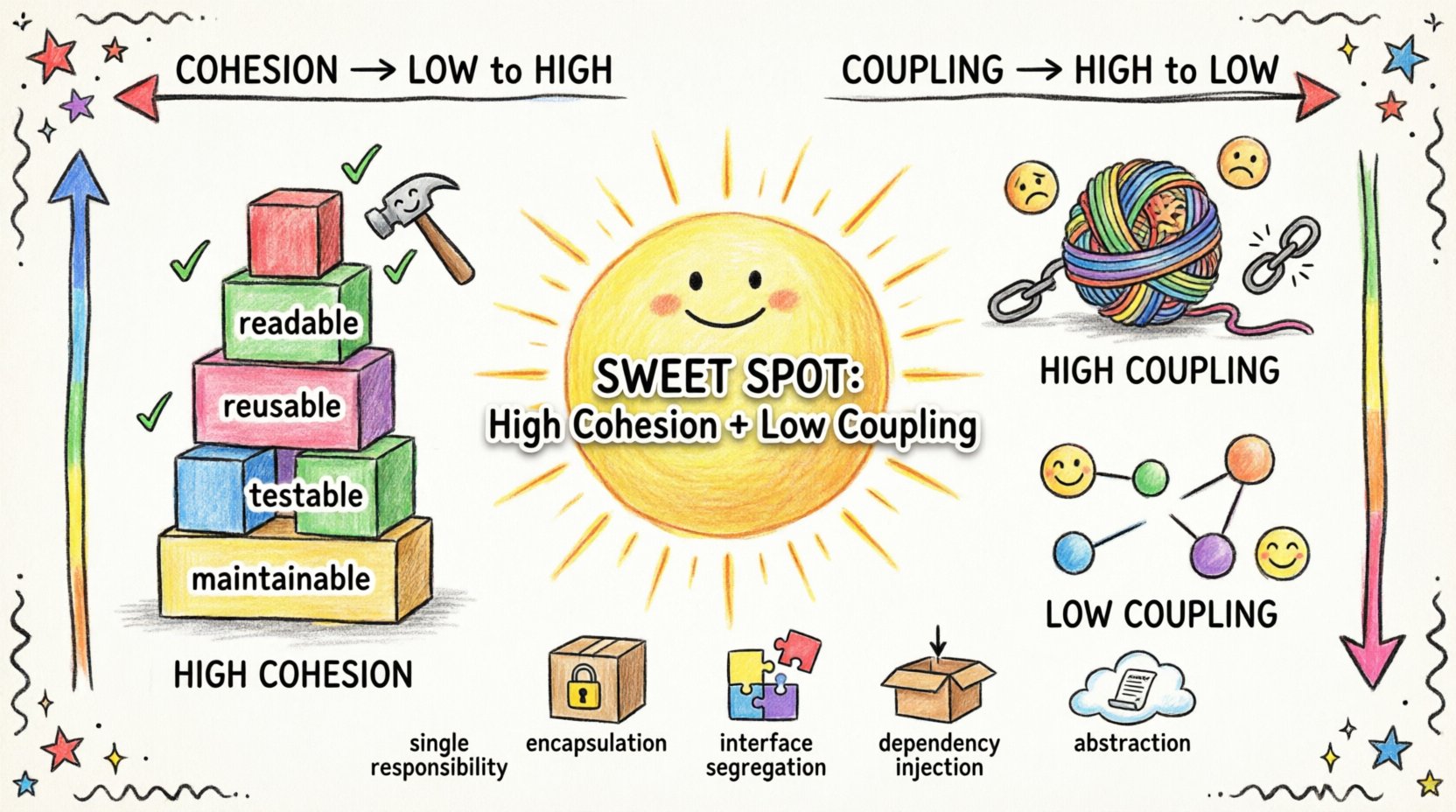
In the landscape of Object-Oriented Analysis and Design, two metrics define the health of a system: coupling and cohesion. These concepts are not merely academic terms; they are the bedrock of maintainable, scalable, and robust software architecture. When developers understand how modules interact and how responsibilities are distributed, they create systems that adapt to change rather than breaking under pressure.
This guide explores the mechanics of these principles. We will dissect the types of cohesion and coupling, analyze their impact on the development lifecycle, and provide actionable strategies to refine your designs. By focusing on these structural elements, teams can reduce technical debt and improve overall code quality.
Understanding Cohesion: The Internal Strength 🧱
Cohesion refers to how closely related the responsibilities are within a single module, class, or component. High cohesion means that a module performs a single, well-defined task. Low cohesion suggests that a module is trying to do too many unrelated things.
Think of a toolset. A hammer is highly cohesive; it is designed for one job. A Swiss Army knife is less cohesive because it combines cutting, screwing, and opening functions into one tool. While versatility has its place, in software design, we generally prefer the hammer approach.
Types of Cohesion
Not all cohesion is created equal. The following table outlines the spectrum from low to high cohesion:
| Level | Type | Description |
|---|---|---|
| Low | Coincidental | Elements are grouped arbitrarily without any meaningful relationship. |
| Low | Logical | Elements are grouped because they are logically similar (e.g., all report printing functions). |
| Low | Temporal | Elements are grouped because they are executed at the same time (e.g., initialization routines). |
| Medium | Procedural | Elements are grouped because they must be executed in a specific sequence. |
| Medium | Communicational | Elements are grouped because they operate on the same data. |
| High | Sequential | Output of one element is input to the next. |
| High | Functional | All elements contribute to a single, specific task. |
Functional and Sequential cohesion are the targets for well-designed modules. When a class exhibits functional cohesion, it means every method within that class contributes to one specific goal. This makes the class easier to understand, test, and modify.
Benefits of High Cohesion
- Readability: Developers can understand the purpose of a module quickly.
- Reusability: A focused module can be moved to other parts of the system with minimal friction.
- Testability: Isolated functionality is easier to verify with unit tests.
- Maintainability: Changes to one aspect of functionality do not ripple unpredictably through unrelated logic.
Understanding Coupling: The External Connection 🔗
If cohesion is about internal unity, coupling is about external dependency. Coupling measures the degree of interdependence between software modules. Low coupling means that modules are independent and can function without knowledge of each other’s internal details.
High coupling creates a web of dependencies. Changing one module forces changes in many others. This creates fragility, where a simple update can break the entire system.
Types of Coupling
Similar to cohesion, coupling exists on a spectrum. The goal is to move towards the lower end of this spectrum:
- Content Coupling (Highest): One module modifies the internal data of another. This is the worst form of coupling.
- Common Coupling: Modules share global data structures. Changes to the global structure affect all users.
- Control Coupling: One module passes a control flag to another, dictating its internal logic flow.
- Stamp Coupling: Modules share a complex data structure (e.g., an object) but only use a few parts of it.
- Data Coupling (Lowest): Modules share only data necessary for their operation. They do not rely on control flags or global state.
Benefits of Low Coupling
- Modularity: Modules can be developed, tested, and deployed independently.
- Parallel Development: Teams can work on different modules without stepping on each other’s code.
- Flexibility: Replacing a module is easier if its interface remains stable.
- Scalability: Systems can grow without becoming unmanageable tangles of dependencies.
The Relationship Between Cohesion and Coupling 🔄
There is a direct correlation between these two concepts. Generally, as cohesion increases, coupling decreases. When a module is focused on a single task (high cohesion), it requires fewer external inputs and produces fewer dependencies (low coupling).
Conversely, a module that tries to do everything (low cohesion) often needs to communicate with many other modules to gather data or trigger actions, resulting in high coupling.
Designers should aim for the “High Cohesion, Low Coupling” sweet spot. This combination creates a system where parts are self-contained and interconnect only through well-defined interfaces.
Strategies to Improve Design 🛠️
How do we achieve this balance in practice? The following strategies guide the design process without relying on specific tools or frameworks.
1. Single Responsibility Principle
Every module should have one reason to change. If a class handles database connections, user authentication, and report generation, it violates this principle. Split these concerns into separate classes. Each class focuses on one responsibility, naturally increasing cohesion.
2. Encapsulation
Hide the internal state of a module. Expose only what is necessary through public interfaces. This prevents other modules from reaching in and modifying internal data, reducing content coupling.
3. Interface Segregation
Do not force clients to depend on methods they do not use. Create small, specific interfaces rather than large, monolithic ones. This reduces stamp coupling and ensures that modules only interact with the data they need.
4. Dependency Management
Use dependency injection concepts to manage relationships. Instead of modules creating their own dependencies, allow them to receive what they need from the outside. This makes it easier to swap implementations and test components in isolation.
5. Abstraction
Use abstract classes or interfaces to define contracts. Concrete implementations can vary without affecting the code that uses them. This decouples the logic from the specific implementation details.
Impact on Testing and Maintenance 🧪📝
The structural quality of coupling and cohesion directly affects the operational lifecycle of the software.
Testing Efficiency
Highly cohesive modules are easier to test. You can mock dependencies and focus on the specific logic of that module. Low coupling ensures that tests for one module do not break when another module changes. This leads to a stable test suite that provides confidence during refactoring.
Maintenance Costs
Software maintenance is often the most expensive phase of development. Systems with low cohesion and high coupling require more time to understand and modify. A change in one area ripples through the system, requiring extensive regression testing. High cohesion and low coupling localize changes, reducing the effort required to fix bugs or add features.
Refactoring Techniques
When reviewing legacy code, look for signs of poor cohesion and coupling:
- God Classes: Classes that know too much or do too much.
- Global Variables: State shared across the entire application.
- Long Parameter Lists: Indicators of high coupling or poor data encapsulation.
- Duplicated Logic: Code that appears in multiple places, suggesting a need for a shared service.
Refactoring involves moving code to improve cohesion. For example, if a method only uses half of a class’s data, move that method to a new class. If a class depends on another for configuration, introduce a factory or injector.
Common Pitfalls to Avoid ⚠️
While aiming for high cohesion and low coupling, it is important to avoid extremes that can hinder performance or usability.
- Over-Abstraction: Creating too many interfaces can make the code harder to navigate. Keep abstractions simple and meaningful.
- Micro-Optimization: Do not split classes just to reduce coupling if the performance gain is negligible. Maintainability is more important than minor efficiency gains.
- Rigid Interfaces: Ensure interfaces remain flexible enough to accommodate future changes without breaking existing implementations.
- Ignores Business Logic: Do not design solely for technical purity. The structure must support the business requirements effectively.
Conclusion on Design Quality 🏁
Managing coupling and cohesion is an ongoing process, not a one-time task. It requires vigilance during code reviews, refactoring sessions, and architectural planning. By prioritizing these principles, developers create systems that are resilient to change.
The goal is not perfection, but progress. Regularly assess your modules. Ask if a class has too many responsibilities. Ask if a dependency is necessary. Small adjustments over time lead to a robust architecture.
Remember that these principles are guidelines, not rigid laws. Use your judgment to apply them where they add value. With a focus on clear responsibilities and minimal dependencies, you build software that stands the test of time.