


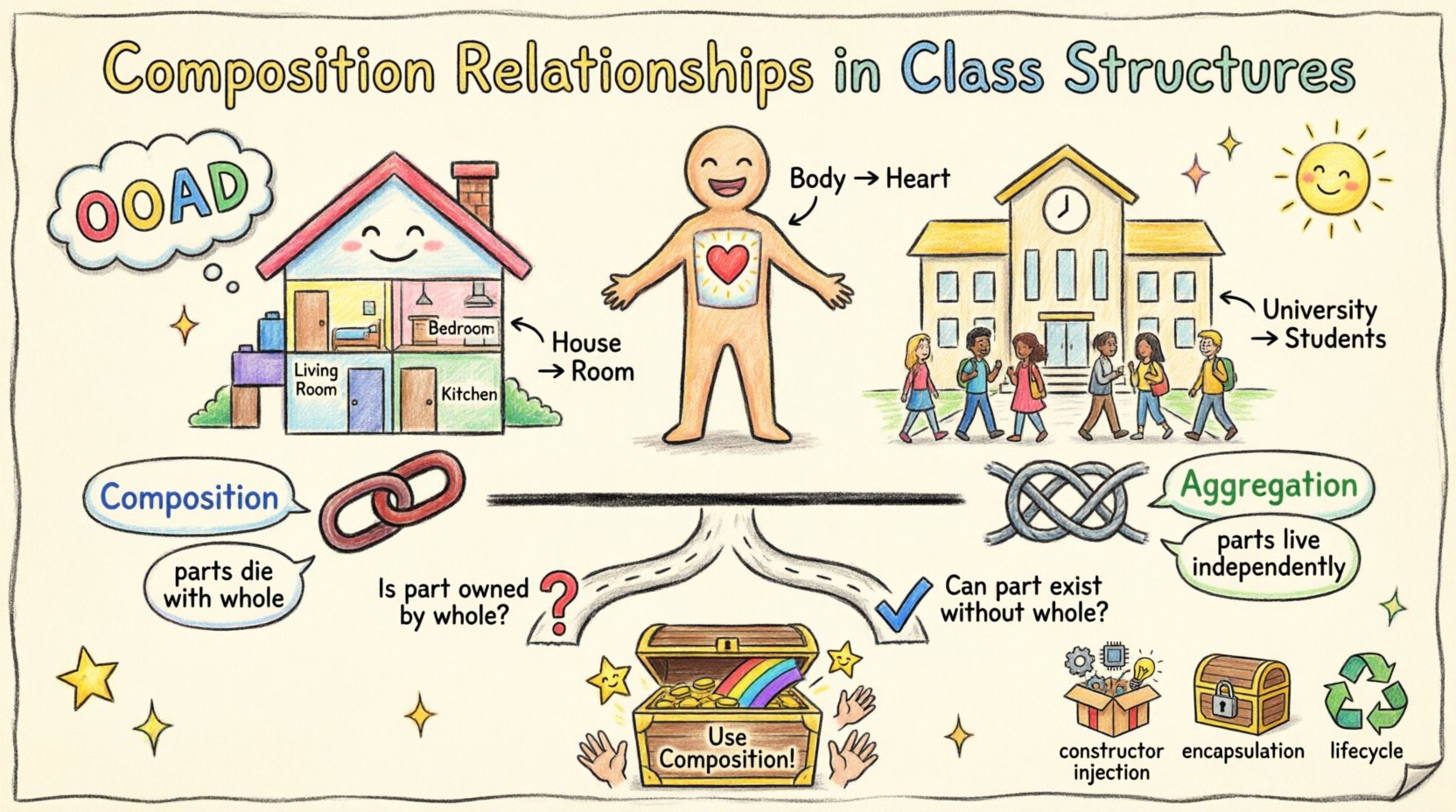
In the landscape of Object-Oriented Analysis and Design (OOAD), defining how objects interact is as critical as defining the objects themselves. Among the various structural relationships, composition stands out as a mechanism that enforces strict ownership and lifecycle dependency. When modeling complex systems, the decision to use composition rather than simple association or aggregation fundamentally changes how data flows and how memory is managed.
This guide explores the mechanics of composition relationships within class structures. We will examine the theoretical underpinnings, practical implementation patterns, and the implications for system architecture. The focus remains on structural integrity and logical consistency, avoiding unnecessary complexity while ensuring robust design.
🧩 Defining Composition in OOAD
Composition is a specialized form of association that represents a “part-of” relationship. Unlike a general link between two independent entities, a composition implies that the part cannot exist independently of the whole. This dependency is structural, not merely logical.
- Ownership: The composite object owns the lifecycle of its components.
- Existence: If the whole is destroyed, the parts are destroyed with it.
- Visibility: Parts are typically not visible outside the scope of the whole.
Consider a simple hierarchy. A House class might contain multiple Room objects. If the House is demolished, the Room objects cease to exist in that context. They do not migrate to another house automatically. This is the essence of composition.
📊 Composition vs. Aggregation
Confusion often arises between composition and aggregation. Both are forms of association, but they differ significantly in lifecycle management and strength of coupling. Understanding this distinction is vital for accurate modeling.
| Feature | Composition | Aggregation |
|---|---|---|
| Ownership | Strong ownership | Weak ownership |
| Lifecycle | Dependent | Independent |
| Creation | Created by the whole | Created externally |
| Destruction | Deleted with the whole | Can exist without the whole |
| Example | Heart and Body | Students and a University |
In aggregation, a University manages a list of Student objects. If the university closes, the students still exist; they simply move to another institution. In composition, a Body manages a Heart. If the body dies, the heart ceases to function as a living organ.
⏳ Lifecycle Management and Memory
One of the primary technical implications of composition is how memory is handled. In many programming paradigms, the composite object is responsible for allocating and deallocating memory for its components.
- Allocation: When the composite object is instantiated, it instantiates its parts.
- Deallocation: When the composite object is destroyed, it recursively destroys its parts.
- Exceptions: Explicit references to parts may be required if external access is needed.
This automatic management reduces the risk of memory leaks and dangling pointers. However, it introduces a rigidity that must be weighed against the flexibility of aggregation. If a part needs to be shared across multiple composites, composition is usually the wrong choice.
🛠️ Implementation Patterns
Implementing composition requires careful attention to how references are passed. The following patterns help maintain the integrity of the relationship.
1. Constructor Injection
The most common method involves passing component instances into the constructor of the composite. This ensures that a composite cannot exist without its required parts.
- Guarantees initialization state.
- Enforces immutability of the reference if the property is read-only.
- Prevents the creation of invalid states.
2. Encapsulated Access
Components should generally be hidden. Providing a getter that returns a reference to a part can break the encapsulation of the lifecycle. If a client receives a direct reference, they might modify the part in a way that compromises the whole.
- Use accessor methods that return copies or interfaces.
- Restrict direct modification of part objects.
- Ensure the composite controls modification logic.
3. Recursive Destruction
When the composite is removed, the system must ensure all nested parts are cleaned up. In languages with garbage collection, this is often implicit. In manual memory management, the composite must explicitly call destruction methods on its parts.
🔗 Relationship to Design Principles
Composition aligns closely with several core design principles that guide maintainable software architecture.
Single Responsibility Principle
Composition encourages breaking down a large class into smaller, focused components. Each component handles a specific aspect of the whole. This separation makes the code easier to test and modify.
Open/Closed Principle
By composing behaviors rather than inheriting them, classes can be extended without modifying existing code. You can swap out one component for another that implements the same interface, changing behavior dynamically.
Dependency Inversion
High-level modules should not depend on low-level modules. Both should depend on abstractions. Composition allows the composite to depend on an interface of the part, allowing the implementation of the part to change without affecting the composite.
🚧 Common Challenges
While composition offers robustness, it introduces specific challenges that architects must navigate.
- Circular Dependencies: If two composites reference each other, it can create a cycle that complicates lifecycle management. Breaking these cycles often requires introducing an intermediary or using weak references.
- Testing Complexity: Testing a composite requires setting up its internal structure. Mocking parts can be difficult if they are tightly coupled.
- Serialization: Saving and loading object graphs can be tricky. The order of deserialization matters. The whole must often be reconstructed before the parts.
- Performance Overhead: Creating and destroying nested objects adds computational cost. In high-performance systems, this overhead must be measured.
🔄 Refactoring Aggregation to Composition
As a system evolves, relationships may need to shift. A common refactoring task is moving from aggregation to composition when ownership becomes clearer.
- Identify the Shift: Determine if the part should now be destroyed with the whole.
- Update Lifecycle Logic: Ensure the composite takes responsibility for the part’s destruction.
- Review References: Remove external references that allowed independent existence.
- Update Tests: Verify that the new lifecycle constraints hold true.
Conversely, moving from composition to aggregation is necessary when a part must be shared. This involves making the creation of the part independent of the whole.
🌐 Real-World Modeling Scenarios
Let us look at how this applies to common domain models.
Scenario 1: Document Management System
A Document contains Page objects. If the document is deleted, the pages are no longer relevant. Composition is appropriate here. The document controls the ordering and existence of pages.
Scenario 2: E-Commerce Order
An Order contains OrderItem objects. When an order is finalized and archived, the items remain historical data. However, if the order is voided, the items are removed. This suggests composition for the active state of the order.
Scenario 3: Financial Portfolio
A Portfolio holds Asset objects. Assets often exist outside the portfolio (e.g., a stock in a public market). Removing an asset from the portfolio does not destroy the asset. Aggregation is the correct choice here.
⚖️ Decision Framework
When deciding whether to implement composition, ask the following questions:
- Does the part logically belong to only one whole?
- Should the part cease to exist if the whole is removed?
- Is the creation of the part dependent on the whole?
- Do we need to hide the internal structure from external clients?
If the answer to these questions is consistently “yes”, composition is likely the correct structural relationship. If the answer is “no”, consider aggregation or association.
🛡️ Safety and Consistency
Maintaining consistency in composition requires strict validation. A composite should never be in a state where it lacks a required part. This is often enforced through:
- Constructor Validation: Throwing an error if a required part is null.
- Invariants: Checking conditions before and after modifications.
- Private Fields: Keeping references to parts private to prevent external tampering.
This level of control ensures that the system remains in a valid state throughout its execution. It prevents scenarios where a user attempts to access a page of a non-existent document.
📈 Scalability Considerations
As the number of classes grows, the complexity of composition trees can increase. Deep nesting can lead to:
- Long initialization times.
- Difficult navigation paths.
- Harder-to-read object graphs.
Designers should aim for shallow hierarchies where possible. Flattening the structure often improves performance and maintainability. If a composite contains another composite, ensure that the inner composite is not an implementation detail of the outer one.
🧪 Testing Strategies
Testing composition-heavy systems requires specific approaches.
- Unit Testing: Test the composite in isolation using mocks for its parts.
- Integration Testing: Verify that the lifecycle events trigger correctly across the entire graph.
- State Testing: Ensure that the composite cannot be modified to an invalid state.
Automated tests should cover the destruction path to ensure no resources are leaked. This is particularly important in environments with limited memory resources.
🔮 Future-Proofing Structures
Designing with composition in mind prepares the system for future changes. If a requirement shifts to allow parts to be shared, moving from composition to aggregation is a localized change. Moving from inheritance to composition is a structural shift that often simplifies the hierarchy.
By prioritizing composition, developers create systems that are modular and robust. The explicit ownership model reduces ambiguity about who manages a specific piece of data.