


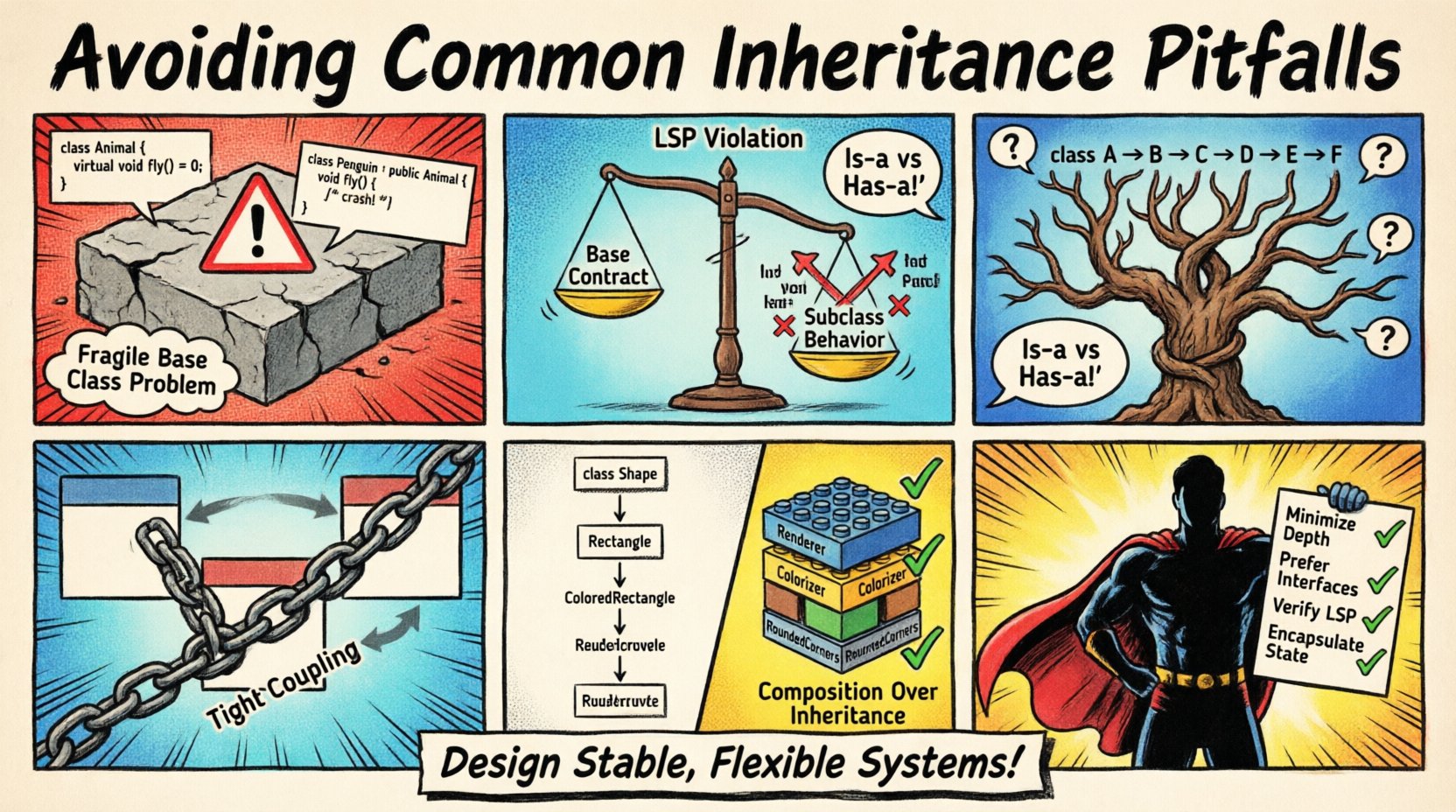
In Object-Oriented Analysis and Design, inheritance is a powerful mechanism for code reuse and abstraction. It allows developers to define a hierarchy of classes where a child class derives properties and behaviors from a parent class. While this structure promotes modularity, it introduces specific risks that can compromise the stability and maintainability of a software system. Understanding these risks is essential for building robust architectures that stand the test of time.
This article explores the structural weaknesses often associated with inheritance. We will examine how improper implementation can lead to fragile codebases, tight coupling, and difficult-to-maintain hierarchies. By recognizing these patterns early, you can design systems that are flexible and resilient.
The Fragile Base Class Problem 📉
The Fragile Base Class Problem occurs when a change in a base class inadvertently breaks the functionality of derived classes. This happens because derived classes rely on the internal implementation details of their parent. When the parent changes, the contract assumed by the child is violated, often without the child developer being aware.
Consider a scenario where a base class method modifies internal state in a specific way. A derived class might depend on this state being in a particular configuration after execution. If the base class refactors that method to optimize performance but changes the order of operations, the derived class may fail silently or throw exceptions.
- Hidden Dependencies: Derived classes often depend on side effects of base class methods that are not documented.
- Testing Complexity: Unit tests for the base class may pass, but integration tests for derived classes may fail unexpectedly.
- Refactoring Risk: Changing the base class becomes a high-risk operation requiring regression testing across the entire hierarchy.
To mitigate this, developers should treat base classes as stable contracts rather than implementation templates. If a base class needs to change frequently, it is often a sign that the hierarchy is too deep or too tightly coupled.
Violating the Liskov Substitution Principle ⚖️
The Liskov Substitution Principle (LSP) is a fundamental concept in design. It states that objects of a superclass should be replaceable with objects of its subclasses without breaking the application. In practice, this means a subclass must honor the invariants and preconditions of its parent.
Violations often occur when a subclass narrows the postconditions or weakens the preconditions of inherited methods. For example, if a parent class defines a method that accepts a broad range of inputs, a subclass might reject certain valid inputs. This breaks the expectation that the subclass can be used anywhere the parent is expected.
- Exception Sprawl: Subclasses throw exceptions that the parent never documented, forcing calling code to handle unexpected errors.
- State Constraints: Subclasses impose stricter constraints on object state that are not visible in the base class interface.
- Behavioral Mismatch: The subclass behaves differently in a way that contradicts the logical contract of the parent.
When designing a hierarchy, ask yourself: Can I swap this class for its parent without rewriting the logic that uses it? If the answer is no, the design likely violates LSP and should be restructured.
Deep Inheritance Hierarchies 🌳
While inheritance promotes reuse, excessive nesting creates a dependency chain that is difficult to navigate. Deep hierarchies, often spanning five or more levels, obscure the source of behavior. When a method call fails in a deeply nested subclass, it can be unclear whether the fault lies in the subclass or one of its ancestors.
Problems with deep inheritance include:
- Complexity Explosion: Every change in a parent ripples through all children. The number of possible combinations of state and behavior grows exponentially.
- Hidden Invariants: State required by a grandparent class may not be obvious to a great-grandchild class developer.
- Testing Overhead: Testing all permutations of the hierarchy becomes a resource-heavy endeavor.
- Readability: Understanding the flow of control requires jumping between multiple files and levels.
A shallow hierarchy is generally preferred. If a class has too many responsibilities or variations, it may be a sign that the class is too large. Consider splitting the hierarchy or using composition instead.
Tight Coupling and Hidden Dependencies 🔗
Inheritance creates a strong coupling between classes. A subclass is tied to the implementation of its parent. This coupling makes the system rigid. If the parent class changes, the subclass must adapt, even if the parent’s functionality is not relevant to the subclass’s specific purpose.
Additionally, inheritance can hide dependencies. A subclass might rely on a method from the parent that it does not explicitly declare. This makes the dependency invisible to static analysis tools and makes the code harder to understand.
- Implementation Leakage: Internal state of the parent becomes part of the subclass’s interface.
- Hard to Mock: In testing scenarios, mocking a base class that has complex internal state can be difficult.
- Single Responsibility Violation: The parent class often accumulates too many features to be useful for all children.
Composition Over Inheritance 🧱
When inheritance becomes problematic, the alternative is often composition. Composition involves building complex objects by combining instances of other classes. This approach reduces coupling and increases flexibility.
Here is a comparison of the two approaches:
| Feature | Inheritance | Composition |
|---|---|---|
| Relationship | Is-a relationship | Has-a relationship |
| Coupling | High (Tied to parent) | Low (Depends on interface) |
| Flexibility | Fixed at compile time | Dynamic at runtime |
| Reuse | Code reuse | Behavior reuse |
| Testing | Complex due to state | Easier, isolated components |
Use composition when you need to reuse behavior without committing to a strict type hierarchy. This allows you to change behaviors at runtime by injecting different components.
Refactoring Strategies for Existing Code 🛠️
Refactoring an existing codebase with deep inheritance issues requires a careful approach. You cannot simply delete the hierarchy; you must migrate it gradually.
Follow these steps to improve your architecture:
- Identify Smells: Look for classes that are too large or have many subclasses that ignore parts of the parent.
- Extract Interfaces: Define interfaces that represent the specific behaviors needed, rather than relying on the base class.
- Introduce Composition: Move logic from the base class into separate classes that can be injected into the subclasses.
- Split Hierarchies: Break large hierarchies into smaller, more focused groups based on distinct responsibilities.
- Update Tests: Ensure comprehensive test coverage before making structural changes to prevent regressions.
Best Practices Checklist ✅
To maintain a healthy object-oriented design, adhere to the following guidelines during the analysis and design phases:
- Minimize Depth: Keep inheritance chains short. If a hierarchy is deeper than three levels, reconsider the design.
- Use Abstract Classes Sparingly: Use abstract classes only when there is a clear is-a relationship and shared implementation is necessary.
- Prefer Interfaces: Use interfaces to define contracts without forcing implementation details.
- Verify LSP: Ensure every subclass can be used interchangeably with the parent in all contexts.
- Document Invariants: Clearly state the invariants that subclasses must maintain.
- Encapsulate State: Avoid exposing protected state that forces subclasses to manage complex internal logic.
- Review Regularly: Conduct code reviews specifically focused on hierarchy structure and coupling.
Conclusion on Design Stability 🏗️
Inheritance is a tool that must be used with discipline. When applied blindly, it creates hidden dependencies and rigid structures. By understanding the pitfalls of deep hierarchies, fragile base classes, and LSP violations, you can design systems that are easier to extend and maintain. Focus on composition where possible, keep hierarchies shallow, and always prioritize the stability of the base contract. This approach leads to software that is robust and adaptable to future changes.