


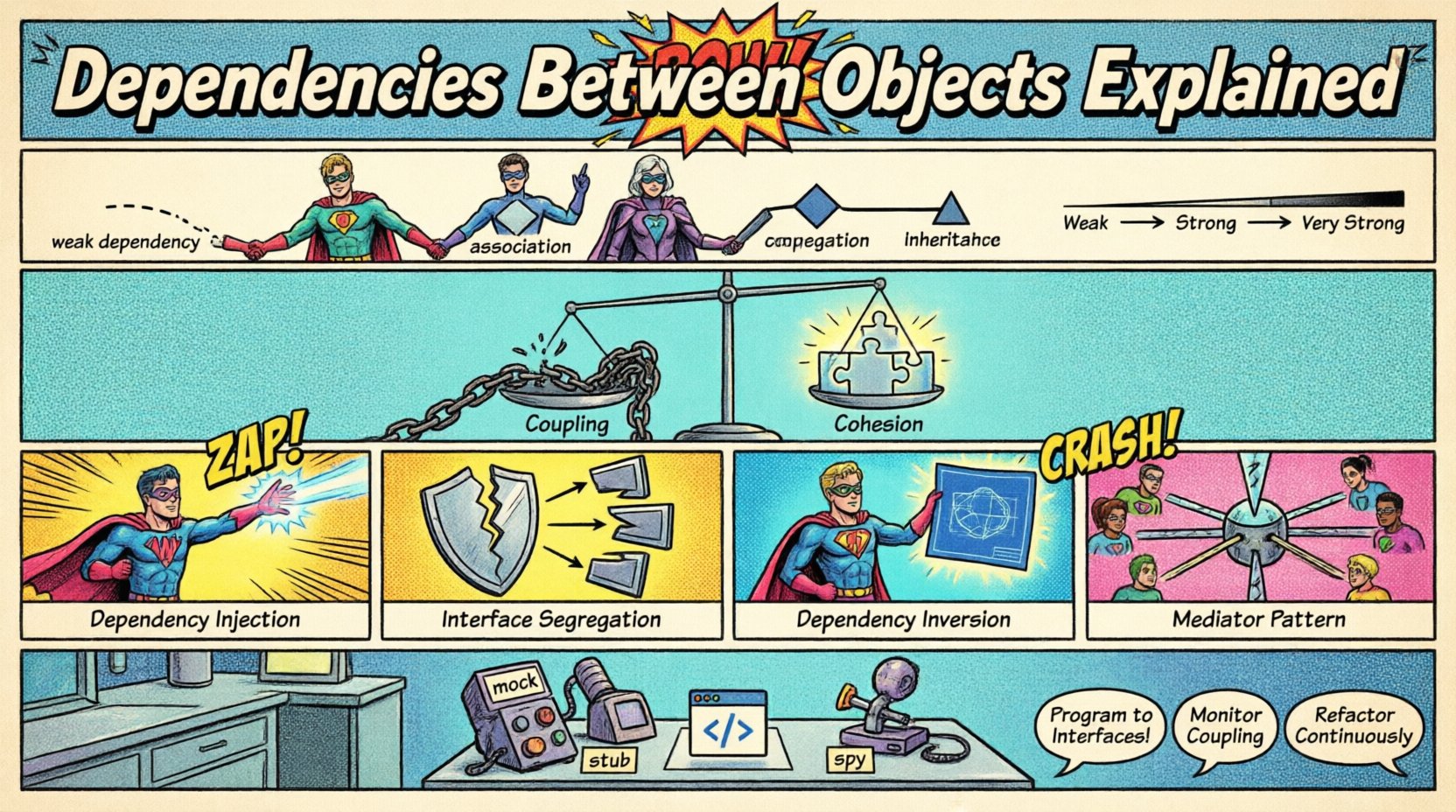
In the landscape of Object-Oriented Analysis and Design (OOAD), the way objects interact defines the stability, maintainability, and scalability of a system. Dependencies between objects are not merely connections; they are the structural bindings that determine how change propagates through a software architecture. Understanding these relationships is fundamental to building robust systems that can evolve without collapsing under their own complexity.
This article delves into the mechanics of object dependencies, exploring the different types of relationships, the implications of coupling, and strategies for maintaining a healthy system structure. We will examine how to identify tight bindings, reduce unnecessary connections, and ensure that your design supports future modifications with minimal friction.
Understanding the Core Concept 🔗
A dependency exists when one object relies on another to perform its function. It implies that the behavior or state of the dependent object is not self-contained but requires input, services, or resources from a client or supplier. In a well-structured design, these links should be intentional, minimal, and managed.
When objects are tightly coupled, a change in one area can trigger a cascade of failures or required updates in unrelated parts of the system. Conversely, loose coupling allows components to function independently, making the system more resilient. The goal is not to eliminate dependencies entirely, as that is impossible in a connected system, but to manage them effectively.
- Dependency: A relationship where a change in the specification of one object requires changes in the object that uses it.
- Association: A structural relationship where objects know about each other and maintain references.
- Aggregation: A specific form of association representing a whole-part relationship without exclusive ownership.
- Composition: A stronger form of aggregation where the lifecycle of the part is tied to the lifecycle of the whole.
Types of Object Relationships 🏗️
To manage dependencies, one must first distinguish between the various types of relationships defined in standard modeling notations. Each type carries a different weight regarding how strongly the objects are bound.
1. Association
An association represents a structural link between objects. It indicates that instances of one class are connected to instances of another. This is often bidirectional, meaning both objects are aware of the relationship.
- Use Case: A Student object might be associated with a Course object.
- Impact: Changes to the Course structure may require updates to the Student data model.
2. Aggregation
Aggregation is a subset of association. It represents a “has-a” relationship where the parts can exist independently of the whole. If the whole is destroyed, the parts remain.
- Use Case: A Department contains multiple Employees.
- Impact: Removing a department does not necessarily delete the employee records.
3. Composition
Composition is a stronger form of aggregation. It represents a “part-of” relationship with exclusive ownership. The lifecycle of the part is strictly controlled by the whole.
- Use Case: A House is composed of Rooms.
- Impact: If the house is demolished, the rooms cease to exist in that context.
4. Inheritance
While not strictly a dependency in the runtime sense, inheritance creates a static dependency. A child class relies on the parent class for its definition. Modifying the parent can break the child.
- Use Case: A Vehicle class and a Car subclass.
- Impact: Removing a method from Vehicle breaks Car if it overrides that method.
5. Dependency (The Classic Relationship)
This is the weakest relationship. It typically occurs when one object uses another as a parameter in a method or returns it as a result. The client does not store a reference to the supplier.
- Use Case: A ReportGenerator method takes a DataFetcher object as an argument.
- Impact: The ReportGenerator is only aware of the DataFetcher during the execution of the method.
Mapping Dependencies: A Comparative View 📊
To visualize the strength of these relationships and their impact on system stability, consider the following comparison table.
| Relationship Type | Strength | Lifecycle Ownership | Visibility |
|---|---|---|---|
| Association | Strong | Independent | Both Sides |
| Aggregation | Medium | Independent | Whole Knows Parts |
| Composition | Very Strong | Dependent | Whole Knows Parts |
| Dependency | Weak | N/A (Transient) | Client Only |
| Inheritance | Static | Dependent | Child Knows Parent |
Coupling and Cohesion: The Balancing Act ⚖️
The health of your object architecture is often measured by two metrics: coupling and cohesion. These concepts are inversely related. High cohesion within a module usually leads to low coupling between modules.
High Coupling
High coupling occurs when classes are heavily interdependent. This creates a fragile system where a change in one class ripples through many others.
- Consequences:
- Increased difficulty in testing isolated components.
- Higher cost of change during maintenance.
- Reduced reusability of code blocks.
- Complex debugging processes due to state entanglement.
Low Coupling
Low coupling means objects interact through well-defined interfaces without knowing the internal implementation details of their partners.
- Benefits:
- Components can be swapped out without affecting the system.
- Parallel development is easier because teams work on independent modules.
- System resilience is improved; failures are contained.
- Onboarding new developers is simpler due to clear boundaries.
High Cohesion
Cohesion refers to how closely related the responsibilities of a single class or module are. A class with high cohesion has a single, well-defined purpose.
- Indicators:
- All methods and attributes contribute to the class’s main goal.
- The class does not perform unrelated tasks.
- Logic is centralized, avoiding duplication.
Managing Dependencies in Architecture 🛡️
Achieving a balance between coupling and cohesion requires deliberate design choices. There are several patterns and principles that help manage object dependencies effectively.
1. Dependency Injection
Instead of creating dependencies internally, objects should receive their dependencies from an external source. This shifts the responsibility of creation to the container or the calling code.
- Constructor Injection: Dependencies are passed when the object is instantiated.
- Setter Injection: Dependencies are assigned after instantiation.
- Interface Injection: The object provides an interface to set the dependency.
By decoupling the creation of objects from their usage, you can easily swap implementations. For example, a logging service can be switched from file-based to network-based without changing the code that requests the log.
2. Interface Segregation
Large, monolithic interfaces force clients to depend on methods they do not use. Splitting interfaces into smaller, specific ones allows clients to depend only on the methods they actually need.
- Result: Reduces the surface area for potential breaking changes.
- Result: Clarifies the contract between objects.
3. The Dependency Inversion Principle
High-level modules should not depend on low-level modules. Both should depend on abstractions. Abstractions should not depend on details; details should depend on abstractions.
- Application: A business logic layer should depend on an interface for data access, not a specific database implementation.
- Benefit: The business logic remains unchanged even if the database technology changes.
4. Mediator Pattern
When objects need to communicate frequently, direct connections create a web of dependencies. A mediator object can act as an intermediary, handling the communication logic.
- Use Case: UI components that need to update each other.
- Benefit: Reduces direct links between components to a single connection with the mediator.
Refactoring for Better Dependency Management 🔨
Legacy systems often accumulate dependencies over time. Refactoring is the process of restructuring existing code without changing its external behavior. Here are steps to improve dependency health in an existing codebase.
- Identify Circular Dependencies: Use static analysis tools to find cycles where Object A depends on Object B, and Object B depends on Object A. Break these cycles by introducing a new interface or extracting shared logic.
- Extract Interfaces: Where a class depends on a concrete implementation, introduce an interface. Change the dependent class to use the interface instead.
- Reduce Parameter Counts: If a method requires too many arguments, they often represent dependencies. Consider wrapping these into a single configuration object or command object.
- Move Logic Up or Down: If a class is doing too much, move the logic to a dedicated helper class (Horizontal Split). If a class is doing too little, merge it with its parent (Vertical Split).
- Cache Dependencies: If a dependency is expensive to create but used frequently, cache it to reduce the overhead of repeated instantiation, though be careful not to introduce global state.
The Impact on Testing 🧪
Dependencies significantly influence the strategy for testing software. Unit tests aim to isolate the behavior of a single unit of code. To do this effectively, external dependencies must be controlled.
- Mocking: Create fake implementations of dependencies to verify interactions without hitting external systems.
- Stubs: Provide hardcoded responses to dependency calls to simulate specific conditions.
- Spies: Track calls made to dependencies to verify that the correct methods were invoked.
When dependencies are tightly bound, testing becomes difficult because you cannot isolate the unit. You might need to spin up a database or a web server just to test a simple calculation. Loose coupling allows tests to run fast and in isolation, which encourages more frequent testing.
Common Pitfalls to Avoid 🚫
Even with good intentions, developers can introduce architectural debt. Be wary of the following common mistakes.
- God Objects: Classes that hold too many responsibilities and dependencies. They become the central point of failure.
- Global State: Relying on global variables to share state creates invisible dependencies that are hard to track and debug.
- Over-Abstraction: Creating interfaces for the sake of it can add complexity without value. Only abstract what changes frequently.
- Ignoring Transitive Dependencies: A class might depend on another, which depends on a third. The first class is transitively dependent on the third. This often goes unnoticed until the third changes.
Key Takeaways 📝
Managing dependencies between objects is a continuous process of balancing structure and flexibility. There is no single “perfect” architecture, but there are clear principles that guide design toward maintainability.
- Acknowledge Connections: Recognize that objects will always interact. The goal is to control the nature of these interactions.
- Prefer Interfaces: Program to interfaces, not implementations. This allows for easier swapping of components.
- Monitor Coupling: Regularly review your codebase for signs of high coupling. Use metrics to track complexity over time.
- Test Early: Design with testing in mind. If a unit is hard to test, it is likely too tightly coupled.
- Refactor Continuously: Address dependency debt as soon as it appears rather than letting it accumulate.
By adhering to these principles, you create a system where change is manageable. Objects remain focused on their specific tasks, interacting only when necessary and through well-defined channels. This leads to software that is not only functional today but adaptable for the requirements of tomorrow.