

Shifting from a procedural mindset to an object-oriented one is more than just learning new syntax. It represents a fundamental change in how you perceive data, behavior, and the relationships between them. In the field of Object-Oriented Analysis and Design (OOAD), this mental pivot is the cornerstone of building robust, scalable systems. Many developers start with a focus on functions and sequences, but mature engineering requires viewing the problem space through the lens of interacting entities.
This article explores the deep structural differences between these paradigms. We will examine how to restructure your thought process to align with object-oriented principles without relying on specific tools or products. The goal is to cultivate a design philosophy that prioritizes encapsulation, modularity, and clarity.
Understanding the Procedural Paradigm 🧩
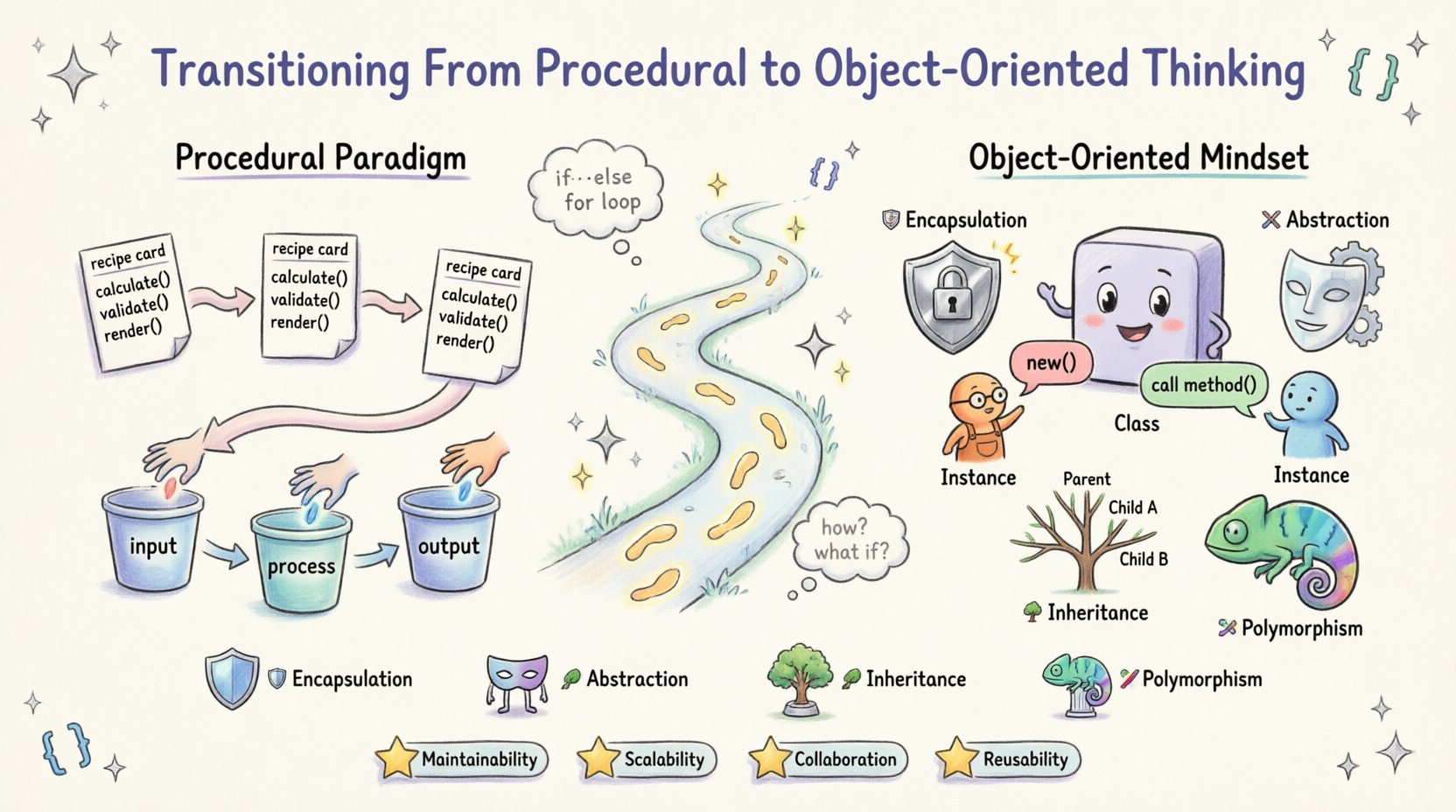
Procedural programming organizes code into procedures or routines that perform actions on data. In this model, data and behavior are often separate. The flow of control is typically top-down, moving from one function to another based on a defined sequence of steps.
- Data-Centric: Data structures are often global or passed explicitly between functions.
- Function-Centric: The primary unit of organization is the function or subroutine.
- Sequential Flow: Execution follows a linear path, often dictated by logic gates and loops.
- Mutable State: Data is frequently modified in place, leading to complex dependency chains.
While procedural methods are efficient for simple scripts or linear tasks, they can become difficult to maintain as system complexity grows. Modifying one part of the system often requires understanding the ripple effects across many functions. This lack of encapsulation makes large-scale analysis challenging.
The Object-Oriented Mindset 🧠
Object-Oriented Analysis and Design (OOAD) flips the perspective. Instead of asking “what functions do I need to run this data?”, you ask “what objects exist in this domain, and how do they communicate?”. Objects combine state (data) and behavior (methods) into a single unit.
- Entity-Centric: The system is modeled around real-world or conceptual entities.
- Behavior Encapsulation: Data is protected from direct access. Interaction happens through defined interfaces.
- Message Passing: Objects send messages to each other to request actions, rather than modifying each other’s internal state directly.
- State Management: An object controls its own state, reducing external dependencies.
This shift reduces coupling between components. If you need to change how an object works internally, other parts of the system do not need to know, provided the interface remains consistent. This isolation is vital for long-term maintainability.
Key Differences: A Side-by-Side Comparison 📊
To visualize the transition, consider how specific concepts are handled in each paradigm.
| Concept | Procedural Approach | Object-Oriented Approach |
|---|---|---|
| Data Storage | Global variables or passed arguments | Attributes within a Class |
| Logic | Functions that operate on data | Methods belonging to objects |
| Modification | Direct access to memory/variables | Invoking public methods (Getters/Setters) |
| Reusability | Copy-paste functions or libraries | Inheritance and Composition |
| Complexity | Increases with function count | Managed via abstraction layers |
The Four Pillars of Object Thinking 🏛️
To successfully transition, you must internalize the four core pillars that define object-oriented thinking. These are not just coding rules; they are design strategies.
1. Encapsulation 🛡️
Encapsulation is the practice of hiding internal implementation details. In procedural thinking, data is often exposed. In object thinking, data is private, and behavior is public.
- Why it matters: It prevents external code from breaking internal logic by changing data directly.
- How to think: Ask “What does this object need to keep private to function correctly?” and “What information must it expose to the outside world?”.
- Benefit: Changes to internal logic do not break dependent modules.
2. Abstraction 🎭
Abstraction simplifies complexity by focusing on essential features while ignoring background details. It allows you to model a concept without defining every possible implementation.
- Why it matters: It allows different parts of a system to interact without knowing the specific type of the object they are dealing with.
- How to think: Define interfaces or abstract classes that represent a contract. Ask “What capabilities does this entity provide?” rather than “How does it calculate this?”.
- Benefit: Promotes flexibility and easier testing through mock implementations.
3. Inheritance 🌳
Inheritance allows new classes to be derived from existing ones, acquiring their properties and behaviors. This models “is-a” relationships.
- Why it matters: It reduces code duplication and establishes a clear hierarchy.
- How to think: Identify commonalities between entities. If two entities share the same core attributes, consider a base class.
- Benefit: Faster development and consistent behavior across similar entities.
4. Polymorphism 🎨
Polymorphism allows objects to be treated as instances of their parent class rather than their actual class. It enables the same interface to be used for different underlying forms.
- Why it matters: It allows you to write code that works with general types, making it adaptable to new types later.
- How to think: Focus on the behavior, not the specific identity. Ask “Can this object respond to this message?”.
- Benefit: Decouples the caller from the implementation, supporting open/closed principles.
Transitioning in the Analysis Phase 🔍
The shift begins before writing code. It starts during the requirements gathering and analysis phase. In a procedural analysis, you might list functions needed to process an order. In OOAD, you identify the entities involved in an order.
Steps for Analysis
- Identify Actors and Objects: Who or what interacts with the system? Identify nouns in the requirements text.
- Determine Responsibilities: What does each object know? What does each object do?
- Define Relationships: How do objects interact? Is it a “has-a” (composition) or “is-a” (inheritance) relationship?
- Model State Transitions: How does an object change state over time? Map out valid transitions.
By focusing on nouns and verbs within the problem domain, you naturally drift toward object modeling. This approach ensures the software mirrors the real-world logic it is intended to support.
Transitioning in the Design Phase 🛠️
Once the analysis is complete, the design phase translates concepts into a structural blueprint. This is where encapsulation and interface design become critical.
Design Principles to Adopt
- Single Responsibility Principle: Ensure each class has only one reason to change. If a class handles both data storage and data validation, split it.
- Dependency Inversion: Depend on abstractions, not concretions. High-level modules should not depend on low-level modules.
- Open/Closed Principle: Classes should be open for extension but closed for modification. Use polymorphism to add new features.
- Low Coupling: Minimize the connections between classes. High coupling makes the system fragile.
- High Cohesion: Keep related functionality together within a class.
When designing, avoid creating “God Objects” that do too much. Break down complex logic into smaller, focused objects. This makes the system easier to reason about and test.
Common Pitfalls in the Transition 🚧
Many developers struggle during this shift. They might apply procedural logic inside object structures, leading to “Active Record” anti-patterns or “Anemic Domain Models”.
- Anemic Domain Model: Creating objects that only hold data (getters/setters) with no behavior. This reverts to procedural thinking.
- Over-Engineering: Creating complex inheritance trees for simple problems. Keep inheritance shallow and composition deep.
- Global State: Relying on static methods or global variables for shared data. This breaks encapsulation.
- Interface Pollution: Creating interfaces that are too broad. Interfaces should be specific to the client’s needs.
To avoid these traps, constantly question your design. If you find yourself passing data around to be modified by a central function, pause. Ask if that data should belong to a specific object instead.
Benefits of Object-Oriented Thinking 📈
Adopting this mindset yields significant long-term advantages for software architecture.
- Maintainability: Changes are localized. Fixing a bug in one object rarely breaks unrelated parts of the system.
- Scalability: Adding new features often involves adding new classes rather than modifying existing code.
- Collaboration: Teams can work on different objects simultaneously without conflicting over shared global state.
- Reusability: Well-designed objects can be utilized in different contexts with minimal adjustment.
Practical Exercises for Mental Shift 🏋️
To solidify this transition, practice modeling problems without thinking about the implementation details.
- Walkthroughs: Describe a process using only objects and their actions. Avoid words like “loop”, “if”, or “function”.
- Diagramming: Draw Class Diagrams before writing code. Focus on attributes and methods.
- Refactoring: Take existing procedural code and try to identify natural boundaries where objects should be formed.
- Domain Driven Design: Study how the business domain maps to your code structure. Align technical terms with business terminology.
Final Thoughts on Architectural Evolution 🌟
Moving from procedural to object-oriented thinking is a journey of continuous learning. It requires unlearning the comfort of linear execution and embracing the complexity of interacting entities. The objective is not to abandon logic or structure, but to organize it in a way that reflects the reality of the system being built.
By focusing on encapsulation, abstraction, inheritance, and polymorphism, you create systems that are resilient to change. The initial investment in learning these concepts pays dividends in reduced technical debt and increased flexibility. As you refine your skills in Object-Oriented Analysis and Design, you will find that the code becomes more intuitive, and the architecture more robust. This foundation supports the creation of software that stands the test of time and evolving requirements.