


Every project manager faces the same fundamental challenge: a finite amount of time and resources against an infinite list of tasks. This imbalance is the root cause of burnout, missed deadlines, and strategic drift. Project prioritization is not merely an administrative task; it is a critical leadership function that dictates the trajectory of success. By deciding what to do first, teams can focus energy on high-impact activities while deferring or eliminating distractions.
This guide explores the mechanics of effective prioritization. We will examine frameworks, psychological factors, and practical processes to help you structure your workload logically. The goal is not to do everything, but to ensure the right things get done at the right time.
📉 Why Prioritization Often Fails
Before implementing a new system, it is vital to understand why existing methods break down. In many organizations, prioritization becomes a reactive process driven by the loudest voice rather than the most valuable outcome. Common pitfalls include:
Reactive Workflows: Team members respond to immediate interruptions (emails, urgent requests) rather than scheduled deep work. This creates a cycle where strategic goals are perpetually deprioritized.
Conflicting Stakeholder Demands: When multiple departments request the same resources without a unified hierarchy, decision paralysis occurs. Without a clear owner of the priority list, everyone gets equal say, and nothing gets done efficiently.
Unclear Definitions of Value: “Important” and “Urgent” are often conflated. A task might be urgent (due today) but not important (low impact). Conversely, important tasks (strategic planning) often lack urgency and get pushed to the bottom of the list.
Resource Misalignment: Assigning a high-priority task to a resource with low capacity creates bottlenecks. Prioritization must account for who is doing the work, not just what is being done.
Addressing these issues requires a structured approach that moves away from intuition and toward evidence-based decision-making.
🛠️ Core Frameworks for Task Evaluation
Several established methodologies exist to help teams categorize and rank work. Each serves a different purpose depending on the project lifecycle and team structure. Below are the most effective approaches.
1. The Eisenhower Matrix
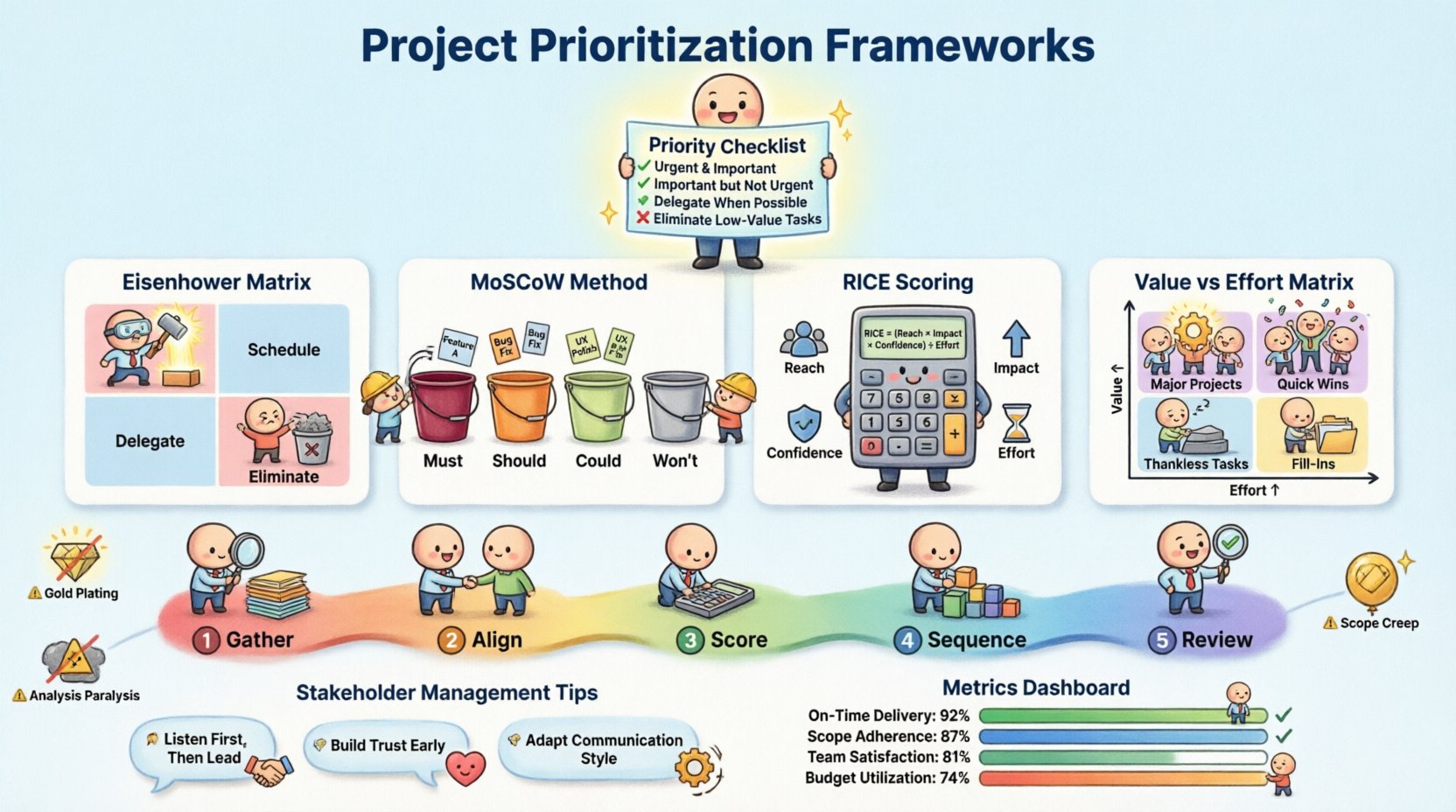
This classic tool categorizes tasks based on two dimensions: urgency and importance. It forces a decision on four distinct quadrants:
Do First: Tasks that are both urgent and important. These are crises or deadlines approaching now. They require immediate attention.
Schedule: Tasks that are important but not urgent. These are strategic activities, planning, and relationship building. They are often neglected because they lack immediate pressure.
Delegate: Tasks that are urgent but not important. These are interruptions or administrative work that can be handed off to others.
Eliminate: Tasks that are neither urgent nor important. These are time-wasters that should be discarded entirely.
Best Use: Daily or weekly planning sessions to manage individual workload and prevent burnout.
2. MoSCoW Method
Originally developed for software delivery, this method is versatile for any project requiring scope management. It classifies requirements into four buckets:
Must Have: Non-negotiable deliverables. If these are missing, the project fails.
Should Have: Important but not vital. These can be deferred if time runs short.
Could Have: Desirable features. These are added only if resources permit.
Won’t Have: Agreed-upon exclusions for the current cycle.
Best Use: Defining scope for a specific phase or release to ensure stakeholders understand trade-offs.
3. RICE Scoring
This quantitative approach assigns a score to each initiative based on four factors. It removes subjectivity by forcing data entry:
Reach: How many people will this impact within a given time?
Impact: How much will this benefit each person? (e.g., High, Medium, Low).
Confidence: How sure are we about our estimates? (e.g., 100%, 80%, 50%).
Effort: How much time or resources are required? (e.g., person-days).
The formula is: (Reach × Impact × Confidence) / Effort. A higher score indicates a higher priority. This is particularly useful when comparing disparate initiatives.
4. Value vs. Effort Matrix
A simple 2×2 grid that plots tasks based on the value they provide relative to the effort required. This helps identify “Quick Wins” (High Value, Low Effort) versus “Heavy Lifts” (High Value, High Effort).
Effort | High Value | Low Value |
|---|---|---|
Low Effort | Quick Wins | Fill-Ins |
High Effort | Major Projects | Thankless Tasks |
Key Takeaway: Focus on “Quick Wins” to build momentum and “Major Projects” for long-term growth. Avoid the temptation to spend too much time on “Thankless Tasks”.
🔄 The Step-by-Step Prioritization Process
Frameworks are tools, but they require a process to function effectively. Follow this workflow to implement prioritization within your team.
Step 1: Gather and Consolidate
Before ranking, you must have a complete inventory. Collect all requests, ideas, and backlog items into a single source of truth. This prevents “shadow lists” where team members track work in separate notebooks or mental caches. Ensure every item has a clear description and an estimated owner.
Step 2: Define Strategic Alignment
Not all projects are equal. Evaluate each item against the broader organizational goals. Does this task support the quarterly objectives? If a request does not align with the mission, it should be flagged for review. This step ensures that energy is directed toward strategic value rather than tactical noise.
Step 3: Apply a Scoring System
Use one of the frameworks mentioned above (RICE, MoSCoW, or Value/Effort) to score the consolidated list. Involve key stakeholders in this scoring to ensure shared understanding. If using a subjective method like MoSCoW, ensure there is a designated authority to break ties when conflicts arise.
Step 4: Sequence and Schedule
Once ranked, map the top priorities to available time slots. Consider dependencies: Task B cannot start until Task A is finished. Sequence the work logically to minimize context switching. High-priority work should be scheduled when energy levels are highest.
Step 5: Review and Adapt
Priorities change. Market conditions shift, and new information emerges. Schedule a regular review (weekly or bi-weekly) to re-evaluate the list. Be willing to move items down or cut them entirely if circumstances warrant. A static priority list is a brittle one.
🗣️ Managing Stakeholder Expectations
One of the hardest parts of prioritization is saying “no” without damaging relationships. Stakeholders often view their request as the top priority. To manage this, transparency is key.
Visualize the Work: Show stakeholders the current workload. When they see that adding a new task pushes an existing deadline back, they understand the trade-off.
Explain the “Why”: When declining a request, explain the strategic reason. “We are deferring this because we are currently focused on the Q3 revenue goals which take precedence.”
Offer Alternatives: If a request cannot be met now, offer a timeline for when it could be addressed. “We cannot start this today, but we can begin next month after the current sprint concludes.”
Centralize Communication: Avoid side-channel requests. Ensure all prioritization discussions happen in a central forum where the full context is visible.
🧠 The Psychology of Decision Making
Prioritization is not just a logic exercise; it is a psychological one. Decision fatigue can lead to poor choices later in the day. To mitigate this:
Batch Decisions: Make prioritization decisions early in the week. Do not spend time re-evaluating priorities every morning.
Set Hard Stops: Limit the time spent on planning. Spending three hours planning a two-hour task is inefficient. Set a timer for prioritization sessions.
Trust Data: Rely on the scoring frameworks rather than gut feelings. This reduces the emotional burden of rejecting a request.
📊 Measuring the Impact of Prioritization
How do you know your new system is working? Track these metrics over time:
On-Time Delivery Rate: Are you completing high-priority items by their deadlines?
Resource Utilization: Are team members consistently overworked or underutilized?
Strategic Goal Achievement: Are the projects that directly support business objectives being completed?
Stakeholder Satisfaction: Are key partners satisfied with the delivery of critical items?
🛑 Common Pitfalls to Avoid
Even with a plan, execution can go awry. Watch out for these traps:
Gold Plating: Adding extra features to a task that were not requested. This wastes time on low-value work.
Analysis Paralysis: Spending too much time debating priorities instead of executing. Perfectionism is the enemy of progress.
Ignoring Capacity: Prioritizing more work than the team can physically complete. Always account for holidays, sick leave, and administrative overhead.
Changing Priorities Mid-Sprint: Constantly shifting the goalposts demoralizes the team and disrupts flow. Stick to the plan unless a critical emergency arises.
🏁 Final Thoughts on Strategic Focus
Effective prioritization is about making choices. It requires the discipline to say no to good opportunities so that you can say yes to great ones. By utilizing structured frameworks, aligning with strategic goals, and managing stakeholder expectations, you create an environment where the right work gets done.
Remember that the priority list is a living document. It evolves as your organization grows and market conditions change. The power lies not in the list itself, but in the consistent practice of reviewing and adjusting it. Start with one framework, apply it rigorously, and refine the process as you learn what works best for your specific team dynamics.
Related posts:
 Project Management 101: A Beginner’s Quick Start Guide to Leading Projects with Confidence
 What Project Managers Actually Do: A Real-World Component Breakdown for Aspiring Leaders
 The Project Management Lifecycle Explained: A Comprehensive Walkthrough from Start to Finish
 7 Common Project Management Mistakes That Derail Teams (And How to Avoid Them)