


Conflict within a project team is not an anomaly; it is an inevitability. When diverse individuals converge with distinct backgrounds, working styles, and objectives, friction is a natural byproduct. The goal of project management is not to eliminate conflict entirely, but to manage it constructively. Unresolved tension can erode trust, delay timelines, and degrade quality. This guide provides a structured troubleshooting framework to navigate interpersonal and task-based disputes efficiently.
Understanding the Nature of Conflict 🧩
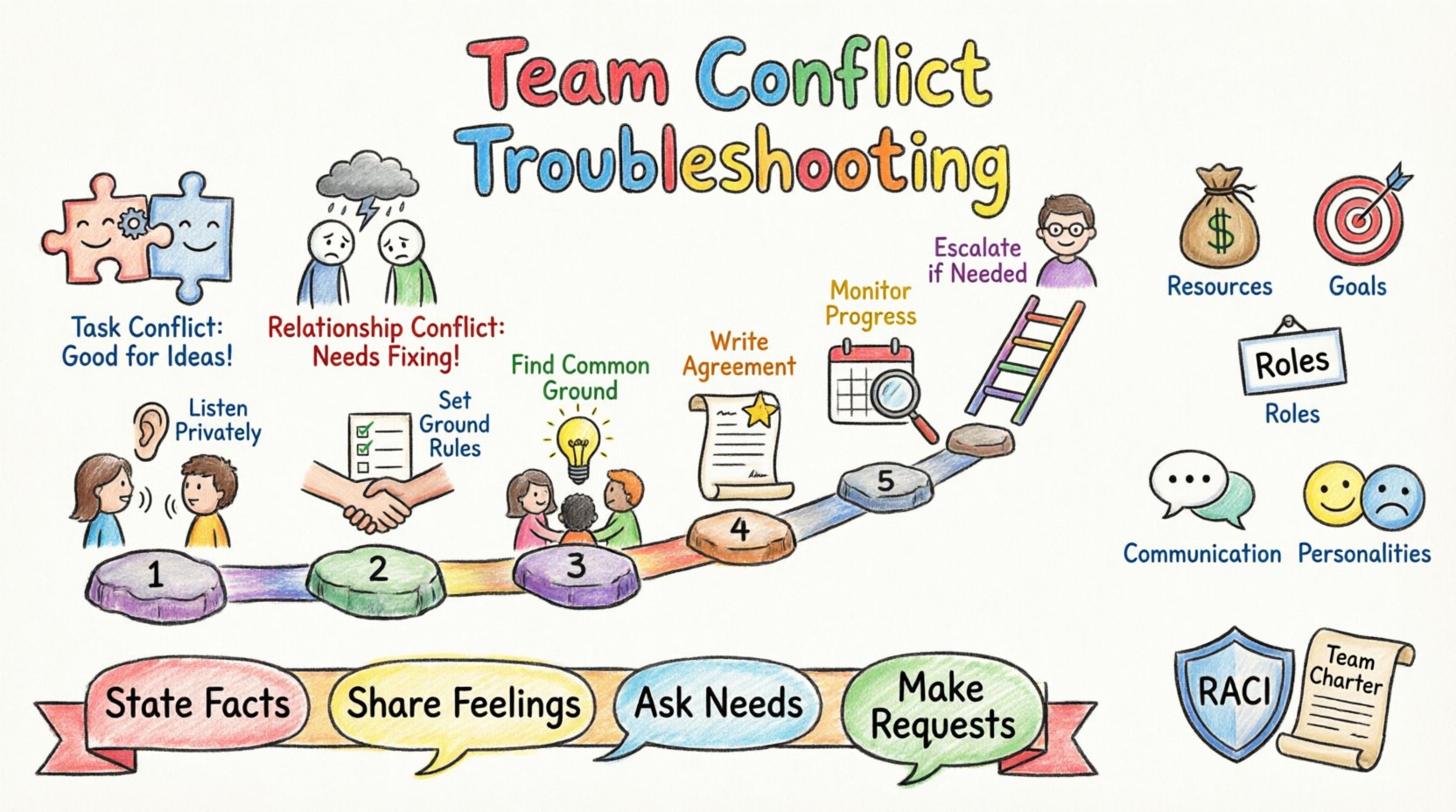
Before addressing symptoms, one must diagnose the root cause. Conflicts generally fall into two categories: task conflict and relationship conflict.
Task Conflict: Disagreements regarding the content and outcomes of the work. This can be beneficial, driving innovation and critical thinking.
Relationship Conflict: Interpersonal incompatibilities involving tension, annoyance, or personal friction. This is almost always detrimental to team cohesion.
A project manager must differentiate between these two. Encouraging debate on a technical solution is healthy. Allowing personal grievances to fester is dangerous. Recognizing the distinction allows for targeted intervention.
Step 1: Observation and Data Collection 👀
Intervention without evidence often exacerbates the situation. Before engaging stakeholders, gather objective data regarding the conflict.
Monitor Communication Channels: Review meeting minutes, emails, and status updates for signs of tension.
Check Progress Metrics: Are deliverables slipping? Is quality fluctuating? Correlation between conflict and performance drops is a strong indicator.
Listen to the Team: Conduct informal check-ins. Do not interrogate; listen for recurring themes in feedback.
Documenting these observations creates a factual baseline. It prevents the resolution process from becoming a debate about whether the conflict exists.
Step 2: Isolating the Root Cause 🔍
Surface arguments are often masks for deeper issues. Use the following diagnostic questions to uncover the underlying driver:
Resource Scarcity: Are team members fighting over access to budget, tools, or personnel?
Goal Misalignment: Do different departments prioritize different metrics (e.g., speed vs. stability)?
Role Ambiguity: Is it unclear who is responsible for specific decisions?
Communication Breakdown: Are information silos preventing transparency?
Personality Clashes: Are working styles fundamentally incompatible without clear protocols?
Identifying the specific cause dictates the resolution strategy. You cannot fix a resource issue with a communication training session. You cannot fix a personality clash with a new spreadsheet.
Step 3: The Troubleshooting Framework 🛠️
Once the cause is identified, apply this six-step framework to resolve the issue.
3.1 Private Dialogue with Individuals
Never address interpersonal conflict in a group setting initially. Meet with the involved parties separately. This allows them to vent without fear of public embarrassment. The objective here is to understand their perspective, not to judge it.
Ask open-ended questions: “How do you perceive the current workflow?”
Practice active listening. Repeat back what you hear to ensure understanding.
Validate their feelings without validating their accusations.
3.2 Establish Ground Rules for Interaction
Before bringing parties together, set the stage for a productive conversation. Define what is acceptable and what is not.
No personal attacks.
Focus on the project impact, not the person.
Commit to a solution-oriented mindset.
Agree on how decisions will be made if consensus is not reached.
3.3 Facilitate Joint Resolution
Bring the parties together in a controlled environment. The project manager acts as a facilitator, not a judge.
State the problem objectively.
Allow each side to present their view without interruption.
Identify common ground. Even adversaries usually share the goal of project success.
Brainstorm solutions together.
3.4 Formalize the Agreement
Verbal agreements are fragile. Document the resolution clearly.
Define specific actions each person must take.
Set deadlines for these actions.
Clarify how the conflict will be monitored moving forward.
Store this record in the project documentation for reference.
3.5 Monitor Implementation
The work is not done once the agreement is signed. Follow up on the agreed actions.
Check in after one week to see if the new behaviors are holding.
Watch for signs of regression.
Reinforce positive interactions when they occur.
3.6 Escalate if Necessary
If the conflict persists despite intervention, it may require higher-level oversight. Escalation is not a failure; it is a risk management decision.
Involve senior leadership if the conflict impacts strategic goals.
Involve Human Resources if the issue involves harassment or policy violations.
Consider resource reallocation if the relationship is irreparable.
Common Conflict Scenarios and Responses 📋
Different situations require different approaches. The table below outlines common scenarios and recommended troubleshooting steps.
Scenario Type | Primary Cause | Recommended Action |
|---|---|---|
Resource Contention | Multiple teams need the same specialist or budget. | Review project priorities. Realign budget or negotiate timeline adjustments based on strategic value. |
Scope Creep | Stakeholders add features without adjusting timelines. | Enforce change control processes. Require formal approval for any addition to the baseline. |
Vision Mismatch | Leadership and execution teams disagree on the end goal. | Conduct a workshop to align on objectives. Update the project charter to reflect the consensus. |
Technical Disagreement | Developers argue over architecture or implementation. | Use data-driven decision making. Run a spike or prototype to compare options objectively. |
Communication Gaps | Information is not flowing to the right people. | Map the communication plan. Establish regular stand-ups or status reports with defined attendees. |
Personality Clash | Individual styles conflict (e.g., detail-oriented vs. big-picture). | Focus on roles and responsibilities. Ensure tasks match individual strengths to minimize friction. |
Communication Techniques for Resolution 🗣️
Effective communication is the bedrock of conflict resolution. Certain techniques can de-escalate tension and foster understanding.
Non-Violent Communication (NVC)
This method focuses on expressing needs without blame. It follows a four-step structure:
Observation: State the facts without judgment. “The report was submitted two days late.”
Feeling: Express how this affects you. “I feel concerned about the timeline.”
Need: Identify the underlying need. “I need to ensure we meet the client deadline.”
Request: Ask for a specific action. “Can we agree on a review process before the deadline?”
Active Listening
Most people listen to reply, not to understand. Active listening requires full attention.
Maintain eye contact.
Nod to show engagement.
Paraphrase their points: “So, what I hear you saying is…”
Ask clarifying questions before offering solutions.
Neutral Language
Avoid charged words that trigger defensiveness. Use neutral terms to describe situations.
Instead of “You ignored my email,” say “The email has not received a response.”
Instead of “This is your fault,” say “The error occurred in this phase.”
Prevention Strategies 🛡️
While resolution is critical, prevention is more efficient. Building a culture that anticipates conflict reduces the need for troubleshooting.
Define Roles and Responsibilities
Ambiguity breeds conflict. Use a RACI matrix (Responsible, Accountable, Consulted, Informed) to clarify who does what.
Ensure every task has a single owner.
Clarify who needs to be consulted before decisions are made.
Document this in the project charter.
Establish a Team Charter
At the start of a project, agree on how the team will work together. This includes:
Communication norms (response times, channels).
Meeting etiquette (punctuality, preparation).
Decision-making protocols.
Conflict resolution procedures.
Regular Retrospectives
Hold periodic sessions to discuss team health, not just project health.
Ask what is going well.
Ask what is hindering progress.
Allow anonymous feedback if necessary.
Act on the feedback immediately to build trust.
When to Escalate to Leadership 📈
There are limits to what a project manager can resolve. Recognizing when to escalate is a sign of maturity.
Strategic Impasse: If the conflict blocks a critical path decision that impacts business goals.
Policy Violation: If the conflict involves harassment, discrimination, or unethical behavior.
Resource Unavailability: If the conflict stems from a lack of resources that only leadership can provide.
Repeated Failure: If multiple attempts at resolution have failed without improvement.
When escalating, bring a summary of the situation, the steps already taken, and a recommendation. This allows leadership to make informed decisions without getting bogged down in the history.
Post-Conflict Learning 📚
Once a conflict is resolved, the team should not simply move on. The experience offers a learning opportunity.
Document the Lesson: What triggered the conflict? How was it handled?
Update Processes: Did a missing process cause the issue? Add it to the playbook.
Rebuild Trust: Publicly acknowledge the resolution. Celebrate the team’s ability to overcome the hurdle.
Review Metrics: Did the conflict impact quality or speed? Adjust future planning buffers accordingly.
Final Thoughts on Team Dynamics 🚀
Handling conflict in project teams requires a balance of empathy and authority. It is not about winning an argument; it is about preserving the integrity of the project and the team. By applying this troubleshooting framework, project managers can transform friction into focus. The presence of conflict does not indicate a failing team; it indicates a complex system that requires active management. With clear processes, open communication, and a commitment to resolution, teams can navigate challenges and deliver successful outcomes.
Related posts:
 Project Management 101: A Beginner’s Quick Start Guide to Leading Projects with Confidence
 What Project Managers Actually Do: A Real-World Component Breakdown for Aspiring Leaders
 The Project Management Lifecycle Explained: A Comprehensive Walkthrough from Start to Finish
 7 Common Project Management Mistakes That Derail Teams (And How to Avoid Them)