


In the landscape of modern project management, stability is often an illusion. Markets shift, requirements evolve, and resources fluctuate. The most successful project managers are not those who prevent change, but those who navigate it with precision. This guide explores the mechanics of managing change in projects, providing a structured approach for handling unpredictable workflows without derailing delivery.
Change is not inherently negative. It is the engine of adaptation. However, uncontrolled change leads to scope creep, budget overruns, and team burnout. The goal is to integrate change management into the project lifecycle, ensuring every modification is evaluated, approved, and communicated effectively.
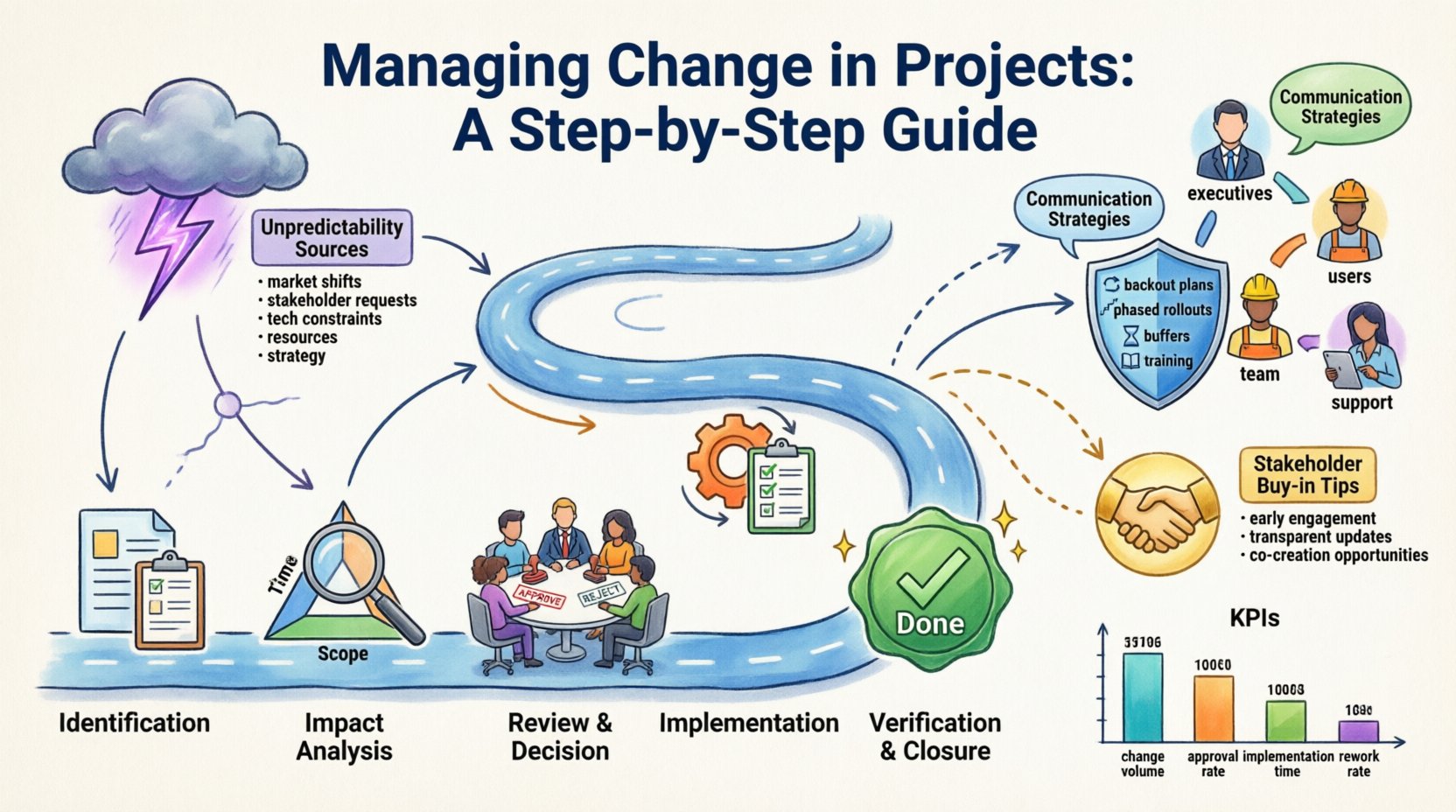
Understanding the Nature of Unpredictability 🌪️
Before implementing a process, one must understand why change occurs. Unpredictable workflows are rarely the result of a single event. They stem from a convergence of factors that create volatility.
Common Sources of Project Change
External Market Shifts: Competitor actions or regulatory updates can force immediate pivots.
Stakeholder Requirements: New insights from clients often reveal gaps in the initial vision.
Technical Constraints: Unforeseen technical debt or integration issues may arise during development.
Resource Availability: Personnel changes or budget cuts alter capacity and timelines.
Organizational Strategy: High-level strategic shifts can reprioritize project goals overnight.
Recognizing these sources allows teams to anticipate potential disruptions. When a change request arrives, the first step is not immediate execution, but classification. Is this a critical strategic pivot or a minor preference adjustment? The distinction dictates the intensity of the response.
The Change Control Process: A Step-by-Step Framework 🛠️
A robust change management process acts as a filter. It ensures that only necessary changes move forward, and that they are executed with minimal disruption. This framework relies on transparency and documentation at every stage.
Step 1: Identification and Documentation
Every change begins with a formal request. Verbal requests should be redirected to a written format to ensure clarity. The documentation must include:
The specific nature of the proposed change.
The business reason or problem it solves.
Who initiated the request.
The desired deadline for implementation.
Without this baseline, the project team lacks the context needed to assess impact. Ambiguity is the enemy of accurate estimation.
Step 2: Impact Analysis
Once documented, the request moves to the analysis phase. This is the most critical technical step. The project manager and team leads must evaluate the ripple effects across the project triple constraint: time, cost, and scope.
Timeline Impact: Will this delay the critical path? Does it require reordering tasks?
Cost Impact: Are there additional resource costs? Do we need to buy new tools or hire external help?
Scope Impact: Does this add functionality, or does it replace existing deliverables?
Risk Impact: Does this introduce new technical or operational risks?
This analysis should be quantitative where possible. Instead of saying “it might delay us,” estimate “it will add three days to the testing phase.” Precision builds trust.
Step 3: Review and Decision Making
The analysis is presented to the Change Control Board (CCB) or the appropriate authority. This group is responsible for approving or rejecting the request based on the impact data.
Role | Responsibility | Key Question |
|---|---|---|
Project Manager | Impact Analysis & Process Facilitation | “What is the cost to deliver this?” |
Sponsor / Stakeholder | Business Value Assessment | “Is this value worth the cost?” |
Technical Lead | Feasibility Check | “Can we build this without breaking the system?” |
Team Representative | Workload Reality Check | “Do we have the capacity to do this?” |
The decision should be binary: Approve, Reject, or Defer. Defer is often the best option for low-priority items during high-stress periods. It acknowledges the value but delays the commitment.
Step 4: Implementation
Once approved, the change becomes part of the project plan. The schedule is updated, resources are reassigned, and the task list is modified. This is not a passive step; it requires active management to ensure the change is integrated smoothly.
Update the project baseline.
Notify the team of the new requirements.
Adjust quality assurance testing plans to cover the new scope.
Ensure documentation reflects the current state.
Step 5: Verification and Closure
The final step is ensuring the change was delivered as requested. This involves testing the specific functionality and confirming that no unintended side effects occurred. Once verified, the change request is formally closed, and the cycle ends.
Communication Strategies for Change 🗣️
Even with a perfect process, change fails if communication is poor. Stakeholders may feel blindsided, and the team may feel overwhelmed. A structured communication plan is essential for managing the human side of change.
Who Needs to Know?
Not all stakeholders require the same level of detail. Segmentation ensures information is relevant.
Executive Sponsors: Need high-level updates on budget and timeline impacts.
End Users: Need to know how the change affects their daily workflow.
Development/Execution Team: Need technical specifications and deadline adjustments.
Support Teams: Need to know about changes that affect maintenance or helpdesk procedures.
Timing and Frequency
Communication should not be sporadic. Establish a rhythm.
Immediate: Notify the team immediately upon a change approval.
Weekly: Include change updates in the standard project status report.
Milestone-Based: Re-evaluate impact at the end of each phase.
Transparency reduces anxiety. When stakeholders understand why a change is happening and what it costs, they are more likely to support the decision. Silence, conversely, breeds rumors and resistance.
Risk Management and Mitigation 🛡️
Change introduces risk. Every modification carries the potential to disrupt existing stability. A proactive risk management approach is required to handle this volatility.
Identifying Change-Related Risks
During the impact analysis phase, specifically look for risks triggered by the change.
Integration Failure: The new feature conflicts with existing modules.
Performance Degradation: The system slows down under the new load.
Knowledge Gaps: The team lacks experience with the new technology or process.
Dependency Delays: The change relies on another team that is behind schedule.
Mitigation Strategies
Once risks are identified, develop contingency plans.
Backout Plans: Define exactly how to revert the change if it fails.
Phased Rollouts: Implement the change in a small group first to test stability.
Buffer Allocation: Add time or budget buffers specifically for change-related activities.
Training: Provide immediate training to bridge knowledge gaps.
By planning for the worst, you reduce the impact of the unexpected. This preparation is what separates a chaotic environment from a managed one.
Stakeholder Engagement and Resistance Management 🤝
People often resist change. This is a natural psychological response to the unknown. Managing this resistance is a key skill for any project leader.
Understanding Resistance
Resistance usually stems from fear. Fear of losing status, fear of increased workload, or fear of failure. Identifying the root cause allows for targeted engagement.
Information Gap: They don’t understand the value. Solution: Educate.
Trust Gap: They don’t believe the team can deliver. Solution: Demonstrate progress.
Comfort Gap: They are happy with the status quo. Solution: Show the cost of inaction.
Building Buy-In
To secure buy-in, involve stakeholders in the process rather than just informing them.
Early Involvement: Invite key stakeholders to review impact analyses.
Feedback Loops: Create channels for them to voice concerns before decisions are finalized.
Highlight Benefits: Focus the narrative on the positive outcomes for their specific department or role.
Acknowledge Trade-offs: Admit where the change creates challenges. Honesty builds credibility.
Measuring Success and Continuous Improvement 📈
How do you know if your change management process is working? You need metrics. Without data, you are guessing. Track the following indicators to gauge health.
Key Performance Indicators
Metric | What It Measures | Target |
|---|---|---|
Change Request Volume | Frequency of changes | Stable or decreasing over time |
Approval Rate | Percentage of approved vs. rejected requests | High value, low waste |
Implementation Time | Time from approval to deployment | Consistent and efficient |
Rework Rate | Work required to fix change errors | Low |
Retrospectives
Conduct post-implementation reviews after significant changes. Ask the team:
Did the process work smoothly?
Was the impact analysis accurate?
Were stakeholders kept in the loop effectively?
What could be improved for the next change?
This continuous improvement loop ensures the methodology evolves with the project needs. It prevents the stagnation of rigid processes and encourages agility.
Navigating High-Velocity Environments 🚀
In some workflows, change is not the exception; it is the rule. Agile environments, for instance, expect change at every sprint. In these cases, the rigid Change Control Board model may need to adapt.
Adapting the Process
Empower the Team: Allow the development team to make minor scope adjustments within a sprint without board approval.
Time-Boxed Changes: Limit the size of changes to fit within a specific iteration window.
Backlog Management: Treat change requests as items in a prioritized backlog rather than emergency incidents.
Definition of Done: Ensure that “done” includes the documentation and testing requirements for the change.
The core principle remains the same: evaluate impact before execution. However, the speed of evaluation must increase to match the speed of delivery. Automation can help here, using tools to track requirements and dependencies, though the decision-making remains human.
Final Thoughts on Stability and Flexibility ⚖️
Managing change is about balancing the need for stability with the necessity of flexibility. A project that cannot change is brittle. A project that changes without control is chaotic. The sweet spot lies in the middle.
By implementing a structured process, maintaining clear communication, and engaging stakeholders proactively, project managers can turn unpredictability into a manageable variable. This approach protects the team from burnout, protects the budget from overrun, and ensures the final deliverable meets the current business needs.
Change will always happen. The difference lies in whether you are reacting to it or leading it. With the right framework, you can guide your project through the storm and deliver value regardless of the conditions.
Related posts:
 Project Management 101: A Beginner’s Quick Start Guide to Leading Projects with Confidence
 What Project Managers Actually Do: A Real-World Component Breakdown for Aspiring Leaders
 The Project Management Lifecycle Explained: A Comprehensive Walkthrough from Start to Finish
 7 Common Project Management Mistakes That Derail Teams (And How to Avoid Them)