


Project management is often described as an exercise in coordination. However, at its core, it is an exercise in information exchange. The difference between a project that drifts off course and one that delivers value consistently often lies in the quality of inquiry during meetings. Many project managers focus heavily on status updates, risk logs, and timeline tracking, yet neglect the most powerful tool in their toolkit: questioning.
Asking the right questions transforms a meeting from a passive reporting session into an active problem-solving workshop. It shifts the dynamic from “What happened?” to “Why did it happen, and what do we do about it?” This guide explores the mechanics of inquiry within the context of project management, providing a framework for engagement that drives clarity and accountability.
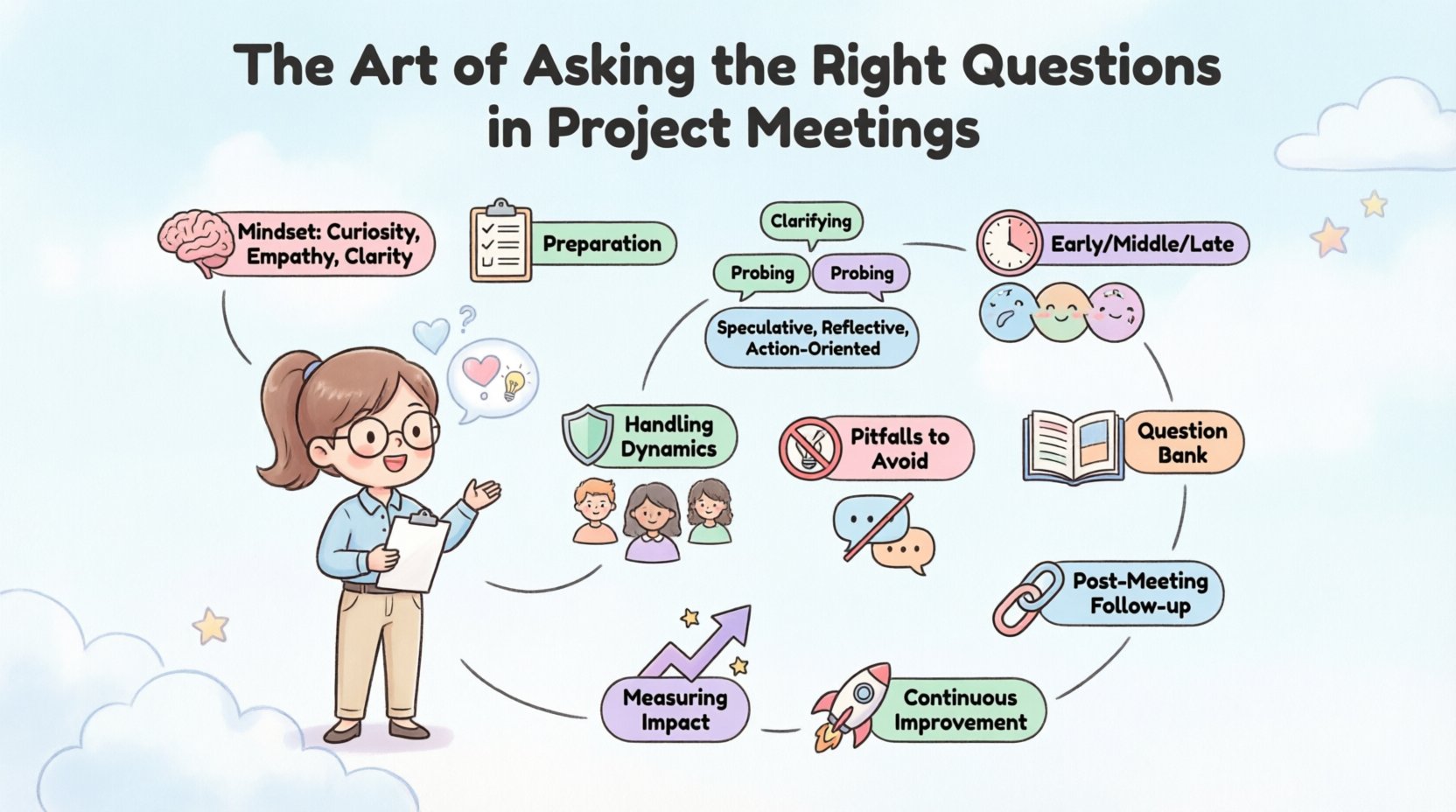
1. The Foundation: Mindset and Intent 🧠
Before formulating specific queries, one must examine the underlying intent. A question asked with suspicion will yield defensive answers. A question asked with genuine curiosity will yield insights. In project management, stakeholders often feel they are being audited. When you enter a meeting room, your posture should signal partnership, not interrogation.
Effective questioning relies on three pillars of mindset:
Curiosity over Certainty: Assume you do not have the full picture. Even if you have the data, the context behind the data is often missing.
Empathy over Judgment: When a delay is reported, the immediate reaction might be frustration. The better reaction is to ask about the obstacles that caused the delay without assigning blame.
Clarity over Complexity: Simple questions often uncover the most complex truths. Avoid jargon and convoluted sentence structures that allow ambiguity to hide.
Consider the difference between these two approaches to a missed milestone:
Weak Inquiry: “Why is this task late again?” (Implies blame, invites defensiveness).
Strong Inquiry: “What factors prevented this milestone from being completed on schedule?” (Focuses on factors, invites analysis).
The goal is to uncover root causes, not just symptoms. This shift in language changes the energy of the room. It invites the team to solve the problem alongside you rather than defending their position against you.
2. Preparation: The Work Before the Meeting 📋
High-quality questions rarely happen by accident. They are the result of preparation. Walking into a meeting with a blank slate forces you to react rather than lead. Preparation allows you to tailor your questions to the specific phase of the project lifecycle.
Review the Documentation First
Before calling or joining a session, review the relevant artifacts. Read the risk register, check the current sprint status, and look at the budget variance reports. This homework allows you to ask targeted questions rather than generic ones.
Define the Objective
Every meeting must have a purpose. Is it for decision-making? Information sharing? Problem solving? Your questions must align with this purpose.
Decision Meeting: Focus on risk, resources, and authority. “Do we have the capacity to approve this change?”
Information Meeting: Focus on understanding and alignment. “Can you walk us through the data source for this metric?”
Problem Solving: Focus on constraints and solutions. “What options have we exhausted so far?”
Know Your Audience
Different stakeholders require different levels of detail. A technical lead might need deep questions about architecture, while a sponsor might need high-level questions about ROI and timeline impact. Anticipating these needs allows you to draft a list of questions beforehand.
3. The Question Matrix: Categorizing Inquiry 📊
Not all questions serve the same function. To manage a meeting effectively, you need a diverse set of question types. Below is a framework for categorizing inquiries based on their function in the conversation.
Question Type | Purpose | Example |
|---|---|---|
Clarifying | To ensure understanding and remove ambiguity. | “When you say ‘done’, what specific criteria define completion?” |
Probing | To dig deeper into an initial answer. | “What led you to that conclusion?” or “Can you elaborate on that risk?” |
Speculative | To explore potential future outcomes. | “If we delay this component, how does it impact the launch date?” |
Reflective | To validate feelings or group dynamics. | “It seems like there is hesitation on this approach. What concerns are we not hearing?” |
Action-Oriented | To move from discussion to execution. | “Who will take ownership of this action item?” |
Using this matrix ensures you do not get stuck in a loop of surface-level information. For instance, if a team member says a feature is “at risk,” a clarifying question gets the definition of risk, while a probing question gets the history of the issue, and an action-oriented question assigns the next step.
4. Timing and Context: When to Ask 🕒
The effectiveness of a question depends heavily on when it is asked. Interrupting a flow to ask a basic clarification question can derail momentum. Waiting too long to ask a critical risk question can leave you with no time to mitigate.
Early Phase: Exploration and Alignment
In the beginning of a project or a new phase, questions should focus on scope and expectations. This is the time to ask about constraints and definitions of success.
“What does success look like for this specific deliverable?”
“Are there any external dependencies we haven’t mapped yet?”
Middle Phase: Monitoring and Adjustment
During execution, the focus shifts to variance and adaptation. Questions should address progress against the plan.
“We are two weeks behind the baseline. What is the specific impact on the critical path?”
“Do we have the resources to absorb this delay, or do we need to re-scope?”
Late Phase: Review and Handoff
Towards the end, questions should focus on stability and lessons learned.
“What documentation is required for the operations team?”
“What went well in our process that we should replicate next time?”
5. Navigating Difficult Dynamics 🛡️
Project meetings often involve high stakes and diverse personalities. Some individuals may dominate the conversation, while others may remain silent. Your questioning strategy must adapt to these dynamics to ensure all voices are heard.
Handling the Dominator
When one person speaks for too long, it is tempting to interrupt. Instead, use a bridging question to acknowledge them and then redirect the floor.
“That is a significant point, thank you for sharing. I want to hear from someone who hasn’t spoken yet on this topic. What is your perspective?”
This technique validates the speaker without allowing them to monopolize the time.
Handling the Silence
Silence can be uncomfortable, but it is often where the best information is found. People need time to process. Instead of filling the silence, wait. If the silence persists, direct a gentle question to the specific individual.
“I notice the room is quiet on this point. Sarah, how does this affect your team?”
Handling Conflict
When two stakeholders disagree, do not ask “Who is right?”. Instead, ask about the underlying interests.
“What is the primary goal behind your proposal?”
“If we cannot do both, which outcome is more critical for the client?”
This shifts the conversation from personal preference to strategic priority.
6. Common Pitfalls to Avoid 🚫
Even experienced practitioners fall into traps when formulating questions. Being aware of these common errors helps maintain the integrity of the discussion.
Leading Questions: Avoid questions that suggest the answer you want to hear. Instead of “Don’t you think this timeline is too tight?”, ask “How feasible do you consider this timeline?”
Multiple Questions at Once: Asking three questions in one breath confuses the respondent. They will likely answer the last one and forget the first two. Ask one question, wait for the answer, then ask the next.
Yes/No Traps: Closed questions limit the depth of the answer. “Is the project on track?” can be answered with “Yes” and end the conversation. “What is the status of the project relative to the baseline?” invites detail.
Emotional Language: Avoid words like “why” when it sounds accusatory. “Why did you do that?” sounds like an interrogation. “What was the reasoning behind that decision?” sounds like an investigation.
7. Building a Personal Question Bank 🗃️
To streamline your preparation, consider building a personal library of questions. Over time, you will find that certain scenarios recur. Having pre-written questions ready saves mental energy and ensures you don’t miss critical checks.
Sample Bank Entries:
On Resources: “Are the assigned roles clearly defined in the team charter?”
On Risks: “Have we identified any single points of failure in this workflow?”
On Stakeholders: “Who else needs to be informed about this decision?”
On Quality: “What is the definition of done for this specific task?”
On Communication: “Is the current cadence of updates sufficient for the team?”
Review and update this bank regularly. As your project methodology evolves, so should your inquiry strategy.
8. Post-Meeting: Closing the Loop 🔗
The art of questioning does not end when the meeting concludes. The follow-up is where accountability is solidified. If you asked a question and received an answer, that answer must be documented and acted upon.
Summarize Answers: In your meeting minutes, record not just what was decided, but what was learned. If a risk was identified, note the mitigation strategy discussed.
Assign Follow-Ups: If a question required further research, assign that task immediately. “John, you mentioned checking the vendor capacity. Can you send those details by Friday?”
Verify Understanding: If a complex issue was discussed, send a brief recap to confirm everyone understands the outcome. “To confirm, we decided to delay the release by one week to address the security patch. Is this accurate?”
This step ensures that the questions asked were not just performative but productive. It creates a culture where questions lead to action.
9. Measuring the Impact of Inquiry 📈
How do you know if your questioning strategy is working? Look for indicators in the project environment.
Reduced Surprises: If issues are flagged early rather than discovered late, your proactive questioning is working.
Higher Engagement: If team members are volunteering information without being prompted, the psychological safety you built through questioning is effective.
Faster Decisions: If meetings move from debate to decision more quickly, your clarifying questions are removing ambiguity efficiently.
Track these metrics over time. If you notice recurring themes in project delays, review your meeting records. Did you ask the right questions during the planning phase? If not, adjust your approach for the next project.
10. Final Thoughts on Continuous Improvement 🚀
Mastery in project management is not about having all the answers. It is about asking the questions that reveal the path forward. The projects that succeed are often the ones where the team feels safe to admit uncertainty and where the leadership team seeks to understand the constraints before demanding results.
By treating questions as strategic assets, you transform meetings from time sinks into value generators. You move from managing tasks to managing understanding. This requires discipline, preparation, and a genuine desire to understand the reality of the work.
Start small. Pick one meeting this week and commit to asking at least three open-ended probing questions. Observe the shift in conversation. Over time, this practice will become second nature, and your projects will benefit from the clarity and direction it brings.
Remember, the goal is not to control the conversation, but to guide it toward the truth. In the complex landscape of project delivery, that truth is the only solid ground you have.
Related posts:
 Project Management 101: A Beginner’s Quick Start Guide to Leading Projects with Confidence
 What Project Managers Actually Do: A Real-World Component Breakdown for Aspiring Leaders
 The Project Management Lifecycle Explained: A Comprehensive Walkthrough from Start to Finish
 7 Common Project Management Mistakes That Derail Teams (And How to Avoid Them)