


Project management is often described as the art of balancing time, cost, and scope. However, the most critical element that often gets overlooked is the quality of the goals themselves. Many teams start with enthusiasm but end up exhausted and underperforming. This disconnect usually stems from setting objectives that look good on paper but lack the foundation for real-world execution. Setting realistic project goals is not about lowering standards; it is about aligning ambition with capacity. When goals are achievable, they drive motivation, ensure resource efficiency, and lead to sustainable success. This guide explores the methodology for defining objectives that teams can genuinely accomplish without burning out.
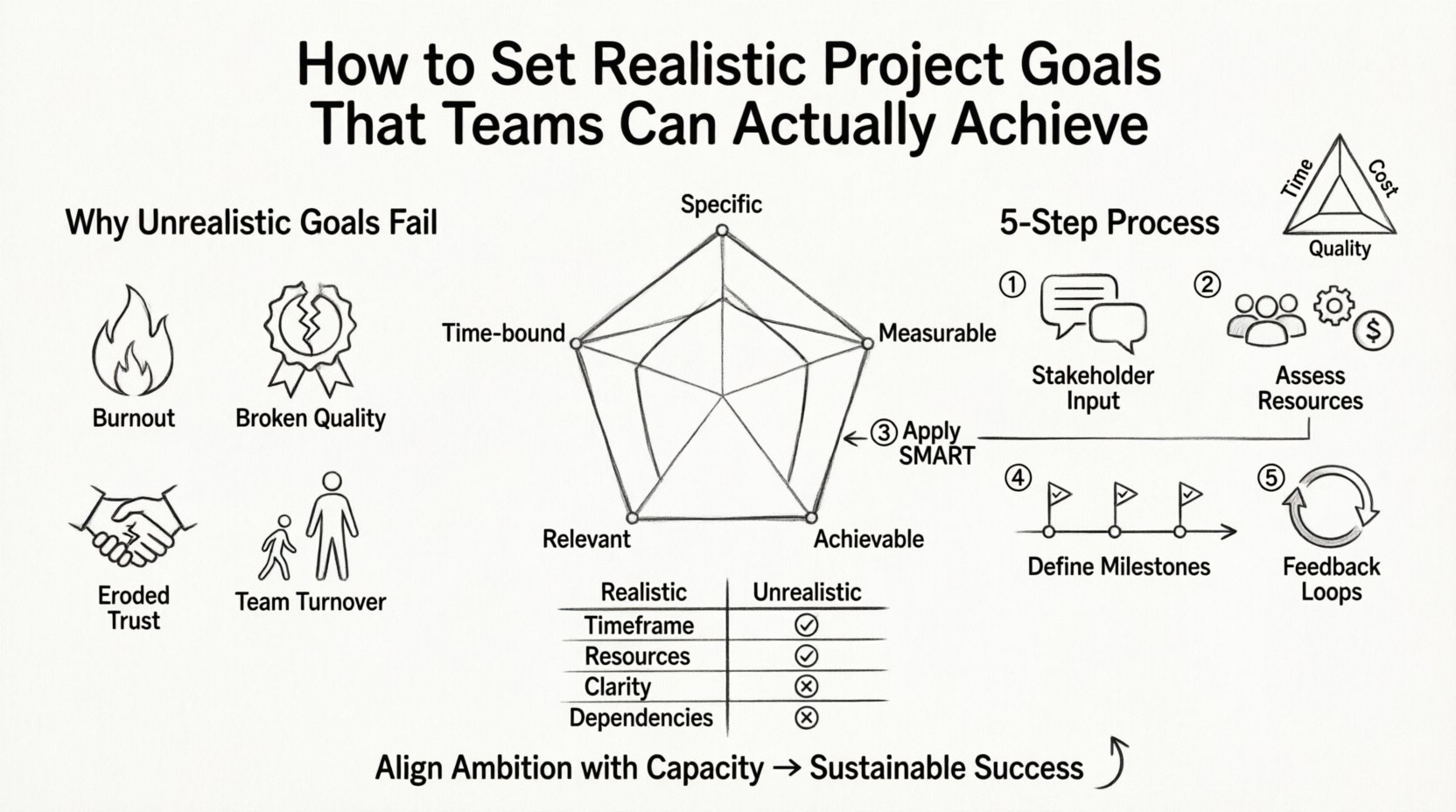
Why Unrealistic Goals Fail Your Team 📉
Before diving into the mechanics of goal setting, it is essential to understand the consequences of failure. When leadership sets targets that exceed the team’s available resources, several negative outcomes occur. These are not just missed deadlines; they are systemic issues that erode trust and morale over time.
Burnout and Fatigue: When deadlines are impossible, team members work longer hours to catch up. This leads to physical and mental exhaustion, reducing the quality of work produced.
Compromised Quality: Rushing to meet an arbitrary date often forces shortcuts in testing, review, or design. The final product may ship on time but fail to meet user needs.
Loss of Trust: If promises are consistently missed, stakeholders lose faith in the team’s reliability. This makes future collaboration difficult.
High Turnover: Talented professionals leave environments where they feel constantly set up for failure. Retention becomes a significant challenge.
Understanding these risks highlights the importance of a grounded approach. Realistic goals are not static; they require constant calibration based on actual performance and feedback.
The Foundation of Goal Setting: Understanding Scope 📏
Scope defines the boundaries of the project. It outlines what is included and, crucially, what is excluded. Without a clear definition of scope, goals become vague and open to interpretation. This ambiguity is the breeding ground for scope creep, where the project grows beyond its original intent without additional resources.
To set realistic goals, you must first understand the constraints. These constraints typically fall into three categories:
Time: The deadline is fixed, or the timeline is flexible based on milestones.
Cost: The budget limits the number of hours, tools, or external services available.
Quality: The level of performance required to satisfy the client or stakeholder expectations.
When these three pillars are not balanced, the project suffers. For example, demanding high quality within a short time and low budget is a recipe for failure. The following table illustrates the difference between realistic and unrealistic goal structures.
Goal Characteristic | Unrealistic Goal | Realistic Goal |
|---|---|---|
Timeframe | Complete a 6-month roadmap in 2 months. | Complete 6-month roadmap in 6 months with phased delivery. |
Resources | Assign 5 tasks to 1 person. | Assign tasks based on individual capacity and skill level. |
Clarity | Improve user experience. | Reduce checkout drop-off rate by 15% within Q3. |
Dependencies | Ignore external vendor timelines. | Align internal milestones with vendor delivery schedules. |
Step-by-Step Guide to Setting Achievable Objectives 🛠️
Establishing goals that stick requires a structured process. It involves collaboration, data analysis, and clear communication. The following steps provide a roadmap for creating objectives that resonate with the team and meet business needs.
1. Gather Stakeholder Input
Goals must align with the broader business strategy. Before setting specific targets, engage with stakeholders to understand their priorities. Ask them what success looks like to them. This ensures that the goals you set are relevant to the organization’s mission. Avoid making assumptions about what the business wants. Direct communication prevents misalignment later in the project lifecycle.
Identify key decision-makers early.
Document their specific needs and constraints.
Clarify what metrics define success for them.
2. Assess Resources and Capacity
Once you know the business needs, you must check if the team can deliver them. This requires an honest assessment of available resources. Consider the following factors:
Human Capital: How many people are available? What are their skill sets?
Tools and Technology: Do you have the necessary software or hardware to execute the tasks?
Budget: Is there funding for training, overtime, or external support if needed?
Time: Are there conflicting projects happening simultaneously?
Be transparent about limitations. If the team is at full capacity, do not promise availability without adding resources. It is better to negotiate a later deadline than to overpromise and underdeliver.
3. Apply the SMART Framework
The SMART framework is a proven method for crafting effective goals. It ensures that objectives are Specific, Measurable, Achievable, Relevant, and Time-bound. Using this framework prevents vague targets that are impossible to track.
Specific: The goal should be clear and unambiguous. Instead of “increase sales,” say “increase sales of product X by 10%.”
Measurable: You need data to track progress. Define the metrics that will be used to measure success.
Achievable: The goal must be possible given current resources and constraints.
Relevant: The goal should matter to the business and align with broader objectives.
Time-bound: Set a clear deadline to create a sense of urgency and focus.
4. Define Milestones
Large goals can feel overwhelming. Breaking them down into smaller milestones makes progress visible and manageable. Milestones act as checkpoints where you can review performance and adjust the plan if necessary. This approach allows for early detection of issues before they become critical failures.
Set weekly or bi-weekly check-ins for major milestones.
Celebrate the completion of each milestone to maintain morale.
Use milestones to validate assumptions made during the planning phase.
5. Establish Feedback Loops
Goal setting is not a one-time event. It requires ongoing communication. Establish regular feedback loops where the team can report blockers, progress, and changes in capacity. This transparency allows for adjustments to be made in real-time. If a task takes longer than expected, the timeline should be updated immediately rather than hidden until the final deadline.
The SMART Framework Explained in Detail 🧩
While the SMART framework is common knowledge, applying it correctly requires nuance. Here is a deeper look at how to apply each component in a project management context.
Specific
Avoid vague language. Specificity eliminates confusion. When a goal is specific, everyone understands exactly what is required. For example, “Improve website performance” is too broad. “Reduce page load time to under 2 seconds for mobile users” is specific. The former leaves too much room for interpretation, while the latter provides a clear target.
Measurable
If you cannot measure it, you cannot manage it. Determine how you will track progress. Will you use percentage increases, dollar amounts, or time saved? Ensure that the data required to measure the goal is available or can be collected without excessive effort. If measuring the goal requires complex data gathering that distracts from the work, the metric may be too burdensome.
Achievable
This is the most critical component for team health. An achievable goal challenges the team without breaking them. To determine achievability, look at historical data. How long did similar tasks take in the past? Adjust for current team size and any known changes in the environment. If historical data suggests a task takes two weeks, do not set a goal of one week unless there is a justified reason for increased efficiency.
Relevant
Ensure the goal contributes to the larger mission. A team might be efficient at completing a task that no longer matters to the business. Relevance ensures that effort is directed toward value creation. Regularly ask: “Does this goal still support our current strategy?” If the answer is no, the goal should be revised or removed.
Time-bound
Deadlines create focus. Without a time limit, work tends to expand to fill the available time (Parkinson’s Law). However, the deadline must be realistic. Setting a deadline that is too tight creates stress, while a deadline that is too loose reduces urgency. Aim for a date that is challenging but attainable.
Common Pitfalls to Avoid 🚫
Even with a solid plan, teams can fall into traps that undermine their goals. Being aware of these common pitfalls helps you navigate them before they impact the project.
Scope Creep: This occurs when new features or tasks are added without adjusting the timeline or budget. To prevent this, implement a formal change request process. Any addition to the scope must be evaluated against the available resources.
Ignoring Team Capacity: Leaders often assume the team can work at 100% efficiency. In reality, people need time for meetings, emails, and rest. Factor in administrative overhead when estimating time.
Lack of Clarity: If the team does not understand the goal, they cannot achieve it. Ensure goals are communicated clearly and that everyone knows their specific role in achieving them.
One-Size-Fits-All Approach: Different teams have different strengths. A creative team may need more time for brainstorming, while a technical team may need more time for debugging. Tailor goals to the specific team’s nature.
Aligning Team Expectations 🤝
Setting the goal is only half the battle; getting the team to buy into it is the other half. If the team feels the goal was imposed without their input, they are less likely to commit to it. Involvement in the planning process increases ownership and accountability.
Open Communication Channels
Create an environment where team members feel safe to speak up about unrealistic expectations. They are often the first to know when a deadline is impossible. Encourage them to provide input on timelines during the planning phase. This collaborative approach builds trust and leads to more accurate estimates.
Regular Check-Ins
Schedule regular meetings to review progress against the goals. These should not be punitive but supportive. Use these meetings to identify roadblocks and offer help. If a team member is struggling, discuss solutions rather than assigning blame. This keeps the focus on achieving the goal rather than finding fault.
Recognition and Rewards
Recognize effort and achievement. When goals are met, acknowledge the team’s hard work. This reinforces positive behavior and motivates the team to maintain high standards. Recognition does not always need to be financial; public acknowledgment and opportunities for growth can be equally effective.
Measuring Success and Adjusting Course 📊
Projects rarely go exactly according to plan. Unexpected challenges arise, and conditions change. The ability to measure success and adjust the course is a key skill in project management. This agility ensures that the team remains on track even when obstacles appear.
Key Performance Indicators (KPIs)
Define KPIs that reflect the health of the project. These might include velocity, burndown rates, or customer satisfaction scores. Track these metrics regularly to get a pulse on the project status. If a KPI trends negatively, investigate the cause immediately. Early intervention prevents small issues from becoming major crises.
Agile Adjustments
Adopt an agile mindset where plans are flexible. If a goal becomes unachievable due to external factors, be willing to revise it. Communicate these changes to all stakeholders immediately. Transparency is key. It is better to have a revised goal that is achievable than to stick to an old goal that is impossible.
Post-Project Review
After the project is complete, conduct a retrospective. Analyze what went well and what did not. Did the goals accurately reflect the work required? Were the resources sufficient? Use this data to inform future goal setting. Continuous improvement ensures that each project becomes more predictable than the last.
Final Thoughts on Sustainable Goal Setting
Setting realistic project goals is a discipline that combines data, communication, and empathy. It requires a leader who is willing to listen to the team and make tough decisions about scope and time. By focusing on achievable targets, teams can avoid burnout and deliver high-quality results consistently. The path to success is not about working harder, but about working smarter with clear, attainable objectives.
Remember that goals are not set in stone. They are living documents that evolve as the project progresses. Stay flexible, maintain open communication, and prioritize the well-being of your team. When you align ambition with reality, you create an environment where success is not just a possibility, but an expectation. This approach builds a culture of reliability and excellence that sustains long-term growth.