


Enterprise architecture is often perceived as a dense forest of acronyms, diagrams, and abstract concepts. For stakeholders ranging from C-suite executives to infrastructure engineers, the complexity can create barriers to understanding and decision-making. This is where the ArchiMate framework shines, specifically through its mechanism for viewpoints. These viewpoints act as lenses, allowing different audiences to see the specific parts of the architecture that matter most to them.
This guide provides a comprehensive look at ArchiMate Viewpoints. We will strip away the unnecessary complexity to focus on how these tools facilitate communication between business processes and technical infrastructure. Whether you are designing a new strategy or auditing existing systems, understanding these viewpoints is essential for clarity and alignment.
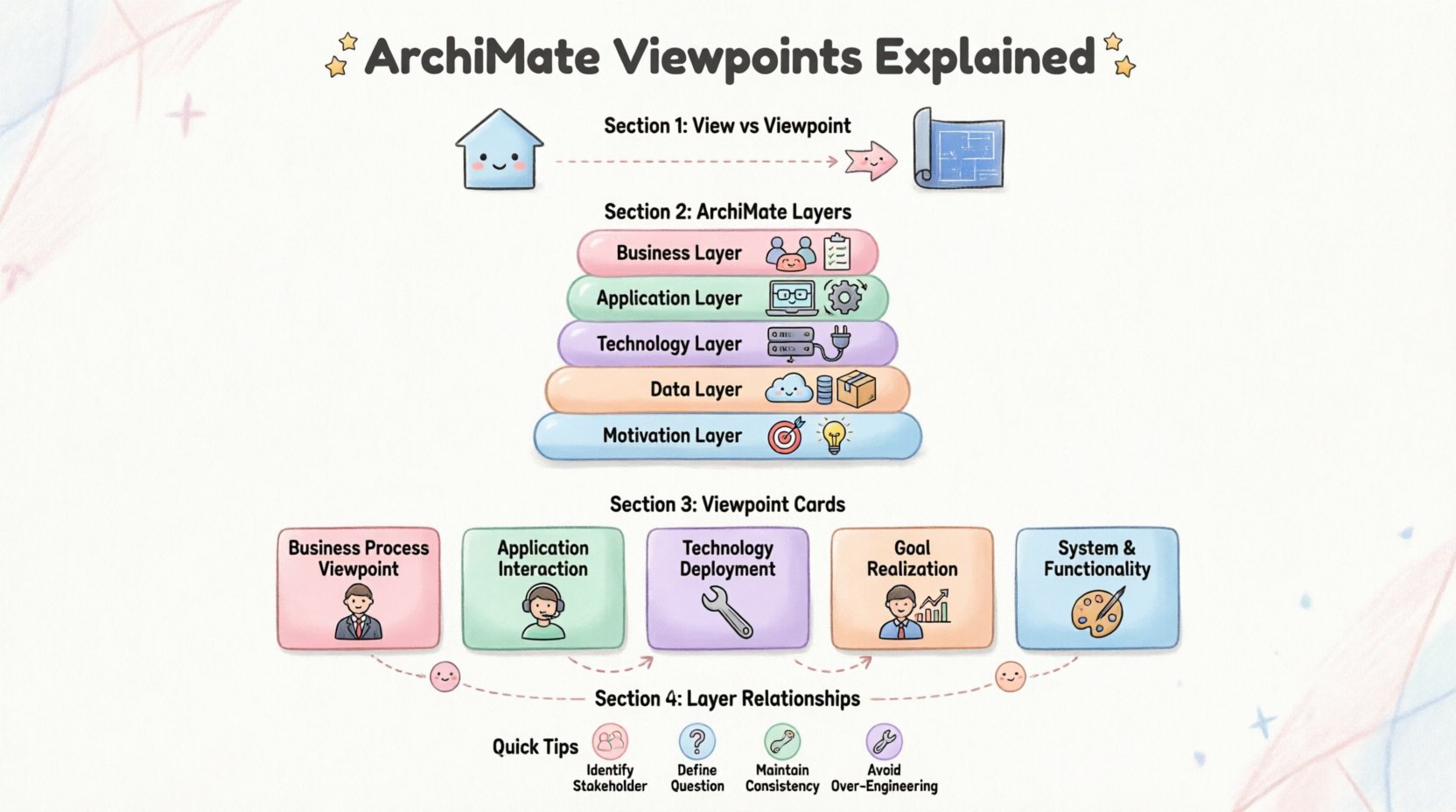
🧩 What Is an ArchiMate Viewpoint?
Before diving into specific types, it is vital to distinguish between a View and a Viewpoint. In the context of architecture modeling, the difference is structural and functional.
- View: A representation of a set of related concerns for a specific stakeholder. It is the actual diagram or document you create.
- Viewpoint: A template or specification that defines how a view is constructed. It dictates which concepts are visible, which relationships are allowed, and the conventions used for notation.
Think of a Viewpoint as the blueprint for a house. It tells you where the doors go, the size of the windows, and the materials to use. The View is the actual house built according to that blueprint. Without a defined Viewpoint, diagrams become inconsistent, confusing, and difficult to maintain over time.
ArchiMate defines these Viewpoints to address specific concerns within the enterprise. By standardizing how information is presented, organizations ensure that a Business Process diagram means the same thing to everyone, regardless of who draws it.
🏗️ The ArchiMate Layers: A Foundation for Viewpoints
To understand which Viewpoint to use, one must first understand the layers of the ArchiMate language. The framework organizes enterprise architecture into five primary layers, plus a Motivation layer. Each Viewpoint typically focuses on one or a combination of these layers.
1. Business Layer
This layer describes the business structure and processes. It includes:
- Business Actors: People or organizations performing roles.
- Business Processes: Activities that produce value.
- Business Functions: Capabilities required to achieve goals.
- Business Objects: Data entities relevant to the business.
2. Application Layer
This layer represents the software systems that support the business. It includes:
- Application Functions: Capabilities provided by software.
- Application Services: External interfaces offered by applications.
- Application Components: Logical building blocks of software.
3. Technology Layer
This layer describes the physical infrastructure. It includes:
- Technology Nodes: Hardware or virtual machines.
- Technology Services: Network or security services.
- Technology Devices: Specific endpoints like routers or servers.
4. Data Layer
While often integrated, the Data layer explicitly handles information structures.
- Data Objects: Logical representations of information.
- Information Flows: Movement of data between objects.
5. Motivation Layer
This layer captures the why behind the architecture.
- Goals: Desired states to achieve.
- Principles: Rules guiding decision-making.
- Requirements: Constraints or needs to be met.
📊 Mapping Viewpoints to Stakeholders
Selecting the correct Viewpoint depends entirely on the audience. A diagram that makes sense to a developer may confuse a marketing manager. The following table outlines common Viewpoints and their primary stakeholders.
| Viewpoint Name | Primary Focus | Target Audience |
|---|---|---|
| Business Process Viewpoint | Business Activities & Roles | Business Analysts, Process Owners |
| Application Interaction Viewpoint | Service Interactions | System Architects, Developers |
| Technology Deployment Viewpoint | Hardware & Network | Infrastructure Engineers, DevOps |
| Goal Realization Viewpoint | Strategic Alignment | Executives, Strategy Team |
| System & Functionality Viewpoint | Software Capabilities | Product Managers, Developers |
🏢 Business Process Viewpoints
The Business Process Viewpoint is often the entry point for enterprise architecture. It focuses on how work gets done. This Viewpoint is critical for identifying inefficiencies and mapping requirements to technical solutions.
Key Components
- Business Processes: The core activities. For example, “Order Processing” or “Customer Onboarding”.
- Business Actors: Who performs the process? (e.g., Sales Agent, Customer).
- Business Roles: The specific function a person holds within the process.
- Business Objects: The information used or created (e.g., Invoice, Order Form).
Why It Matters
When aligning business and IT, this Viewpoint bridges the gap. It allows you to trace a high-level business goal down to specific actions. If a goal is “Reduce Order Time by 20%”, the Business Process Viewpoint helps identify which step in the workflow is causing the delay. It does not show the code, but it shows the logic that the code must support.
💻 Application & Technology Viewpoints
Once the business needs are defined, the focus shifts to the systems that enable them. These Viewpoints are more technical but remain accessible if structured correctly.
Application Function Viewpoint
This Viewpoint focuses on the logical functions of software without getting bogged down in physical implementation details.
- Application Functions: What does the software do? (e.g., “Calculate Tax”, “Generate Report”).
- Application Services: How does the software interact with the outside world?
- Application Components: The modular parts of the application.
Technology Deployment Viewpoint
This Viewpoint maps software onto physical infrastructure. It answers the question: “Where does this run?”
- Technology Nodes: The computing platforms (servers, containers).
- Communication Paths: How nodes connect (network links).
- Deployment Nodes: The specific hardware hosting the software.
For example, a System and Functionality Viewpoint might show that the “Payment Module” relies on the “Database Service”. A Technology Deployment Viewpoint would then show that the “Payment Module” runs on “Web Server A” and the “Database Service” runs on “DB Server B”. Connecting these two views reveals the full dependency chain.
🎯 Motivation Layer Viewpoints
Architecture without purpose is just a diagram. The Motivation Layer provides the rationale for the structure. Viewpoints in this layer connect the “What” and “How” to the “Why”.
Goal Realization Viewpoint
This is perhaps the most strategic Viewpoint available. It visualizes how specific requirements and capabilities contribute to higher-level goals.
- Goals: The ultimate objectives (e.g., “Compliance”, “Cost Reduction”).
- Requirements: Specific conditions needed to achieve goals.
- Principles: Rules that must be followed.
In a Goal Realization Viewpoint, you might see a Goal named “Secure Customer Data”. Below it, you would find a Requirement “Encrypt Data at Rest”. Below that, you might find a Technology Service “Encryption Service”. This lineage demonstrates clearly how a technical implementation supports a strategic mandate.
Principle Viewpoint
This Viewpoint focuses on the rules that govern the architecture. It is useful for governance and compliance checks.
- Principles: Statements of intent (e.g., “Cloud First”, “Buy Before Build”).
- Standards: Specific technical requirements.
🔗 Layer Relationships and Flow
One of the most powerful aspects of ArchiMate Viewpoints is their ability to show relationships across layers. Architecture is rarely isolated to a single layer. A business process change often requires a software update, which in turn requires infrastructure scaling.
Access Relationships
Viewpoints often utilize Access Relationships to show how one element uses another.
- A Business Process accesses an Application Function.
- An Application Function accesses a Technology Node.
Assignment Relationships
Assignment Relationships show who or what is responsible for an element.
- A Business Actor assigns a Business Process.
- A Technology Node assigns an Application Component.
By combining these relationships, architects can create Layered Views. A Business Service Realization Viewpoint, for instance, might show how a Business Service is realized by an Application Service, which is deployed on a Technology Service. This end-to-end visibility is crucial for impact analysis.
🛠️ Selecting the Right Viewpoint
Having too many diagrams can be as damaging as having too few. The goal is to provide just enough information to make decisions without overwhelming the audience. Follow these guidelines when selecting Viewpoints.
1. Identify the Stakeholder
Start with the person reading the diagram. If it is a financial director, they care about cost and risk (Motivation Layer). If it is a network engineer, they care about latency and connectivity (Technology Layer).
2. Define the Question
What specific question are you trying to answer? If the question is “How does data move between systems?”, use a Data Flow Viewpoint. If the question is “What happens if this server fails?”, use a Technology Deployment Viewpoint.
3. Maintain Consistency
Once a Viewpoint standard is chosen, apply it consistently. Do not mix notation styles in the same document. Consistency reduces cognitive load and speeds up understanding.
4. Avoid Over-Engineering
Do not model every single detail. Focus on the elements relevant to the specific concern. A Viewpoint should be a filter, not a dump of all data.
⚠️ Common Pitfalls in Modeling
Even with the right Viewpoints, mistakes can occur. Being aware of common errors helps maintain the integrity of the architecture.
1. The “Kitchen Sink” Diagram
Trying to fit every layer into one diagram is a common mistake. This creates a spaghetti diagram that is unreadable. Keep layers separated or use specific cross-layer Viewpoints designed for that purpose.
2. Ignoring the Motivation Layer
Many models stop at the Technology Layer. Without the Motivation Layer, it is difficult to justify why certain investments are made. Always link technical decisions back to business goals or requirements.
3. Inconsistent Naming
Using different names for the same concept (e.g., “User Login” vs “Authentication”) confuses stakeholders. Maintain a shared vocabulary or glossary across all Viewpoints.
4. Lack of Context
Diagrams without a legend or context are useless. Ensure every element is clearly labeled and the scope of the diagram is defined.
📝 Best Practices for Documentation
Documentation is the lifecycle of the architecture. It is not a one-time task. Here are best practices to keep your documentation valuable.
- Version Control: Treat your architecture models like code. Track changes and maintain history.
- Metadata: Add authors, dates, and version numbers to every Viewpoint.
- Annotations: Use text notes to explain complex relationships that diagrams alone cannot convey.
- Regular Reviews: Architecture changes. Schedule regular reviews to ensure the Viewpoints reflect the current state of the enterprise.
- Accessibility: Ensure that the documentation is accessible to all relevant stakeholders, not just the architects.
🔄 Evolving with the Enterprise
Enterprise architecture is dynamic. As the organization grows, so do the requirements for Viewpoints. A startup might only need a simple Business Process Viewpoint. A large corporation might require a full suite of Motivation, Strategy, and Technology Viewpoints.
The flexibility of the ArchiMate framework allows you to scale your modeling efforts. You can start with the high-level Business and Motivation Viewpoints and gradually add Application and Technology detail as the organization matures. This phased approach prevents overwhelm and ensures that the architecture remains relevant.
🔍 Conclusion
ArchiMate Viewpoints are not just about drawing diagrams; they are about facilitating understanding. By selecting the right Viewpoint for the right audience, organizations can align their business processes with their technical infrastructure effectively. The key lies in clarity, consistency, and a focus on the specific concerns of the stakeholders involved.
Whether you are defining a new strategy or troubleshooting a legacy system, these Viewpoints provide the structure needed to navigate complexity. By avoiding unnecessary jargon and focusing on the relationships between business and technology, you can create architecture that drives value rather than creating confusion.
Remember, the goal is not to model everything perfectly, but to model what matters. With the right Viewpoints in place, the path from business intent to technical execution becomes clear and manageable.