


Enterprise architecture is a discipline that thrives on clarity. However, the terminology surrounding frameworks like ArchiMate can sometimes obscure more than it reveals. For practitioners entering the field, the concept of a Viewpoint often becomes a source of confusion. Is it a template? Is it a tool? Or is it a governance mechanism? Many resources suggest a complexity that does not exist in practice. This guide aims to strip away the unnecessary jargon and focus on the functional reality of ArchiMate Viewpoints.
Understanding how to define and apply Viewpoints is essential for effective communication between stakeholders. Without this foundation, models become artifacts that nobody reads. The goal here is to provide a grounded approach to modeling that prioritizes value over complexity. We will explore the distinctions between views and viewpoints, address common misconceptions, and outline a practical path for implementation.
🔍 Defining the Core Concepts
Before addressing myths, it is necessary to establish the definitions used within the framework. The distinction between a View and a Viewpoint is the most critical concept to grasp.
- Viewpoint: A specification of the conventions for constructing and using a view. It defines the languages, methods, and notations used. It is the recipe.
- View: The representation of a set of related elements from a particular perspective. It is the meal prepared using the recipe.
Think of a Viewpoint as the rules of engagement for a specific audience. It dictates what language is spoken (e.g., Business, Application, Technology) and what concerns are addressed. It ensures that the resulting View is relevant to the people consuming it.
🚫 Common Myths About ArchiMate Viewpoints
There is significant noise in the industry regarding how Viewpoints should be used. Many new architects feel pressured to create extensive libraries of Viewpoints before delivering any value. This approach often leads to analysis paralysis. Below is a breakdown of the most prevalent myths compared to the operational reality.
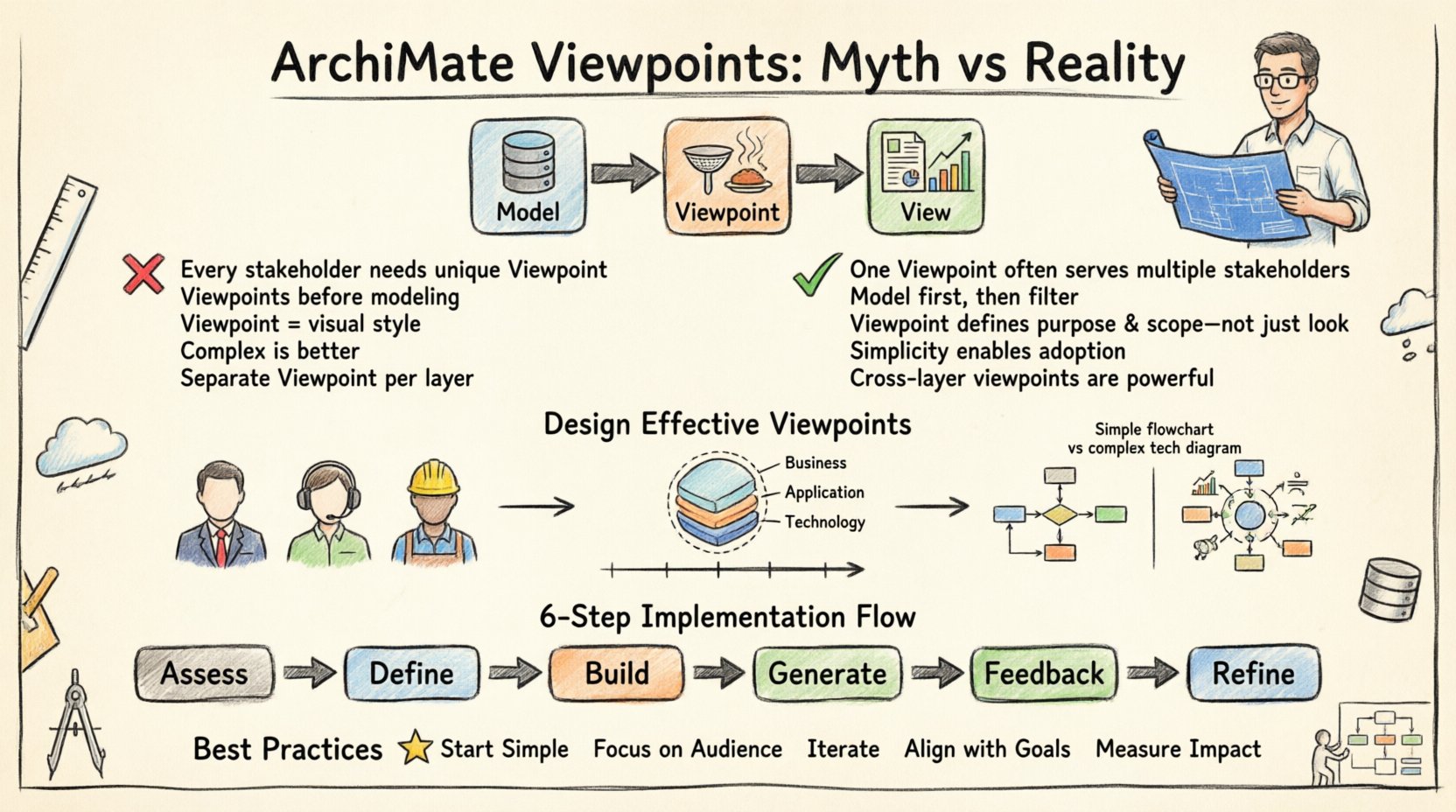
| Myth | Reality |
|---|---|
| Every stakeholder needs a unique Viewpoint. | A few well-defined Viewpoints can serve multiple stakeholders with similar concerns. |
| Viewpoints must be created before any modeling begins. | Viewpoints often evolve alongside the model as needs become clearer. |
| A Viewpoint defines the visual style (colors, fonts). | A Viewpoint defines the content scope and language, not the presentation aesthetics. |
| Complex Viewpoints are better than simple ones. | Simplicity increases adoption. Complex Viewpoints are often ignored. |
| You need a separate Viewpoint for every layer. | Integrated Viewpoints can show cross-layer relationships effectively. |
🧩 The Relationship Between View, Viewpoint, and Model
Confusion often arises because people treat the Model, View, and Viewpoint as separate entities that exist in isolation. In reality, they function as an integrated system.
- The Model: This is the single source of truth. It contains all the architectural elements and relationships defined in the framework.
- The Viewpoint: This acts as a filter. It determines which parts of the Model are relevant for a specific context.
- The View: This is the output generated by applying the Viewpoint to the Model.
Imagine a database containing all your company’s assets. The Viewpoint is the SQL query. The View is the result set displayed on the screen. The Model is the database itself. If the query is poorly defined, the result is useless, even if the database is perfect.
🎯 Designing Effective Viewpoints
Creating a Viewpoint requires a deep understanding of the audience and their decision-making processes. It is not about showing everything; it is about showing the right things. Here is a structured approach to designing them.
1. Identify the Audience
Who is looking at this architecture? Are they business executives, technical developers, or security auditors? Each group has different priorities.
- Executives: Focus on value streams, business capabilities, and strategic goals.
- Developers: Focus on application components, data structures, and interfaces.
- Infrastructure Teams: Focus on nodes, devices, and network connections.
2. Define the Scope
Once the audience is known, define the boundaries. What is included in the Viewpoint? What is excluded?
- Layers: Will this cover Business, Application, Technology, or all of them?
- Processes: Are we looking at the entire value chain or a specific sub-process?
- Timeframe: Is this the current state, target state, or a transition?
3. Select the Notation
The visual language must match the cognitive load of the audience. Using a detailed technology diagram for a business strategy meeting is a common failure mode. Ensure the notation (e.g., flow diagrams, structure diagrams) aligns with the Viewpoint’s intent.
🔄 Iterative Development and Governance
Viewpoints are not static artifacts. They require maintenance and evolution. As the organization changes, the Viewpoints must adapt to reflect new realities.
Establishing Governance
Without governance, Viewpoints can become inconsistent. One team might use different terminology than another. A governance framework should include:
- Standardization: Define standard Viewpoints for common use cases.
- Approval Process: Who authorizes new Viewpoints or changes to existing ones?
- Documentation: Maintain clear documentation explaining the purpose and usage of each Viewpoint.
Maintenance Cycles
Regular reviews ensure that Viewpoints remain relevant. Schedule periodic assessments to check if the Viewpoints are still serving their intended purpose. If a Viewpoint is rarely used, it may be time to retire it or merge it with another.
🤝 Communication and Stakeholder Alignment
The primary purpose of a Viewpoint is to facilitate communication. If a Viewpoint does not lead to better understanding, it has failed its purpose.
Facilitating Dialogue
Viewpoints should be used as conversation starters, not final verdicts. Presenting a View to a stakeholder should invite questions and feedback. This iterative dialogue helps refine the model and ensures alignment.
- Workshops: Use Viewpoints in collaborative sessions to validate assumptions.
- Reviews: Conduct formal reviews where stakeholders sign off on the View.
- Feedback Loops: Capture feedback to update the Viewpoint definitions.
Avoiding Jargon
While ArchiMate provides a standard language, it is not always intuitive for non-specialists. When presenting Views derived from Viewpoints, translate technical terms into business language where appropriate. The Viewpoint defines the technical constraints, but the communication should bridge the gap to business value.
🧱 Practical Implementation Steps
For teams looking to adopt this approach, a phased implementation reduces risk and increases success rates.
- Assess Current State: Review existing documentation and models to identify gaps in communication.
- Define Key Viewpoints: Start with the top 3-5 Viewpoints that address the most critical stakeholder concerns.
- Build the Core Model: Populate the underlying model with the necessary elements to support these Viewpoints.
- Generate Views: Create the first set of Views using the defined Viewpoints.
- Gather Feedback: Present the Views to stakeholders and collect input.
- Refine: Adjust Viewpoints and models based on feedback.
🌐 Integration with Other Frameworks
Enterprise architecture rarely exists in a vacuum. Organizations often use multiple frameworks such as TOGAF, ITIL, or COBIT. ArchiMate Viewpoints can be designed to align with these standards.
- TOGAF: Align Viewpoints with the Architecture Content Metamodel and the Architecture Development Method phases.
- ITIL: Map Application and Technology Viewpoints to IT Service Management processes.
- COBIT: Ensure Governance and Risk Viewpoints cover control objectives.
This integration ensures that the architectural work supports broader organizational governance and compliance requirements without creating duplicate efforts.
⚠️ Pitfalls to Avoid
Even with the best intentions, certain pitfalls can derail an ArchiMate initiative. Awareness of these common errors helps in steering clear of them.
- Over-Modeling: Creating too many details in the Viewpoint that obscure the main message. Focus on the essentials.
- Under-Modeling: Providing too little detail to be useful. Ensure the Viewpoint contains enough information for decision-making.
- Ignoring Context: Failing to consider the specific context of the stakeholder. A Viewpoint for a project manager differs from one for a CTO.
- Static Definitions: Treating Viewpoints as permanent. They should evolve with the organization.
📈 Measuring Success
How do you know if your Viewpoints are working? Success is not measured by the number of Viewpoints created, but by their impact.
- Adoption Rate: Are stakeholders actively using the Views derived from these Viewpoints?
- Decision Speed: Has the time required to make architectural decisions decreased?
- Clarity: Are misunderstandings regarding the architecture reduced?
- Consistency: Are similar concerns addressed consistently across different projects?
🛠️ Tools and Automation
While the focus is on the conceptual framework, the tools used to manage Viewpoints play a significant role in efficiency. Modern modeling environments support the definition and management of Viewpoints.
- Template Management: Ability to save Viewpoint configurations for reuse.
- Filtering: Automated filtering of the model based on Viewpoint criteria.
- Reporting: Generation of reports and documentation directly from Views.
Automation reduces the manual effort required to maintain Views. It ensures that the View remains synchronized with the Model. If a change is made in the Model, the View updates automatically according to the Viewpoint rules.
🌱 Future Considerations
The landscape of enterprise architecture is shifting. Agile methodologies, DevOps, and cloud computing are changing how architecture is delivered. Viewpoints must adapt to these changes.
- Agile Alignment: Viewpoints may need to be more granular to support sprint-level planning.
- Cloud Focus: Technology Viewpoints may need to emphasize cloud services and serverless architectures.
- Data Centricity: With the rise of data-driven organizations, Data Viewpoints will become increasingly important.
Staying ahead of these trends requires a flexible approach to Viewpoint design. The framework should support the evolving needs of the business, not constrain them.
📝 Summary of Best Practices
To summarize the journey from hype to reality, keep these principles in mind.
- Start Simple: Do not overengineer the Viewpoint definitions initially.
- Focus on Audience: Design for the reader, not the creator.
- Iterate: Treat Viewpoints as living documents that evolve.
- Align with Goals: Ensure every Viewpoint serves a specific business or technical goal.
- Measure Impact: Track the effectiveness of your architectural communication.
By adhering to these practices, architects can build a robust framework for communication that delivers tangible value. The complexity of ArchiMate should be a tool for clarity, not a barrier to entry. With the right approach to Viewpoints, the architecture function becomes a strategic enabler rather than a bureaucratic hurdle.
The path forward involves consistent application of these principles. As the organization matures, the Viewpoints will become more refined, providing deeper insights without adding unnecessary overhead. This balance is the key to sustainable enterprise architecture.