


In the complex landscape of enterprise architecture, clarity often gets lost amidst the noise of technical jargon and abstract diagrams. For technology teams tasked with building systems that must align with business goals, the ability to translate high-level strategy into concrete implementation details is critical. This is where the concept of ArchiMate Viewpoints becomes indispensable. It is not merely about drawing boxes and arrows; it is about structuring information so that it resonates with specific stakeholders, from the C-suite to the engineering floor.
Understanding how to utilize these viewpoints allows organizations to bridge the gap between intent and action. This guide explores the mechanics of ArchiMate viewpoints, how they facilitate the flow of information from strategic planning to operational execution, and how technical teams can leverage them without getting bogged down in unnecessary complexity.
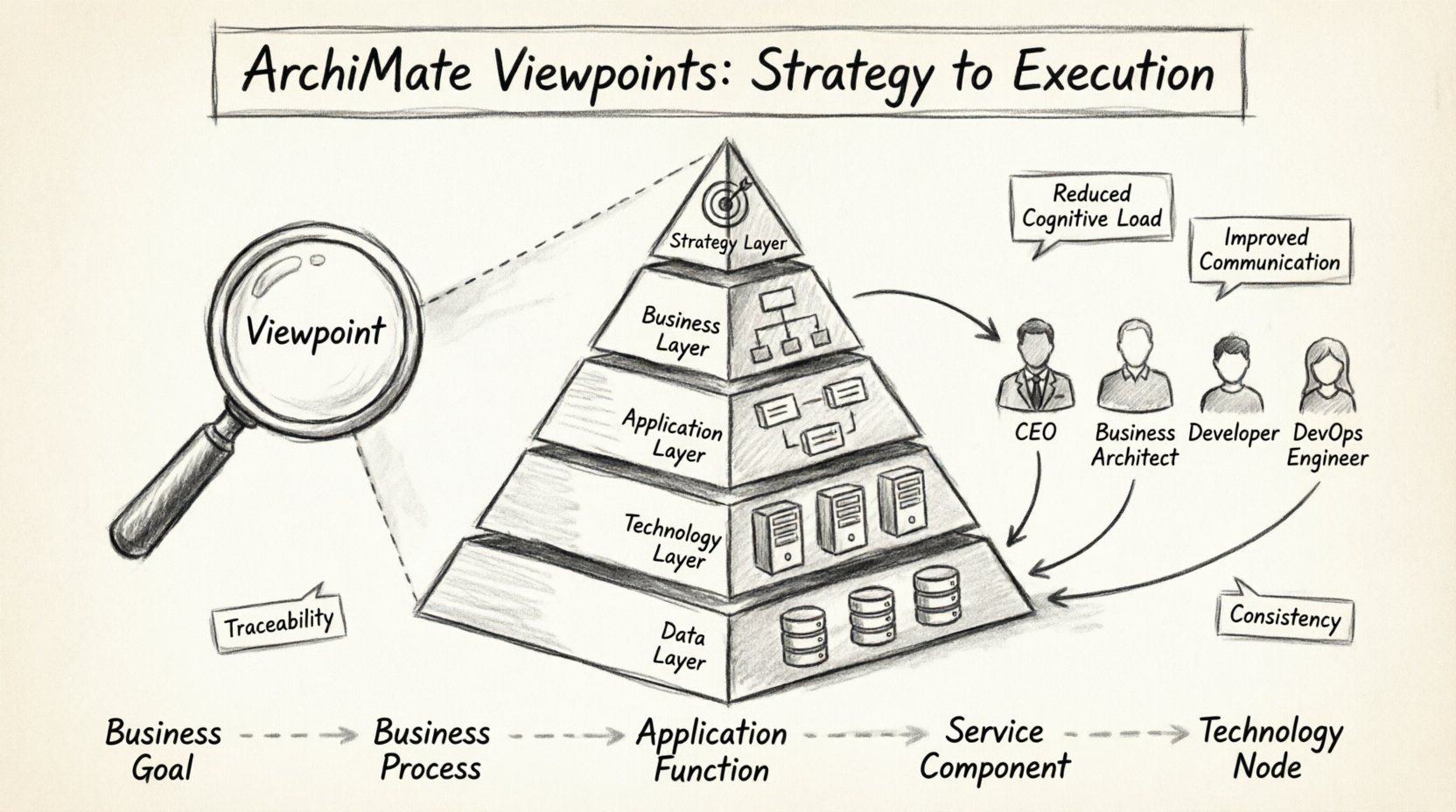
What Are ArchiMate Viewpoints? 🧩
At its core, an architecture framework provides a language and a structure. ArchiMate is a modeling language used to describe, analyze, and visualize business and IT architecture. However, a complete architecture model can be overwhelming. It contains too much data for a single person to digest. This is where the distinction between a View and a Viewpoint becomes vital.
- View: A representation of a set of related artifacts (like a diagram or document) from a specific perspective.
- Viewpoint: The convention used to create a view. It defines the purpose, the audience, and the specific elements and relationships to be included.
Think of the Viewpoint as the lens through which the architecture is observed. A different lens is required for a financial auditor than for a software developer. A business architect might focus on value streams, while a technology architect concentrates on infrastructure nodes. The Viewpoint dictates what information is relevant and what should be filtered out.
Why Viewpoints Matter for Tech Teams 🛠️
For technology teams, the primary challenge is often context. Developers need to understand how their code fits into the broader application landscape. DevOps engineers need to see deployment paths. Without structured viewpoints, information remains siloed.
Viewpoints offer several distinct advantages:
- Reduced Cognitive Load: By filtering out irrelevant details, stakeholders can focus on what matters to their role.
- Improved Communication: Standardized viewpoints ensure that everyone interprets the architecture in the same way.
- Traceability: They facilitate the tracking of requirements from business goals down to technical components.
- Consistency: They enforce standards across different projects and departments.
Core ArchiMate Viewpoints Explained 🔍
The ArchiMate specification defines several standard viewpoints. While custom viewpoints can be created, understanding the standard ones provides a solid foundation. These are generally categorized by the layers of the architecture they address.
1. The Business Layer Viewpoints 👔
This layer deals with the organization’s structure, its capabilities, and the processes it runs. Viewpoints here often focus on:
- Value Chain: How value is delivered to customers.
- Business Process: The flow of activities and roles.
- Organizational Structure: How teams and departments interact.
For a tech team, understanding the business layer is crucial. It answers the question: “What problem are we solving?” rather than just “How are we building it?”
2. The Application Layer Viewpoints 💻
The application layer represents the software systems that support the business processes. Key viewpoints include:
- Application Usage: Shows which applications are used by business processes.
- Application Interaction: Details the data exchange between applications.
- Application Function: Breaks down applications into specific functions or services.
Developers and system architects spend the most time here. This is where the logic of the system lives. It defines the boundaries between microservices, monolithic blocks, or legacy systems.
3. The Technology Layer Viewpoints 🖥️
This layer covers the hardware and software infrastructure required to run the applications. Viewpoints focus on:
- Deployment: How software artifacts are deployed onto nodes.
- Network: How infrastructure components communicate.
- Infrastructure: The physical and logical resources available.
Operations and infrastructure teams rely heavily on these views to manage servers, cloud instances, and network configurations.
4. The Data Layer Viewpoints 📊
Data is the connective tissue of modern enterprise architecture. Viewpoints here clarify:
- Data Flow: How data moves through the system.
- Data Structure: The logical organization of information.
5. The Strategy Layer Viewpoints 🎯
Perhaps the most critical for leadership, these viewpoints connect the “Why” to the “What.”
- Strategy Implementation: Links business goals to the assets required to achieve them.
- Gap Analysis: Identifies the difference between the current state and the target state.
Mapping Stakeholders to Viewpoints 👥
One size does not fit all. A successful architecture practice maps specific viewpoints to specific roles. Below is a breakdown of who needs what information.
| Stakeholder Role | Primary Focus | Recommended Viewpoint Type |
|---|---|---|
| Chief Executive Officer | Business Goals, Value | Business Motivation, Value Chain |
| Business Architect | Processes, Capabilities | Business Process, Organizational |
| System Architect | Application Logic, Integration | Application Interaction, Usage |
| Software Developer | Functions, Interfaces | Application Function, Data Flow |
| DevOps Engineer | Deployment, Infrastructure | Deployment, Technology |
| Security Officer | Risk, Access, Compliance | Security, Implementation |
Connecting Strategy to Execution 🧵
The true power of ArchiMate Viewpoints lies in their ability to create traceability. This is the practice of linking a high-level business goal to the specific technical component that supports it.
Consider a scenario where a company decides to improve customer retention. This is a strategic goal. Through the architecture process, this goal is translated into a requirement for a new customer analytics module. This module is then mapped to a specific application function. That function runs on a specific server cluster.
By maintaining these links through viewpoints, the organization can answer difficult questions:
- Which application supports this strategic goal?
- If we decommission this server, which business process is affected?
- Does this new feature align with our long-term technology roadmap?
The Implementation & Migration Layer
Change is constant. The Implementation and Migration layer deals with projects and initiatives that move the enterprise from a current state to a target state. Viewpoints in this layer help manage:
- Project Planning: What needs to be built or changed?
- Resource Allocation: Where are the constraints?
- Transition States: What does the system look like during the change?
For tech teams, this layer prevents the chaos of unplanned changes. It ensures that every line of code written contributes to a defined migration path.
Implementing Viewpoints in Tech Workflows ⚙️
Adopting these viewpoints requires more than just buying a license for a modeling tool. It requires a shift in how information is created and consumed. Here is how to integrate them into daily workflows.
1. Define Your Audience First
Before drawing a single shape, ask who will read this diagram. Is it for a board meeting? A code review? A security audit? The answer determines the Viewpoint.
2. Standardize the Notation
Ensure that all team members use the same symbols and relationships. Ambiguity in notation leads to ambiguity in execution. If everyone knows that a specific shape means “Database,” there is no confusion during handoffs.
3. Keep It Living
Documentation that sits in a static repository is often ignored. Viewpoints should be part of the active development lifecycle. When a new microservice is added, the Application Viewpoint should be updated immediately. When the infrastructure changes, the Technology Viewpoint must reflect it.
4. Automate Where Possible
Many modern modeling environments allow for the generation of reports directly from the model. This reduces the manual effort of maintaining documentation. Ensure that your tools support the export of these viewpoints in formats that are easy for stakeholders to consume, such as PDF or interactive web views.
Common Challenges in Viewpoint Adoption 🛑
While the benefits are clear, there are obstacles that often slow down adoption. Being aware of these pitfalls helps teams navigate them.
- Over-Modeling: Trying to capture every single detail in every viewpoint leads to diagrams that are impossible to read. Keep it simple. Focus on the relevant elements.
- Siloed Information: If the Business team uses one tool and the Tech team uses another, traceability is lost. Aim for a unified source of truth.
- Resistance to Documentation: Developers often prefer code over diagrams. Explain the value. Show them how a good Viewpoint saves them time when troubleshooting or onboarding new members.
- Lack of Training: ArchiMate has a learning curve. Invest in training so that team members understand the semantics of the language, not just the mechanics of the tool.
Ensuring Traceability from Strategy to Code 📉
The ultimate goal is alignment. When strategy changes, the impact on the codebase should be visible. This requires a robust linking mechanism.
A typical traceability chain looks like this:
- Business Goal: Increase online sales by 20%.
- Business Process: Streamline checkout process.
- Application Function: Payment Gateway Module.
- Service Component: API Endpoint /checkout.
- Technology Node: Cloud Load Balancer.
By maintaining this chain, a tech team can prioritize work. If the goal changes to “Reduce latency,” the team knows to look at the Technology and Application layers immediately. If the goal changes to “Expand to new markets,” the focus shifts to the Business and Application layers.
Best Practices for Long-Term Success ✅
To sustain the value of ArchiMate Viewpoints over time, consider these recommendations:
- Iterative Refinement: Start with high-level views and refine them as the project progresses. Do not try to create the perfect diagram on day one.
- Version Control: Treat architecture models like code. Store them in a version control system. This allows teams to see how the architecture evolved over time.
- Regular Reviews: Schedule architecture reviews where stakeholders can validate the viewpoints. This ensures the models remain accurate.
- Focus on Value: Always ask, “Does this diagram help someone make a decision?” If the answer is no, remove it.
FAQ: Common Questions About ArchiMate Viewpoints ❓
Can I create my own Viewpoints?
Yes. While the standard viewpoints cover most needs, organizations often have unique requirements. You can define custom viewpoints that filter the model data according to your specific organizational needs.
Do I need a specific tool to use ArchiMate?
While modeling tools make the process easier, the language itself is independent of the software. You can sketch viewpoints on paper, but digital tools are necessary for maintaining traceability and complex relationships at scale.
How often should I update the viewpoints?
Updates should happen whenever a significant change occurs. This could be a new system deployment, a merger, or a shift in business strategy. Real-time updates are ideal, but at a minimum, updates should coincide with release cycles.
Is ArchiMate suitable for Agile teams?
Absolutely. Agile teams can use lightweight viewpoints to capture the architecture of their sprint deliverables. The key is to keep the overhead low and the value high. Use viewpoints to clarify dependencies rather than to create bureaucracy.
What is the difference between a View and a Viewpoint?
A Viewpoint is the template or the rules for creating a view. A View is the actual diagram or document produced using that template. One Viewpoint can generate multiple Views for different people.
Final Thoughts on Architecture Alignment 🏁
The journey from strategy to execution is fraught with complexity. ArchiMate Viewpoints provide a structured method to manage that complexity. They do not replace the need for human judgment or technical expertise, but they provide the context in which those skills can be applied effectively.
For tech teams, embracing these viewpoints means moving away from ad-hoc documentation and toward a disciplined approach to architecture. It ensures that the systems built today are aligned with the goals of tomorrow. By selecting the right Viewpoint for the right audience, organizations can reduce risk, improve communication, and accelerate delivery.
The effort required to maintain these models is an investment. The return is a technology landscape that is coherent, understandable, and aligned with business value. As the digital landscape continues to evolve, the ability to visualize and manage these connections will remain a critical competency for any modern technology organization.